





Yet another theft at a French museum: Joseph Forêt’s*Apocalypse*, a monumental artist’s book famous for its cover by Salvador Dalí, based on the text of St. John, was stolen during the night between Sunday, October 4, and Monday, October 5, from the Centre d’art contemporain in Issoire, a town of about 15,000 residents in the French department of Puy-de-Dôme, in Auvergne. The book weighs 210 kilograms and, when opened, measures 150 meters in length. Its bronze cover alone weighs 150 kilograms and is adorned with precious stones and sculpted by Salvador Dalí. Inside are 150 large scrolls, on which fourteen 20th-century artists and writers have written or created their works, along with approximately 95,000 handwritten letters.
The disappearance of the work was confirmed by the Clermont-Ferrand prosecutor’s office, which has opened an investigation and entrusted the case to the investigative unit of the Clermont-Ferrand gendarmerie. Investigators have described the volume as “an exceptional and unique work.” The theft thus draws attention to a singular object in the history of 20th-century artist’s books, born from a project conceived by publisher Joseph Forêt in 1958, in which he succeeded in involving some of the most important artists and writers of his time. Forêt, an art publisher who passed away in 1991, had conceived*L’Apocalisse* as a collective work dedicated to the Gospel of St. John, and his knowledge of the art world allowed him to approach leading figures directly: he was friends, among others, with Maurice Utrillo, Salvador Dalí, and Bernard Buffet. His intention was to bring together diverse artistic and literary sensibilities around the theme of the end of the world, with the aim of creating a dialogue between painting and writing within a book destined—by its scale and ambition—to be much more than an ordinary volume, so much so that fourteen artists and writers agreed to participate in the project (though there were also those who declined the invitation: François Mauriac refused to take part). The painters involved were Salvador Dalí, Léonard Foujita, André Trémois, Leonor Fini, Georges Mathieu, Ossip Zadkine, and Bernard Buffet; they were joined by the writers Jean Cocteau, Jean Rostand, Georges Rops, Ernst Jünger, Jean Giono, Emil Cioran, and Jean Guitton.
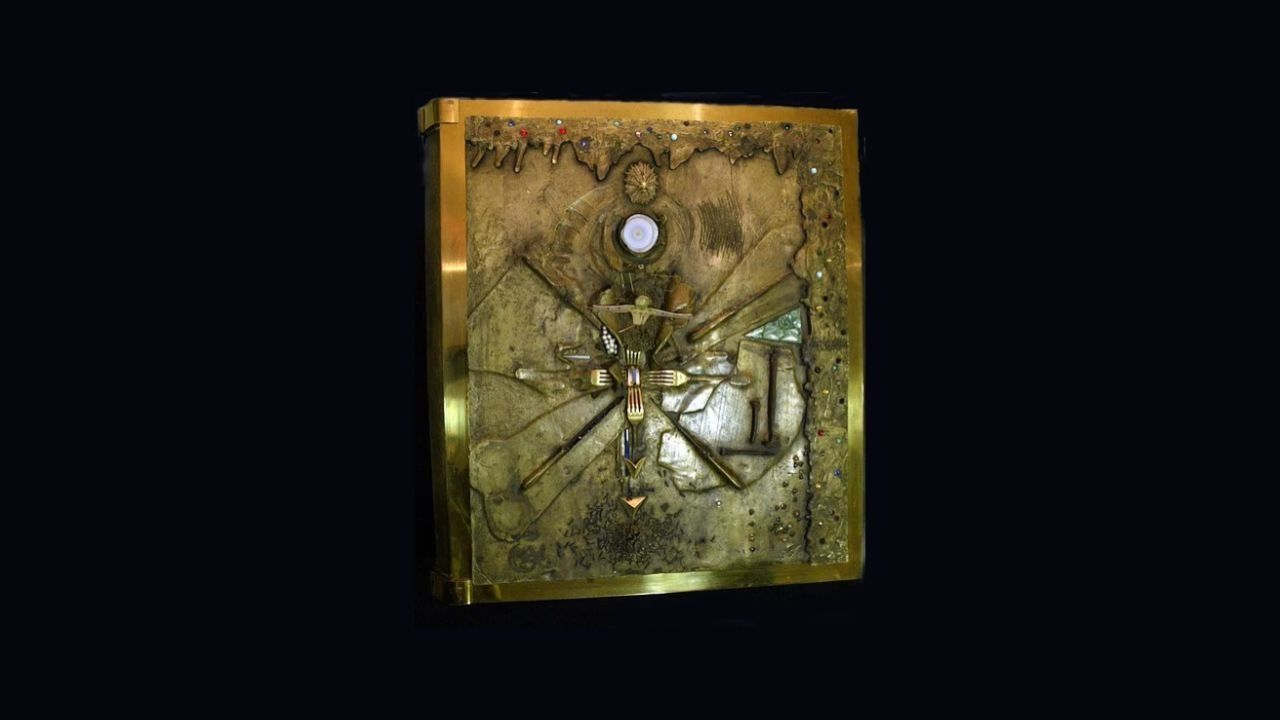
According to Christian Karoutzos, the collector who would later purchase the work, Forêt organized the artists into two groups of seven precisely because of the symbolic significance attributed to this number in the text of the Book of Revelation: essentially, the book arose from the intention to create a sort of total work centered on the biblical text, in which various artistic forms could contribute to the representation of the apocalyptic theme. The result was impressive—an object of extraordinary proportions: the Apocalypse weighs a total of 210 kilograms, while the bronze cover alone weighs 150 kilograms (it is decorated with precious stones and features a sculpture by Dalí). When fully unfolded, the book reaches 150 meters in length, comprising 150 large scrolls specifically selected for the work (and the authors wrote directly on their surfaces in their own hand). The work is completed by approximately 95,000 hand-written letters.
Its creation required the work of 25 different artisan workshops and spanned over a decade: the project, which began in 1958, continued until 1972. The volume also enjoyed an international exhibition tour in the years immediately following its completion: between 1961 and 1972, it was featured in 146 exhibitions in various parts of the world. Its history as a collector’s item also helps explain why the theft carries such particular significance today: the work had been purchased in Japan and brought back to France in 2003 by Christian Karoutzos, a collector of Greek origin residing in Auvergne and president of an art restoration company in Issoire (which is why it is located in that town). Karoutzos had decided to purchase *The Apocalypse* after learning that it was to be sold at auction. In 2003, he explained to AFP that he had wanted to prevent the volume from being scattered: the purchase was therefore also motivated by a desire to preserve the integrity of the work, which Forêt had conceived as a unified whole.
The collector did not disclose the price he paid for the volume, which he considered priceless; however, he recalled that, at the time of its creation, the Apocalypse had been valued at two million francs—equivalent to about 300,000 euros today—a figure that, according to the valuation at the time, made the work the most expensive book in the world. And it is also this characteristic that has accompanied the fame of Joseph Forêt’s *Apocalypse* for decades: not only a book of exceptional dimensions, but an artifact in which some of the most important names in 20th-century art and literature were involved, along with a substantial number of artisans and skilled craftsmen.
Dalí’s involvement is probably the most immediately recognizable aspect of the work, but the book is not limited to his contribution: the bronze cover sculpted by the Spanish artist is just one component of the entire project, which was created by bringing together painting, literature, calligraphy, sculpture, and artisanal craftsmanship.*L’Apocalisse* had been conceived by Forêt as his life’s work, and for over fifty years since its inception, the volume has been tied to a history that spans the art market, the world of collecting, and international exhibitions, ultimately leading to the museum in Issoire. Now that history has been interrupted by the theft. The circumstances of the theft are currently under investigation. Given its size and weight, the volume is not easily comparable to a normal book: it is a monumental artifact, composed of various materials and designed from the outset to be displayed and unfolded. And precisely because of its imposing nature, one wonders how it was possible to remove it from its museum.
|
| The giant Book of Revelation, illustrated by Salvador Dalí, was stolen in France |

Warning: the translation into English of the original Italian article was created using automatic tools. We undertake to review all articles, but we do not guarantee the total absence of inaccuracies in the translation due to the program. You can find the original by clicking on the ITA button. If you find any mistake,please contact us.






















 IT
IT FR
FR DE
DE ES
ES CN
CN


