



by Redazione 02/09/2026



Categories: News / Disclaimer
An official ceremony was held at the Villa dei Capolavori in Mamiano di Traversetolo to mark the return of the three works stolen in March and recovered by the Carabinieri after nearly five months, with the participation of local authorities and the Parma District Attorney’s Office.

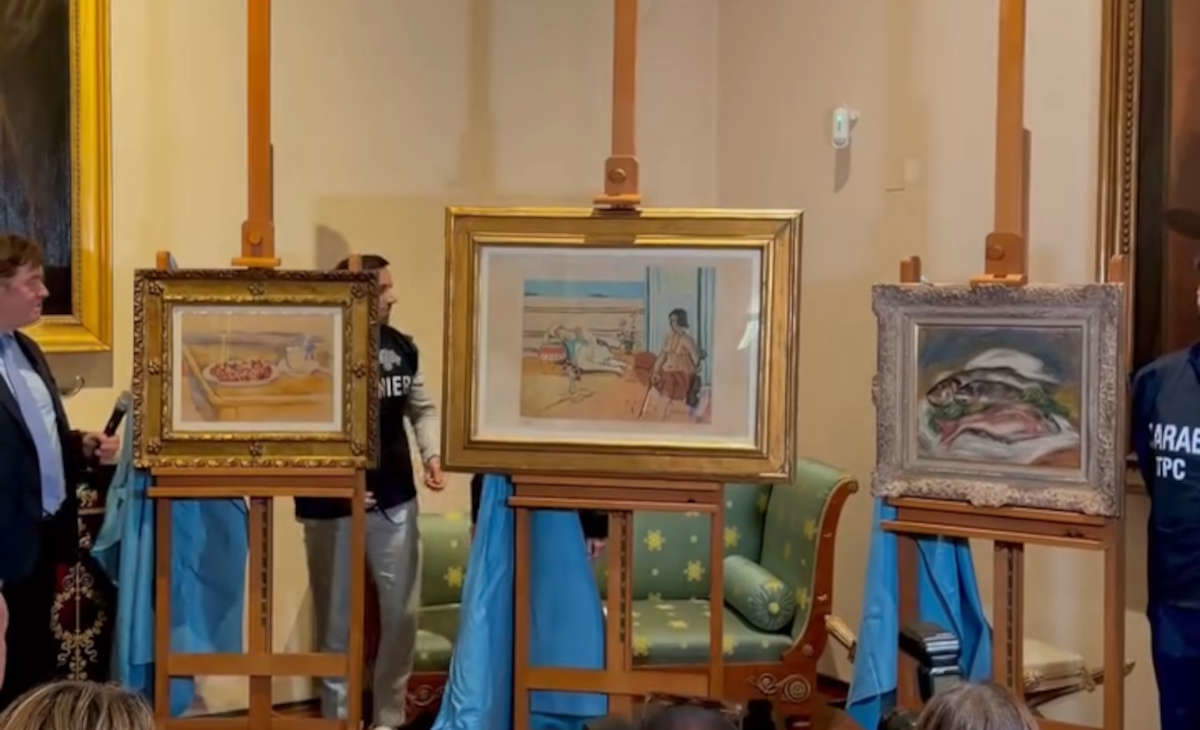
The three works by Paul Cézanne, by Pierre-Auguste Renoir and Henri Matisse, which were stolen from the Magnani-Rocca Foundation in Mamiano di Traversetolo ( Parma) last March and later recovered in Parma on August 14, are once again on public display in the very spot where Luigi Magnani had placed them . The Magnani-Rocca Foundation re-unveiled them today, September 2, 2026, during an official ceremony held in the Goya Room of the Villa dei Capolavori, attended by officials and representatives of various institutions. Alongside the Foundation, the event’s key participants were the Carabinieri and the Parma Public Prosecutor’s Office, which led the operation that resulted in the return of the three masterpieces to the community.
The works had been stolen from the Villa in March and were recovered after nearly five months of investigation. In the weeks leading up to their discovery, they had captured the attention and emotional engagement of art lovers around the world: the news of their recovery garnered international attention, with major global media outlets covering the story. That story reached its symbolic conclusion today: in front of the guests attending the ceremony, the three works were publicly unveiled, in a gesture intended to evoke the ritual that Luigi Magnani himself reserved for his guests whenever he presented a new addition to the collection. The unveiling was performed by the day’s guest of honor, the Provincial Commander of the Carabinieri of Parma, Andrea Pagliaro, who led the Carabinieri officers who—in collaboration with the Cultural Heritage Protection Unit and the Parma Public Prosecutor’s Office—made the return of the three paintings possible.


 The
TheThe Foundation’s president, Gino Gandolfi, emphasized that the ceremony was not dedicated solely to the return of the three masterpieces, but above all to recognizing those who recovered them: “Today,” he said, “we did not merely celebrate three masterpieces returning home: we celebrated those who brought them back. The Carabinieri have demonstrated to the world a uniquely Italian excellence, and the Foundation will be forever grateful to them. In recent months, we have felt the affection of art lovers from every continent: today we can tell them all that beauty has triumphed.”
The Foundation’s scientific director, Stefano Roffi, also spoke during the ceremony, recalling the history of the collection: “Luigi Magnani,” he stated, “chose these three works one by one, and wanted them to find a home in his house alongside Monet, Goya, and Morandi. Seeing them again in the rooms of the Villa means piecing together a vision that the collector had built over the course of a lifetime. Their place is here, in front of the public: this is the profound meaning of a collection.”
Starting tomorrow, the three works will once again be on view to the public in the rooms of the Villa dei Capolavori, returning to their original locations within the museum itinerary envisioned by Magnani. Their return also coincides with the opening of the Foundation’s fall season, which will kick off on September 12 with a major exhibition dedicated entirely to Man Ray, curated by Stefano Roffi, Walter Guadagnini, and Mauro Carrera.
The Magnani-Rocca Foundation is one of the most significant art institutions on the Italian scene. Its headquarters, the Villa dei Capolavori located in Mamiano di Traversetolo, near Parma, houses the collection assembled by Luigi Magnani over the course of his life, comprising works by Titian, Dürer, Rubens, Goya, Canova, and Monet, as well as, of course, works by Renoir and Cézanne, and a collection of works by Giorgio Morandi—considered one of the most significant existing collections dedicated to the Bolognese artist. Surrounded by the Parma countryside, the villa retains the charm of a great collector’s residence, with its neoclassical and Empire-style furnishings, and is nestled in a romantic park featuring exotic plants, monumental trees, and the famous white and colorful peacocks that have always inhabited the garden.
|
| Works by Cézanne, Renoir, and Matisse Return to the Magnani-Rocca Foundation Following the Theft |
Warning: the translation into English of the original Italian article was created using automatic tools. We undertake to review all articles, but we do not guarantee the total absence of inaccuracies in the translation due to the program. You can find the original by clicking on the ITA button. If you find any mistake,please contact us.