




by Raja El Fani 01/09/2026



Categories: Opinions / Disclaimer
The Strait of Messina is a unique natural and cultural heritage site, but the theft of Antonello’s works from the MuMe reopens a deeper wound: that of a Sicily still too often deprived of its artistic prominence and left without adequate protection. An article by Raja El Fani.
The Strait of Messina is unique in the world for its beauty and natural richness; it clearly surpasses the Bosphorus in quality of life, the Strait of Istanbul—which connects the Black Sea to the Sea of Marmara, is heavily trafficked, and unsuitable for swimming—is about thirty kilometers long, just like the Strait of Messina, but so narrow that it resembles a river, with a seabed as even as a riverbed that never exceeds 120 meters in depth. With its funnel-like shape, the Strait of Messina, on the other hand, is a canyon that reaches a depth of 2,000 meters where the Tyrrhenian and Ionian Seas meet, bringing deep-sea species to the surface (if this isn’t already a model of coexistence). And so, unpredictable currents that don’t have time to warm up offer a Mediterranean swimming experience that at times resembles the traditional winter swimming in the Öresund, the Scandinavian strait separating Denmark from Sweden.
The Strait of Messina does not need a bridge to unite Sicily and Calabria, which lie embraced between the Peloritani and Aspromonte ranges—massive, sister mountain ranges sharing the same rock composition—because they are part of the same tectonic plate, distinct from the rest of the Apennines. This deep-rooted geological continuity refutes any speculation about the supposed need to further connect the two shores. For further evidence of the Strait’s model of well-being and coexistence, one need only watch at dawn the gentle waltz of the eleven historic feluccas owned by Sicilian and Calabrian shipowners, with their long, right-angled double metal truss structure, taking turns through eddies and whirlpools to fish for swordfish at set times and in alternating seasons. A model of sustainability and brotherhood, as well as a recognized and protected craft. Anyone passing along the coastal road between July and August (May and June are the months for the Calabrian feluccas), looking out over the sea from the neighborhoods stretching from Paradiso to Faro—where, not coincidentally, the future Maxxi Med, renamed MIRA just this past July, has been chosen as its location —may be captivated by the spectacle and poetry of this artisanal fishing tradition, deeply rooted in its territory, blending elements of bullfighting and regattas yet remaining spontaneous and ethical.


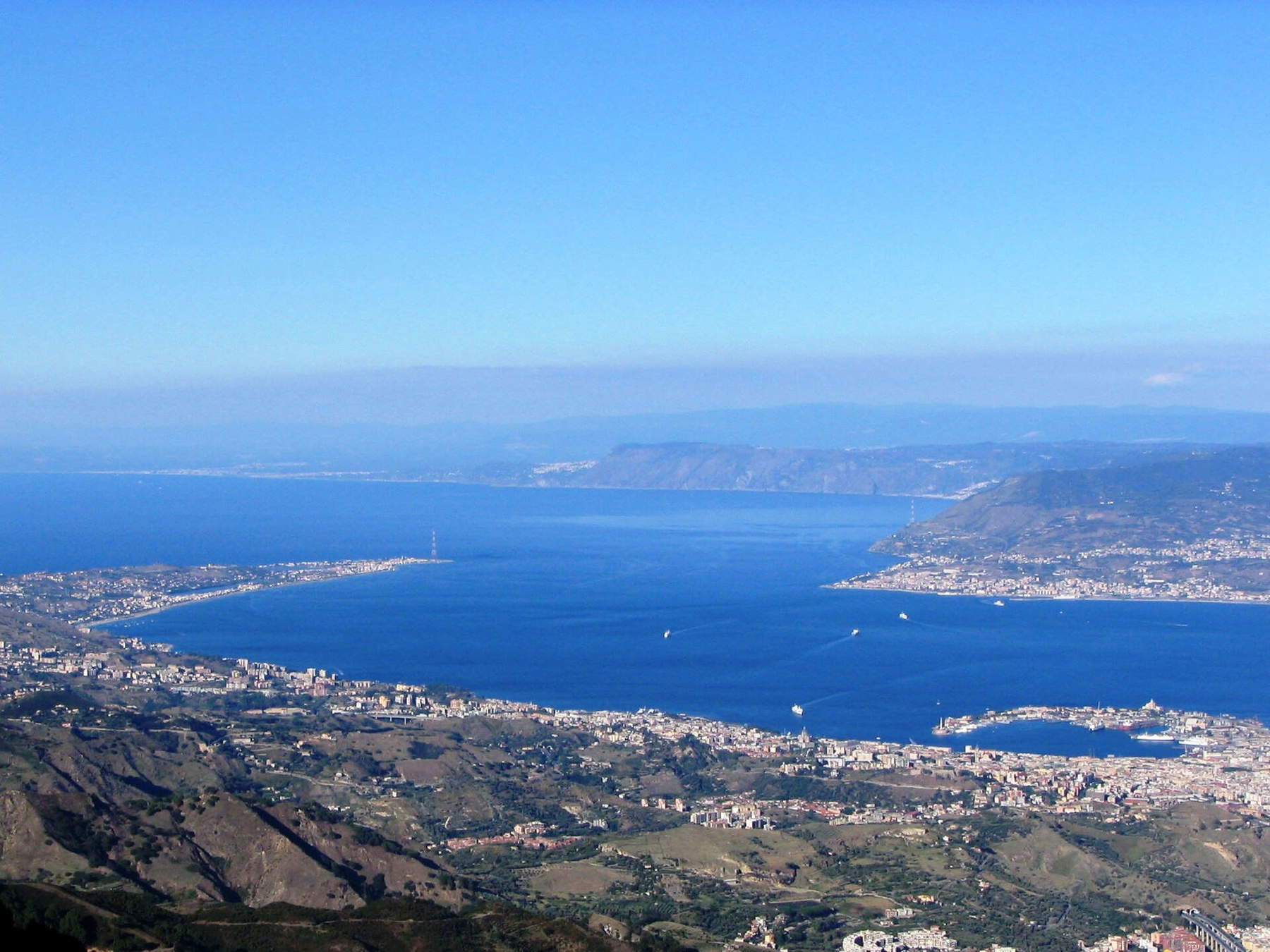
The trapezoid stretching from Capo Peloro-Scilla in the north (linked by the two pylons—now cable-less and, together with the Morandi Towers, symbols of local industrial archaeology, known as the Guardians of the Strait and standing over 200 meters tall) to Capo d’Armi-Capo Sant’Alessio to the south—offers those who know how to experience this Strait a rare eudaimonia, the term denoting the flourishing of the soul, with which no statistical measure of BES (Equitable Sustainable Well-being) or GNH (Gross National Happiness) would ever dream of competing. Even the region’s most famous star, Antonello da Messina, on par with the appeal of the Riace Bronzes—magnificently displayed and securely guarded at the Archaeological Museum of Reggio Calabria—chose to return there despite the Sforza family’s desperate efforts to keep him at the castle in Milan as their court portraitist. Antonello returned to Messina several times—and we can well understand why—after each of his long formative journeys to Naples and then to Venice, until he settled there permanently at the height of his career, by then artistically mature enough to open a workshop (the equivalent of a company or foundation today) and offer the Italian Renaissance another hub of avant-garde influence. This was a rather unusual choice—and in some ways perhaps even a risky one—for a painter of his stature, and it speaks volumes about his personality and independence.
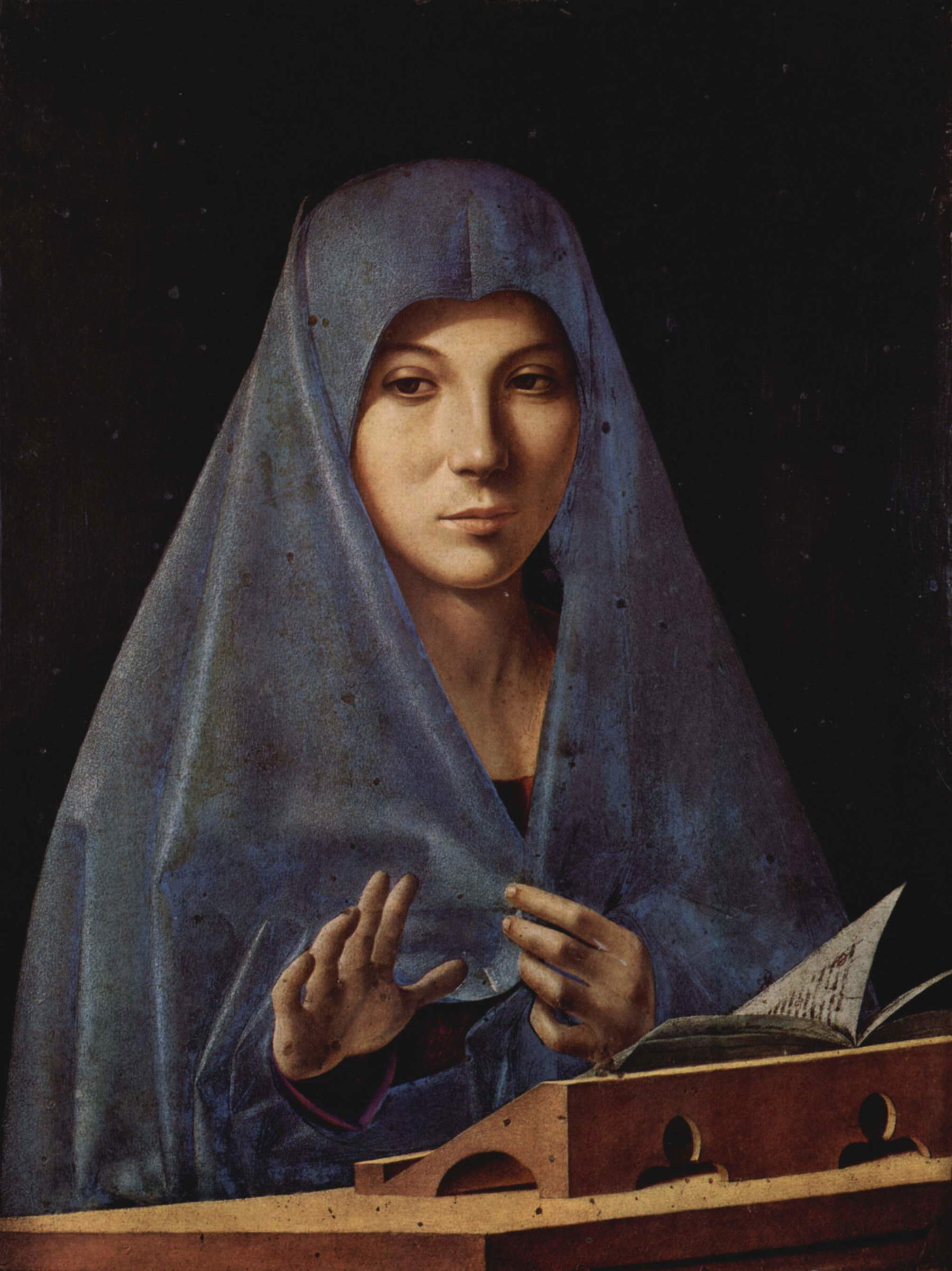
Having lived from 1430 to 1479, Antonello chose not to emigrate, as the French artist Marcel Duchamp did five centuries later when he fled to America, taking his synthesis of European avant-garde movements—including Cubism, Futurism, and Dadaism— *Nude Descending a Staircase*. During his travels in the 15th century, Antonello absorbed the light and colors of Flemish painting, the techniques passed down by Colantonio in a cosmopolitan Naples, and the perspective and scientific geometry of Tuscan masters such as Piero della Francesca, further refining his craft in Venice by building on Mantegna’s innovations and influencing Bellini. Over the centuries, every revolutionary painter has carried his or her signature masterpiece as proof of mastery. Leonardo da Vinci arrived in France with his *Mona Lisa*, which he had begun in Florence, and Picasso cemented his reputation with the advent of Cubism in Paris through his portrait of the collector Gertrude Stein and *Les Demoiselles d’Avignon*. Antonello’sAnnunciation, housed at Palazzo Abatellis in Palermo and painted in Messina between 1475 and 1476, is one of a series of revolutionary portraits in art history that, like the Mona Lisa, embody a testament in painting to an aesthetic turning point. No one before Antonello had dared to alter the iconographic conventions of the Annunciation. The Virgin’s raised hand emerging from the blue veil is already a feat of perspective in itself—a true special effect ahead of its time; then there is the layering of various and contrasting emotional nuances in her eyes and smile, achieved through imperceptible modifications—a technique we will find again in the smile of Leonardo’s Mona Lisa thirty years later; the lectern, which serves as a miniature representation of the architectural transition from the Gothic trefoil arch to the Renaissance semicircular arch; the central fold of the Virgin’s veil, which explicitly marks the vanishing point—Antonello’s declaration of his affiliation with the avant-garde of perspective; and finally, the rustling pages of the Holy Scriptures on the lectern, delicately turned by the implied flight of the archangel Gabriel off-screen, which establish Antonello as the inventor of the first subjective perspective in painting.

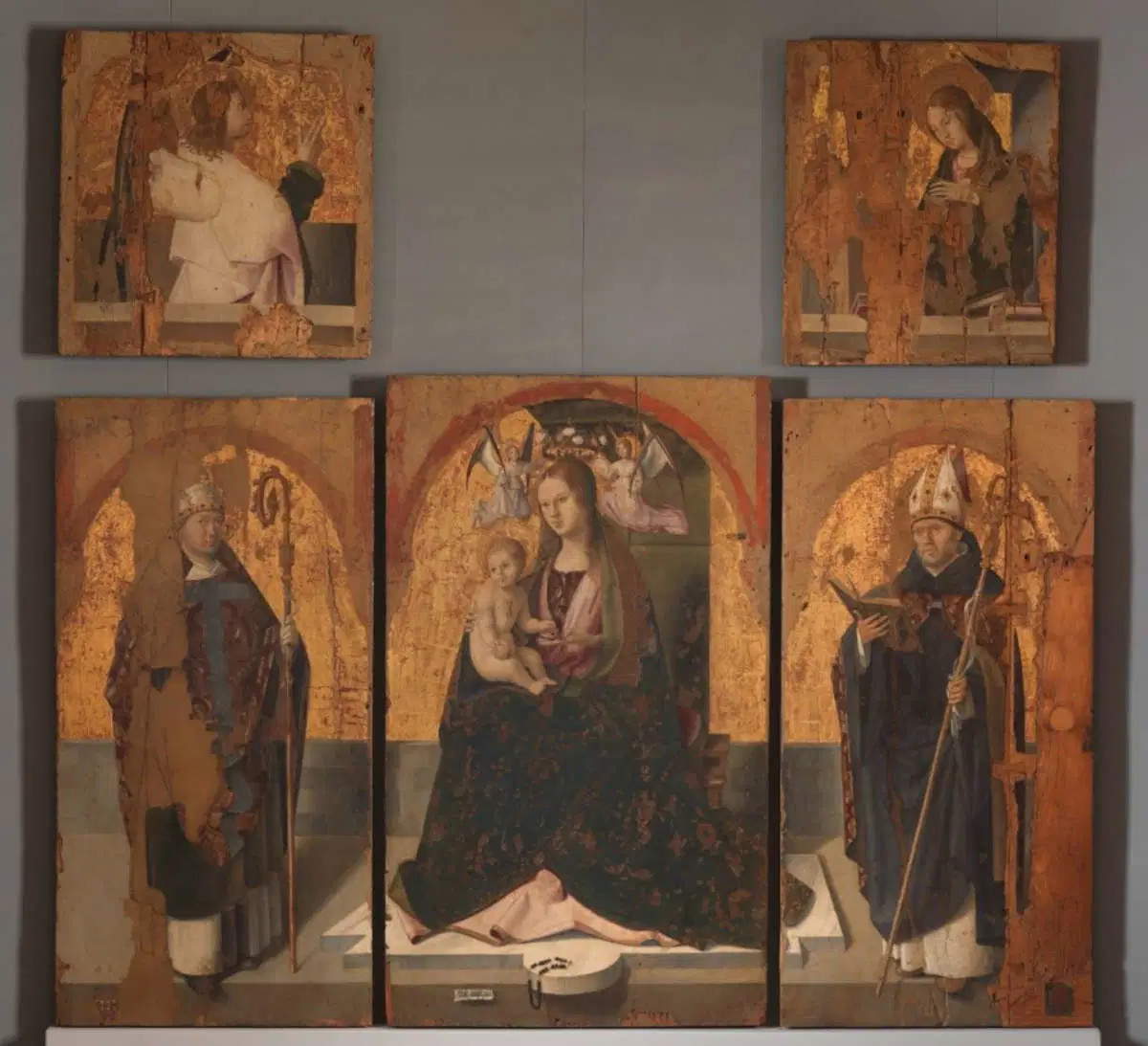
Withthe Annunciation, Antonello achieved a freedom of expression that he could not yet afford in the San Gregorio Polyptych, commissioned by the abbess of the convent of the same name, Fabria Cirino—who was, in effect, a patron of the arts ahead of her time. The two panels depicting the Virgin Mary in the Messina Polyptych foreshadowthe Annunciation of Palermo, much like Gertrude Stein’s portrait foreshadowed Picasso’s *Les Demoiselles*, which was the first of Picasso’s faces to be transformed into a mask. The Virgin of the Annunciation in the upper right panel of the Polyptych is already depicted with a hand emerging from her cloak, reaching toward the Angel in the opposite panel—a gesture as modest as it is deliberate, characteristic of Antonello. The Madonna and Child Enthroned forms the central focal point of the polyptych not only as a subject but because it contains two exceptionally precious details. The first is the rosary, which appears to have fallen by chance and, suspended on the edge of the marble step, serves as the narrative device that conveys the three-dimensionality of the space and gives the panel its nickname, the Madonna of the Rosary. This marble step—or throne, as it were—boldly extends into the two side panels depicting Saints Gregory and Benedict, realistically uniting the figures within a single space despite the patron’s request for a transcendent golden background in keeping with tradition. The second detail is the date and the artist’s signature on the crumpled scroll at the bottom, rendered with shading: “Antonellus Messanensis me pinxit.” The importance of specifying a place in the signature underscores—more than mere custom or pride—Antonello’s programmatic intent to establish a school precisely in the city where he was born and to become there the interpreter and master of an international art form skillfully refined over the years. It is all of this that was stolen from Messina and Sicily in the so-called “Ferragosto theft”—the proof attesting to the existence and origin of a Sicilian Renaissance. But without the stolen Madonnas, it is the Italian Renaissance that has been crippled.
The theft of the French Crown Jewels from the Louvre (which, before becoming a museum, served as the “Buckingham Palace” of the French monarchy prior to the court’s move to the Palace of Versailles under the Sun King) was immediately followed by a reaction from French President Macron. In Taranto on August 21, President Mattarella inaugurated the Mediterranean Games without so much as a mention of the theft. We are waiting for the protocol and schedule of the head of the Italian state—a Sicilian born in Palermo, where in 1980 his brother, then President of the Sicilian Region, was killed by the Cosa Nostra—to allow him to issue an official statement. In the meantime, as the investigation proceeds and we await the first press conference, the lack of national awareness on the part of Italy’s highest institutions is cause for concern, as it creates a climate of silence. Given the gravity of this incident, we would have expected at least messages of solidarity with Sicily from all Italian museums.
Setting aside its news value, the so-called “Ferragosto theft” at the MuMe—which includes, in addition to the Madonna del Rosario and the two smaller upper compartments featuring the Archangel Gabriel and the Annunciation, a two-faced Christ with another Madonna and Child behind it—and which, for now, is classified as theft of cultural property under Article 518-bis of the Penal Code—is, to all intents and purposes, a crime, a very serious one, regardless of whether investigators find evidence of mafia involvement, as was the case with Caravaggio’s *Nativity*, stolen in 1969 and never recovered. The penalties ranging from 6 to 10 years in prison in this case are paltry and should be much more severe. And in front of the museums that house our treasures—which are, in fact, veritable national treasure troves—we need the military, just as was the case at the Bardo Museum in Tunis after the terrorist attacks; we shouldn’t just arm the guards. Without it—let’s face it—it’s far too easy to steal cultural property; it’s tantamount to consigning Italian art history to trafficking, damage, or even destruction, as happened at Palmyra. Let us remember that Rauschenberg’s works arrived at the Venice Biennale aboard a military ship, and we are not talking here about recent works of art, but rather about assets of inestimable value—our cultural heritage. If art today has become a weapon of war—now more so for criminals than for the government—it is urgent that we give due political weight to the attack and the damage inflicted on Sicily this summer.
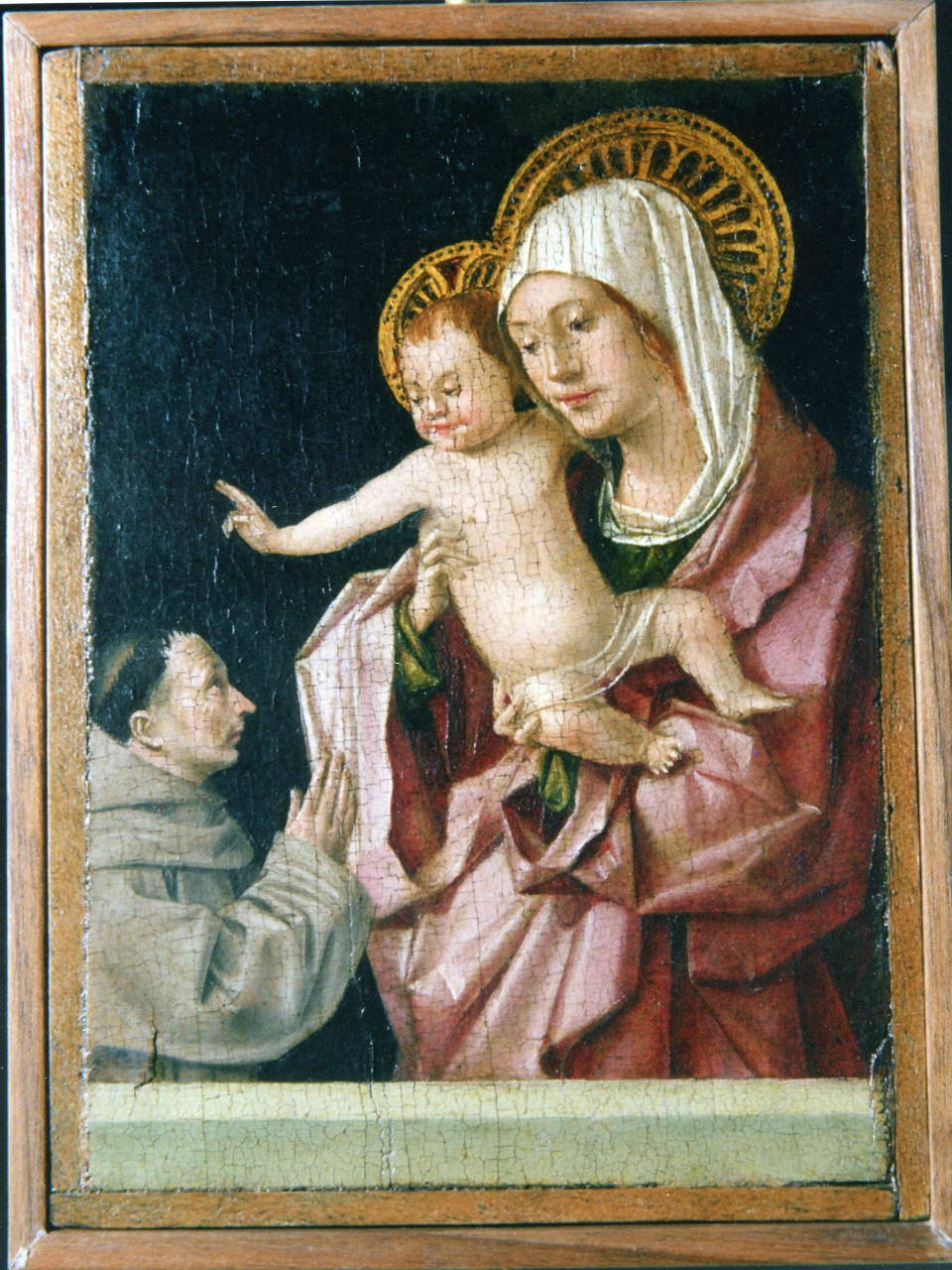
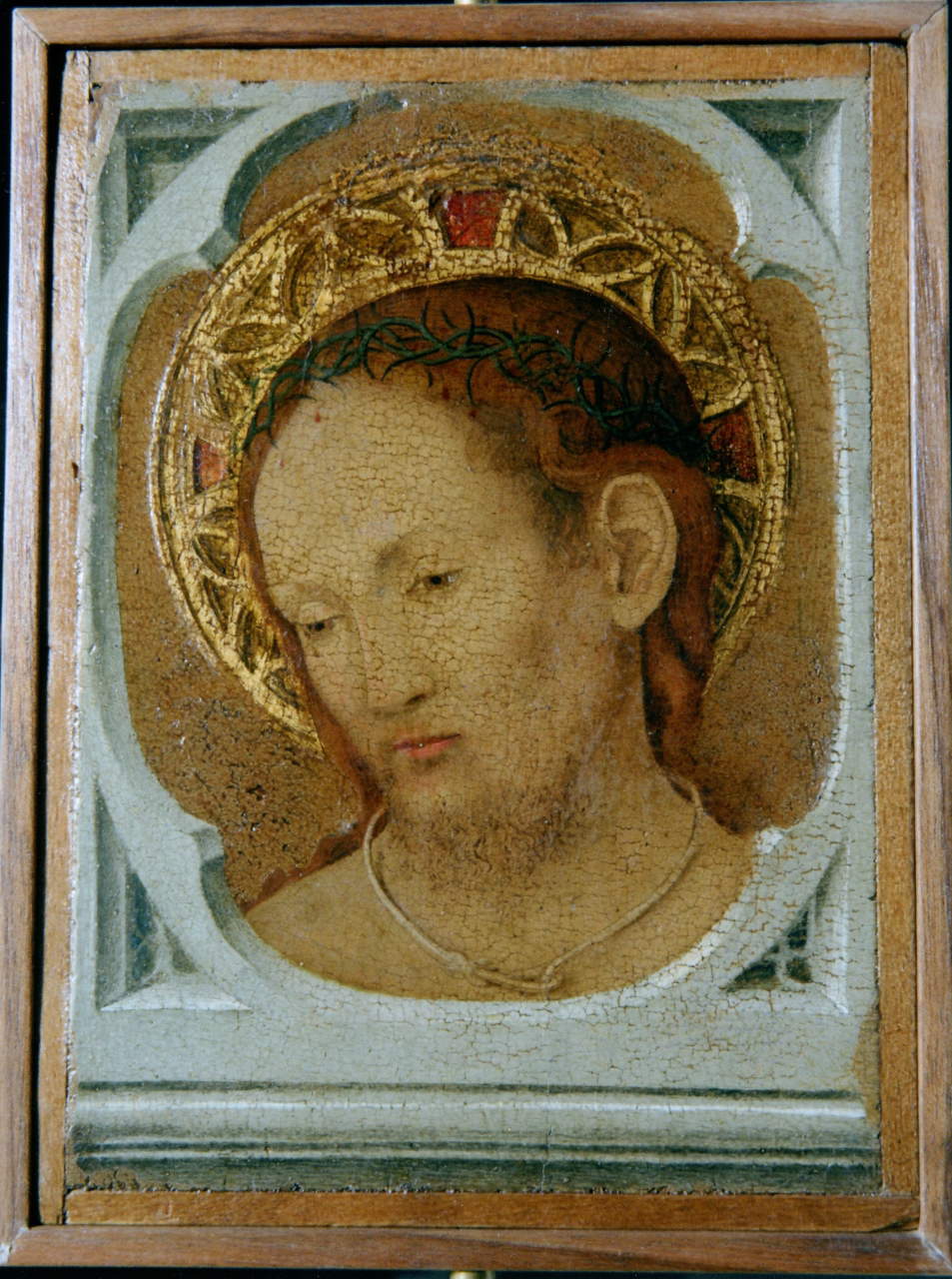
As I am on vacation along the Messina coast, as I am every year, I can attest that in the days following the mid-August holiday, I saw nothing but a drone and a helicopter sent to patrol the coast for a couple of days—not a single Coast Guard patrol at sea on the horizon, not a single siren—utter calm. The eyesores of ships loaded with cruise passengers and cargo vessels continue to travel back and forth through the Strait, along with ferries and hydrofoils, undisturbed; and as the MuMe coordinator confided to me with frustration on the day the museum reopened, all that traffic in the Strait—the tourist flows—is never channeled toward the MuMe. It’s striking that the Strait’s economy hasn’t been affected in the slightest by this tragedy, or that tour operators aren’t being seriously mobilized to include stops at the city’s cultural sites, which are currently being intentionally omitted due to political responsibility. At this point, it’s no longer tourism—it’s a form of captivity.
So, at least for informational purposes, we’re providing a map here of Antonello’s other works in the region for anyone wishing to take a consolatory tour and gauge the gravity of Sicily’s loss: in addition to the unmissable *Annunciata* at Palazzo Abatellis in Palermo and three other panels depicting saints, until November 4, you can see two of Antonello’s smiling portraits of men on display together at the Mandralisca Museum in Cefalù before they move on to Palazzo Madama in Turin this winter, where they will remain until February 2027, then another earlier *Annunciation* at Palazzo Bellomo in Syracuse, and finally two early panels at the Pinacoteca Civica in Reggio Calabria. And in the event that the panels from the MuMe are not recovered, we ask that the *Ecce Homo* from L’Aquila be transferred to Messina as soon as possible with the necessary security escort and accompanied by an up-to-date and proportionate surveillance system. Sicily’s cultural significance, the development of the entire island, and its connection to the Italian state cannot remain hostage to the secondary project of a bridge across the Strait.
Warning: the translation into English of the original Italian article was created using automatic tools. We undertake to review all articles, but we do not guarantee the total absence of inaccuracies in the translation due to the program. You can find the original by clicking on the ITA button. If you find any mistake,please contact us.