




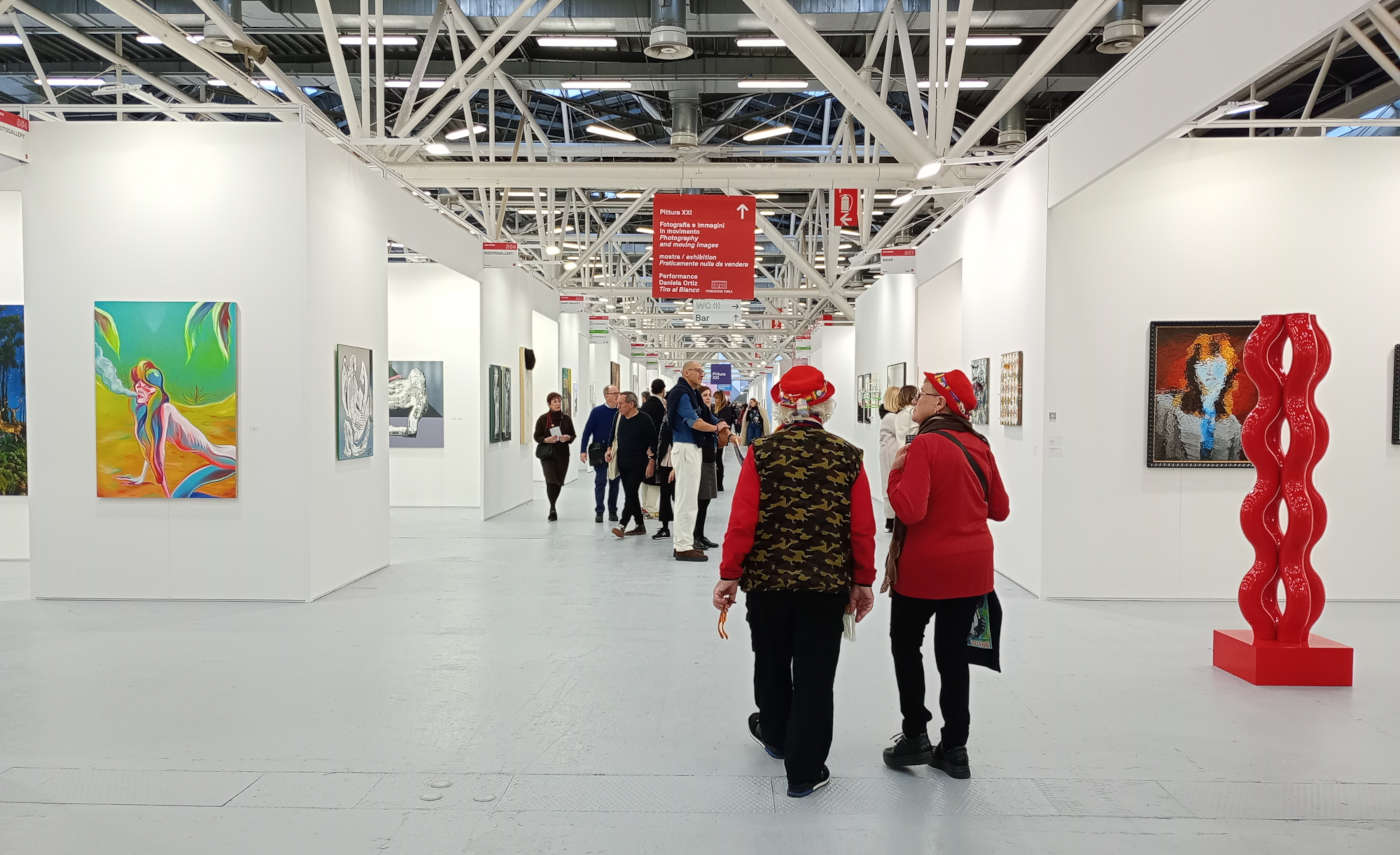
To talk about the market today is to talk about art, artworks, and all the dynamics that strongly influence the lives of artists and, consequently, the making of artworks. In the last fifteen years we have witnessed the dominance of modern and contemporary art fairs as three- or four-day events around which a small biennial is created. A real “vacation package” that pampers collectors who in this way can spend a pleasant weekend having the feeling of seeing everything (and badly).
Fairs should be the place to reap what has been sown before, and not the place to sow and reap at the same time. The serious problem is that in contemporary art there are no places and times to sow and particularly to find the reasons and motivations for the artwork. In other words, we would need exhibitions and projects that are truly disconnected from the market and where artists, within appropriate critical and curatorial frameworks, can experiment, dare, take risks, do what in industry we might call “Research and Development.”
In addition, fairs demand high costs to participate and thus galleries are forced to raise prices for contemporary works, and this for no real reason but simply as a matter of “participation costs.” Such arbitrary price increases go to congest an already difficult contemporary market with very high prices that are not reflected in the long run against the real values on the field. This comes after many years in which critical confrontation, such as the ability to argue the value of contemporary artworks, is completely absent, and where therefore there are no times and places to find reasons and motivations. And all this further disincentivizes the collecting of the contemporary by fortifying more and more the collecting of the modern, which offers safer values being sedimented over time. In other words, galleries are forced to pay to participate in a large “mall” where they find themselves in close competition with dozens and dozens of national and international galleries.
The Covid period, as if it were a merciless critic, made clear an over-reliance on fairs. In fact, the market, and the well-being of the whole system, depended simply on the opening or closing of fairs. In Italy, an association of galleries called Italics, in reaction to this excessive dependence, and precisely during Covid, began to organize an annual event, the Panorama exhibition, as a widespread and itinerant cultural event in the most beautiful places in Italy. This move turns out to be strategic and essential in order to decrease the dependence on big international fairs and create its own platform that can create its own audience and collection, with ambitions of attracting also from the international scene. If you will, “Panorama” is a modern and contemporary art fair masquerading as a “cultural event,” and allowing some Italian galleries to participate with very low costs and cutting out all the competition from international galleries. Here again, however, the place of sowing coincides with the place of harvesting, and there are no ways to explore and argue the reasons and motivations for the contemporary versus a modern/antique that is the real source of livelihood of the major art galleries.
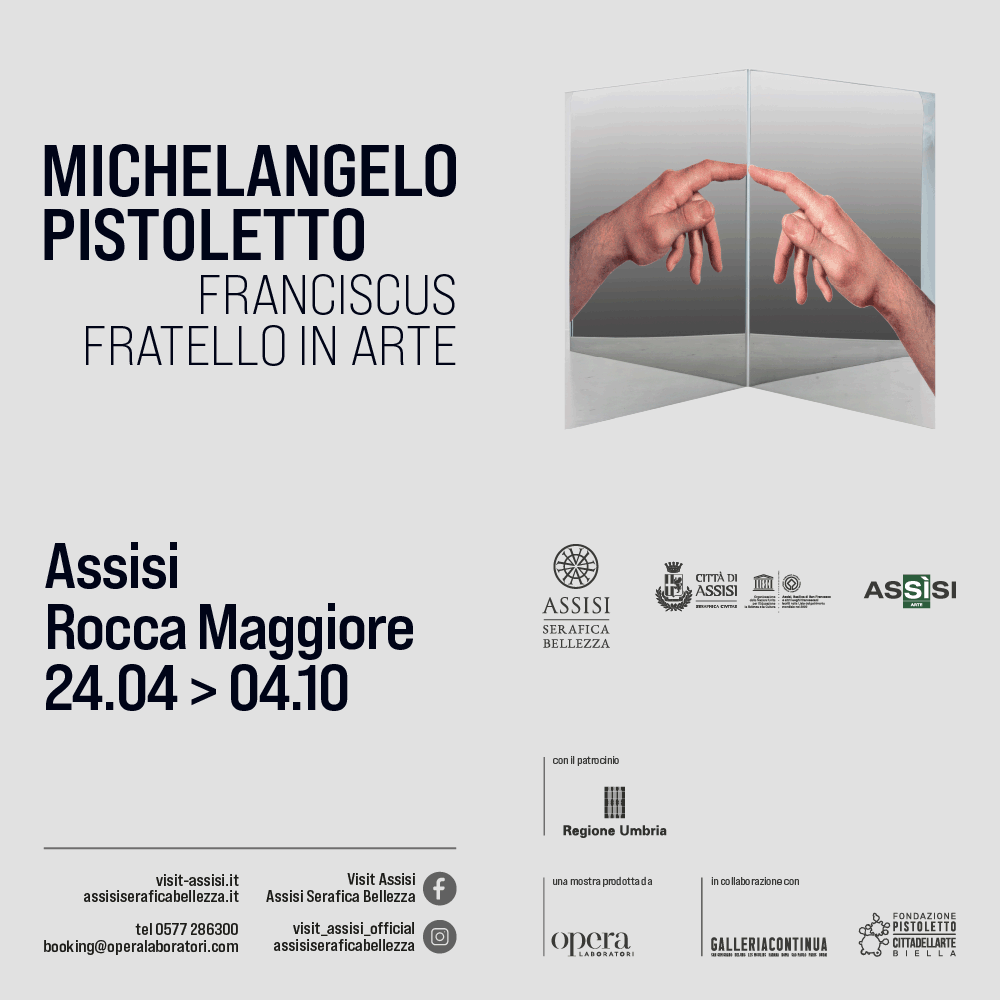
After all, why should an art gallery spend time and money on motivating and arguing for the contemporary, when this work would lead it to lower receipts than it can achieve with the modern without any effort? If I can easily sell a mirrored painting by Michelangelo Pistoletto for 100,000 euros, why should I engage in supporting a young person by making a lot of effort and achieving, if anything, a 10,000 euro sale? Here is that the young artist is only required to be a good complement to the artwork. The work must be formally pleasing and attract the collector’s attention in seconds. In this way, with a low receipt, the sale can be closed without too much effort, and the work will still go to furnish the collector’s “beach house.” This system, which we see as much in fairs as in alternatives to fairs such as Panorama, over the years kills contemporary art and makes it “pleasant and harmless interior decoration”-it is what we might call “evolved IKEA.”

The author of this article: Luca Rossi
“Luca Rossi" è un nome di fantasia in cui idealmente convergono tutti i ruoli del sistema dell'arte: artista, critico, curatore, blogger e osservatore indipendente. È stato definito da Fabio Cavallucci “la personalità artistica più interessante d'Italia”. Dal 2009, “Luca Rossi”, collettivo aperto e figura controversa nel sistema artistico, cerca di stimolare quotidianamente un dibattito più critico nell'ambito dell'arte contemporanea, intesa come materia capace di rivestire un ruolo fondamentale nel nostro presente. Dalle sue riflessioni critiche, ampiamente diffuse, sue le definizioni di “Ikea evoluta”, “Sindrome del Giovane Indiana Jones” e “Nonni Genitori Foundation”, è nato un progetto artistico non convenzionale, che comprende anche attività di divulgazione e formazione, culminate nel 2016 con la creazione della Luca Rossi Art Academy & Coaching (documenta.live). Nel febbraio 2026, un Hidden Work di Luca Rossi è entrato nel nuovo percorso espositivo di Osteria Francescana di Massimo Bottura, segnando un ulteriore sviluppo del progetto e della ricerca intorno agli Hidden Works. Nel 2014 Giacinto Di Pietrantonio, in un’intervista, definì Luca Rossi la promessa futura dell'arte contemporanea, paragonandolo a ciò che Vanessa Beecroft avrebbe potuto essere negli anni Novanta. Alcuni “nodi critici” sviluppati nel corso degli anni da Luca Rossi sono entrati a far parte del linguaggio dell'arte italiana e hanno contribuito a cambiare la prospettiva e la visione di molte persone, dentro e fuori il settore. Nel 2014, la celebre critica d'arte Angela Vettese dichiarò che, dopo aver letto i testi di Luca Rossi, aveva deciso di non dedicarsi più alla pratica artistica, ma esclusivamente alla teoria.Warning: the translation into English of the original Italian article was created using automatic tools. We undertake to review all articles, but we do not guarantee the total absence of inaccuracies in the translation due to the program. You can find the original by clicking on the ITA button. If you find any mistake,please contact us.

















 IT
IT FR
FR DE
DE ES
ES CN
CN


