




by Andrea Bruciati 09/09/2026



Categories: Opinions / Disclaimer
Performance art should challenge critics to rethink the relationship between mind and body; to do so, a new lens might be useful: “peptide performance.” A “biochemistry of action” to move beyond Cartesian mind-body dualism: thought, emotion, matter, and perception converge in the body. An article by Andrea Bruciati.

Criticism of performance art has a fundamental problem: it continues to conceive of the body as if it were Cartesianly separated from the mind. For decades, bodily actions have been interpreted alternately as conceptual exercises—in which the mind uses the body merely as a medium—or as pure visceral shocks intended to challenge the viewer. This rigid opposition risks obscuring the deepest nature of performance, which is neither pure abstraction nor mere theater of pain.

To understand what happens within the space of an action, we can try shifting our perspective and viewing the body not merely as the artist’s instrument, but as a place where thought, emotion, and matter converge. It is in this context that the insights of neuroscientist Candace Pert can offer a surprisingly fruitful framework for interpretation: not to uncritically import neurobiology into art criticism, but to adopt biochemistry as an interpretive model for the performative process. In her book *Molecules ofEmotion*(1997), Pert developed a conception of the mind-body relationship that challenges the traditional Cartesian separation. Through her study of opioid receptors and neuropeptides, the researcher has helped describe a biochemical communication network in which the nervous system, the endocrine system, and the immune system are deeply interconnected. From this perspective, emotions do not belong exclusively to an abstract dimension of the mind, but manifest through material processes that involve the entire organism.


It is here that a new, ad hoc critical category may emerge: the peptide performance. Not an existing scientific category, nor an attempt to explain performance physiologically through biochemistry, but a critical lens through which to examine the relationship between body, emotion, perception, and meaning. What if the body were not the medium for the idea, but the very place where the idea occurs?
When an artist subjects their body to a prolonged state of stillness, exhaustion, endurance, or pain, they are not simply translating an idea into an action. They are engaging their own organism in a process in which perception, emotion, stress, attention, and physiological response interact continuously. This does not mean that such physiological processes exhaust the meaning of the action; rather, it means that the meaning of the performance is also constructed through a body that perceives, reacts, and changes during the action. The performer physically navigates the experience, and the body becomes the site where the idea becomes a concrete event—a form of embodied knowledge where the boundary between the intellectual and physical dimensions dissolves.
Flesh and History: Abramović, Pane, Mendieta
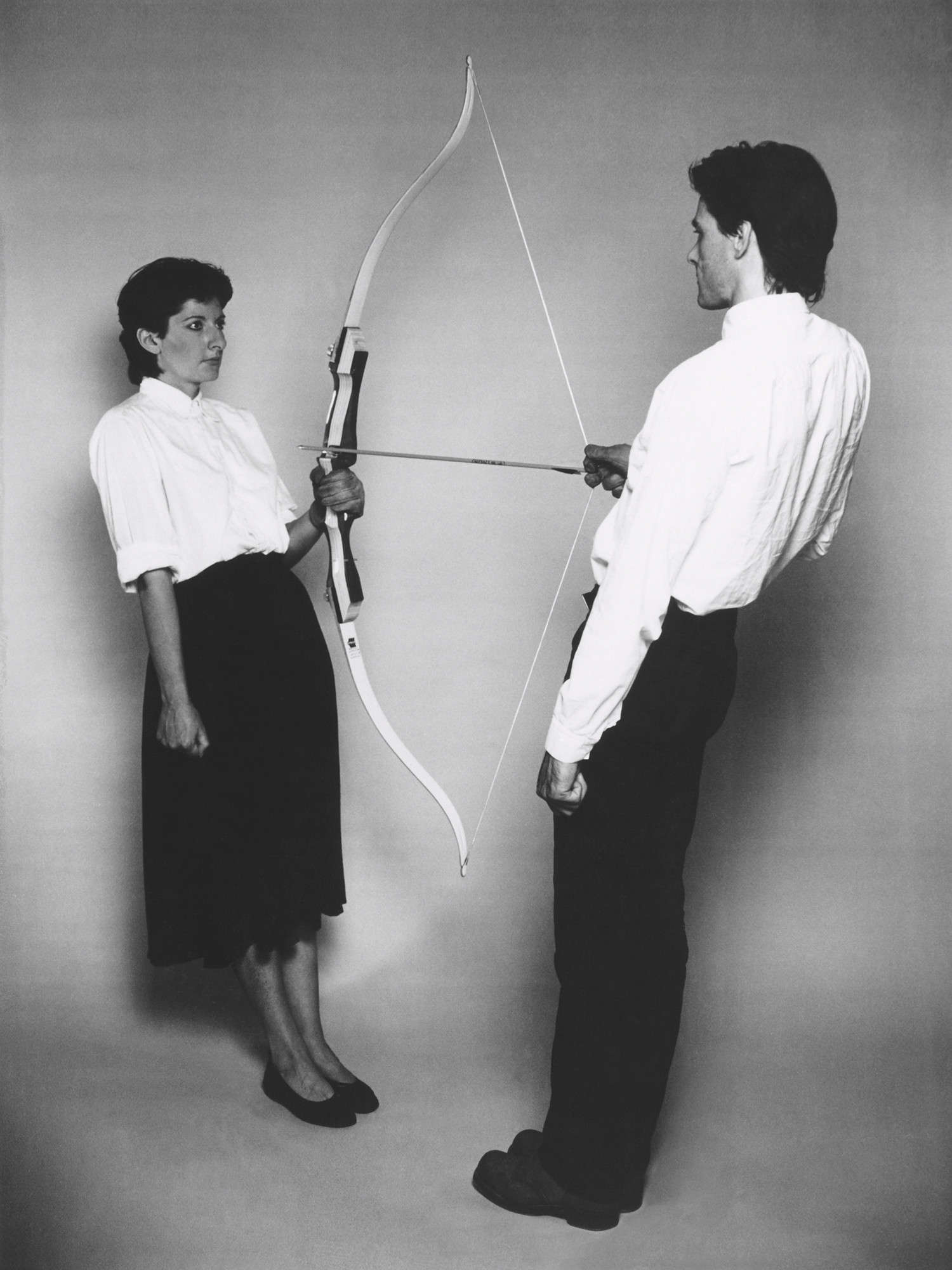
Viewed through this lens, the most famous examples in the history of body art take on a different meaning. Consider *Rest Energy* (1980), a performance by Marina Abramović and Ulay: she holds a drawn bow, while he holds an arrow pointed at his own heart, for approximately four minutes. Microphones amplify their heartbeats and breathing in real time, making them audible to the audience in the hall. Here, the biological data is not a critical inference: it is the sound material of the work itself. Fear, adrenaline, and the actual increase in heart rate caused by proximity to danger do not merely accompany the action—they constitute it. The physiological data, however, does not in itself constitute the meaning of the work: it becomes part of the work because it is made perceptible, shared, and inscribed in the relationship between the two performers and the audience. The body does not act out the tension; it produces it, and that production is made public in real time, so that the audience does not merely receive a representation of fear but enters into a relationship with a real bodily signal of the action.
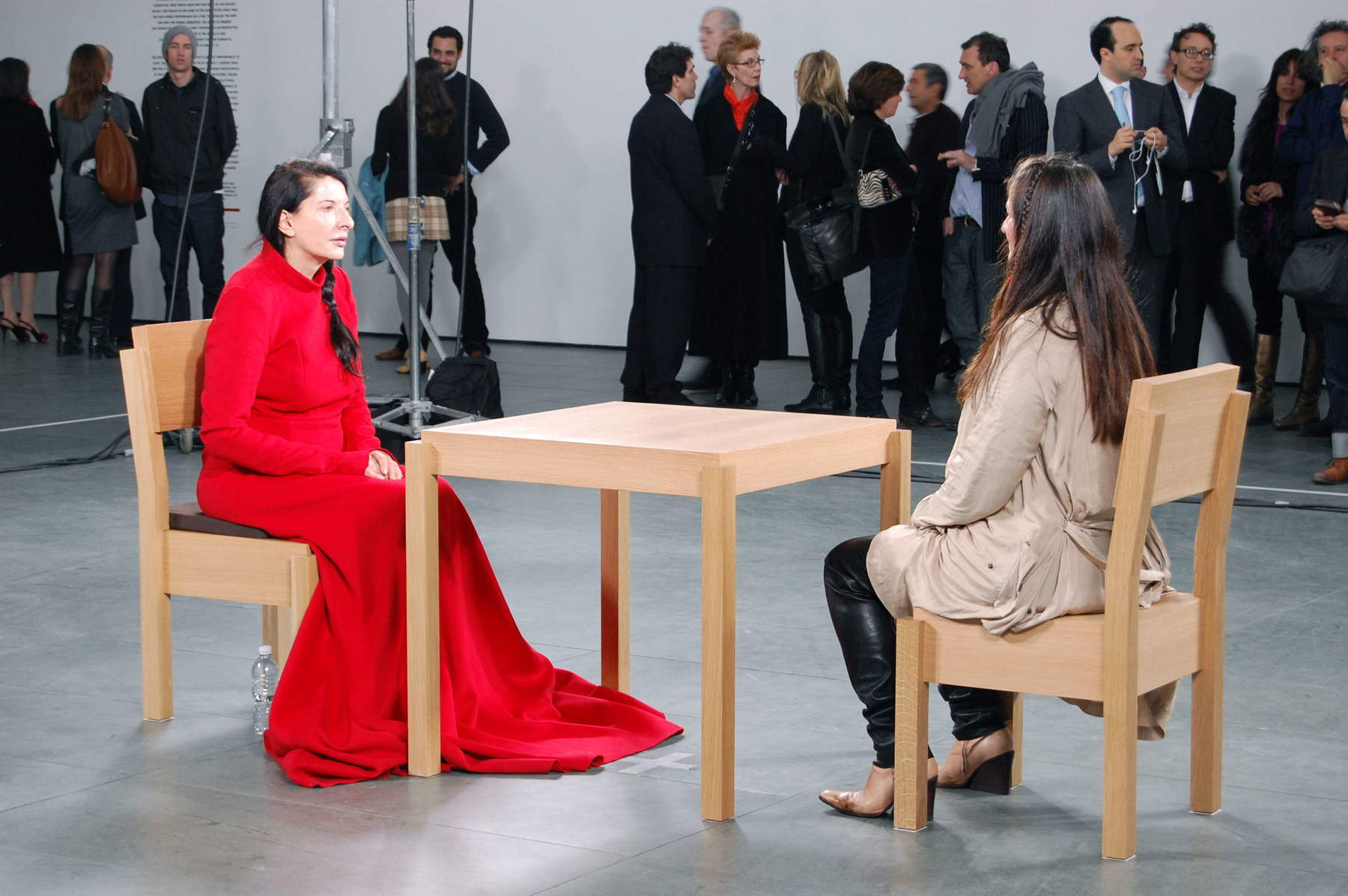
A different register, more spread out over time, emerges in *The Artist Is Present*, where 736 hours of prolonged stillness produces a cumulative physical and psychological state in which attention, fatigue, and emotion mutually shape one another. The viewer who sits across from the artist and reacts emotionally is not necessarily merely interpreting a symbol: they may be drawn into a perceptual and relational situation in which attention, proximity, and emotion interact.
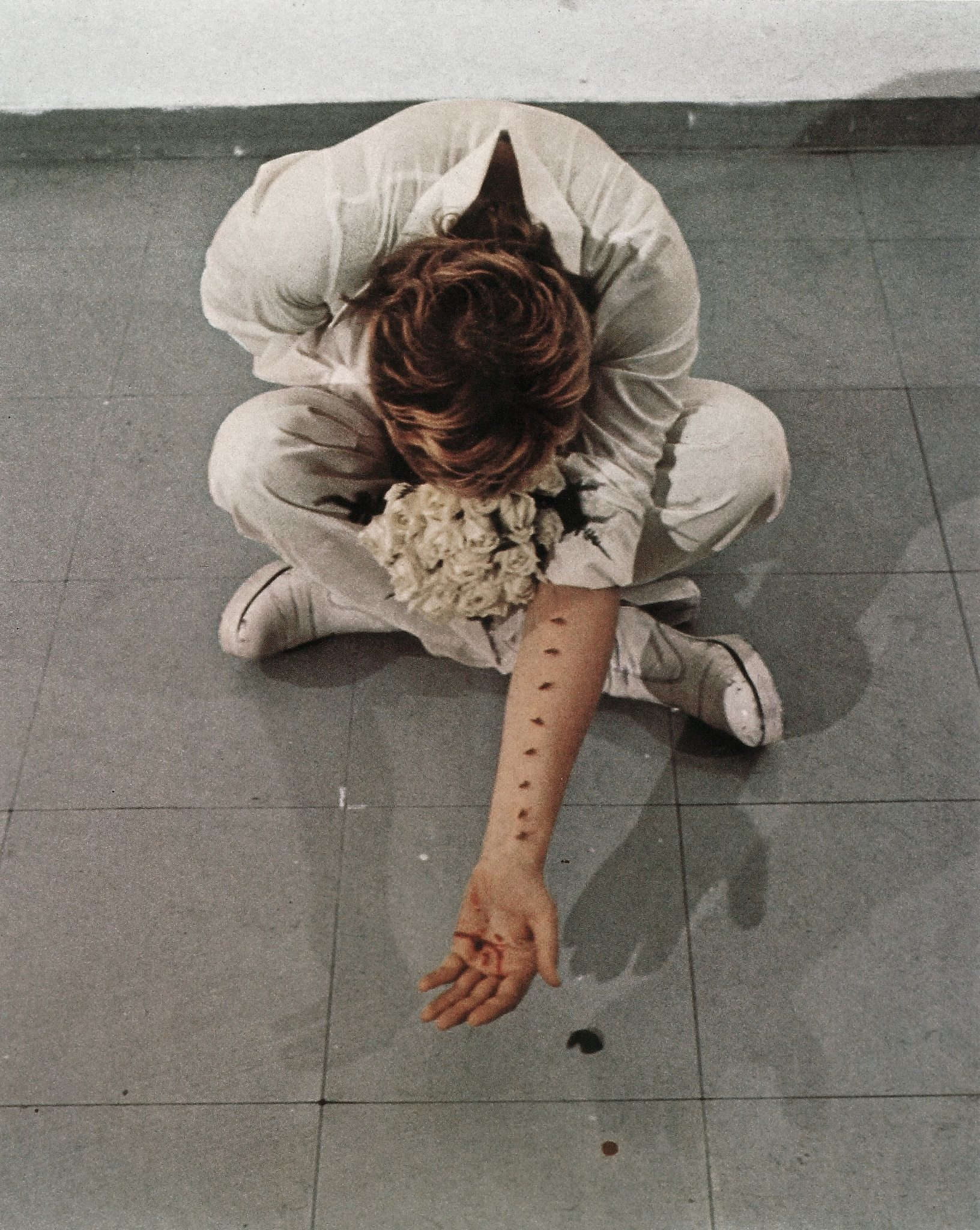
The same holds true, in an even more radical way, for Gina Pane’s actions. In *Azione sentimentale*, the scalpel that cuts into the flesh is not a stage prop. The pain and the wound are not symbols of suffering to be represented, but authentic bodily events that involve the artist’s physiology and alter the perception of those who witness them. The artist does not “show” the pain: she inhabits it. And the viewer, faced with real blood, does not merely contemplate an image: they are called upon to engage perceptually and physically with the reality of the action. The meaning of the action therefore lies not only in the documented wound, but in the relationship that wound establishes between the artist’s body and that of the viewer.
A different geometry—more spatial and rigorous—emerges in *Moment de l’action mélancolique 2 x 2 x 2* (Naples, Studio Morra). Pane arranges three couples (two women, two men, and one woman and one man) on stage, each holding a bouquet, to create a shared emotional space that portrays bonds beyond the heterosexual norm. Then the artist enters the scene and draws hearts on her own palm, on her shoulder, and finally on the bare back of a woman in the audience. The gesture is not a representation: it is a physical transfer of emotion from one body to another. But it is with blood that the action takes its unexpected turn: Pane cuts off her ear and pierces her arm with pins, while she rinses her mouth with cold milk and spits it out warm, nourishing with her own warmth a world she defines as cold and insensitive. The 2 x 2 x 2 cube of the title is not merely a stage measurement: it is an emotional cell, a closed space in which emotion concentrates and becomes matter. Milk and blood are not merely metaphors: they are bodily fluids that pass through the mouth and skin, offered by the artist as both nourishment and wound.
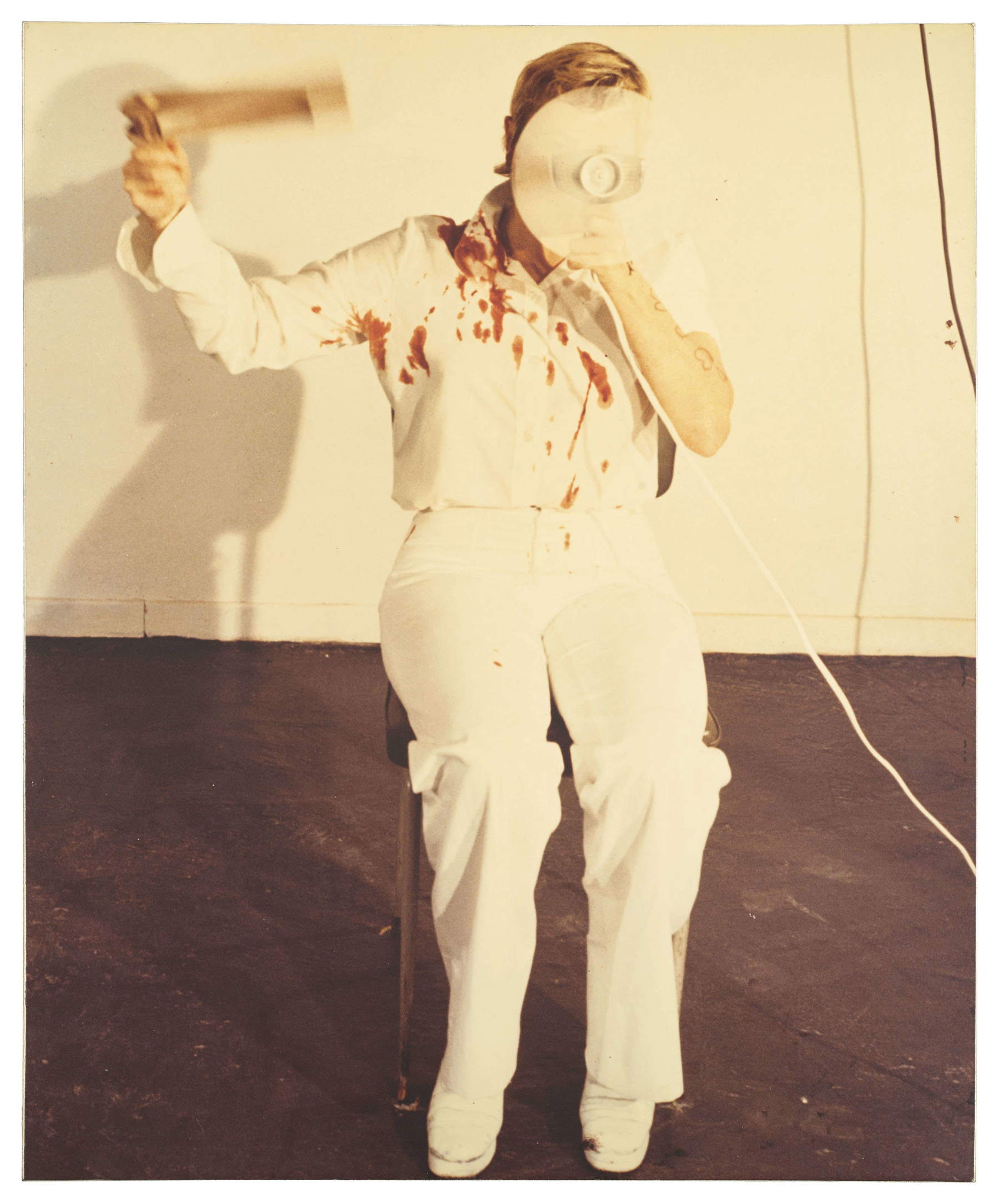
Ana Mendieta’s *Siluetas* can also be reinterpreted through this lens. The body imprinted in mud, earth, blood, or vegetation does not merely represent a symbolic relationship with nature. It enacts a conception of the individual as an organism inseparable from the environment in which it lives. The skin, rather than constituting an absolute boundary, becomes a fluid boundary through which the body continually enters into a relationship with the world. The imprint is not merely an image left on the ground: it is the material trace of a relationship between the interior and the exterior, between the body and the earth that receives it.
Ana Mendieta leaves an equally radical, though silent, trace in *Untitled (Body Tracks) * (Iowa City, 1974). The artist immerses herself in red tempera paint and lets herself fall onto a white sheet spread out on the ground, rolling and sliding until she imprints her body like a living seal. There is no audience in the room: the action is documented live by the camera, but the gesture remains performative because the body does not pose—it passes through. The paint is not a substitute for blood: it is the very substance of the passage, the tangible residue of a movement that cannot be repeated identically. The white sheet becomes the canvas of a bodily map where the arms, hips, and legs trace a territory without clear boundaries between skin and paint. Here, the body does not represent; it imprints. And the imprint is not a static memory, but the trace of an event in which body, movement, and paint interact to produce an irreversible mark. The viewer encountering the image does not contemplate an icon: they witness a snapshot of a body that has surrendered its substance to the surface, transforming action into matter.
There is, however, a limit to this “peptide-based” interpretation, and the three artists demonstrate this better than any theory. Pert’s biochemical perspective tends to describe a universal, neutral, biochemical body. But the thinking body in performance is not an abstract body: it is a historical body, marked by gender, politics, and power. Pane’s wound is not merely a physiological event; it is an act that reclaims the female body from the regime of the gaze. Abramović’s stillness is not merely meditative discipline; it is a stance on time and space in a world that denies women the right to public stillness. And Mendieta’s imprint is not merely a fusion with nature; it is the search for a land that welcomes an exiled body. Peptide performance, then, not only dismantles Cartesianism; it also dismantles the presumption that the body is neutral territory. The body thinks, yes. But it thinks from a specific body, at a specific time, against someone.

The Embodied Spectator and the Tremor of Criticism
At this point, the issue inevitably extends to the viewer as well. The performance does not, in fact, end with the artist’s physiological transformation. The performer’s exposed body also elicits a response in the observer. Silence, tension, physical proximity, and the perception of pain or exertion can engage the viewer on perceptual, motor, and emotional levels.
It is here that the comparison with the studies by Vittorio Gallese and David Freedberg on embodied simulation (“Motion, Emotion, and Empathy in Aesthetic Experience,” 2007) becomes particularly interesting. Their research has helped demonstrate how the observation of actions, gestures, and bodily states can engage the observer’s perceptual and motor systems linked to the embodied understanding of others’ experiences. From this perspective, observing a bodily gesture can involve processes of embodied simulation that contribute to the perceptual and motor understanding of the action. This does not mean that the spectator literally “experiences” the same physiological experience as the performer, but rather that the distance between the performer and the spectator can also be considered a bodily and perceptual relationship.
It is not required, of course, that the performer’s physiological response be transferred to the spectator through a literal biochemical contagion. It is precisely here that “peptide performance” must be understood as a critical category and not as a physiological diagnosis of the work. Biochemistry, in other words, is not called upon to explain the work, but to provide a model through which to rethink the relationship between bodily matter, emotion, perception, and meaning. Its value lies in suggesting a different conception of aesthetic experience: not a message that originates in the artist’s mind and reaches the viewer’s mind, but an event in which bodies, perceptions, and emotions enter into a reciprocal relationship.
Performance thus becomes a space where Cartesian dualism can be put to the test in concrete terms. The artist thinks with the body, the body reacts to thought, the viewer perceives that reaction and in turn responds to it. The artwork is not merely what is represented, but also the bodily and perceptual process that arises from the encounter between the action and the observer. It is in this sense that the “peptide performance” can become a critical category: not because body art should be reduced to neurobiology, but because art criticism can finally stop treating the body as merely the material vehicle of a mental intention.
Interpreting performance through the lens of Candace Pert thus means reframing the question. It is not merely a matter of asking what it means for a body to act, resist, suffer, or expose itself, but also what happens to that body as it does so and what happens to the bodies observing it. Viewed through this lens, performance is therefore neither a conceptual void nor a mere physical provocation. It is an experience in which thought and matter continually intersect. Perhaps this is what performance has always sought to tell us and what art criticism has continued to overlook: thought is not separate from the flesh. It is in the flesh that thought occurs. And if thought is truly in the flesh, then can art criticism—which has no flesh, which does not tremble, does not sweat, and does not fear—still claim to interpret performance?
Warning: the translation into English of the original Italian article was created using automatic tools. We undertake to review all articles, but we do not guarantee the total absence of inaccuracies in the translation due to the program. You can find the original by clicking on the ITA button. If you find any mistake,please contact us.