





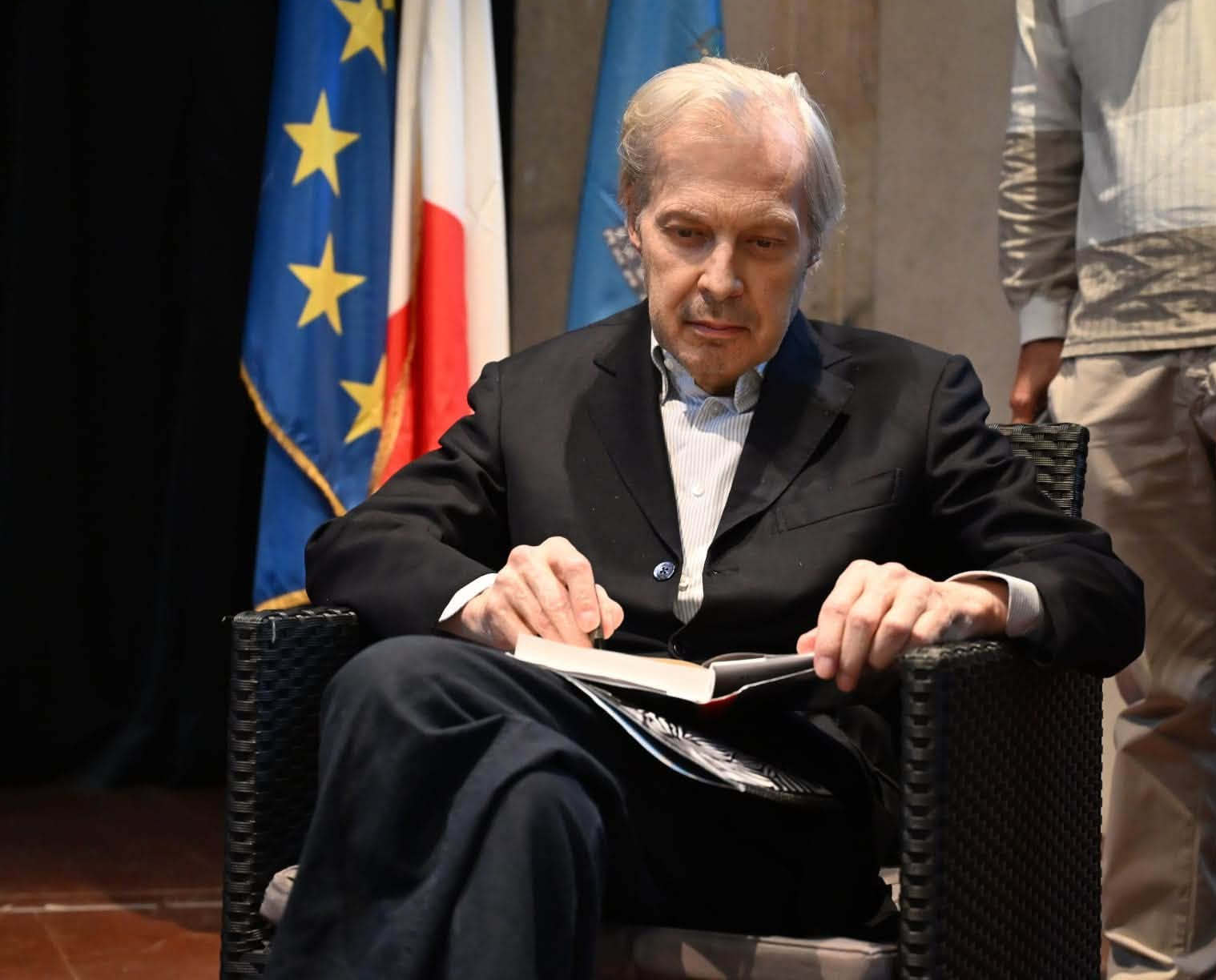
I haven’t started—and I won’t start—keeping track of the media attacks accused of having torn down Vittorio Sgarbi’s public image: Ermes Antonucci has already taken care of that in *Il Foglio*, where he wrote an article—largely with which I agree—that includes a thorough account of the relentless attacks, attributed primarily to *Il Fatto Quotidiano* and *Report*, with a precise reconstruction of the date and place of origin of the entire operation. Nor do I have any grounds to believe that the current state of Vittorio Sgarbi’s health is due to the combined offensive efforts of Travaglio’s newspaper and Ranucci’s former TV show. I believe this is a matter best left to those with the expertise, but even if the problem were solved, the solution would be of limited use: even if a cause-and-effect relationship were not established, it has been a fact for several months now that the illness—whatever its cause—has produced a Vittorio Sgarbi who is shattered yet at the same time refined, suffering yet absolute, transformed into another version of himself, a Vittorio Sgarbi increasingly distant from the tumult of current events and the trappings of public life, and yet—precisely for this reason—miraculously present, with a luminescent presence that operates by subtraction.
Now, the fact that there has been a long, inquisitorial furor against Sgarbi certainly does not mean that one should have remained silent, that it would not have been proper to launch the investigations, that it would not have been proper to raise the issue of the compatibility between his public office and his work as a lecturer, the issue of the presence of Rutilio Manetti’s painting in his collection, the issue of ownership of Vittorio Zecchin’s painting, and so on. It should also be noted that, at present, Sgarbi has been acquitted in the first instance in all three cases (regarding Manetti because the act does not constitute a crime, regarding Zecchin because the charges were unfounded, and regarding the lectures because the Court of Auditors ruled that his institutional duties were not incompatible with his professional activities: In an interview, Sgarbi had, moreover, attributed the bulk of his distress precisely to this legal proceeding and to his subsequent resignation as undersecretary, which he considered an “absolute injustice”).
Of course, someone, with the smug pedantry of a bureaucrat, will be quick to point out that the acquittal regarding the Manetti painting is not final, that the acquittal in the case of financial damage was issued by the first-instance judicial division of the Court of Auditors, and that any prosecutor’s office has the option to file an appeal—which has already been done in the case of Manetti’s painting. It’s true; none of the proceedings can yet be considered definitively concluded. Perhaps, however, one could venture the reprehensible imprudence of turning one’s gaze away from the legal proceedings and focusing instead on the methods by which the investigations by *Il Fatto* and *Report* were staged and presented to the public. Here’s the thing: if one looks at the methods, then one will likely end up concluding that the investigations into Vittorio Sgarbi have more in common with entertainment, with a show, with a serialized drama, than with journalism. This raises a significant issue of responsibility: when the line between investigative journalism and entertainment blurs, is the journalist still the professional who seeks to uncover the substantive truth of the facts, or do they end up becoming a mere showman who sets the stage for an emotional verdict even before a judicial one is handed down—knowing full well, moreover, that emotional verdicts are more resistant to appeals than those issued by the judiciary?
One can agree that “show journalism” risks having the effect of influencing public perceptions in a more or less covert manner. The stakeouts outside exhibitions, the chases after openings, the musical backdrops featuring the theme from *The Pink Panther*, the provocative questions, the digging up of stories from twenty, thirty, or forty years ago, articles in which revelations from the former driver, the former social media manager, and other former alleged accomplices—who later repented and became improvised advocates of punitive justice—were passed off as interesting. After all, it’s not every day you get your hands on such a visible and juicy target—the kind that guarantees months of articles and viewership—and when it happens, it’s hard to believe you have so much material at your disposal to produce a viable alternative to Netflix for the enjoyment of the honest citizen. The problem is, though, that it’s hard to classify all of this as journalism.
Rather than a reckless form of investigative journalism, all this media pressure on Vittorio Sgarbi has ended up resembling, if anything, a sensationalist spectacle of news for self-righteous petty-bourgeoisie glued to their couches—a genre of entertainment crafted for the amusement of a moralistic audience that watches with smug satisfaction as the pestles, blenders, electric mills, grinding stones, gear wheels—all the paraphernalia for shredding (and the same goes for the massacre—certainly no less idiotic—that is reducing what remains of Sigfrido Ranucci’s public image to rubble), the equivalent of a *Temptation Island* conceived for that audience that marks its territory by professing its aversion to reality TV and lining up for cultural festivals, yet never misses an episode of the Sgarbi series (Incidentally, it’s not as if you’re a stranger to the mechanics of *Temptation Island* just because you’re finishing up the second volume of *In Search of Lost Time* in the original language: you’re exactly the same as those who get caught up in Sara and Gabriele’s love story; it’s just that, in your case, they try to call that same kind of entertainment “investigative journalism”). All perfectly legitimate, of course, and besides, this kind of grind is entertaining. Perhaps even too much so: isn’t it the case that if journalism becomes entertainment, the public will eventually realize they prefer the original, and we’ll all have to change careers?

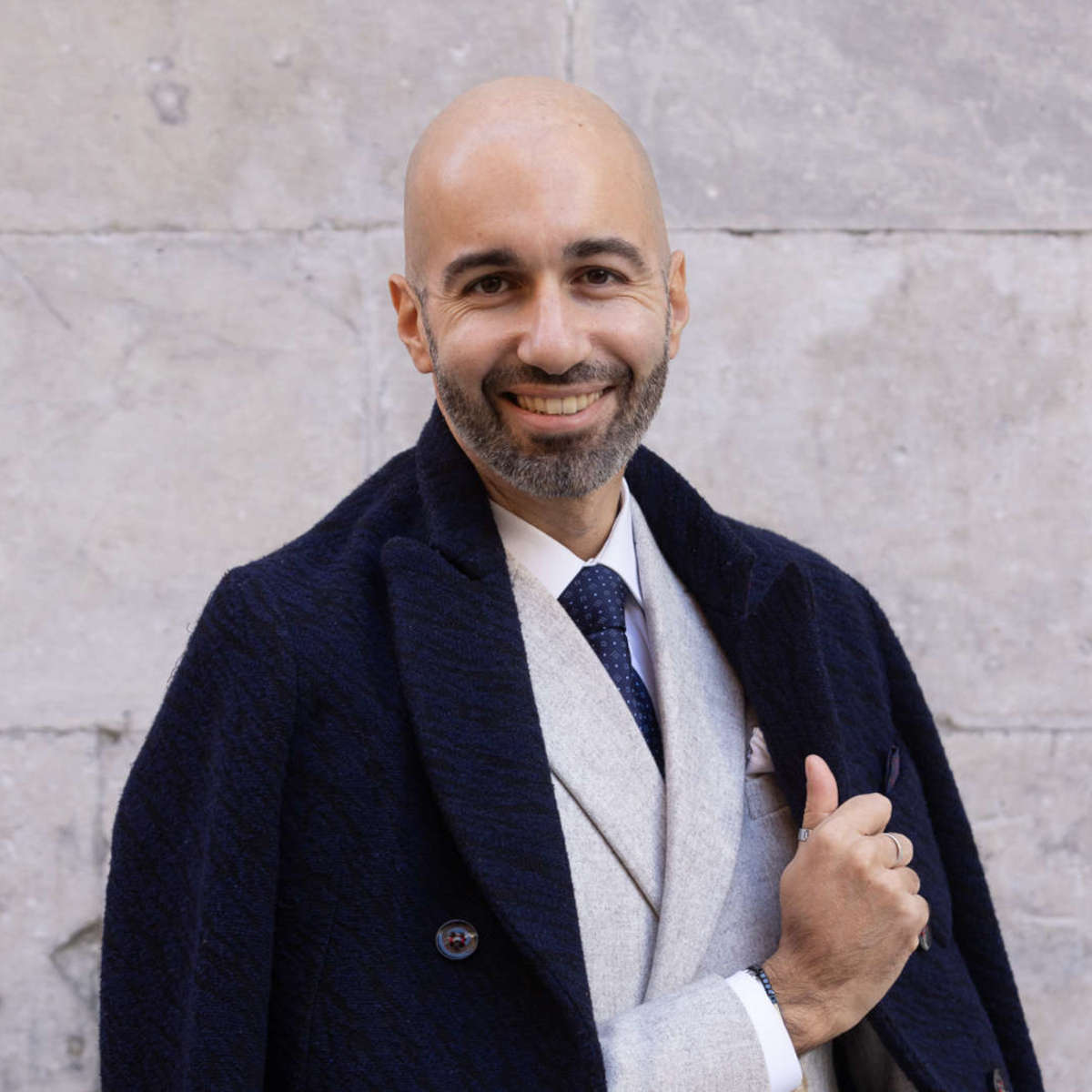
The author of this article: Federico Giannini
Nato a Massa nel 1986, si è laureato nel 2010 in Informatica Umanistica all’Università di Pisa. Nel 2009 ha iniziato a lavorare nel settore della comunicazione su web, con particolare riferimento alla comunicazione per i beni culturali. Nel 2017 ha fondato con Ilaria Baratta la rivista Finestre sull’Arte. Dalla fondazione è direttore responsabile della rivista. Ha scritto i libri Vero, Falso, Fake. Credenze, errori e falsità nel mondo dell'arte (Giunti editore, 2025) e Immagini del potere. Arte e propaganda da Augusto a Trump (Giunti editore, 2026). Collabora e ha collaborato con diverse riviste, tra cui Art e Dossier e Left, e per la televisione è stato autore del documentario Le mani dell’arte (Rai 5) ed è stato tra i presentatori del programma Dorian – L’arte non invecchia (Rai 5). Al suo attivo anche docenze in materia di giornalismo culturale all'Università di Genova e all'Ordine dei Giornalisti, inoltre partecipa regolarmente come relatore e moderatore su temi di arte e cultura a numerosi convegni (tra gli altri: Lu.Bec. Lucca Beni Culturali, Ro.Me Exhibition, Con-Vivere Festival, TTG Travel Experience).
Warning: the translation into English of the original Italian article was created using automatic tools. We undertake to review all articles, but we do not guarantee the total absence of inaccuracies in the translation due to the program. You can find the original by clicking on the ITA button. If you find any mistake,please contact us.


























 IT
IT FR
FR DE
DE ES
ES CN
CN


