



by
Federico Giannini  @federicogiannini1
06/09/2026
@federicogiannini1
06/09/2026



Categories: Opinions / Disclaimer
A territory is neither a static category nor something that can be explained by a one-size-fits-all theory. A town is not a postcard, a statistic, or the confirmation of a theory. What, then, can an outsider who wants to talk about it do? Perhaps begin by accepting that every territory is made up of contradictions and transformations that defy preconceived formulas. An opinion piece by Federico Giannini


A tiny, probably long-forgotten anecdote: a few years ago, the town where I live was abruptly roused from its usual lethargy by a study that the regional government had commissioned from an engineer, a university professor, who had been asked to devise solutions to spare the city the hassle of flooding after every downpour slightly heavier than usual—a situation that, in these parts, actually occurs with a certain, worrying, and ominous frequency. A “master plan outlining the necessary actions to manage flood risk,” to put it in more official terms. Among the various measures the master plan proposed to manage flood risk was the demolition of all the bridges in the historic center. Now, I don’t recall exactly whether—and if so, through what means—my fellow citizens averted the risk of the historic bridges being demolished (counter-analysis, search for alternative solutions, driving the engineer out with pitchforks, or similar structural interventions in support of municipal expertise), but I’m fairly certain that, about ten years after the master plan was drawn up, all the bridges are still in place.


I don’t have a clear idea of what the moral of this fable is (perhaps that no single point of view is sufficient to govern a territory), but I think it has something to do with the online bashing that’s currently stirring up emotions in my social media bubble and frantically driving the keyboards of a well-known teacher and a well-known poet who spend their days writing on social media. If I were to offer a summary for those who aren’t just idling away their time, it could be put this way: It’s mid-August or thereabouts, and the first guy, like everyone else, heads off on vacation, going to laze around in some unspecified little village in the Lombard valleys, and upon his return, he writes a post—among the three thousand he manages to churn out every day on his Facebook wall (and thus amid a post on the state of healthcare in Cuba, one on delivery riders’ rights, and yet another in which—I imagine after firm, strenuous, and daring resistance—he ends up giving in to the temptation to weigh in on “woke” issues, and so on and so forth) where she says that the towns in question are full of dry fountains, closed little churches, and “old, white Italian men” (I always feel a certain admiration for those who use this American-style phrase that specifies, alongside nationality, specifies skin color—even when you’re talking about a hamlet in Valcamonica rather than a suburb in Alabama), prone to disruptive drunkenness, whose main occupation seems to be pestering the village bartender first thing in the morning. Walks through these untamed villages are, of course, peppered with abundant readings of Turoldo and Pasolini, the teacher is keen to inform us. Some might notice that, by simply substituting the Landsknechts for the drunken villagers and * In Search of Lost Time* for Pasolini, Alain Elkann on the train to Foggia eventually comes to mind—but let’s not digress. The fact is that this post would have gone completely unnoticed, were it not for the fact that the aforementioned poet takes it tremendously seriously, responding to it by opening in the third person as if issuing a formal statement (he feels compelled to remind the public of his self-proclamation as the supreme expert on villages, or “paesologist” as he himself has been calling himself for several years), and immediately the contest begins to see who can go on the longest rambling tirades, with the enthusiastic participation of their respective cliques. In the end, presumably feeling compelled to prove that both are capable of doing more than just trading blows over the airwaves, they produce two texts: the teacher, a rambling diatribe of exactly 100,000 characters (largely devoted to an indictment of the other’s pseudo-methodology), riddled with distortions and oversimplifications, in which his ideas on the problems of “rural areas” are forced into a pre-set ideological framework—and which ends up replacing the other’s paternalism with yet another form of paternalism—and the poet a thirty-point manifesto, a sort of wish list forwelfare state, which he first submits to *Repubblica* and then—unconcerned with anyone who might object that the poet hasn’t given the slightest thought to the feasibility of his wish list—feeds to his followers on social media (note that, to those who ask him for clarification on funding, the poet replies: ‘The money is there; it’s just a matter of choosing how to spend it,’ which I believe roughly corresponds to the standard response on the subject offered by the valley dwellers the teacher met at eight in the morning in the little village café).


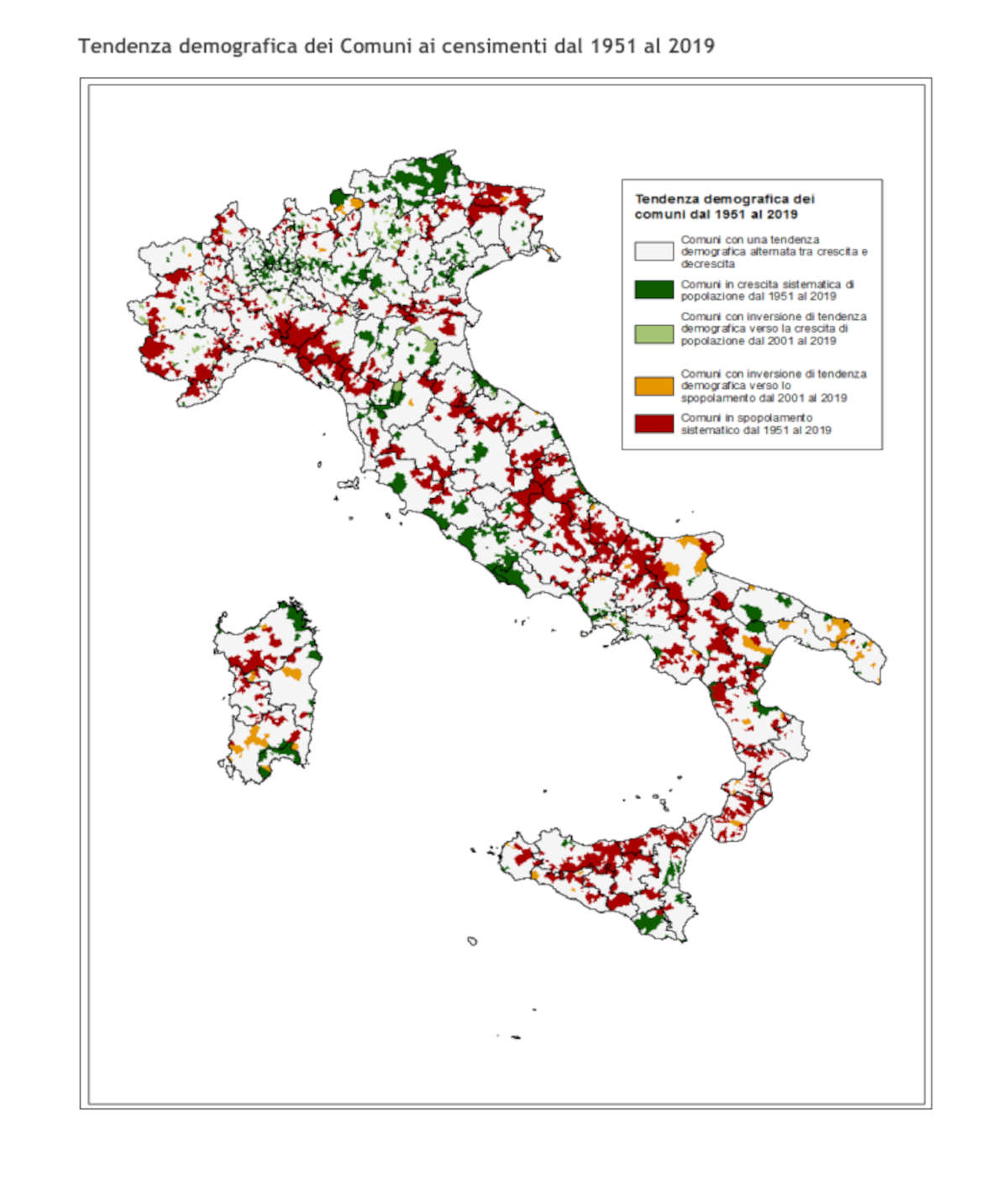
It’s telling that some observers haven’t hesitated to label these minor mid-August skirmishes as a “debate on small towns”: first, because it isn’t a debate. Second, because it’s not entirely clear what a “small town” is: setting aside the term “villages” (since, at the mere mention of this term, all participants in the discussion are immediately seized by spasms and convulsions), is there a threshold for population or territorial size below which one can speak of a “village” and above which it makes sense to speak of a “city”? People speak of “villages” as if they were a coherent entity (or at least coherent enough to be explained by a monolithic theoretical framework), but what are villages? If we wanted to approach the subject with a little more rigor, then we would have to rely on the maps produced by ISTAT and the Agency for Territorial Cohesion, and it would be more appropriate to speak, if anything, of centers, suburban municipalities, and inland areas (and even this would be a further simplification compared to a classification that is even more complex than this), based on the presence of and distance from public services and infrastructure. In Tuscany, for example, a place like Castellina in Chianti—with just over two thousand residents—which to most will appear as a pleasant, touristy, and depopulated village, all stone and wine cellars overflowing with ruddy-faced Americans, is classified as a “suburban municipality,” whereas Piombino, with 32,000 residents—home to steel mills, a major metallurgical hub, a regasification terminal that alone covers one-tenth of the nation’s gas needs, and a port from which hundreds of thousands of tourists set sail for the Island of Elba, is considered a peripheral municipality, on the penultimate rung of the SNAI classification (below that, there are only a few tiny villages lost in the woods of the Casentino or the Pistoia Apennines). For the purposes of this “debate,” then, which of the two locations best fits the archetype of a “village”? The thing is, I don’t believe there can be a fixed and geographically precise category of “village”—the kind that village scholars and assorted know-it-alls might have in mind: there is certainly a cliché, a prefabricated template that roughly corresponds to that of the “small Apennine town experiencing systematic depopulation from 1951 to the present,” which in fact largely overlaps with the map of demographic trends recorded by ISTAT, but it is nonetheless a vague way of addressing the issue (the cliché, so to speak, fits rather well for the mountains of central and southern Italy, but in certain areas—such as roughly all of Umbria, the South Tyrolean valleys, much of the Tuscan hinterland, or the Ionian coast of Lucania—it no longer aligns perfectly), and depopulation is often seen as a symptom of social decline and vice versa, but social decline is a phenomenon that can coexist with stable population levels—or even with growth—and it is a phenomenon that also affects large cities. And then, how do we view cities—even medium-sized ones—whose historic centers are affected by the same phenomena as “small towns,” that is, that are experiencing a severe exodus of businesses and residents, who are increasingly drawn to move to the suburbs—either because they are more convenient and better served, or simply because the historic centers have become unlivable?


The topic, moreover, is too broad to be the subject of a single debate. “Debate on small towns” would be like saying “debate on cities”: what does that even mean? From what perspective should “small towns” be examined? On what issues? Infrastructure? Social decline? Depopulation? Commercial desertification? Employment? Hydrogeological safety? Schools? Transportation? Settlement patterns? The real estate market? Tourism? Planning? Built heritage? Agriculture? Healthcare facilities? Cultural institutions? Who is this person discussing “villages” in the broad sense—some kind of know-it-all who knows every facet of the issue inside and out? And then, what does it mean, as the poet says, to “save the villages”? From what must we save them? And which villages must we save? Are the problems of a village in the Lower Mantua region the same as those of a village in Irpinia or the Val di Sole? And what about the residents’ capacity for control and action (their “agency,” as those in the field would say)? Is it possible that they are meant to be merely literary material (which, incidentally, would also be entirely legitimate: it ceases to be so, however, when literature is mistaken for a method) or, on the other hand, merely statistical counterevidence? Can we speak of the right of representation for the subaltern if, in the end, the most we can propose is to replace an aesthetic with an academic apparatus, or an identity-based rhetoric with technical knowledge that is believed to be emancipatory but may be just as deaf to reality? And so far we’ve spoken only of diagnosis, without even scratching the surface of the topic of remedies: what actions, then? Which sectors are more strategic than others? What are the expected outcomes? What feasibility studies have been conducted? Which projects can serve as examples—how many were launched with public funding (and how much public funding), how many have continued to sustain themselves, and what have they produced for the local community?
Of course, the teacher and the poet deserve some credit; it would be dishonest not to admit it: to the former, for his insistence against the marketing of villages—against the messaging that keeps selling them to us as havens of authenticity, with reopened mountain huts and happy shepherds, restored frescoes and small cheeses, balconies with geraniums and local wines (though I still prefer this marketing to the self-important posturing of those who move to a different ZIP code for the weekend and, after a Saturday and Sunday of strolls, want to explain to the locals what’s best for us “provincials”: I find that a more honest form of indifference). Second, the ability to have helped draw some form of attention to these areas. I doubt, however, that a few Facebook posts—or an ideological essay, no matter how long—that tackle the topic of “villages” (whatever that means) in a tremendously maximalist way can provide the basis for a serious discussion of regional policies. This, of course, does not mean that one should discuss regional policies only if one is an urban planner, architect, sociologist, anthropologist, engineer, designer, economist, demographer, agronomist, labor lawyer, physician, tourism professional, or an expert in cohesion, infrastructure, innovation, or planning: that would be yet another oversimplification. And even more foolish would be the assumption that only those who live in a given territory have the right to speak about it: there should be no sort of epistemic authorization required to speak about a territory. The point is, however, that one cannot claim to be everything at once, or to speak on behalf of others.
Therefore, since I do not have—like any self-respecting speaker on the “rural debate”—a ready-made strategy (partly because there have already been other intellectuals on permanent duty on social media revealing profound truths, such as that these areas lack banks, post offices, maternity wards, buses, and broadband—and finally suggesting that investment is needed in inland areas), nor do I have any ready-made truths at my disposal; I can only wonder about the contribution someone whose profession is that of a cultural journalist (or, in more realistic terms, a scribbler who often finds himself wandering about and writing about what he sees). There are, of course, tools such as investigations, interviews, feature stories, long-form pieces, data journalism, and the entire toolkit of serious journalists who intend to study a phenomenon (everyone has their own toolkit: an economist will build a model, an urban planner will design, a local resident will possess situated knowledge of the territory, a poet might write a piece of literature about the towns, and a teacher might construct a theoretical interpretation). A toolkit that a cultural journalist should generally be able to handle with a certain ease (I usually say that I share, roughly speaking, 97% of my DNA with a war correspondent, but that remaining 3% is what separatesHomo sapiens from chimpanzees). How is it, then, that a cultural journalist who has no desire to use the tools of journalism proper can speak about a place without claiming to substitute their voice for that of those who live there (it may well be a very powerful voice, one that continually interprets the place, but it will never be interchangeable), without pretending to have grasped the soul of a place after spending half a day there (there are already plenty of our compatriots who spend the weekend in Athens, look at the Parthenon and the Archaeological Museum, and come back acting like expert scholars of Greek culture specializing in the history of Ottoman colonialism: well, we need to set ourselves apart), and without wanting to tell its inhabitants how they should behave or what’s best for them? I have no idea, but I think a good starting point is to consider ourselves travelers rather than “country experts” (even without openly claiming that title: it’s the attitude that counts). So I believe—though I could be wrong—that it might be of some use to revive a tradition of travel writing, present in our journalism and literature even today (Ivan Carozzi’s *Chronicles from Hidden Italy* , for example, or, shifting the medium, a program like *Il Provinciale*), which possessed what today would be considered a kind of audacity—namely, it never dreamed of starting from a theory about the country in search of confirmation: rather, it cultivated the curious idea of starting from concrete places, traversing them, observing what was there and what was not, and letting the layers of the place gradually construct a narrative. Of course: one might say this is a way to sidestep the problem, a form of renunciation, but one that at least has the audacity not to turn into a political contribution. And besides, odeporic writing will in any case have produced deposits of raw information; it will have produced some kind of knowledge, even if merely descriptive, personal, or mediated.
Manganelli had spoken of “geographical criticism or geocriticism,” that is, “treating a place in the same way we essentially treat a book,” namely as “a system of stimuli that acts upon us, and which we can—in the case of a hurried visit—review, or, in the case of a more patient stay, reconstruct through a genuine critique.” Of course, these days the intermingling of the words “review” and “stay” will lead most people to think of Tripadvisor or something similar, but I believe that, more productively, the premise can be applied to something a little more daring, one that goes beyond both the rhetoric of the postcard-perfect village and the rhetoric of the town with a flat EEG—the town where you are welcomed by “a resigned humanity that has nothing to ask of you,” to borrow an image from the poet. A form of cultural journalism, then, that knows how to unearth the image of contradictory, layered, opaque places—places that have been disfigured, changed, improved, devastated, and in any case shaped by the history that has settled in their streets and on their rooftops, and where the inhabitants are neither pathetic statistical extras nor heroes holding out, but simply mortals facing problems and forced to decide what to do (let us therefore banish any attempt at cheap romanticism regarding the villagers: they, too, are part of a region’s history). But perhaps even this is asking too much, so it would be a good idea to simply limit ourselves to considering the territory as something that is not static. And this is not because I have opted for some virtuous form of dynamism: it is, more simply, due to an inexorable historical—and perhaps even natural—law, which dictates that in any place, over time, economic structures change (a single resource, for example, can take on a completely different economic and social significance over time), as do its fortunes, the functions of its buildings, its demographic composition, and even its perception of its own history. Rhetoric usually demands—even more than a pretentious authenticity—an opportunistic immutability. Whether we’re talking about “suspended villages where time seems to have stood still” (to borrow the phrasing of idea-poor marketing) or resistance or wasted beauty or something along those lines, well, perhaps it would already be something to remember that material history shows that continuity is made up of transformations. Without hiding, of course, our status as outsiders—and thus without seeking to set ourselves up as spokespeople for places where we stay for only two or three days, without passing off our own opinion as exhaustive knowledge, without trying to confuse our own voice with that of the place. You don’t have to be a resident of a town to write about it; it’s enough to be aware that you’re an outsider. In fact, sometimes refusing to offer explanations for a place—and thereby, paradoxically, making it even more indecipherable—might be the only outcome of any real value.
Warning: the translation into English of the original Italian article was created using automatic tools. We undertake to review all articles, but we do not guarantee the total absence of inaccuracies in the translation due to the program. You can find the original by clicking on the ITA button. If you find any mistake,please contact us.