




by Giuseppe Adani 21/07/2026



Categories: Works and artists / Disclaimer
The “perfect room” continues to generate great interest in Correggio, following the academic conference held at the University of Turin last May. It deserves to be examined through a compelling synthesis—a focused analysis that brings it back from a certain critical dispersion. The Abbess’s Chamber is a clear manifestation of Benedictine faith. An article by Giuseppe Adani.

To speak of the Camera di San Paolo, frescoed by Correggio in Parma in 1518, would first and foremost lead to the vast body of literature that this famous painted room has inspired, featuring the names of celebrated authors and themes spanning a wide range of subjects. I will limit myself here to recalling Lucia Fornari Schianchi’s illuminating assessment: “the essentially perfect room: the richest and most precious pergola in Italian art.” Unfortunately, for some time now, the “interpretation” of this room by art scholars has been entirely shifted toward a secular, mythological, and formalistic perspective. Recently, at a public event, we even heard it claimed that Correggio’s Room has no religious significance whatsoever. This is a grave insult to the painter and to the history of art. For this reason, I have decided to present the following as a simple, concise, and precise contribution.
I will explore some ideas that I consider compelling and necessary for understanding, from the very depths, the pictorial creation of the Chamber. In my opinion, it is essential to immerse oneself in the artist’s personality, spirit, and culture and to find within them the fundamental reasons for his choices.


First of all, we must recall the time interval that Abbess Giovanna Baroni da Piacenza chose to insert between the completion of the Araldi Room and the painting of her own study—that is, from 1514 to 1518. While Araldi had carefully crafted the various points of reference intended to stimulate the nuns’ thoughts during their cloistered days, now, for Giovanna, this rather scattered arrangement was no longer sufficient for meditative elevation above earthly affairs, and a profound shift was needed to give a total, deeply powerful meaning to religious life. I believe that this break in time played a helpful role in Giovanna’s contemplation and that this desire was made explicit by the Abbess to the new painter whom she had chosen with great care. It is worth noting that Cristina Cecchinelli’s very recent studies have confirmed that this Abbess possessed a distinct and consistent personality in her leadership role. There was, therefore, a mutual discovery of exceptional caliber.
In fact, the other key figure—the one who met with Giovanna—was Antonio Allegri, a young painter of sublime calling and talent who had received—especially at the Monastery of Polirone—a strong biblical, spiritual, and intensely Benedictine education. The two artists’ collaboration gave shape to the fundamental concept: the Abbess’s Studiolo was to proclaim a complete immersion in the eternal truth of monastic life. Here is the result of their collaboration.
Antonio Allegri, who was already being called “the Correggio,” brought to the project his professional mastery, marked by the most precise Mantegnian traits regarding spatial unity and the resulting unity of environmental transfiguration; to these was added the vibrant incorporation of many Leonardesque elements within the same theme. On a formal level, the Chamber was meant to be and demonstrate a totum in unum in accordance with the mystery of salvation. The walled space, therefore, could not simply display pictorial decoration—however noble—but had to transform itself and serve as a total instrument of regeneration.
Therefore, we must carefully consider the spiritual formation and meditative depth with which the young painter had evidently sought, even from his earliest works, to build a bridge between the anagogical, ineffable truths and pictorial tactility—that is, the typically visible means of communication capable of addressing the human person. We refer here in particular to the Polirone fresco (1513) and the Madonna of St. Francis (1514–15), without forgetting other carefully conceived canvases he had already completed.
Thus, for our Antonio, the Abbess’s Chamber becomes a marvelous place of transfiguration. As a “place,” it must embody all that Christian civilization had already developed as a meeting of souls, as a vessel for prayer, and as a physical passage toward the infinite. In fact, according to the rules, the Study was where periodic meetings between each nun and the Abbess were to take place—that is, the “accounts” prescribed by St. Benedict to assess the journey of each soul and the progressive purification of each toward the Heavenly Jerusalem.
And this is where Correggio, an expert and keen observer of architecture, applies himself, drawing on the evolution of places of worship from the early Christian era onward: basilicas, baptisteries, and chapels. And in the “Chamber”—through the painting, but with the aid of the pre-existing masonry structure—we see that here, too, the two dynamic symbols of Western Christian architecture, specifically Roman-Benedictine architecture, converge, recalling that St. Benedict was a Roman: the journey through earthly life, as a broad process of learning, and the turning upward, seeking in the ideal empyrean above oneself the firm, meditative, and comprehensive conclusion of the “center”—that is, the dome.
In fact, there are two defining qualities of Western Christian architecture that we see in the basilicas studied and perfected in the early centuries, and we should always examine them in the precious floor plans. These are the principles we will find reflected in the Chamber. One is linearity—the steady path of the faithful, who enter the sacred space and traverse it in prayer, seeking grace. This linearity symbolically pertains to temporal life, to the human need to receive Grace in the sacraments, and is composed of the liturgy, visits, and observances: see, for example, the side aisles of various early Christian churches, which circled all the way around the apse. The idea of the earthly journey remains a constant in the life of the Church, as a means of drawing closer to God, and endures to this day. Out of innocent curiosity, let us consider that we ourselves, when in a church, try to observe various things carefully. Let us also think of sacred journeys, such as the Via Francigena or the Camino de Santiago, along which, at every stop in a church, the pilgrim will wish to perform the “vuelta de los cuerpos sanctos.” Turning to our own context, the Convent must be viewed—and first and foremost conceived—as an instrument or path of purification and sublimation. Thus, every nun, under the guidance of the Abbess, could discern within these four walls the great symbols of biblical truths.
The other quality is the pause. We perceivethis equally in the sacred basilicas, which so often conceived and built the dome: it involves surrendering oneself to the adoration of God’s infinite transcendence, immersion in the contemplation of the Absolute as the supreme good; and this calls for turning one’s gaze upward, in complete silence, in the fulfilling desire for divine communion. Ideally, the dome recalls the roof of a martyrium (a martyr’s tomb) and at the same time symbolizes theanástasis, the Resurrection of Christ. It was Correggio himself, in his Benedictine dome of San Giovanni—so close to the Camera (1520)—who threw open the “heaven of heavens” and caused Jesus himself to descend toward San Giovanni, that is, toward the earth: a clear sign of divine-human communion.
At this point, we can imagine ourselves as a visitor to the Camera di San Paolo. We could be the young girl asking to become a Benedictine novice, or any person wishing to understand the reasons behind the artistic choices they see. Premise: every pictorial element served a purpose in the Chamber’s overall message, and we must clarify this with vivid and straightforward realism. Let’s start at the base of the fresco.
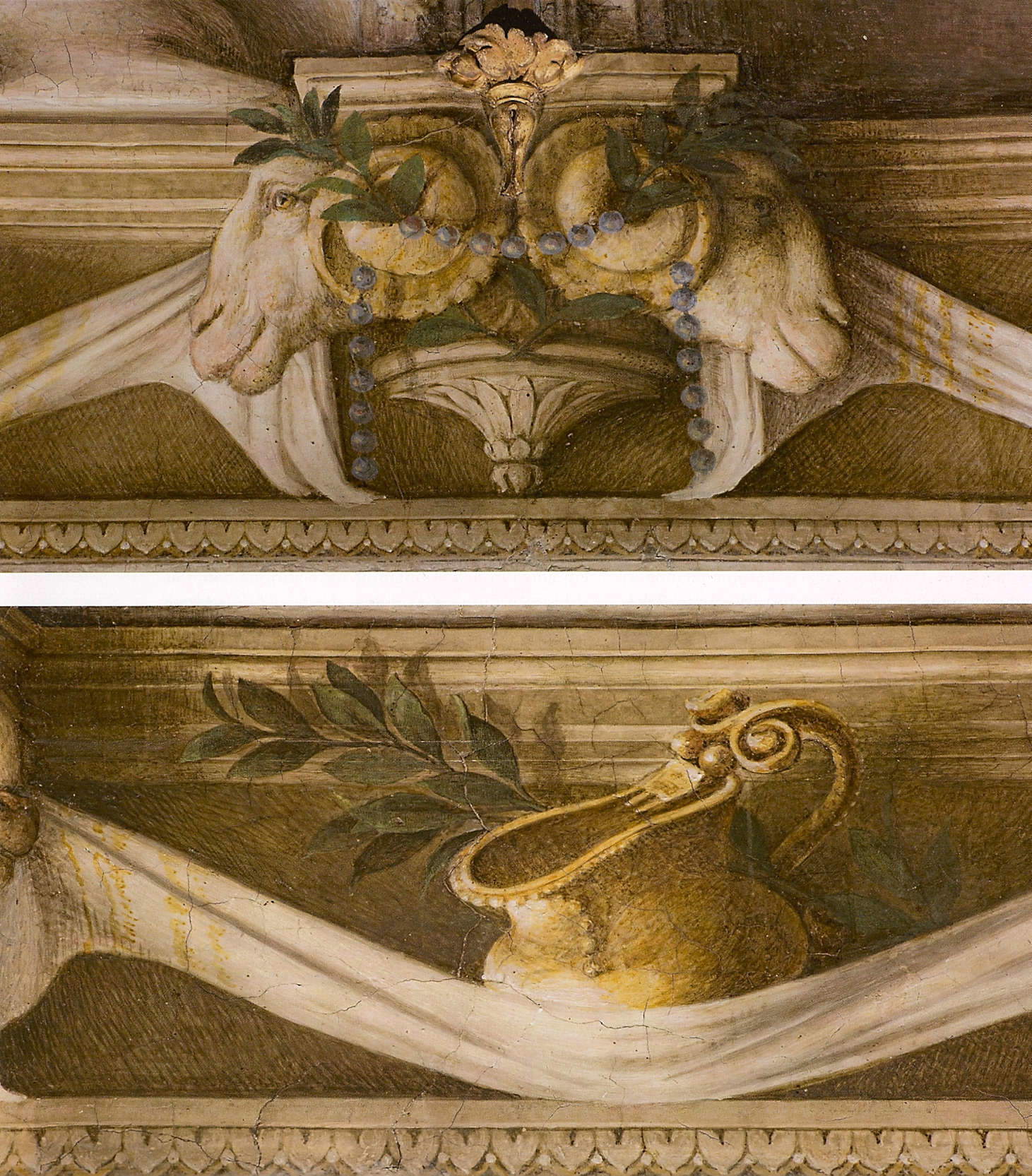
The base of the great frescoed epiphany is a band that runs at a steady pace along all four walls—obviously allowing for the breaks at the two windows—and clearly ties the entire space together. The “architectural” band—a classical entablature suspended above the movable furnishings of the study where the wisdom of the books was housed—firmly declares that the space is a sacrificial chamber: the continuous epistyle, in fact, depicts twenty-six severed ram’s heads, suggesting a major religious ritual of a social nature, one large enough to involve an entire community. In Hebrew, the pronunciation of the number twenty-six corresponded exactly to the name of God. In the choice of monastic life, a disposition toward sacrifice was fundamental. This is a first, very powerful reference. But the same architectural ensemble also contains figures associated with a banquet: in ancient rites, the slaughter of sacrificial animals was followed by the roasting of the meat, which the offerers then consumed. This also occurred among the Jewish people, among whom sharing a meal at the same table forged a very strong and enduring bond between individuals and families: a bond of blood, in fact. All of this then finds its expression in the monastic vows, which create the same bond.
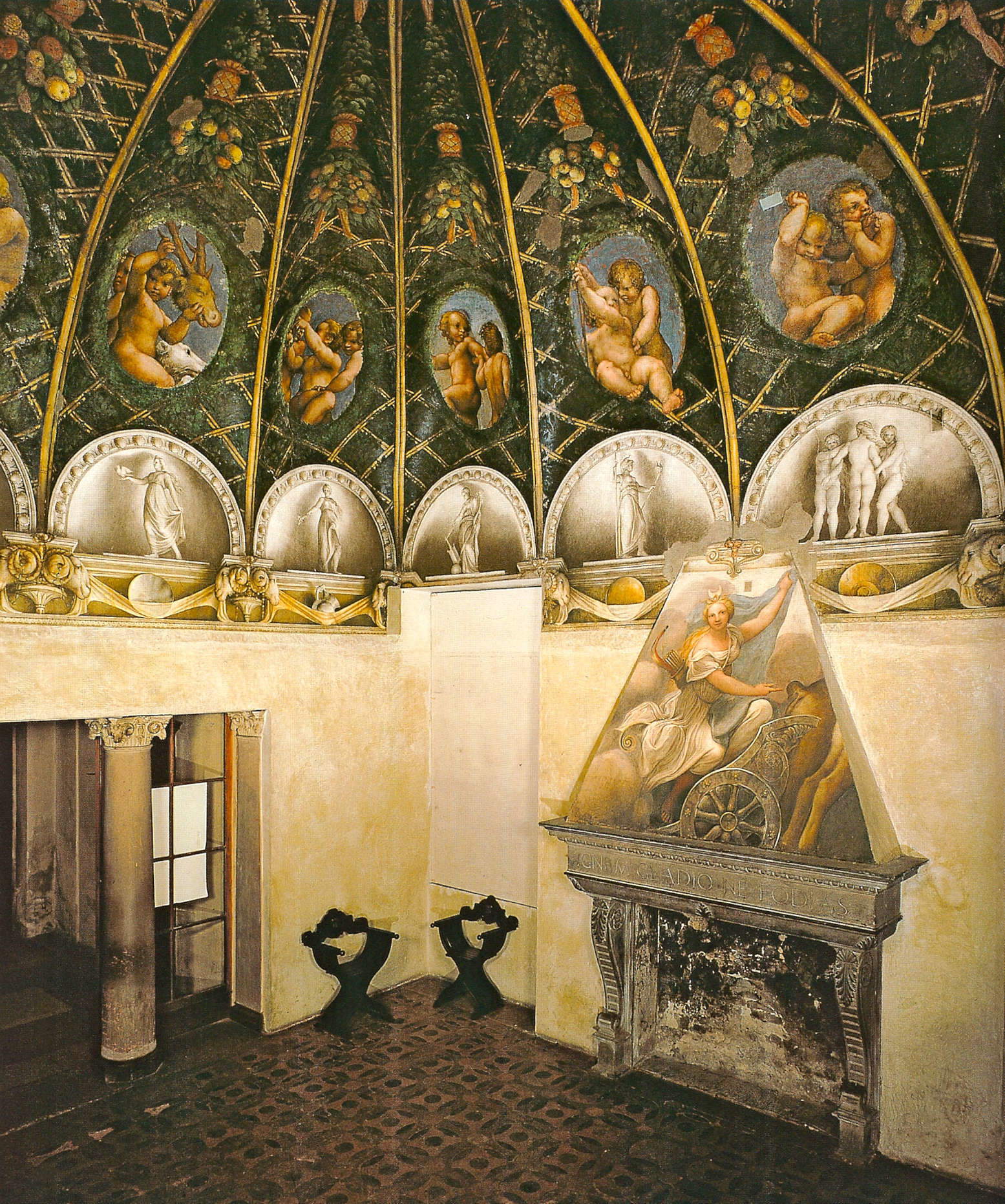
Note: After the monastic bond was formed, each nun embarked on her long life journey. And here the lunettes appear appropriately, with their sweeping arc and burgeoning figurative inventions. We must remember that we are proceeding with an ascending examination of the Chamber’s walls, but Correggio began his fresco work from the top: a clear sign that the entire design of the space had been established and its imaginative interpretations had already been chosen. The lunettes have long served as a testing ground for interpretation for nearly all commentators who have studied and published on the subject, and a great deal of intellectual energy has been expended on them. But it is our specific intention to state that the series of lunettes serves merely as a connecting element within the entire monastic meditation and nothing more. They constitute an inviting, exemplary, thought-provoking, and cautionary anthology concerning earthly life: their subjects are therefore drawn from history, biblical narrative, archaeology, and myths, presenting a highly appealing array of evocations and situations—some elaborate and interwoven—but all serving meditative and religious purposes. This flow of life is clearly guided by Giovanna-Diana, who appears as a beautiful ruler above the fireplace: observe her gestures. And it is the fireplace itself that reminds us that spiritual warmth is found in material warmth and how it soars toward the sky.
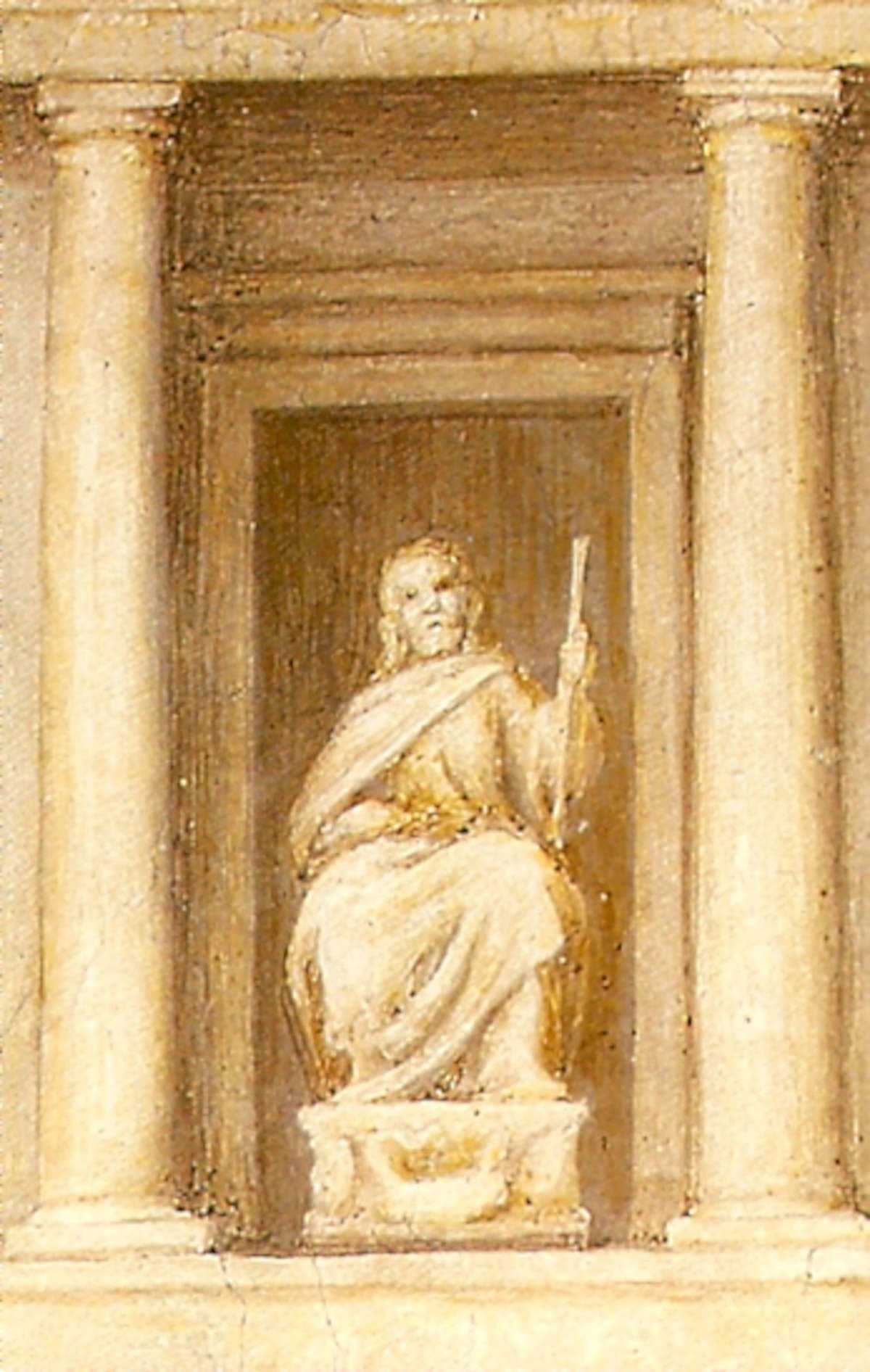
We feel it is important, however, to point out that the most difficult figure among the lunettes is the one on the south wall, where we see not “a mysterious male figure”—as has been hastily written, and for which commentary has almost always been avoided— but a divine figure standing on a step marked by a dolphin, seated outside thenaós, in front of the door, holding a scepter and resting a crown of thorns on his lap. Two other dolphins stand on the acroteria of the temple: these figures underscore the mythical role of “savior of mankind” that Greek tradition has always attributed to this beloved aquatic creature. It is therefore not inappropriate to identify an image evocative of Jesus the Redeemer himself, who stands as the seal of the lunette-shaped oratio, and to whose Face—amid all human affairs—the Bible repeatedly urges us to turn.
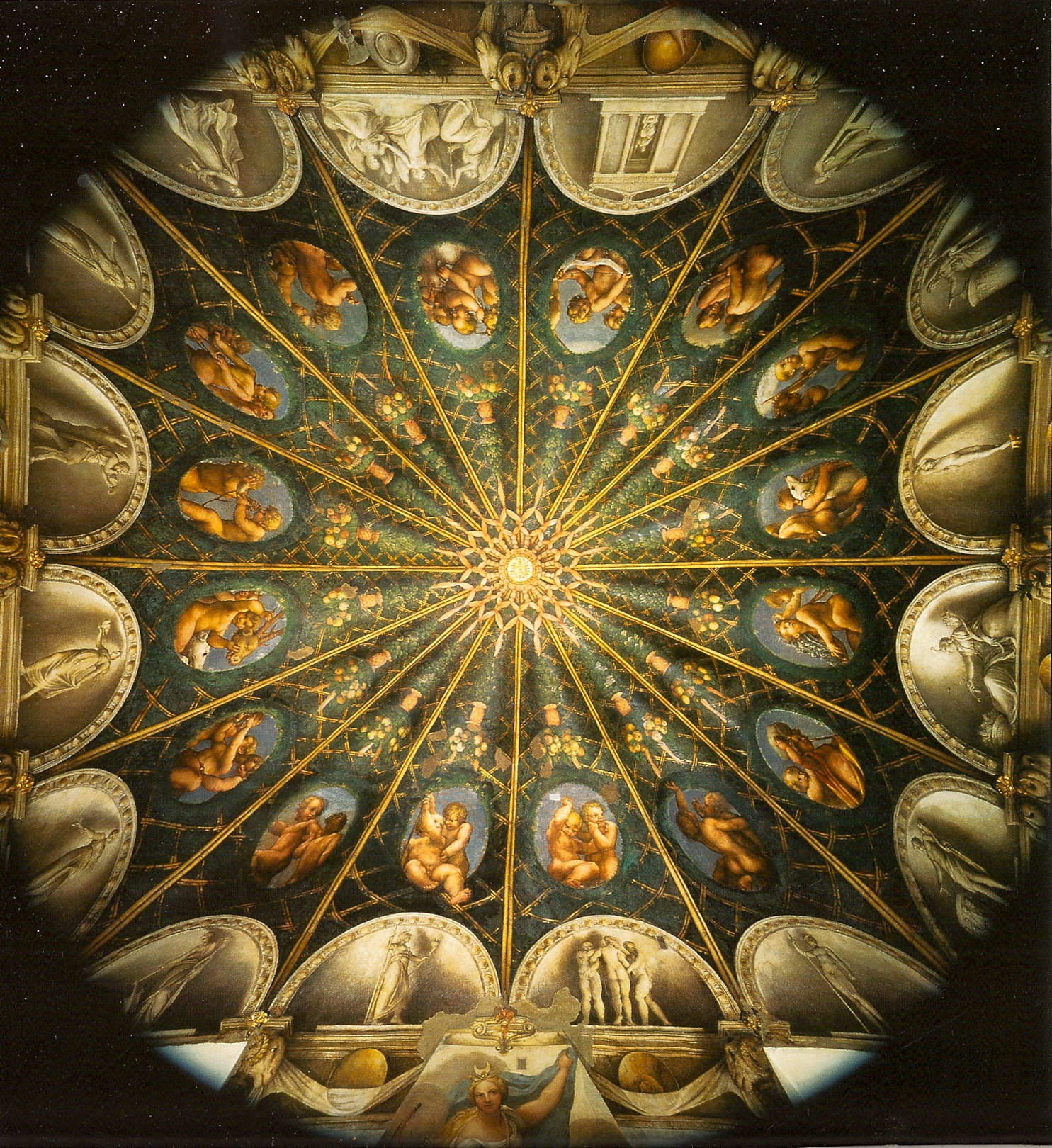
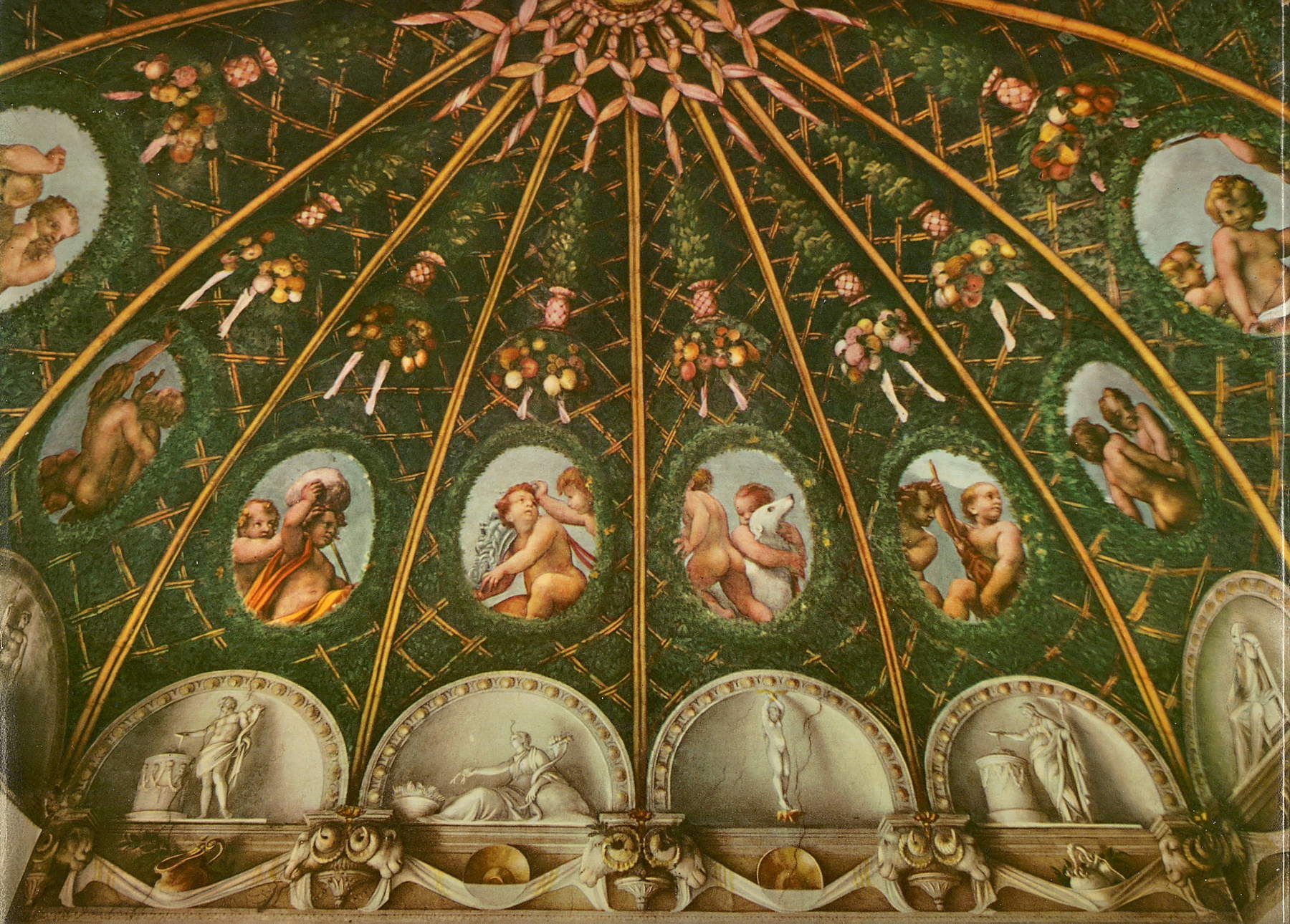
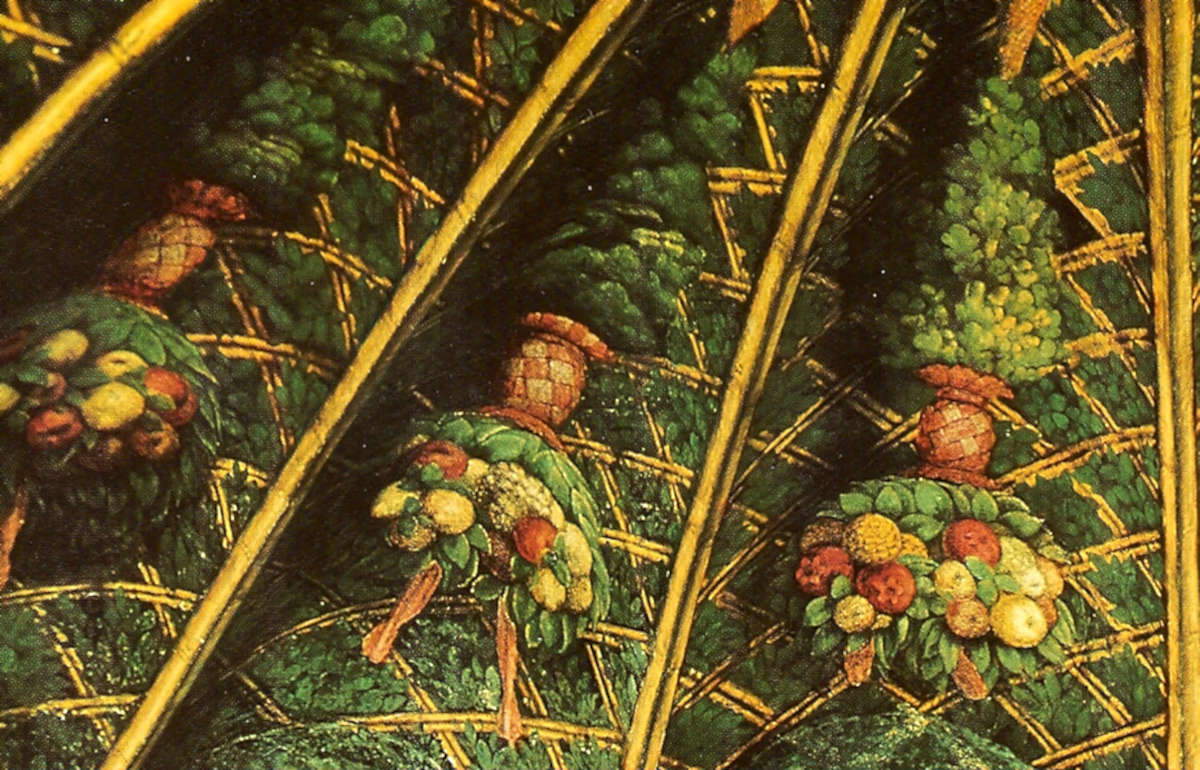
Above the lunettes stretches the powerful curve of the vault, which decisively emphasizes the sense of containment and unity of the entire room. We thus feel welcomed and protected by a generous green canopy of leaves and fruit that makes us happy guests, embraced by the joy of a restful freshness where the gentle whispers of the wind rustle. This is the most beautiful pictorial interpretation of the “pergola of rest” that St. Benedict preached. The Founder, in fact, well aware of the toil of his monks (who originally spent centuries clearing land and channeling water using only wooden tools), recommended that they stop every now and then and lie down in the shade of a pergola to lift their minds to God. The preciousness of this delicate care shown by St. Benedict was vigorously revived in the fifteenth century by the great Abbot Ludovico Barbo, who carried out a structured reform and a powerful revitalization of the entire monastic order. The dome of the Stanza is therefore the indispensable pergola that ensures rest for the body and the mind’s focus on God. Until recently, there was a lack of botanical scholarship regarding this marvelous work of art: now Renza Bolognesi, in her comprehensive 2018 Quaderno, reassures us and offers an extraordinary examination of the plants, the fruits on the hanging garlands, and their symbols: a unique and surprising contribution.
But the vast canopy of vegetation, with its reeds and woven branches whose loops quiver with a gentle fullness, is pierced by sixteen openings—ingeniously rendered in foreshortening—through which the sky is directly visible, all inhabited by nude cherubs who mimic the gestures of life. Herein lies the overall meaning, whose significance is precise: heaven itself is the culmination of our life in eternity. The cherubs are our souls (“unless you become like children…”) and their childhood and nakedness represent the timeless fulfillment of a joyful innocence that we will possess. During his earthly ministry, Jesus had often referred to the “Kingdom of Heaven” without adding any description, but in the final moments of his life—on the cross—he had said to the good thief, “Today you will be with me in the garden.” “Paradeisos” is the exact term Jesus utters. The garden of all happiness is the ultimate, intoxicating culmination of the symbolic discourse of the Camera di San Paolo that Correggio has offered us. The room is thus the total vital aspiration toward God and His paradise.
Bibliographic note.
Regarding the meaning of the Chamber, we first recommend Andrea Muzzi’s *Il Correggio e la Congregazione Cassinese*, S.P.E.S., Florence, 1982. For historical context, we recommend: Cristina Cecchinelli, “Abbesses, Power, Art, and Reform in the Monastery of San Paolo between the Fifteenth and Sixteenth Centuries,” in *The Monastery of San Paolo in Parma*, edited by Matteo Bola and Sauro Rossi, STEP, Parma, 2020. For a highly insightful analysis, see Renza Bolognesi’s *Correggio and the Chamber of San Paolo: Unpublished Revelations*, Silvana Editoriale, 2018.
Warning: the translation into English of the original Italian article was created using automatic tools. We undertake to review all articles, but we do not guarantee the total absence of inaccuracies in the translation due to the program. You can find the original by clicking on the ITA button. If you find any mistake,please contact us.