





“The first impression you feel, deep within yourself, is that of your precarious existence—an impression that cannot be concealed upon entering this place of meditation; yet this is immediately followed by wonder and surprise at the magnificent work, which comes to fill the senses.” It was 1864, and Giuseppe Antonio Ravaschio (1799–1867) used these words to guide, in spirit, the visitor about to enter the “new Staglieno Cemetery” for the first time. More than 160 years later, the feelings one experiences upon crossing the threshold of the Staglieno Monumental Cemetery are not all that different: a mixture of deep respect for what was called, with remarkable modernity, a “place of meditation,” and “wonder and surprise” at the majesty of the complex. It is difficult to find terms more effective than those used by Ravaschio, then the cemetery’s chaplain, in his *Memoirs on the Staglieno Cemetery* (Genoa, Printing Office of the Royal Institute for the Deaf and Mute, 1864).
It is astonishing to note that, just thirteen years after the complex opened (the first burial took place on January 1, 1851), a full-fledged guide to Staglieno had already been published, proposing a conscious approach to the cultural appreciation of the cemetery. This mediation between heritage and visitors remains relevant today and introduces us to the complex challenges of the present: reconciling the primary functions of monumental cemeteries (farewell and remembrance) and their preservation with the new ways in which these places are experienced and visited.
The Staglieno Days address these objectives—an entire weekend of meetings and events aimed at highlighting the complex as a vibrant space for the city, a special place where visitors can embark on a journey through art, memory, and transformation. The event, now in its second edition, seeks to respond to the growing interest in new forms of cultural, civic, and environmental engagement with monumental cemeteries and takes place as part of the European Heritage Days, September 26–27, 2026. The program is exceptionally rich and includes musical performances—with musical presentations curated by the Niccolò Paganini Conservatory—and theatrical productions such as *Eppur bisogna andar* (*Field of the Fallen for Freedom*, curated by Maniman Teatro) and *Giovani ali spezzate* (*Broken Young Wings*, curated by Pillole della Val Boreca). Historical reenactors in period costumes will be scattered throughout the cemetery, and the story of Caterina Campodonico will be told in her own words by the famous peanut vendor herself, accompanied by sculptor Lorenzo Orengo and the voices of the Voltri Historical Group. Of great interest is the opening of a Restoration Point, organized by the Superintendence of Archaeology, Fine Arts, and Landscape for Liguria: this will be an opportunity to discover the Staglieno restoration workshop, while the Secular Temple will host various conferences and a Digital Corner that will allow visitors to virtually explore the complex. Finally, there will be no shortage of guided tours, ranging from 12 themed itineraries led by science communicators to tours led by technicians and experts. The two-day event will culminate in evening performances offering the rare chance to experience Staglieno at sunset: the theatrical production *Le voci di Staglieno. Una Spoon River genovese* —curated by Sipario Strappato—and a concert by the Sizohamba Gospel Choir. A dynamic and modern perspective that, as the evocative opening quote reminds us, has ancient roots.
When Ravaschio published his guide in 1864, the concept of the cultural, artistic, and civic value of cemeteries was still in its infancy, though there were already some significant precedents: as early as 1808, Antoine Caillot’s *Voyage pittoresque et sentimental au champ du repos sous Montmartre, et à la maison de campagne du Père Lachaise, à Montlouis*(1759–1839) had been published as early as 1808, while in Italy, the *Giornale a comodo di quelli che frequentano il cimitero di Bologna e la sua chiesa* (1821) had been deemed insufficient to meet the growing demands of visitors as early as 1824.
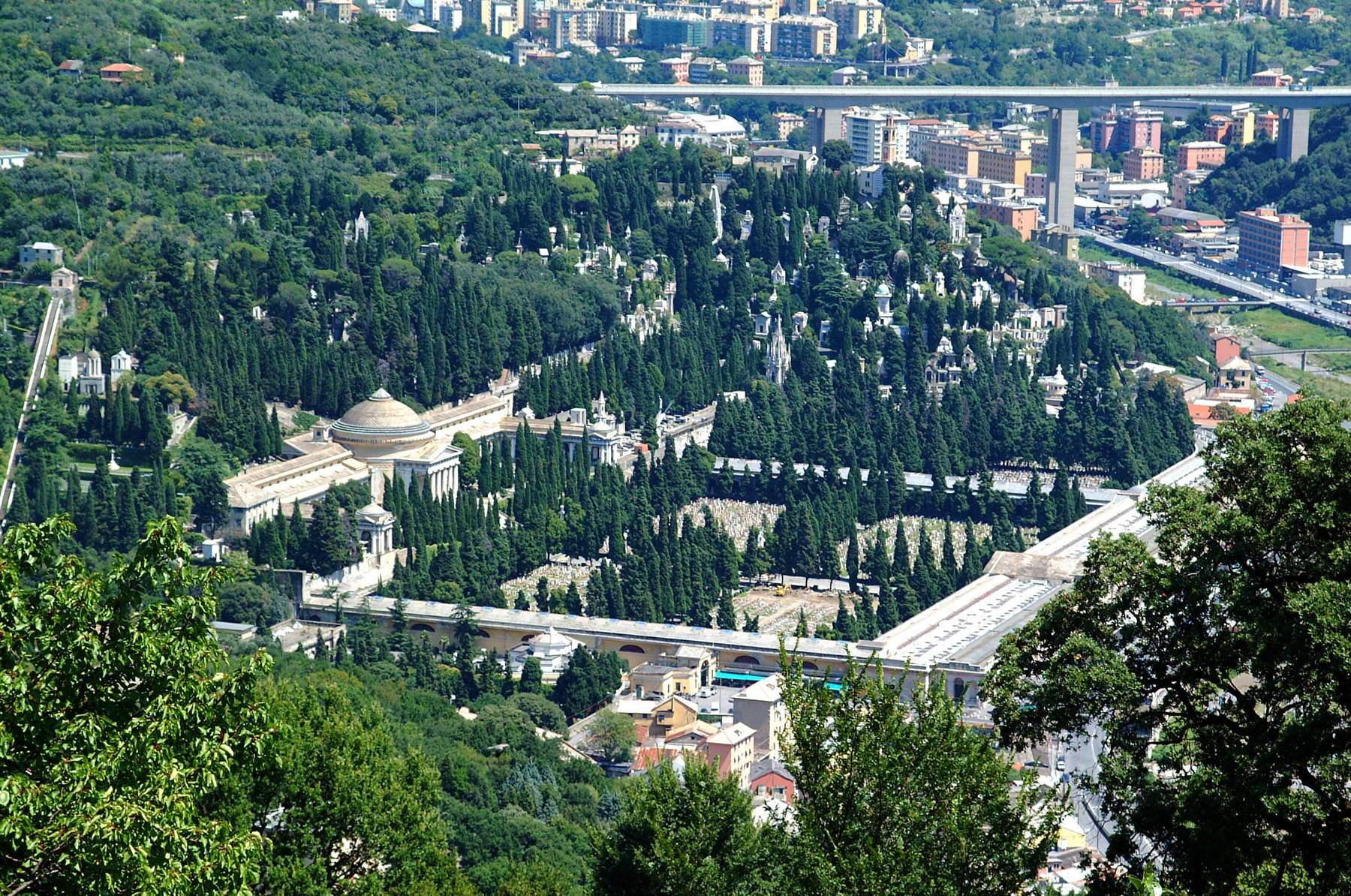
The chaplain of Staglieno, however, did not have an easy time of it, and his publication was met with skepticism: the request sent to city hall, to which he wished to dedicate the volume, was rejected, and there was no shortage of disputes over the book’s authorship. The public, on the other hand, appreciated the initiative, which was followed in 1883 by the more successful *Visitor’s Guide* by Giovanni Minuto (1857–1914), by Ferdinando Resasco’s *The Staglieno Necropolis* (1892) (1844–1929), and so on, right up to the modern multilingual brochures that welcome today’s visitors at the complex’s tourist and cultural information center. Of course, the setting is no longer that of the “pleasant district of Marassi, adorned with delightful gardens and populated by sumptuous palaces” but the impression one gets upon catching a glimpse of Staglieno’s silhouette—perhaps from a car as you exit the Genova Est interchange, or from a bus window—is still the one described by Ravaschio: “You see the majestic Necropolis rising up, whose overall structure, glimpsed from afar, invites you to slow your pace to view it up close.”
After crossing the modern bridge over the Bisagno River—adorned with streetlamps and railings designed by Gino Coppedè (1866–1927) and salvaged from the demolition of the Ponte Pila— you are greeted by a long and austere façade, punctuated by a regular sequence of niches and the three arches of the main entrance. The original design, as is well known, was the work of architect Carlo Barabino (1768–1835), but it was his student Giovanni Battista Resasco (1798–1872) who brought it to full fruition. According to Resasco’s intentions, the exterior niches were meant to house sculpted portraits of illustrious Genoese figures. Ravaschio offered some amusing reasons for opposing this idea: “If these were placed on the public street, we ask, who could defend and protect them from the ignorant masses, who, lacking sufficient discernment to appreciate works of the highest value, would soon leave them battered and mutilated?”
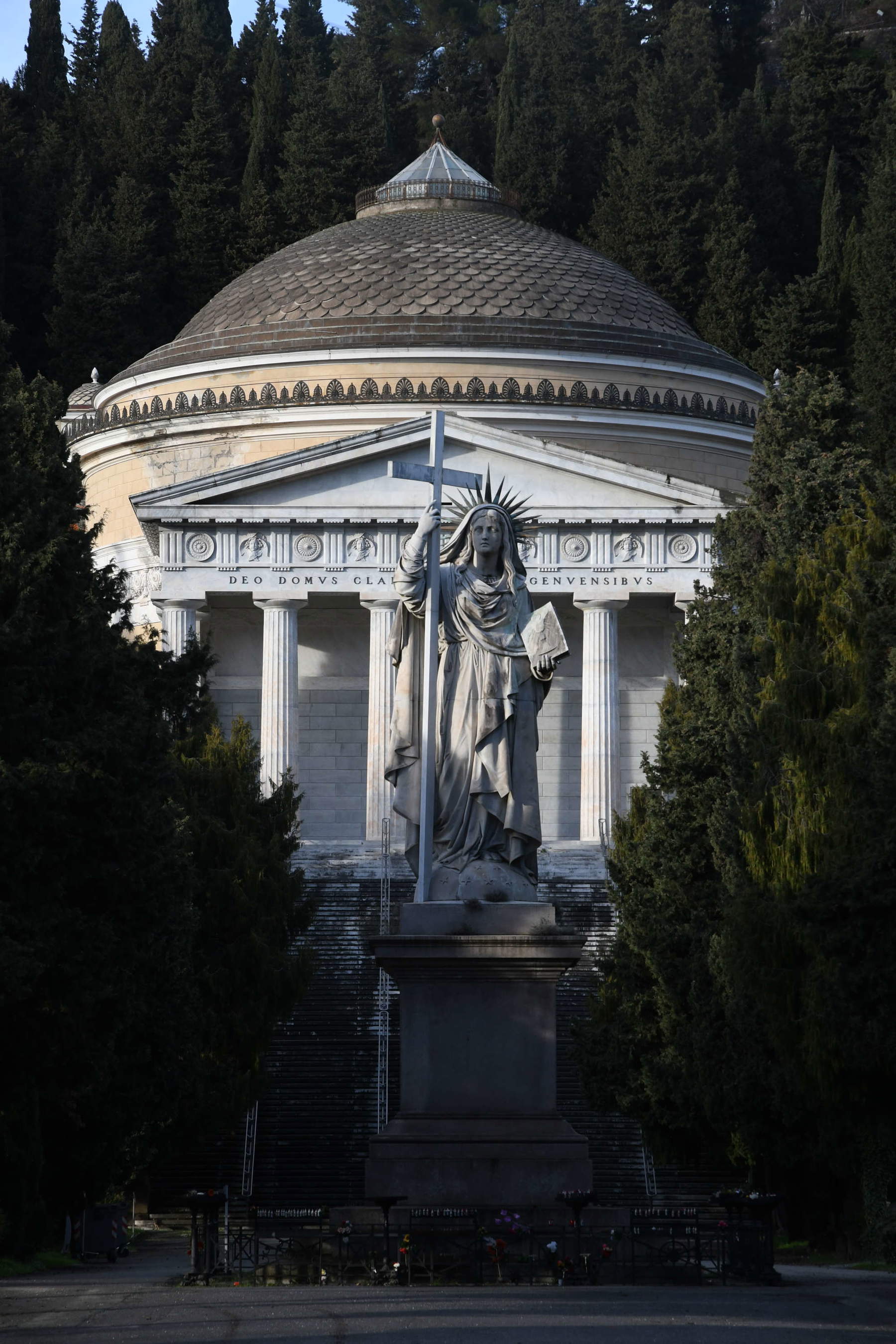
Leaving to the chaplain his reflections on the “vandalistic spirit” of mid-19th-century Genoese youth, we pass through the entrance gates, allowing ourselves to be captivated by the unparalleled scenic effect: the architecture frames the long perspective that runs through the historic quadrangle, culminating in Resasco’s solemn Pantheon and punctuated by the statue of Faith (1875) by Santo Varni (1807–1885). All around, galleries and porticoes open up, from which countless marble sculptures look out: Ravaschio’s vision—that Staglieno would become “a truly rich emporium of fine arts”—seems to have come true.
“Behold the temple of art, behold the city of the dead”: this time it is Giovanni Minuto who takes us by the hand, capturing the impression one feels beneath these vaults, today as in the past. The risk is that of getting lost, which is why we recommend that, once you reach the towering figure of Faith —whose titanic proportions are truly striking—you turn left, walk through the porticoes, and head to the information desk to pick up the essential paper map of the complex. This will also be an opportunity to get updates on events and themed tours, as well as to pick up informational or in-depth materials. The challenge remains: Staglieno’s immense size. There are 180 points of interest mapped out across seven sectors, and the complex, with its undulating terrain, spans more than thirty hectares. There is an elevator available, and an internal minibus service operates, but a single day is not enough for a complete tour.
It is also enjoyable—and truly fascinating—to explore the cemetery at your own pace, letting yourself be drawn to hidden corners and surprising funeral chapels, and using the QR codes found near many monuments to learn more. What we’re offering today, therefore, is not a specific physical itinerary or a virtual guided tour, but a set of coordinates— a historical-artistic map to help you navigate Staglieno’s vast sculptural and architectural heritage, highlighting a few truly unmissable elements and inviting you to discover its lesser-known aspects as well.
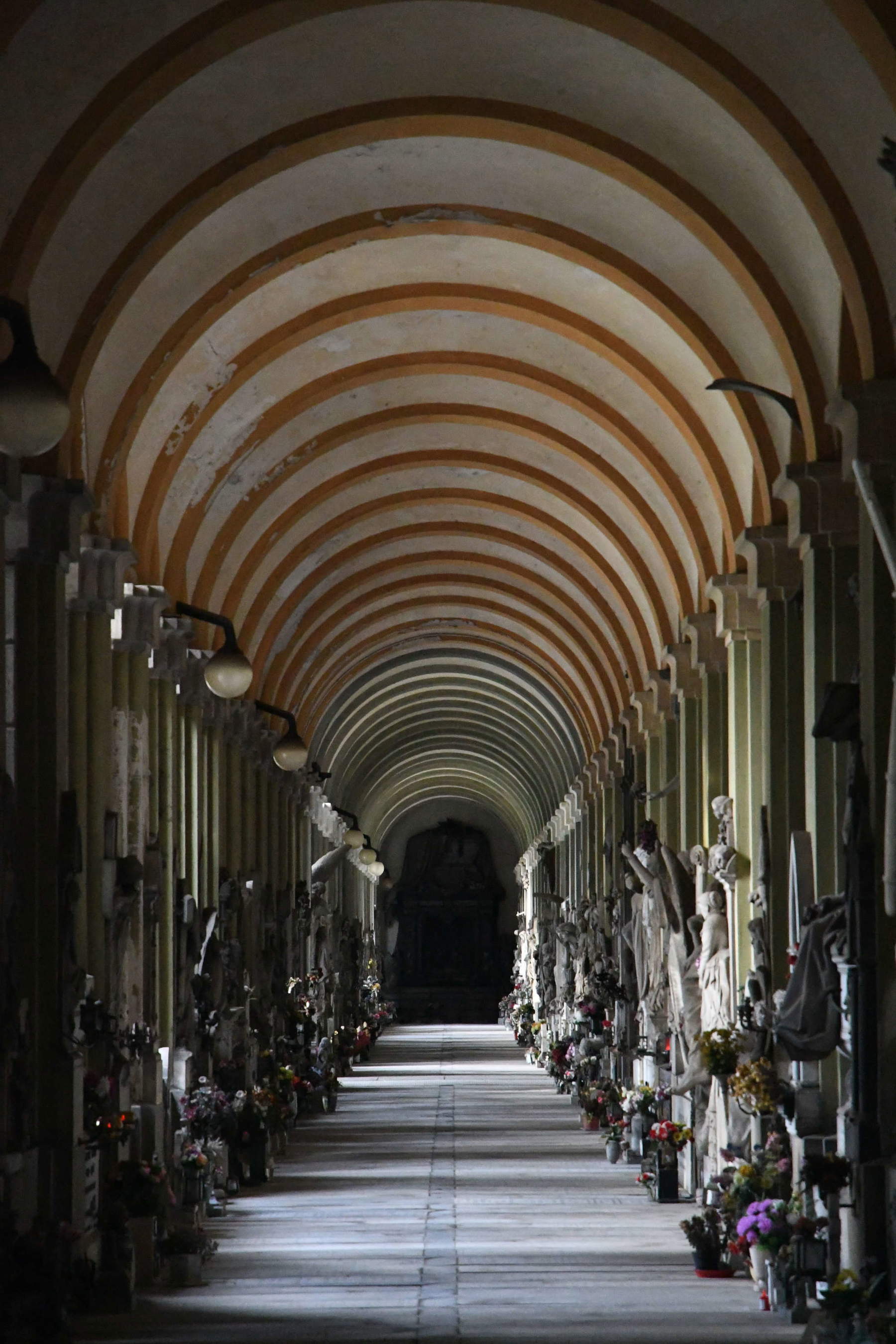
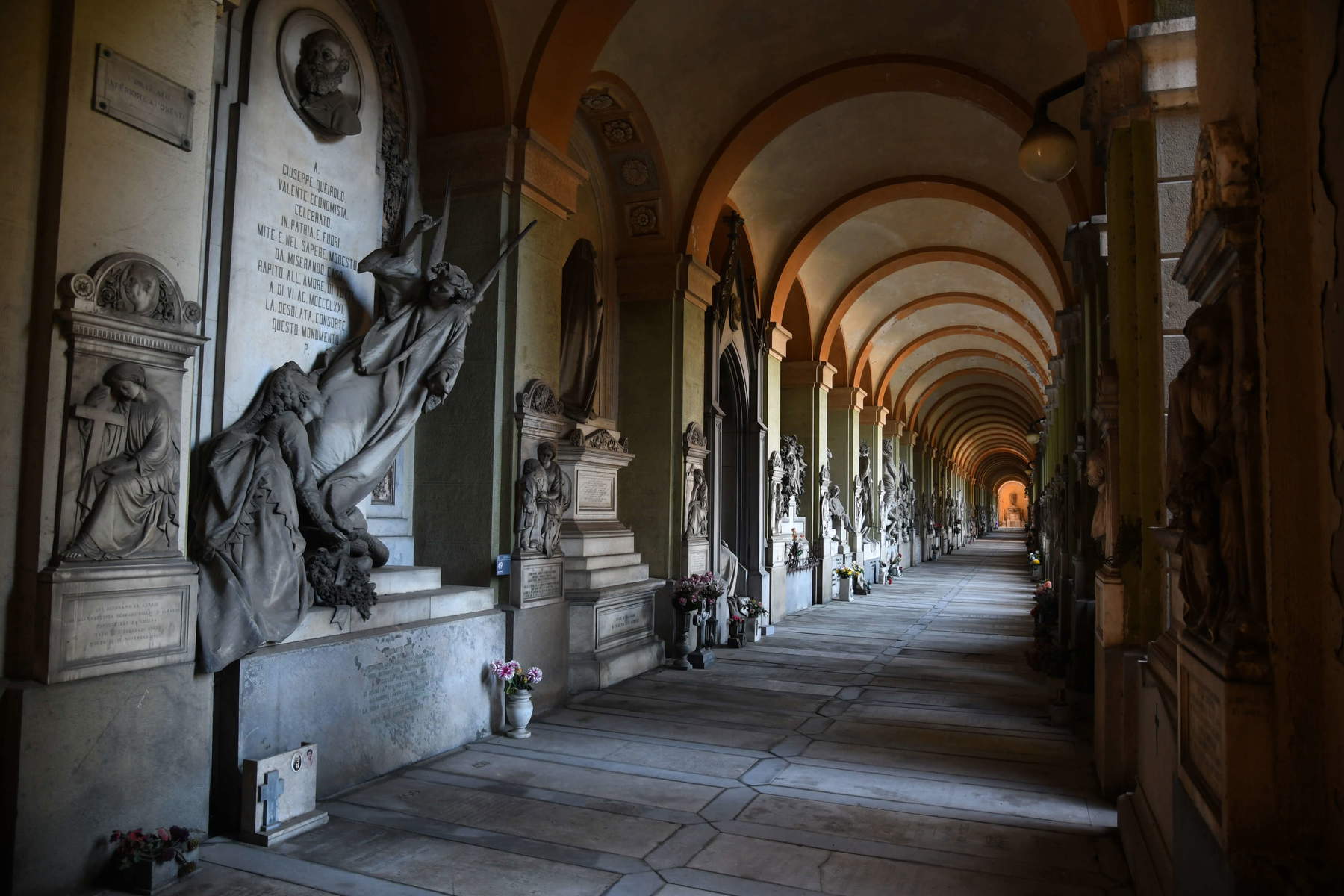
The lower portico on the west side houses some of the cemetery’s oldest graves: the sculptor Santo Varni dominates the scene, both through his works and as the undisputed leader of the school. A student of Lorenzo Bartolini (1777–1850) in Florence, he was appointed professor of sculpture at the Ligurian Academy of Fine Arts in 1838—where he himself had previously studied—and went on to lead the academy until his death in 1885. In addition to the imposing statue of Faith, which we have already encountered, Varni created more than forty funerary monuments for Staglieno, playing a leading role in the gradual transition from a purist form of Neoclassicism to a sentimental form of Naturalism.
The tomb of Giovanni Francesco Donghi (1801–1852), erected a little over a year after the cemetery’s opening, clearly exemplifies the early phase of his artistic career: atop a massive sarcophagus adorned with strigils —that is, decorated with the wavy fluting motif common to many ancient tombs—rises an austere pedestal upon which rests the figure of Prudence, exceptionally elegant in her static pose, more akin to a classical deity than to the allegorical representation of a cardinal virtue. The courtly character and archaeological style of the composition are disrupted only by the depiction of the two young cherubs supporting the large central garland: they have languid poses, melancholic expressions, and are sexually characterized (the one on the right clearly has feminine features). These are the first signs of what would unfold in the decades to come.
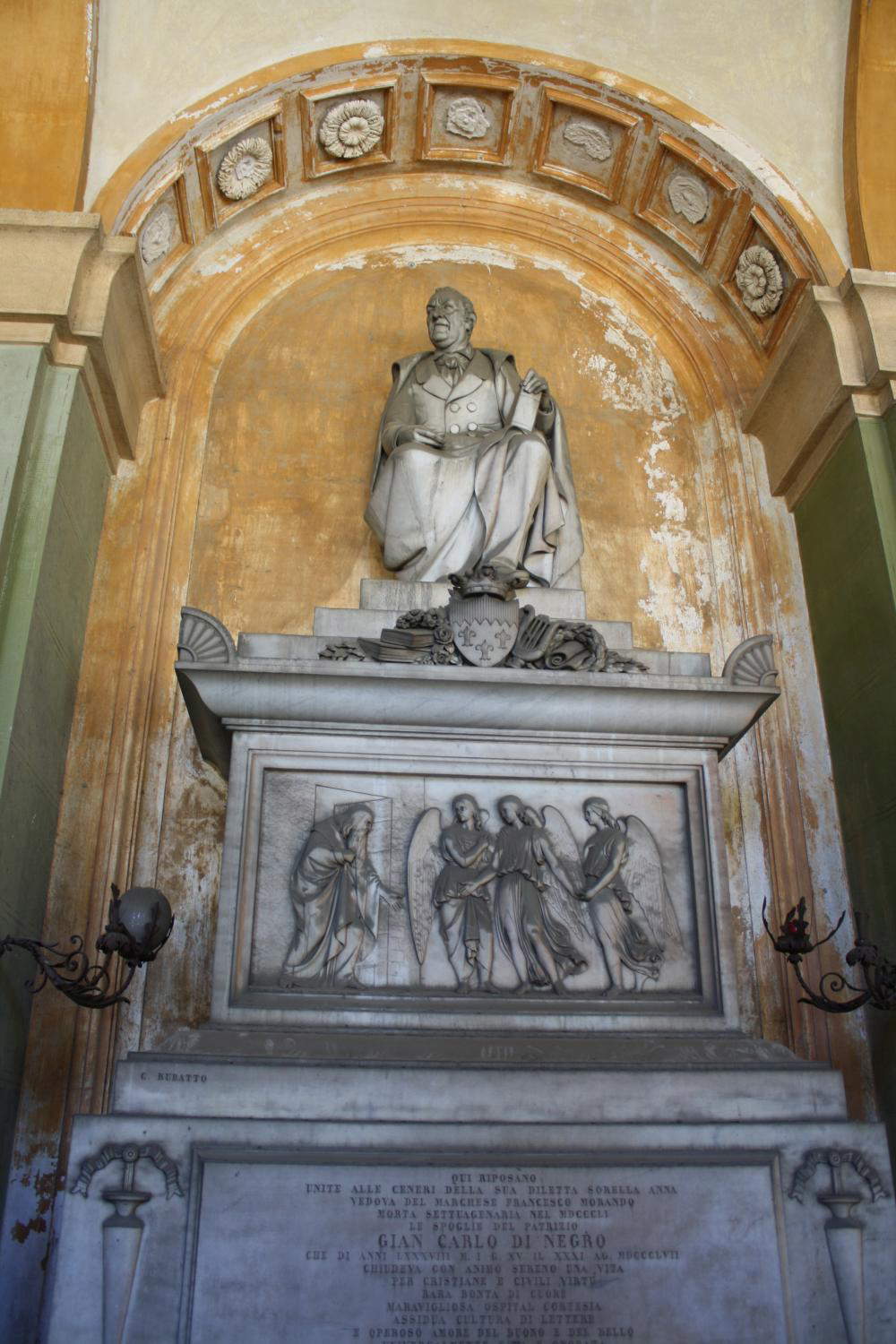
A few meters away, the monument to Gian Carlo di Negro (1769–1857) features a composition not dissimilar in tone, created by Carlo Rubatto (1810–1891) in 1861. Dominating the scene, however, is no longer an allegorical, divine, or mythological figure, but a full-length portrait of the deceased—a Genoese patrician and refined intellectual of liberal ideas—dressed in contemporary attire and with a lively expression, as if he were about to rise and strike up a conversation. The bas-relief below, depicting Abraham and the three angels, alludes to the marquis’s renowned hospitality; his famous “Villetta” was later purchased by the city of Genoa and converted into a public park and museum.
The presence of such reliefs in tombs was fairly common, but it was when the subject moved beyond allegory to become part of a biographical narrative that one of Staglieno’s most characteristic features emerged: the depiction of the living—relatives, family members, heirs—alongside the deceased.
At the head of the same portico, at the entrance to the front galleries, there is one of the earliest examples of this kind; while the structure of the Danevaro monument (1863) by Giovanni Battista Cevasco (1817–1891) is conventional—a tall sarcophagus, classical style, and a sacred allegory (Faith)—the same cannot be said of the central scene, which depicts the deceased, Ermenegilda Danovaro, wife of the wealthy shipowner Andrea, on her deathbed while an angel holds back with his hand the gesture of affection from her son “who, in frantic anxiety, tries to throw himself upon his mother to press a final kiss upon her cold forehead” (Ravaschio).
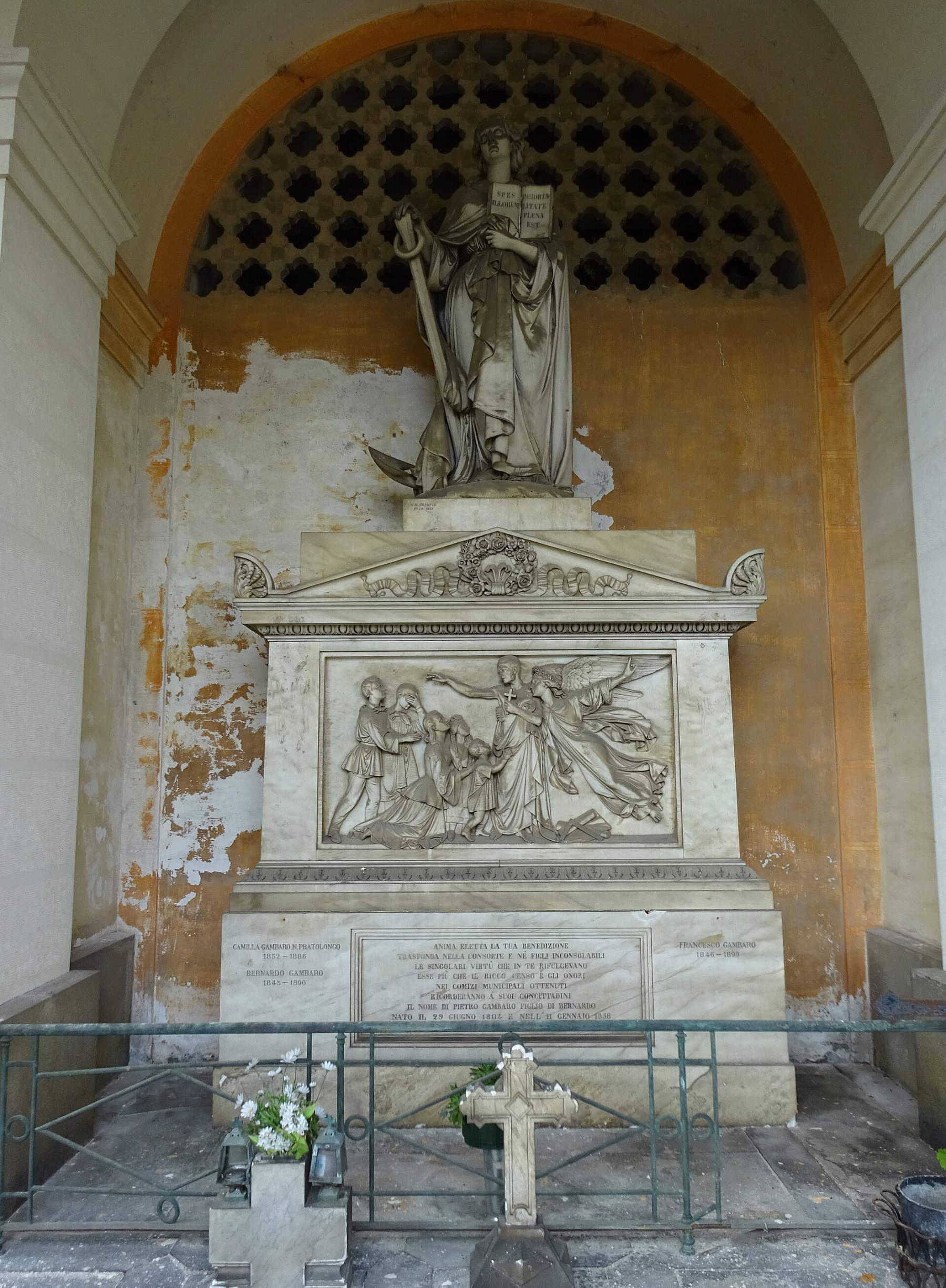
The upper western portico contains two similar examples: the Gambaro monument (1861), also by Cevasco, depicts a poignant farewell. Pietro Gambaro, a wealthy building contractor, bids farewell to his family: his older sons, who receive his blessing; his wife, who holds their eldest daughter close; and his youngest daughter, who tries to hold him back. On the right, the angel of death reminds us of humanity’s inescapable fate while simultaneously pointing, with his left hand, to the figure of Hope above.
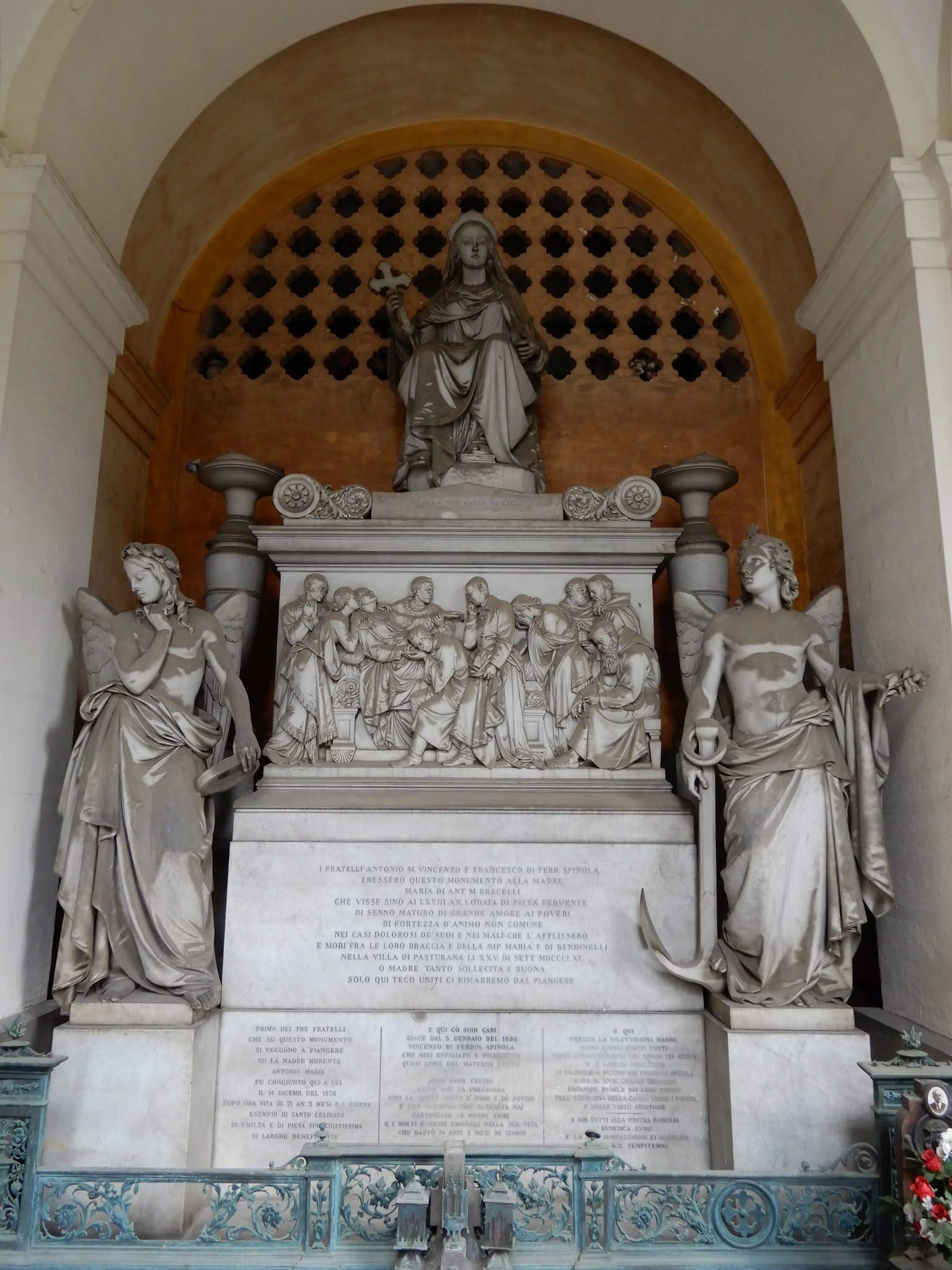
The nearby tomb of Maria Bracelli Spinola (1864) demonstrates how Santo Varni, too, was part of this new cultural climate: while the overall composition remains courtly and conventional, featuring the usual allegorical repertoire, the central relief gives way to a more realistic depiction: the deceased breathes her last in the arms of her family, in a sentimental and intimate atmosphere, underscored by the presence of the three clergymen on the right. The composition is among Varni’s most celebrated works, especially for the delicate and androgynous figure of Eternal Sleep, with its indecipherable charm.
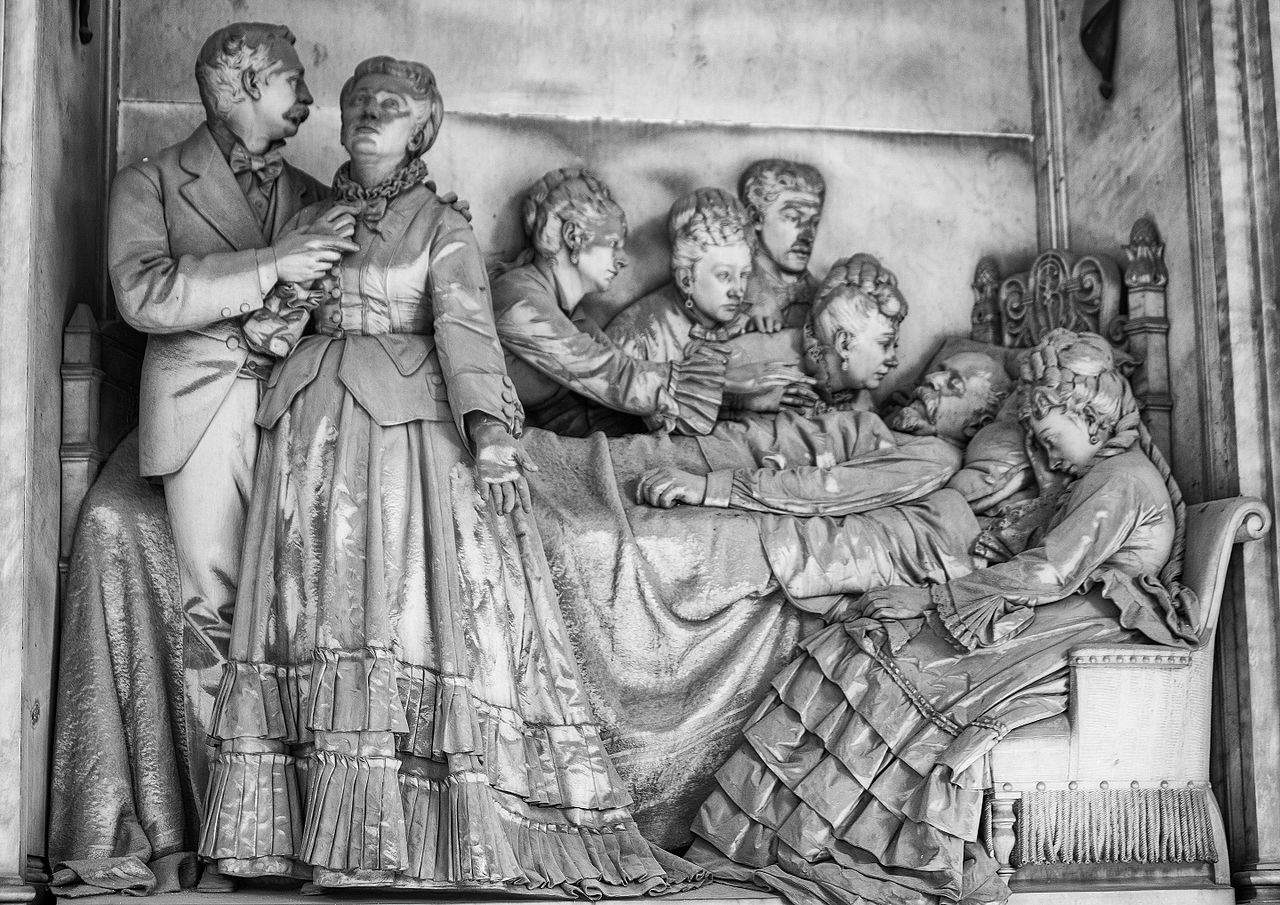
Things change—and significantly so—in the nearby tomb of the Raggio family (1872) by Augusto Rivalta (1835–1925): considerably younger than the artists discussed so far, Rivalta had been one of Varni’s students before moving to Florence, where he attended the studio of Giovanni Duprè (1817–1882) and came into contact with the Macchiaioli before embarking on a successful career in monumental sculpture. The farewell scene is still present, but its role is now central: the figures have grown in size, transitioning from high relief to the round, and occupy the center of a scene where there is no room left for sacred or allegorical representations. This marks the birth of so-called bourgeois realism—and it is no coincidence that Carlo Raggio (1814–1872) was one of the most renowned shipowners of his time, specializing in routes to South America and the importation of coal—the style most closely associated, in the collective imagination, with Staglieno. Not only the clothing and hairstyles, but also the furnishings now evoke an opulent bourgeois interior, and the expressions convey the most intimate and everyday grief, without any heroic or mystical overtones. The figure standing on the far left is his son, Edilio Raggio (1840–1906), who continued his father’s business ventures by being among the first to invest in steam navigation: one of the founders of Ilva, he served as a member of parliament from 1874 until his death. He is buried next to his father.
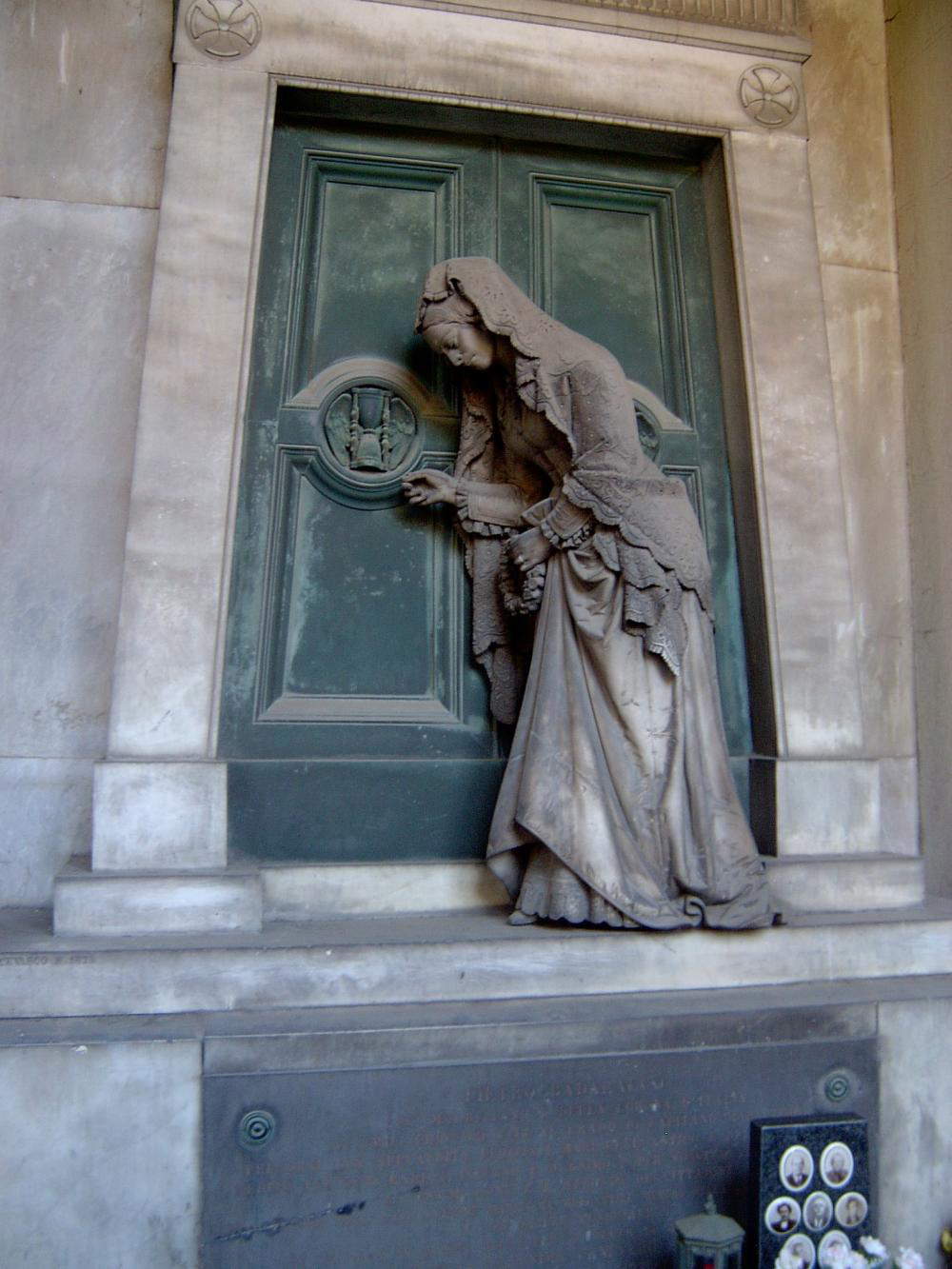
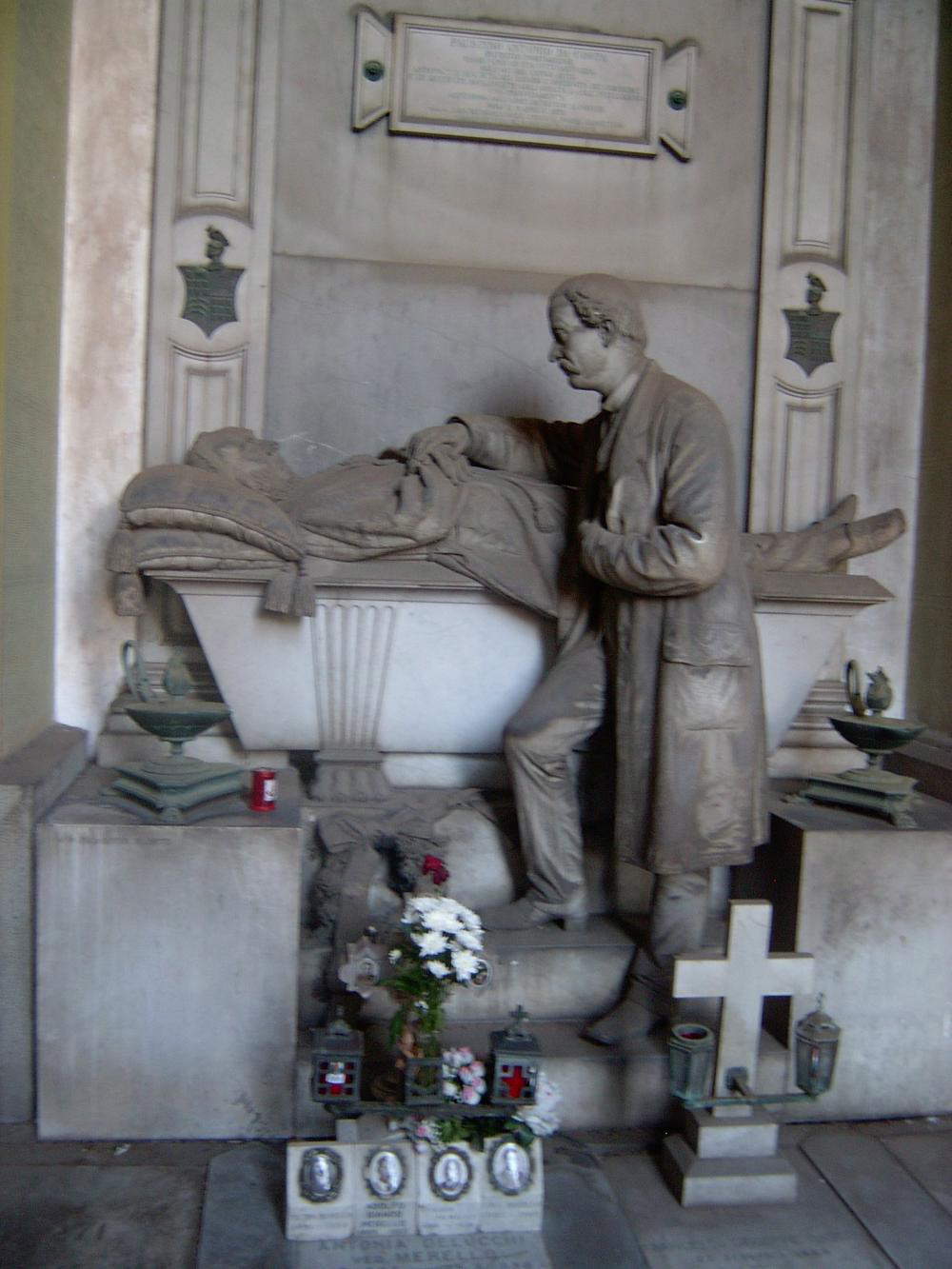
Gradually, as the figures of the deceased were relegated to often marginal roles—in the form of busts or medallions—the mourners, with their expressions of grief and emotion, took center stage. This is the case with the Badaracco Monument (1875) in Cevasco, where the widow takes center stage, in the act of knocking on the door of the tomb (or of the world of the dead?), or in the monument to Faustino Antonio Da Costa (1877) by another of Varni’s students, Santo Saccomanni (1833–1914), where the figure of the adopted son stands out, affectionately bidding farewell to the deceased’s body.
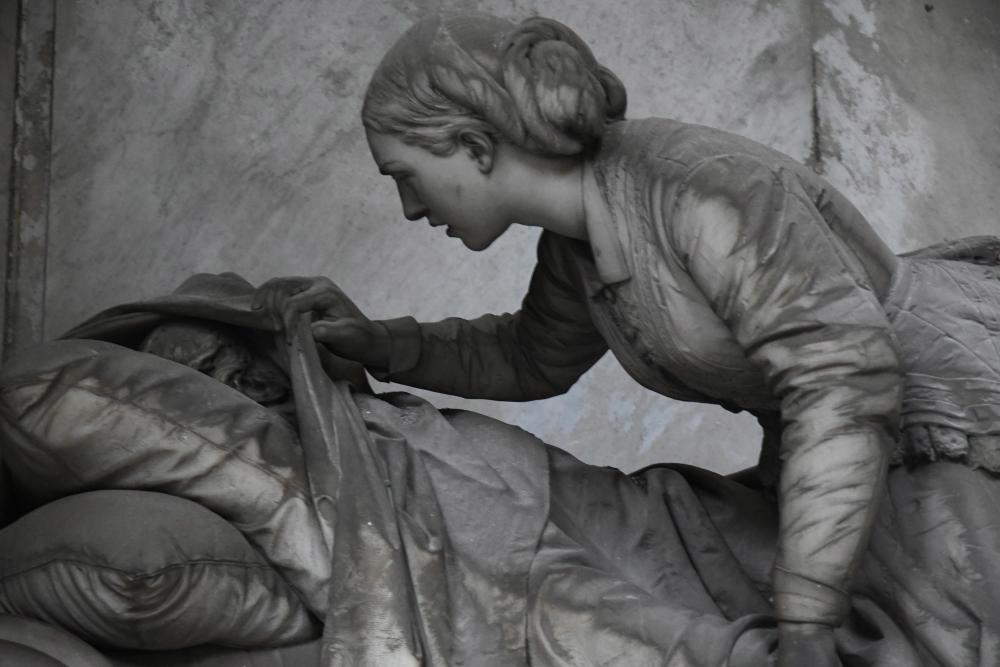
In the “Pienovi Tomb” (1879) by Giovanni Battista Villa (1832–1899)—also a member of Varni’s school—it is once again the gesture of a young widow, Virginia Aprile, that captures our attention: we see her bidding a final farewell to her husband, whose hand she grasps beneath the covers as she lifts (or lowers?) the edge of the heavy blanket covering the body. The sense of mystery—the deceased is almost entirely hidden from view—and Virginia’s beauty make this work one of the most admired. The fascination deepens when one considers the couple’s biographical details: Pienovi had passed away in 1870 at the age of ninety-one. His wife, in her second marriage, was about sixty years his junior; she followed him thirty years later, in 1900.
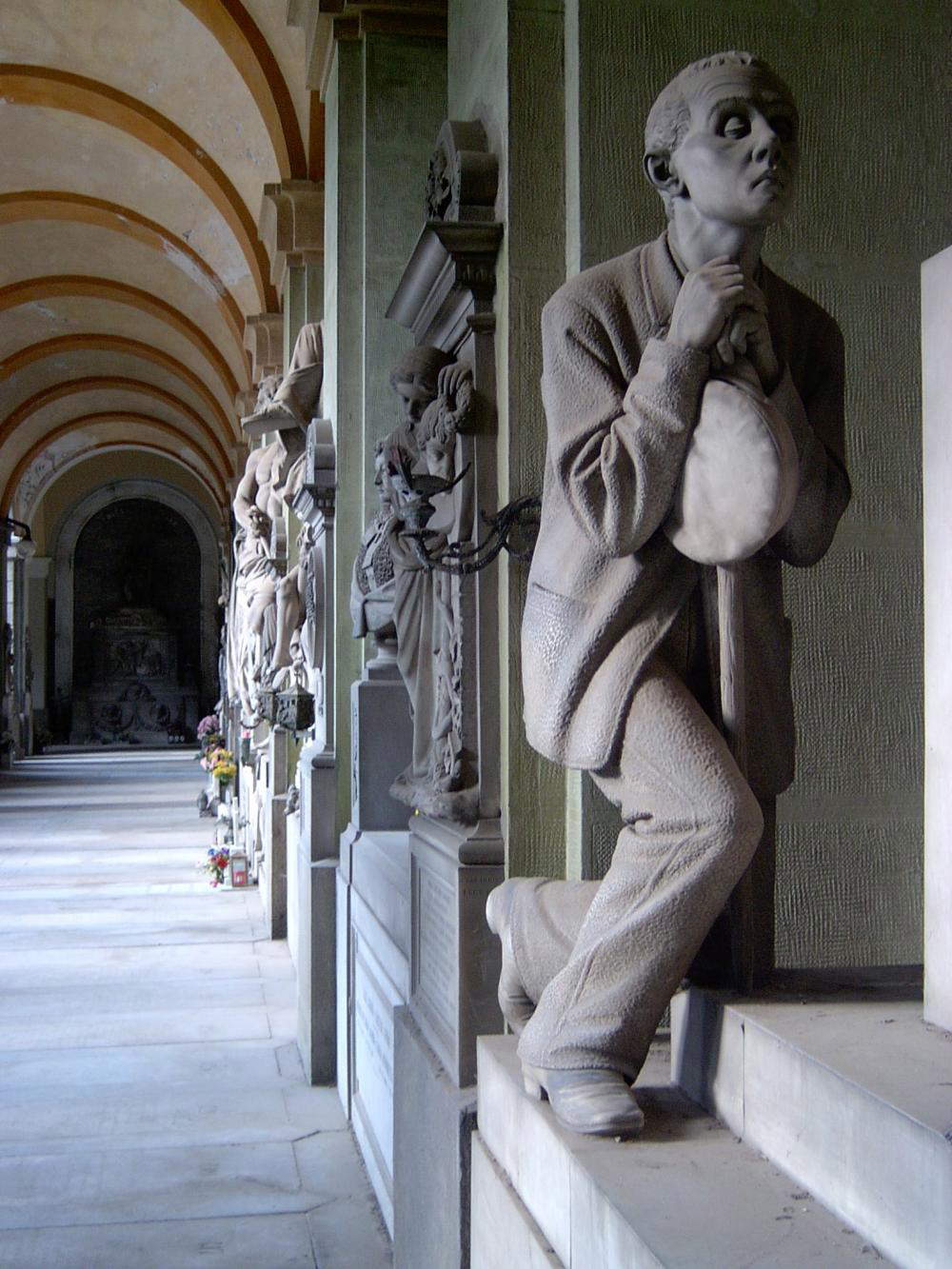
The last two decades of the nineteenth century marked the peak of this artistic trend: the themes became more popular, as did the emotions they conveyed. The figures began to invade the viewer’s space, ensuring maximum emotional engagement. The ornamental work, already extremely refined in the previous period, became even more meticulous; the rendering of hair, details, and fabrics became obsessive, blurring the line between reality and representation, between the lives of the living and those of the dead. Some of the best-known tombs in the lower western portico belong to this phase: that of Tommaso Pellegrini (1888), by the sculptor Domenico Carli (1829–1912), is striking for its crowded composition from which the figure of a beggar in tattered clothes emerges, contrasting with the elegantly dressed little girl who seems to be blowing a kiss to the deceased, while the widow writes the epitaph.
The Amerigo monument (1890), by Giacomo Moreno (1832–1910), places the figure of a blind man, in the act of kneeling, alongside that of an orphaned girl making the sign of the Cross. Also by Moreno is the Gallino tomb (1894), where the viewer’s emotional engagement reaches its peak. The surviving family—the husband and their two daughters—is depicted visiting the grave of the deceased, just like any other family from Genoa’s affluent bourgeoisie at the turn of the century visiting Staglieno. A familiar image, understandable to all, in which many could see themselves, sharing feelings that transcended social classes.
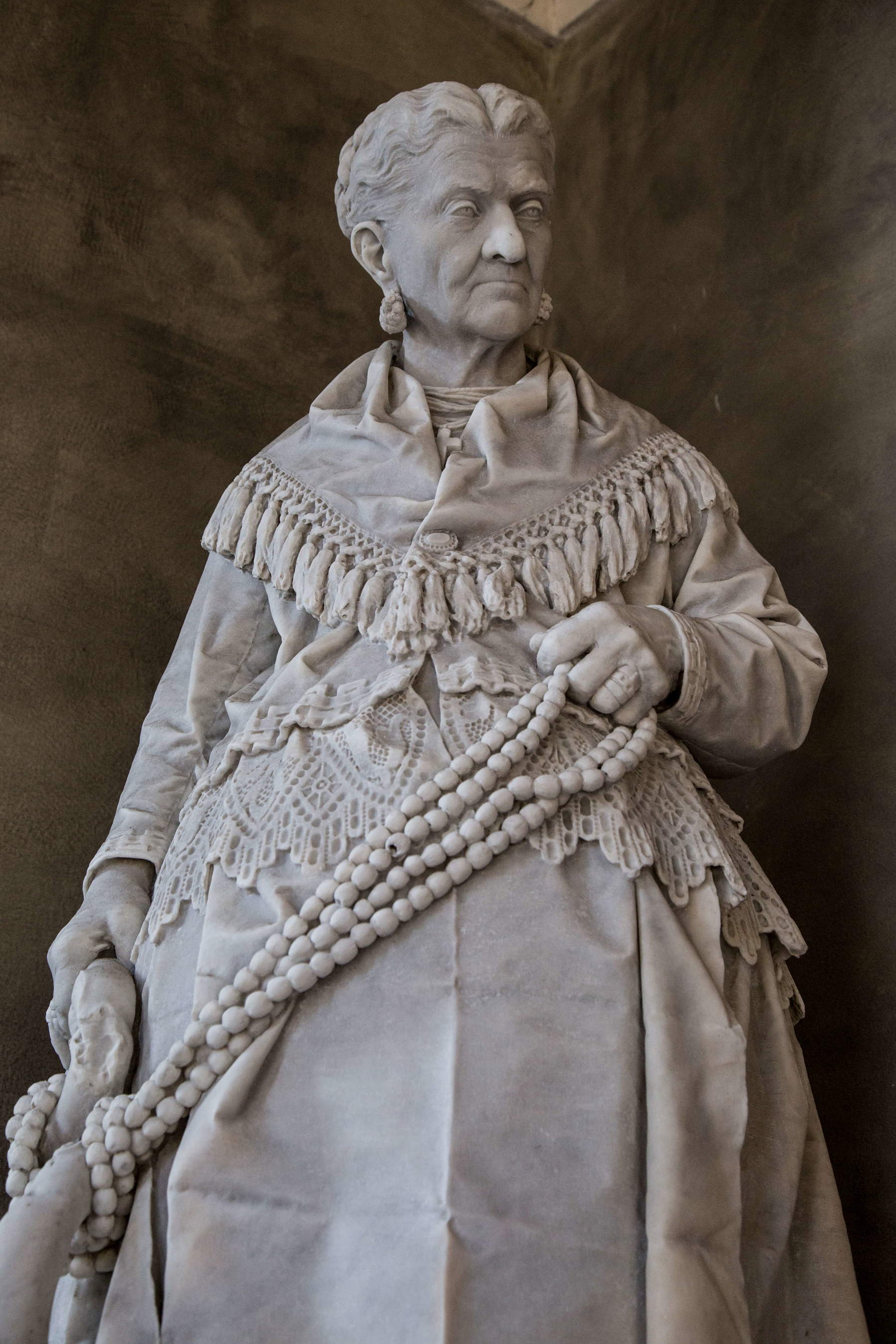
A case apart is the now-famous *Caterina Campodonico* by Lorenzo Orengo (1838–1909): the famous peanut seller is an essential stop on any visit, both for her personal story—the commoner who saved her entire life’s earnings to commission a funeral portrait worthy of a queen—and for the actual quality of the sculpture. Caterina proudly displays her origins—in the beautiful inscription in dialect dictated by Giovan Battista Vigo (1844–1891)—and her trade; the hands of one who has always worked, the canestrelli and the reste—the traditional necklaces of hazelnuts that young men used to give to their sweethearts. Orengo, yet another of Varni’s students at the Academy, must have taken the commission very seriously, creating a vivid and profound portrait in which the impressive virtuosity in the carving of the marble highlights the weathered yet proud and deeply human face of Cattainin Campodonico (a paisanna).
This style of representation, almost a challenge to the world of photography, would remain popular for a long time—at least until World War I—gradually absorbing new aesthetic trends; fin-de-siècle realism, however, would not be the only voice present at Staglieno, where the first signs of a new cultural climate had already appeared as early as 1882.
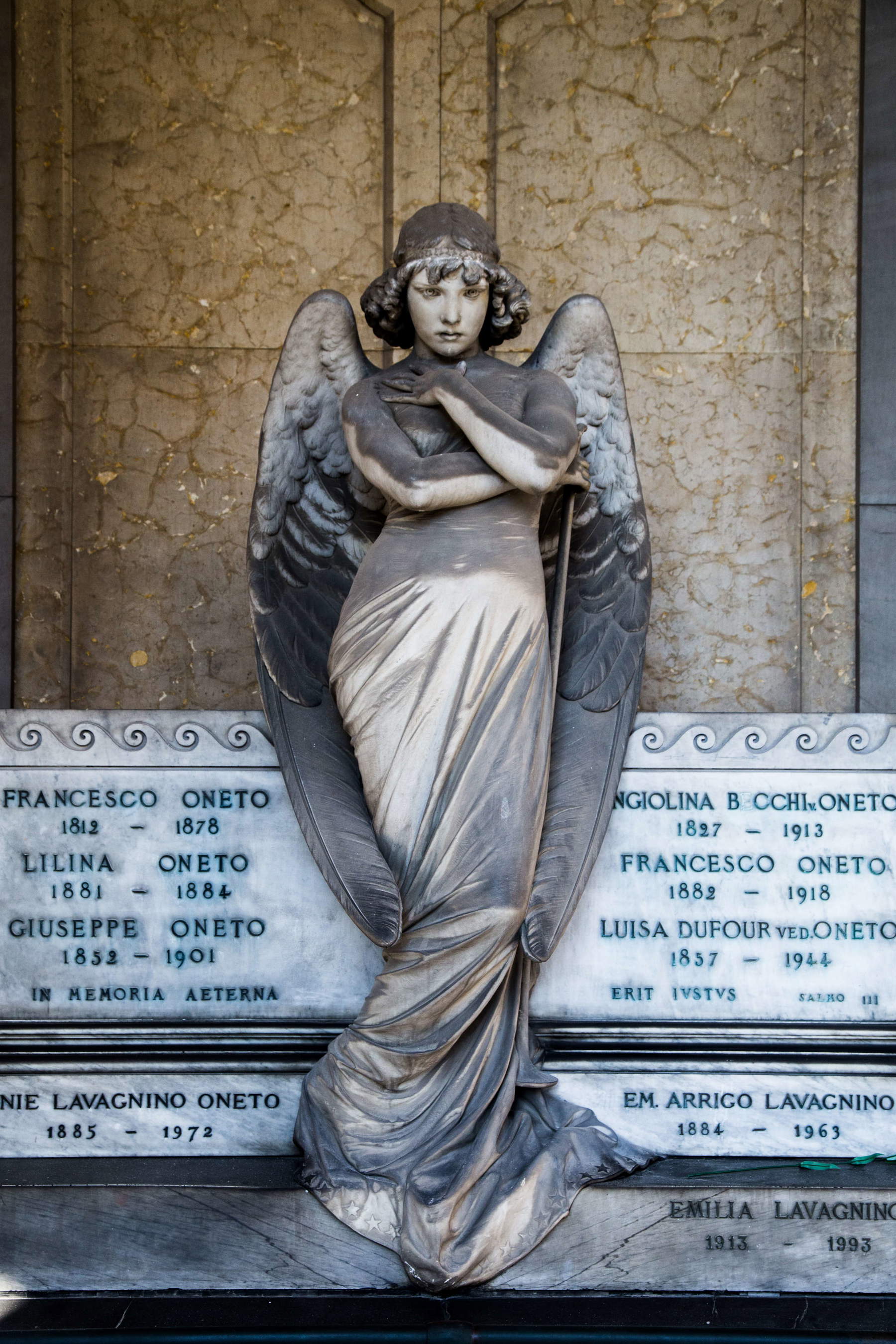
Giulio Monteverde’s (1837–1917)*Angel* for the Oneto tomb arrived that year to shake up established certainties and open up unprecedented perspectives. A real, tangible presence—an angel that is anything but reassuring, who makes no comprehensible gestures but remains distant and inscrutable. Contemporaries were struck by it but remained, to some extent, bewildered:the Oneto Angel has feminine forms and is barely covered by a sheer robe that, rather than concealing her body, accentuates her curves. An isolated, unsettling, and magnetic figure that stands in stark contrast to the crowded and opulent compositions nearby. Her elusive gaze and the gesture of her arms—and the finger clasping the mouthpiece of the trumpet—invite meditation and silence; a meditation that seems to offer no certainty other than that of the inevitable end.
In this mature phase of his career, Monteverde embraces Symbolist influences and anticipates what would become a widespread trend in the following decades: to appreciate this, one need only stroll near the lower eastern portico and the semicircular northeastern portico, the first major addition to the cemetery’s original core.
The Debarberi Tomb (1918), by Luigi Brizzolara (1868–1937), demonstrates how this cultural foundation lent itself well to absorbing the most elegant Art Nouveau influences, while the Caprile Tomb (1924) by Edoardo De Albertis (1874–1950) captures the intersection of Symbolism and Art Deco geometrization.
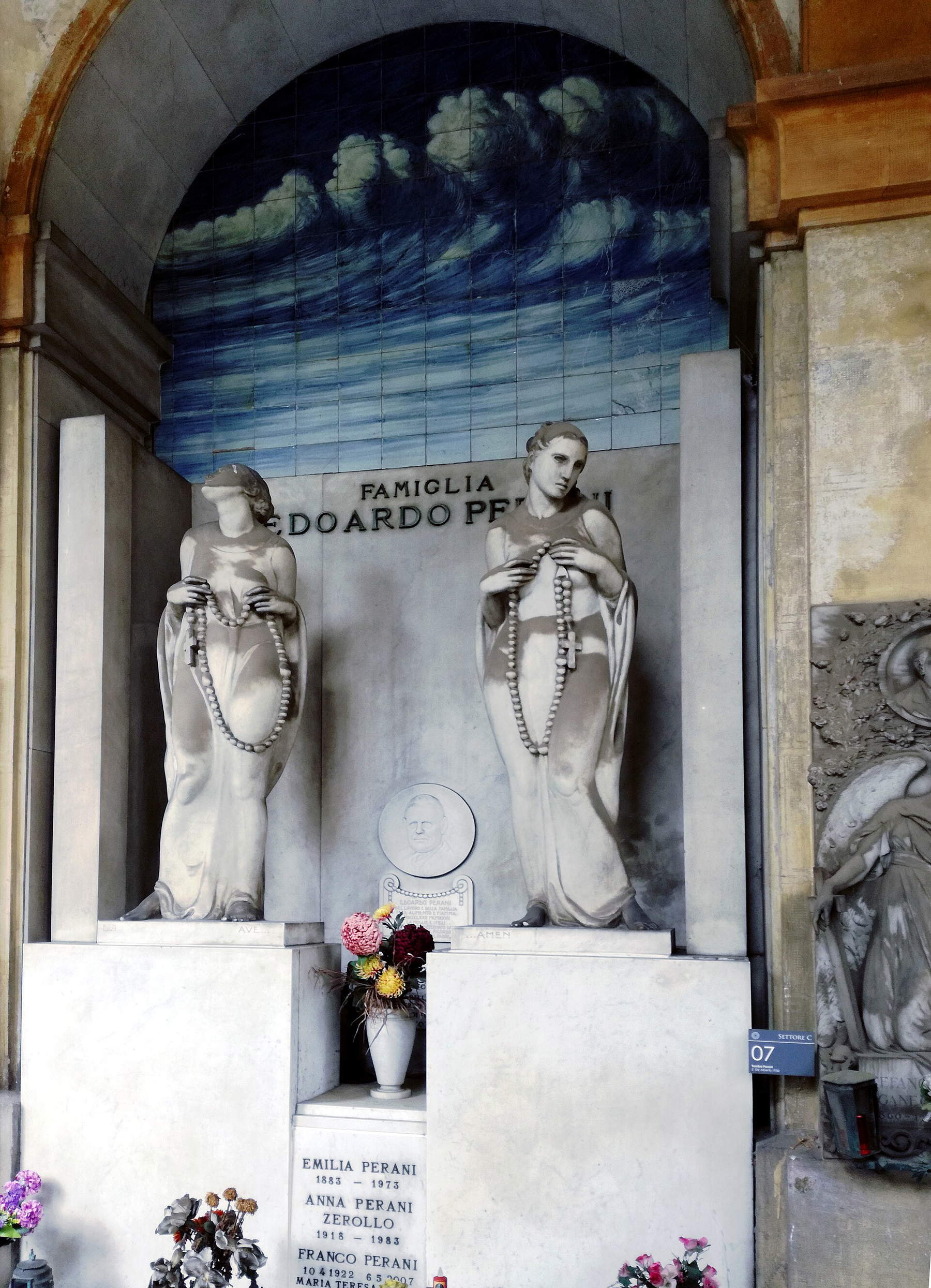
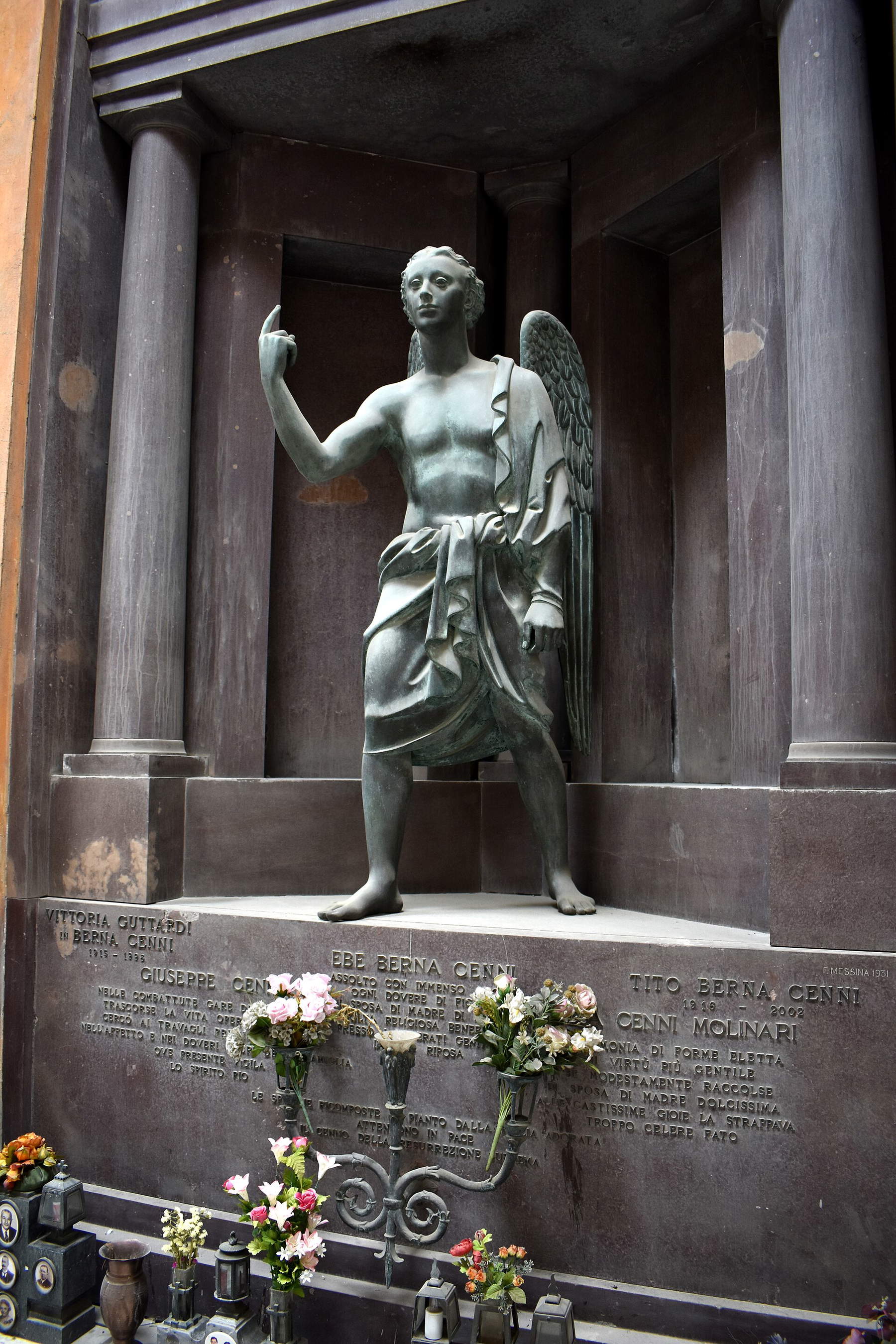
On the opposite side of the structure, the Montino Portico, built in the 1920s, showcases the triumph of these stylistic elements: the emergence of new colors, mosaics, and majolica, along with an increasing use of dark bronze tones and green and black marbles. De Albertis embraces Art Deco aesthetics with greater conviction in the Perani (1930) and Scorza (1931) monuments, while Francesco Messina (1900–1995)—who had previously created the Risen Christ (1922) for the Chapel of the Suffrages—revives the deep connection with classical, ancient, and Renaissance traditions in the lesser-known Cenni tomb (1931, in the front galleries).
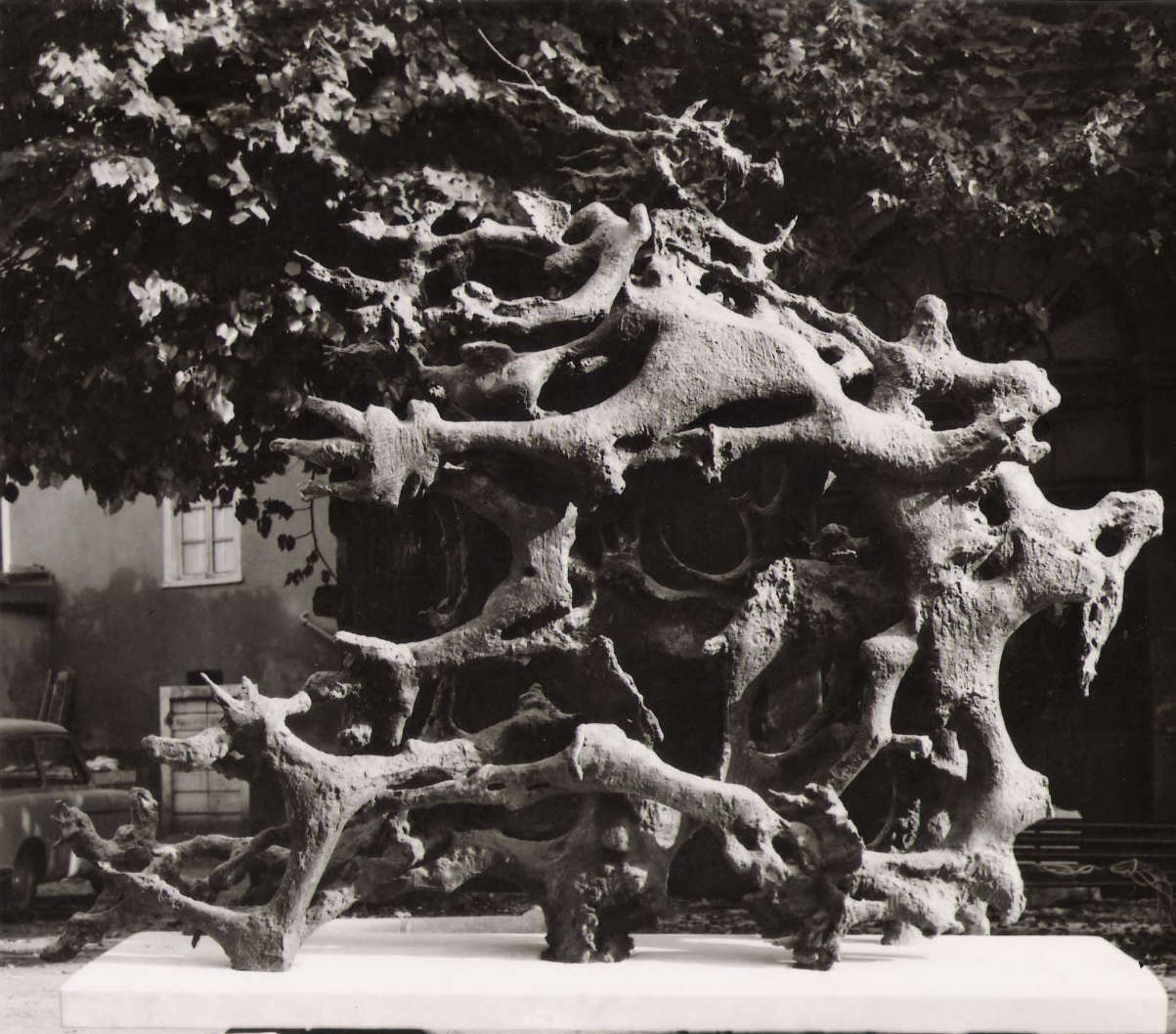
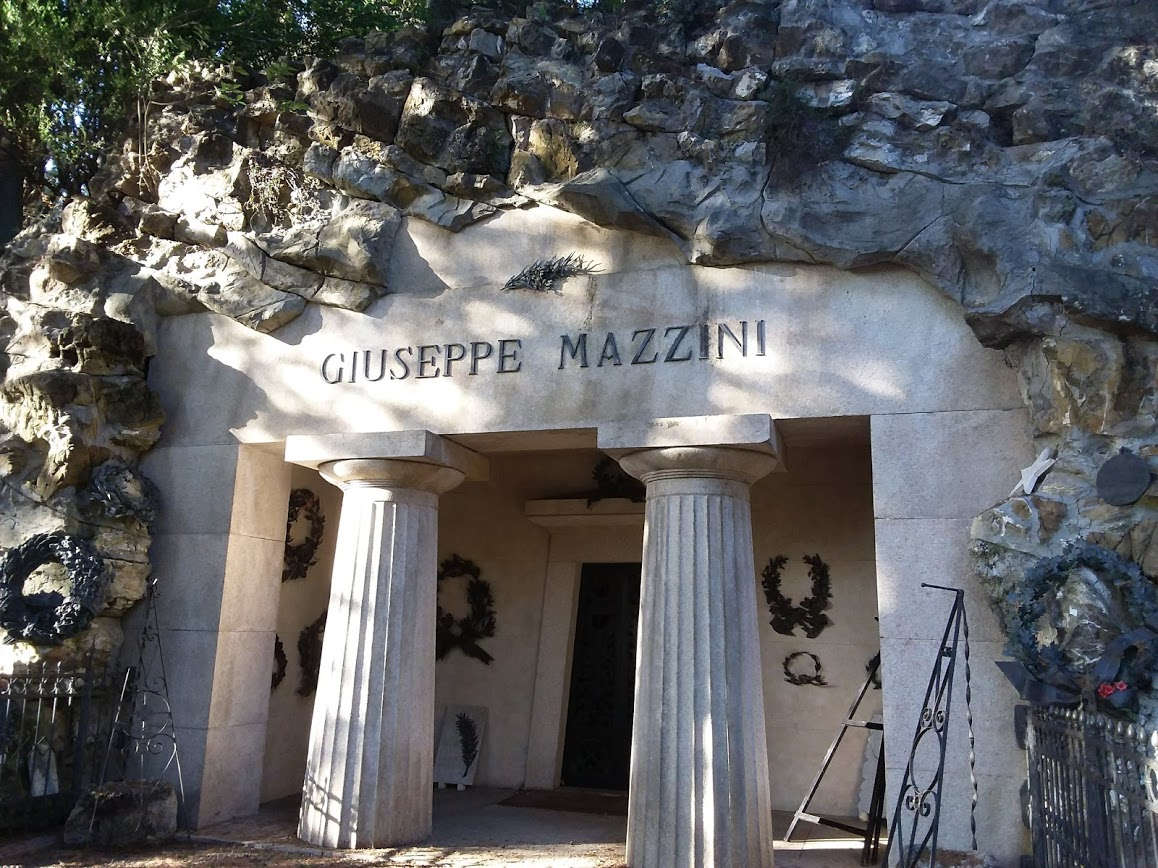
The imposing portico of Sant’Antonino, whose construction began in 1937, was the last project with monumental ambitions for Staglieno: here, a short distance from the tomb of Gilberto Govi (1885–1966), one of the city’s most iconic figures, lies one of the complex’s most unique burial sites: that of the Mele-Pasqua family, designed by Edoardo Alfieri (1913–1988). The client, the refined collector Emma Angelica Mele, specifically asked the sculptor to create a monument that was “original, a departure from the usual funerary conventions, and inspired by complete artistic freedom.” Alfieri responded with a bronze composition titled *Soffia il Vento* (*The Wind Blows*): a dramatic intertwining of branches, not without Futurist echoes, inspired by a passage from the Gospel: “The wind blows where it wills, and you hear its voice.” The work drew opposition from some members of the cemetery’s acceptance committee: the indignant remark by the marble workers of the time provides the perfect commentary for this brief historical-artistic overview: “Staglieno is not a modern art gallery; this is a place where people come to mourn their loved ones.” There may, of course, be other ways to approach a complex reality like Staglieno. Many—almost all—approach the solemn mausoleum of Giuseppe Mazzini, built in 1874 by Gaetano Vittorio Grasso (1849–1899), with a certain reverence, while others seek out the graves of popular figures from the second half of the 20th century, from the aforementioned Gilberto Govi to Fernanda Pivano, Edoardo Sanguineti, and Fabrizio De André.
Finally, the journey of those following the new wave influences inspired by Joy Division is quite unique; the English band active from 1976 to 1980, which used several photographs of Staglieno—taken in 1978 by photographer Bernard Pierre Wolff (1930–1985)—for the covers of two of their albums.
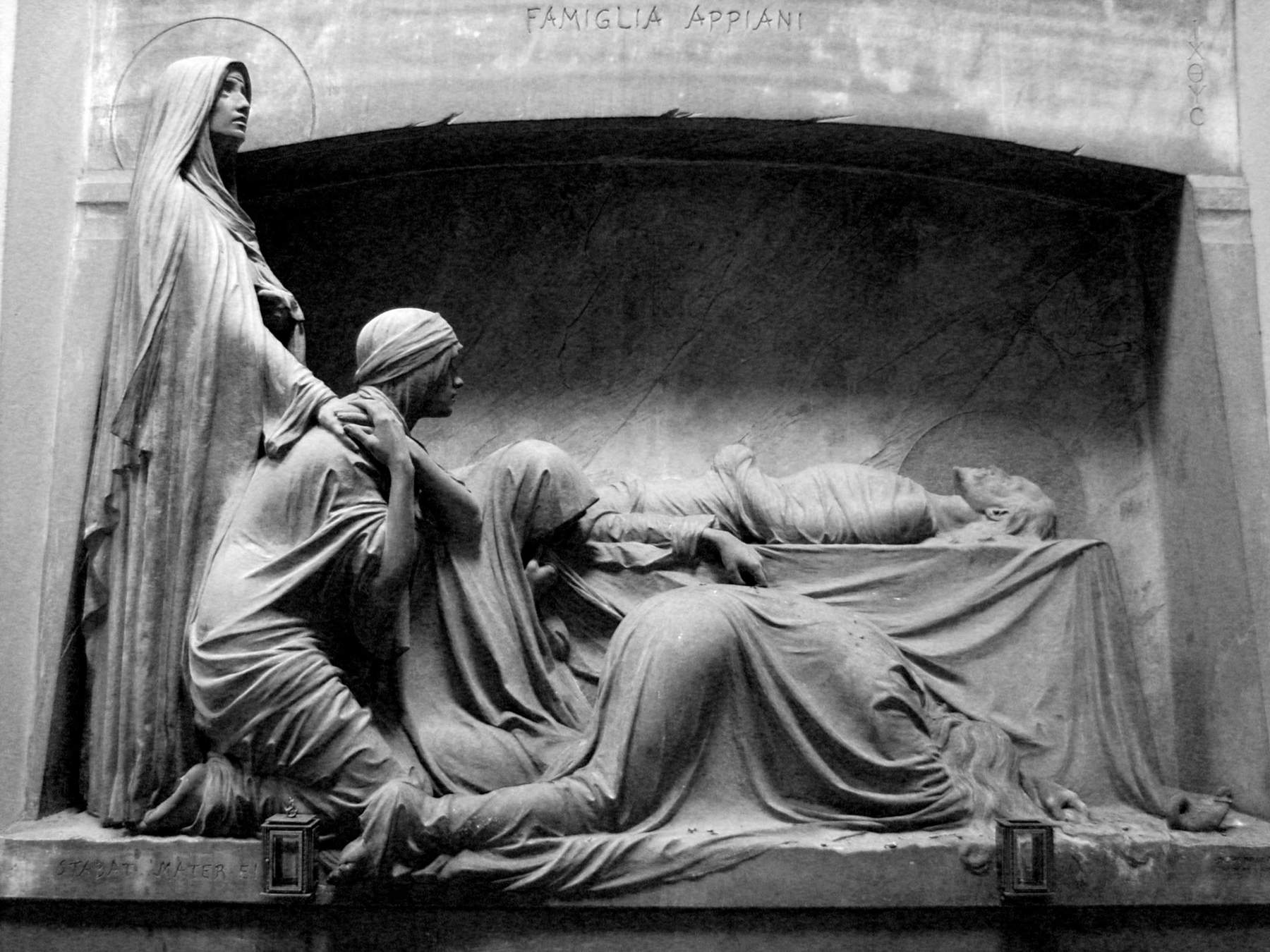
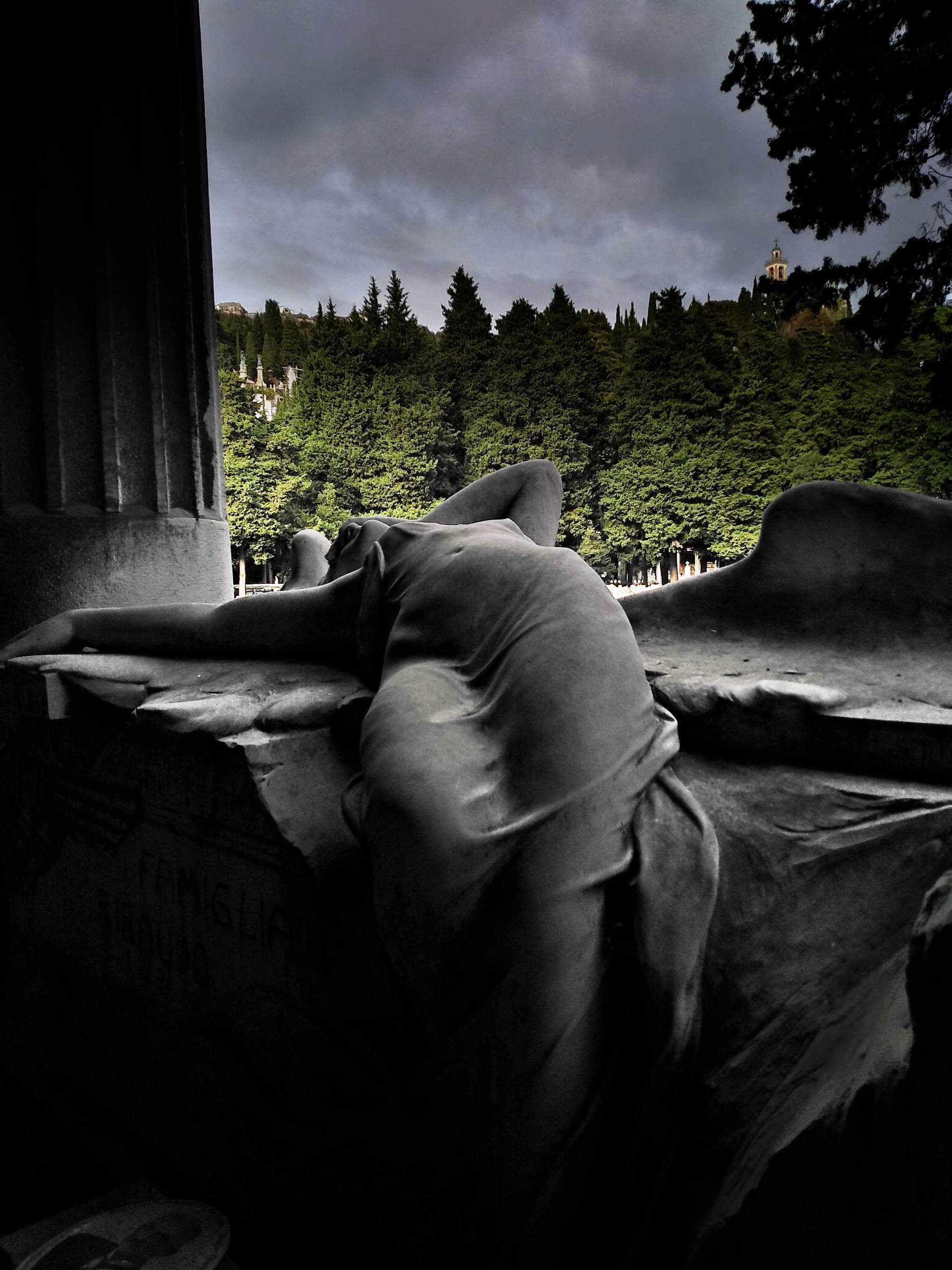
For the album *Closer* (1980), they chose the central detail of the evocative Appiani tomb (1910) by Demetrio Paernio (1851–1914), a Lament over the Deposed Christ in which the garments and drapery take center stage, imbuing the composition with a profound sense of sorrow and mystery. The whole scene takes on additional significance in light of the tragic circumstances surrounding the album’s release, which came just two months after the suicide of the band’s frontman, Ian Curtis (1956–1980). Instead, it was OnoratoToso’s (1860–1946)*Fallen Angel* , from the Ribaudo tomb (1910), that was chosen for the 12-inch version of the single “Love Will Tear Us Apart” (1980), which remains Joy Division’s best-known song to this day.
The climb toward the Irregular Grove—or Grove of the Thousand—is deeply captivating yet more challenging. Here, a succession of chapels in an eclectic style unfolds, where classical, Neo-Gothic, and Byzantine influences come together to create original and unexpected syntheses.
We realize that finding one’s bearings in such a varied landscape is no easy task, and Staglieno undoubtedly lends itself to multiple interpretations. The Staglieno Days, along with the events organized in May as part of the Week of Discovering European Cemeteries (an annual event of the ASCE —the Association of Significant Cemeteries in Europe), offer a unique opportunity to explore this complex reality for the first time or to discover its unusual and little-known aspects.
Staglieno Days is an event organized by the City of Genoa in collaboration with the Ministry of Culture, the Superintendence for Archaeology, Fine Arts, and Landscape for Liguria, funded by tourist tax revenues, with co-financing from the European Union under the PN Metro Plus program, thanks to the support of the City of Genoa’s institutional sponsors—Iren and Coop—and contributions from sponsors Asef, Zanetti Group, Geolander, and Trimble.
For information: https://www.visitgenoa.it/it/staglieno-days-2026
Reservations: https://www.eventbrite.com/cc/staglieno-days-2627-settembre-2026-4862082

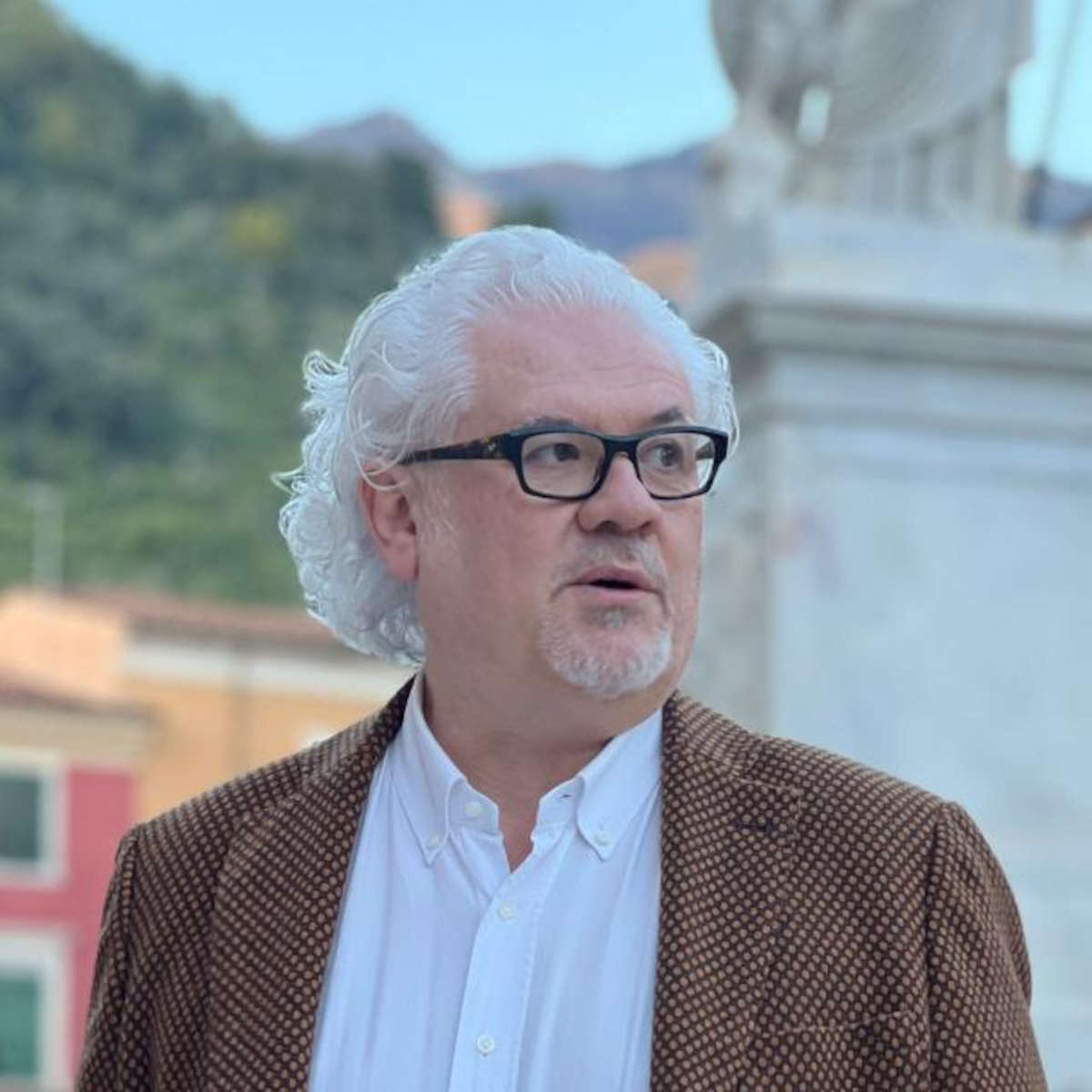
The author of this article: Andrea Fusani
Andrea Fusani, storico dell’arte, si occupa principalmente di scultura, mercato e storia del lavoro artistico nel lungo Settecento. Dopo la laurea in Beni Culturali, conseguita a Pisa nel 2001, ha lavorato a lungo nel settore privato organizzando eventi, mostre e spettacoli. Dal 2019 è tornato a dedicarsi a tempo pieno alla ricerca e, nel 2023, ha conseguito il Dottorato di ricerca interuniversitario toscano (Università di Firenze, Pisa e Siena) con una tesi sul mercato della scultura tra Carrara e i paesi europei (1742-1814). È stato borsista dottorale, borsista di ricerca e collaboratore a contratto presso il Dipartimento di Civiltà e Forme del Sapere dell’Università di Pisa, lavorando nell’ambito della convenzione tra l’Ateneo e la Galleria degli Uffizi. Ha pubblicato vari saggi scientifici e il volume Pietro Leopoldo I Granduca di Toscana, un ritratto inedito. Domenico Andrea Pelliccia (1736-1821), Milano, 2024. È perito stimatore iscritto al ruolo e collabora con gallerie di alto antiquariato. Dirige il progetto di valorizzazione, apertura e restauro di Palazzo Sarteschi Del Medico Staffetti a Carrara.
Warning: the translation into English of the original Italian article was created using automatic tools. We undertake to review all articles, but we do not guarantee the total absence of inaccuracies in the translation due to the program. You can find the original by clicking on the ITA button. If you find any mistake,please contact us.






















 IT
IT FR
FR DE
DE ES
ES CN
CN


