





A fruit that symbolizes summer, the watermelon has always been associated with the idea of freshness and refreshment during the hottest months of the year. Its presence on our tables, however, tells a much older story, linked to the places and cultures that have accompanied its spread. Over time, it has also found its way into the visual arts, where the fruit has been depicted as a symbol of sensory pleasure and a connection to the natural world. Its inclusion in the repertoire of still lifes is the result of a long history of cultivation and representation, which has led the fruit to become part of the agricultural and culinary imagination of various civilizations.
The earliest evidence of its cultivation dates back toPharaonic Egypt, where the fruit was already known thousands of years ago and, according to tradition, was also placed in tombs as food for the journey to the afterlife. Over the centuries, its spread extended to various regions of the Mediterranean and Asia: by around the 10th century, watermelon cultivation was well established in China, a country where the fruit would eventually take on particular cultural significance—as evidenced by the founding of the China Watermelon Museum in Beijing, a museum entirely dedicated to the culture of this fruit. On the Italian peninsula, however, the watermelon likely arrived in the 12th century via the Arabs, gradually becoming part of local agricultural and dietary practices.
Its presence is also documented in medieval art and literature: one such depiction appears inthe *Tacuinum Sanitatis*, the illustrated manuscript dedicated to the relationship between food, health, and nature. In the miniature *Landmann bei der Melonenernte* (Farmer During the Melon Harvest), created around 1390 and preserved in the *Codex Vindobonensis Series nova 2644* at the Austrian National Library in Vienna, the watermelon appears among the produce of the earth associated with personal care and seasonal cycles, demonstrating how the fruit had by then become an integral part of European agricultural culture.
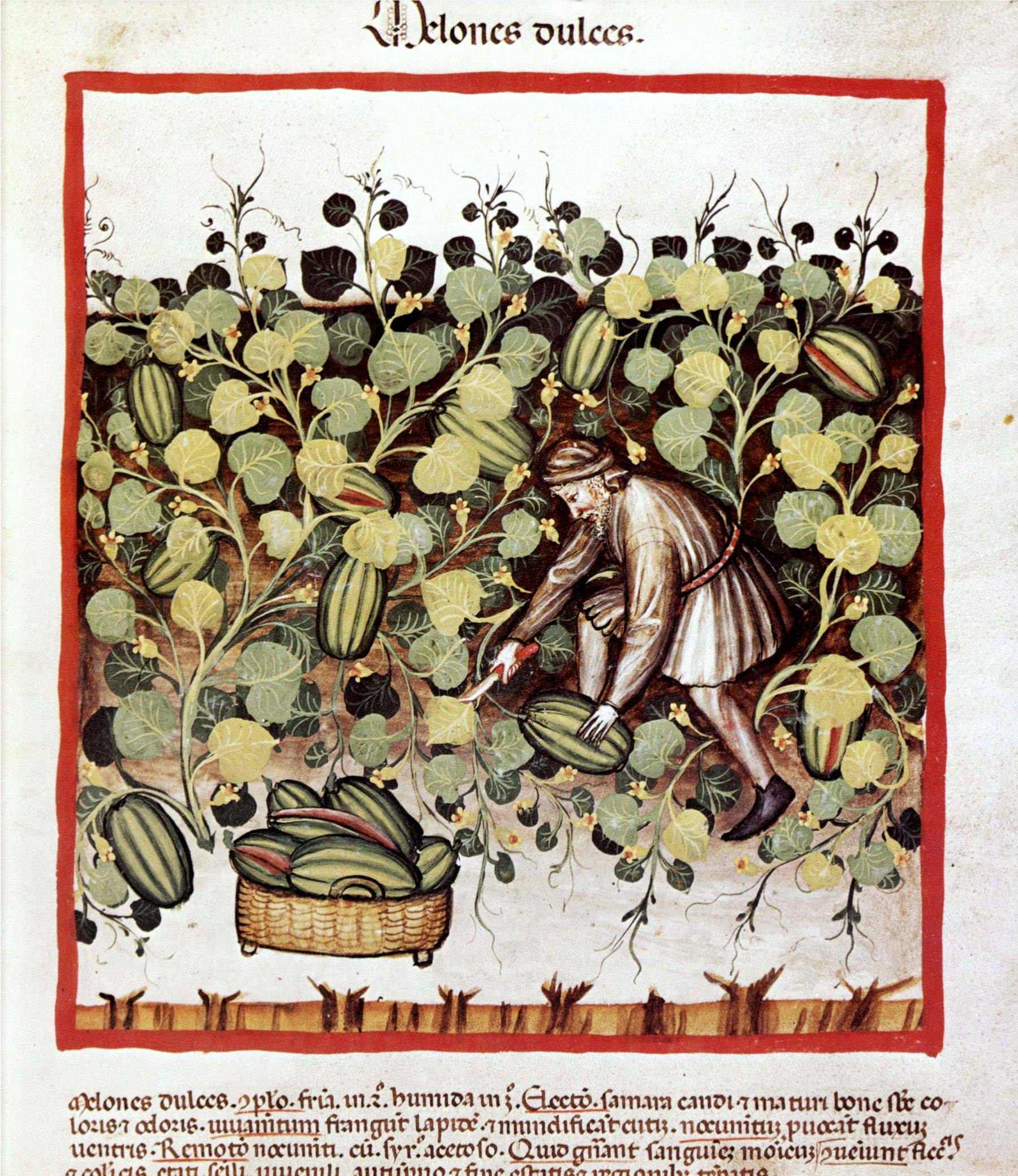
It is precisely this long-standing relationship between humans and nature that finds a new interpretation in seventeenth-century painting. In Tuscan still lifes, the watermelon transcends the role of a mere food item and becomes a subject through which artists can explore the diversity of the plant world, the abundance of agricultural production, and painting’s ability to render reality with precision and wonder. The depiction thus becomes an opportunity to observe and describe the natural world even more effectively through painting. In this context, the watermelon enters the artists’ repertoire and captures their attention due to its formal and chromatic characteristics: its voluminous shape, the contrast between the green rind and the red flesh, and the possibility of revealing, through a cross-section, the texture of the natural material.
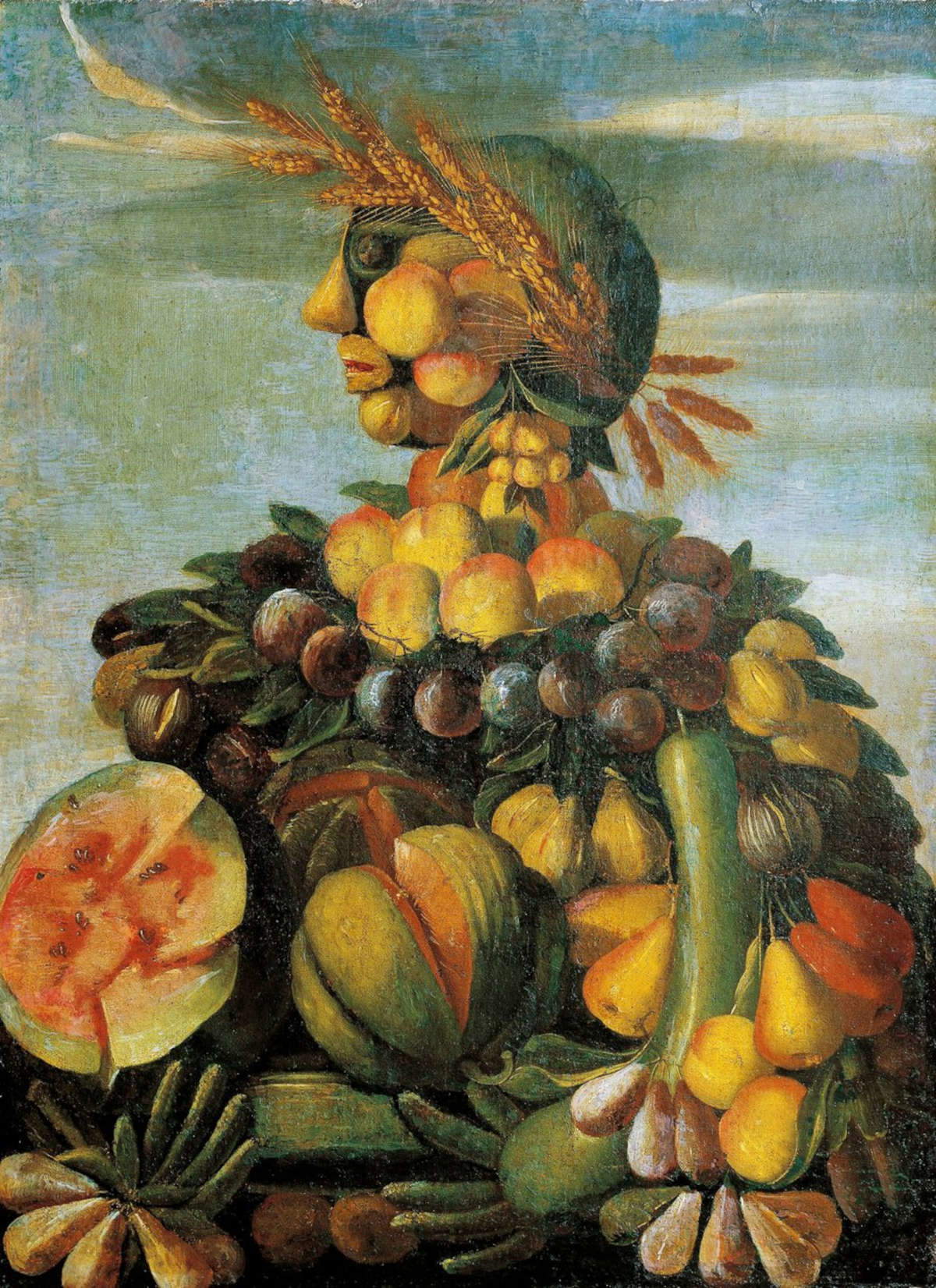
In any case, its presence in the compositions is not merely an aesthetic choice. The watermelon, in fact, was part of the culinary culture of the time and became an element through which to represent the variety of the earth’s produce. One of the earliest surviving examples in Tuscany dates back to the late sixteenth century. The Still Life with Fruit, also known as *Summer*—a work attributed to an artist working in the manner of Giuseppe Arcimboldo, part of a cycle dedicated to the seasons, and now housed at the Galleria Corsi within Palazzo Bardini in Florence—depicts an arrangement consisting of a melon, a watermelon, plums, and wheat. The work, datable to between 1575 and 1599, demonstrates the popularity of Arcimboldo’s innovations; he was known for his compositions built from natural elements transformed into surprising images. Although it does not yet belong to the full-fledged era of 17th-century still life, the painting reveals a growing interest in the independent depiction of fruits and vegetables, a trend that would develop further in the following decades. The watermelon appears here as part of a natural repertoire in which all elements contribute to the construction of the image. Its presence foreshadows a new focus on the depiction of reality and on the possibility of transforming everyday foods into pictorial subjects.
Over the course of the 17th century, still life gained its own autonomy as a pictorial genre, and the watermelon became a permanent fixture in artists’ repertoires. Fruits and vegetables were depicted with increasing attention to form, texture, and botanical details, in compositions where the observation of reality was combined with the pursuit of visual harmony. One example is the *Still Life with Fruit* attributed to Michelangelo Pace, known as Michelangelo del Campidoglio (Rome, 1610 –1670), datable to between approximately 1675 and 1699 and housed at the Pinacoteca Comunale Foresiana in Portoferraio.
The painting features a composition rich in elements: two bunches of white and black grapes with vine leaves, cherries, a pomegranate, a melon, raspberries, a pear, a peach, and a slice of watermelon arranged on a wooden shelf. On the right, on a raised level, three figs are depicted. The watermelon contributes to the work’s chromatic balance alongside the other fruits, adding to the variety of shapes and colors in the composition. The painting, initially attributed to Bartolomeo Bimbi, was later reattributed by critics to Michelangelo Pace due to differences from the almost scientific precision of the Florentine painter’s still lifes.
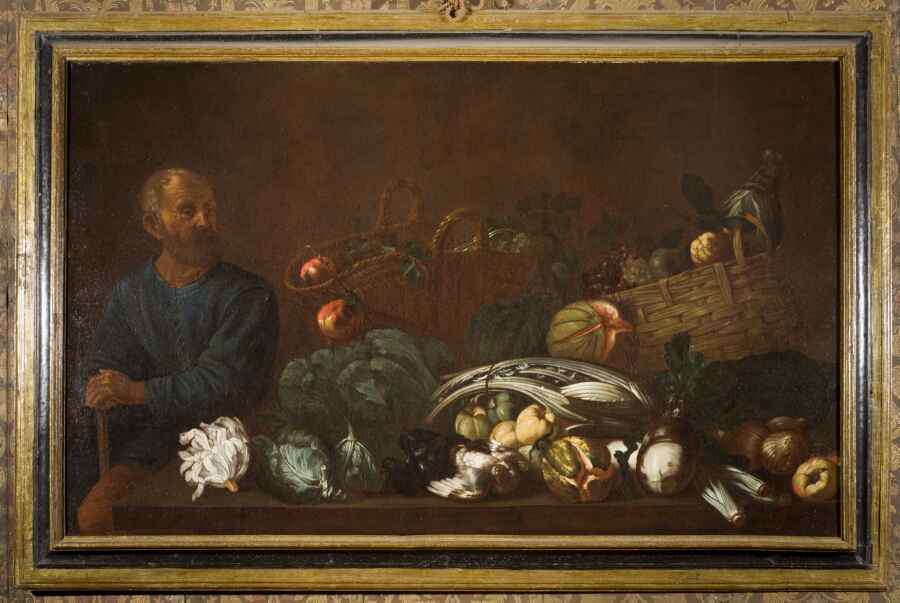
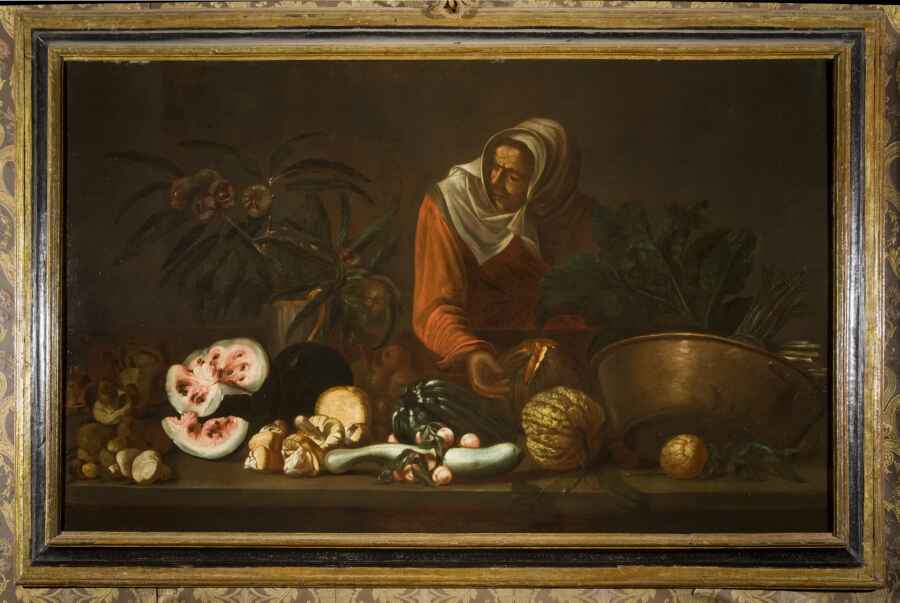
A new interpretation of the still life emerges in the works of Simone del Tintore (Lucca, 1630–1712), one of the leading figures in genre painting in Lucca during the seventeenth century and a pupil of Pietro Paolini. Between approximately 1675 and 1699, he created two canvases now housed at the National Museum of Palazzo Mansi in Lucca: *Still Life with a Female Figure * and *Still Life with a Male Figure*.
In the first work, a woman dressed in red is flanked by a copper vessel and an arrangement of fruits and vegetables. Alongside apricots, pomegranates, mushrooms, and an elongated squash, a watermelon also appears, incorporated into this natural scene. Here, the fruit contributes to the creation of a scene rooted in everyday life. Simone del Tintore uses food and objects as tools to depict a domestic setting and the relationship between humans and what they produce and consume. The painting stands in direct contrast to *Still Life with a Male Figure*, which depicts a man alongside a table, a chair, a basket, a shopping bag, and some doves. Here, too, natural elements and everyday objects play a central role. Both works belong to the artist’s mature period, characterized by compositions that are more complex than the simple arrangement of fruits and objects. The presence of figures transforms the still life into a genre scene, while the depictions of plants remain the most recognizable feature of Simone del Tintore’s painting.
The depiction of the watermelon finds one of its best-known expressions in the work of Bartolomeo Bimbi (Florence, 1648–1729), an artist known for the precision with which he depicted fruits, flowers, and animals. His painting is distinguished by an almost scientific attention to the documentation of natural varieties. His still lifes are compositions that preserve the memory of botanical species and agricultural products. His focus on documenting natural varieties is also evident in an episode involving a massive watermelon sent to the painter by Grand Duke Cosimo III de’ Medici. According to the account by Francesco Saverio Baldinucci (as recounted by Andrea Fusani in his article for *Finestre sull’Arte*, “Bartolomeo Bimbi, the Painter Who Transformed Fruit and Vegetables into Wonders”), the fruit weighed 105 pounds—about 36 kilograms—and was sent to Bimbi with instructions to depict it in its entirety and then return it to the court.
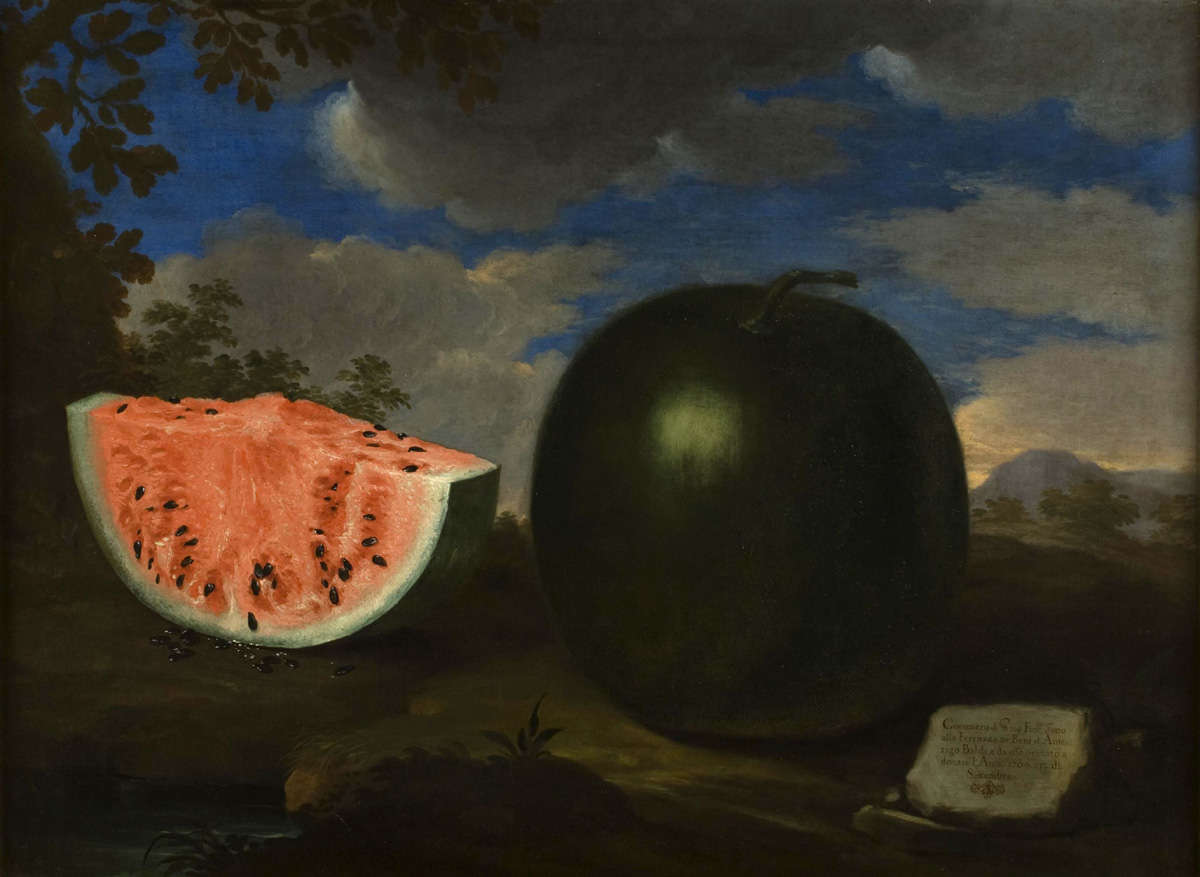
The painter completed the work quickly and, along with his payment, received a large slice of the watermelon itself, which had been set aside specifically to be included in the painting. The Grand Duke also ordered that the artist share that portion with his family and friends. This episode is linked to the painting known asAmerigo Baldi’s Watermelon (named after the owner of the farm where the prodigious fruit was harvested), created in 1704 and now housed in the Botanical Section of the Natural History Museum in Florence.
The popularity of the watermelon as a still-life subject continued well beyond the 17th century, as part of a tradition that had by then become firmly established in Italian painting. In the early 18th century, the fruit continued to appear in the compositions of artists interested in depicting food and objects of daily life, maintaining that balance between observation of reality and artistic exploration that had characterized the previous century. One example is the Still Life with Watermelon attributed to Cristoforo Munari (Reggio Emilia, 1667–Pisa, 1720), datable to between 1700 and 1749 and part of the collection at Palazzo Blu in Pisa. The painting fits within the typical repertoire of Italian still life, where fruits and objects are arranged within the pictorial space through a careful balance of forms, colors, and surfaces.
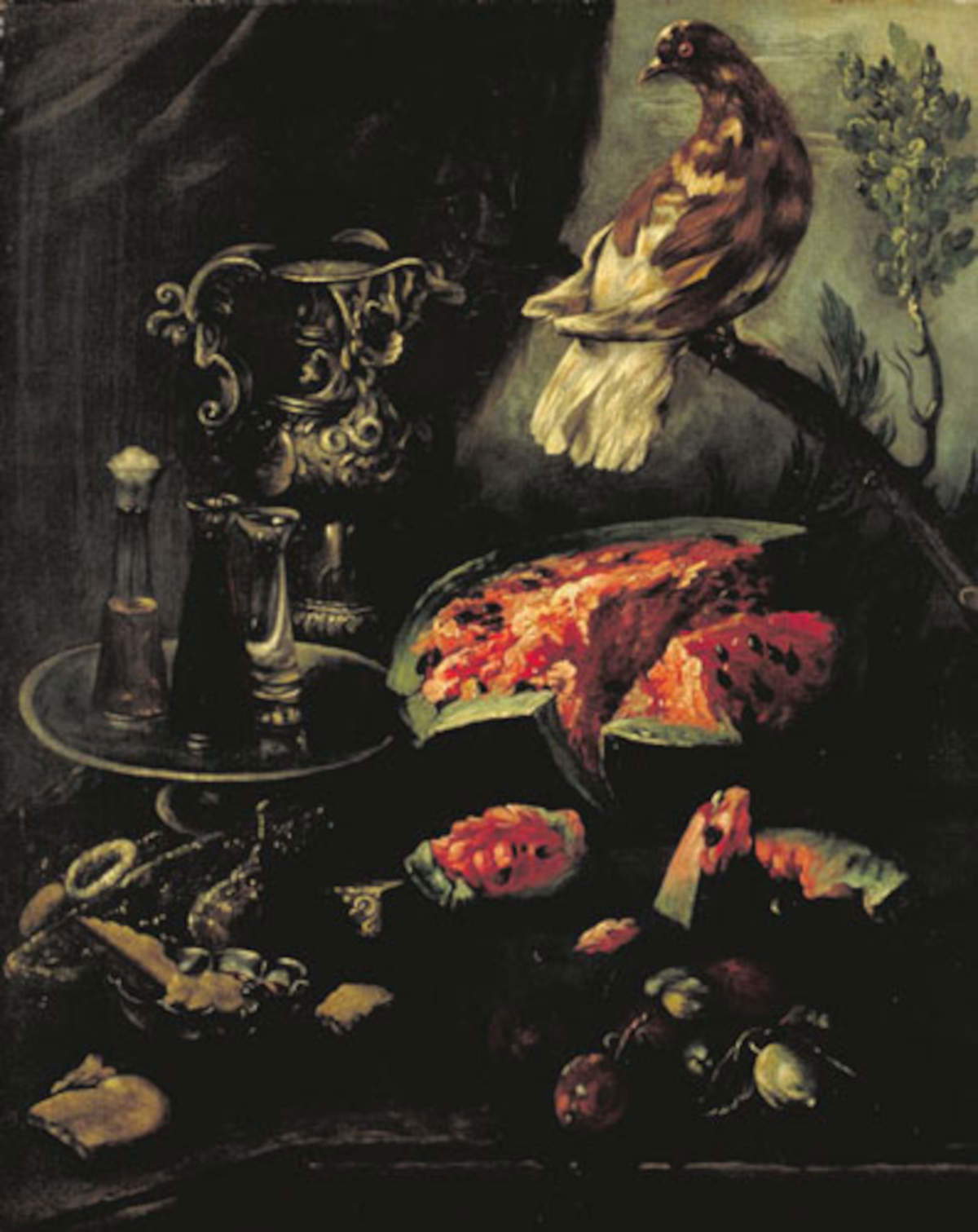
The painting, which appeared on the Roman antiquities market with an initially tentative attribution to Munari, was subsequently added to the artist’s catalog by Luigi Salerno, who recognized in the composition certain elements present in numerous other works by the painter, considering them part of his customary repertoire. This interpretation is not shared by the scholar Baldassari, who argues that neither the compositional elements nor the painterly style offer sufficiently convincing parallels with Munari’s confirmed body of work. A Still Life with Fruit of Tuscan Origin, housed in Lucca and dating to the 18th century, also belongs to the same tradition. The canvas features watermelon, grapes, figs, and peaches, presenting a composition built around the seasonal variety of agricultural produce.
The presence of watermelon in 17th-century Tuscan still lifes thus reveals a unique aspect of genre painting: the ability to transform elements of everyday life into tools of knowledge. Through the depiction of fruits, artists construct images that blend an interest in botany with food culture. In this case, the watermelon accompanies the evolution of the Tuscan still life and becomes an element that successfully blends the precision of description with the pursuit of formal balance. Its presence in 17th-century paintings thus reveals how artists viewed the natural world, with the aim of transforming it into an image.


The author of this article: Noemi Capoccia
Originaria di Lecce, classe 1995, ha conseguito la laurea presso l'Accademia di Belle Arti di Carrara nel 2021. Le sue passioni sono l'arte antica e l'archeologia. Dal 2024 lavora in Finestre sull'Arte.Warning: the translation into English of the original Italian article was created using automatic tools. We undertake to review all articles, but we do not guarantee the total absence of inaccuracies in the translation due to the program. You can find the original by clicking on the ITA button. If you find any mistake,please contact us.
























 IT
IT FR
FR DE
DE ES
ES CN
CN


