



by Redazione 20/07/2026



Categories: Ancient art / Disclaimer
Following its restoration at the Central Institute for Restoration and its exhibition at the Metropolitan Museum of Art in New York, Raphael’s “Banner of the Holy Trinity” returns to the Municipal Art Gallery of Città di Castello, where it is displayed in a new setting.
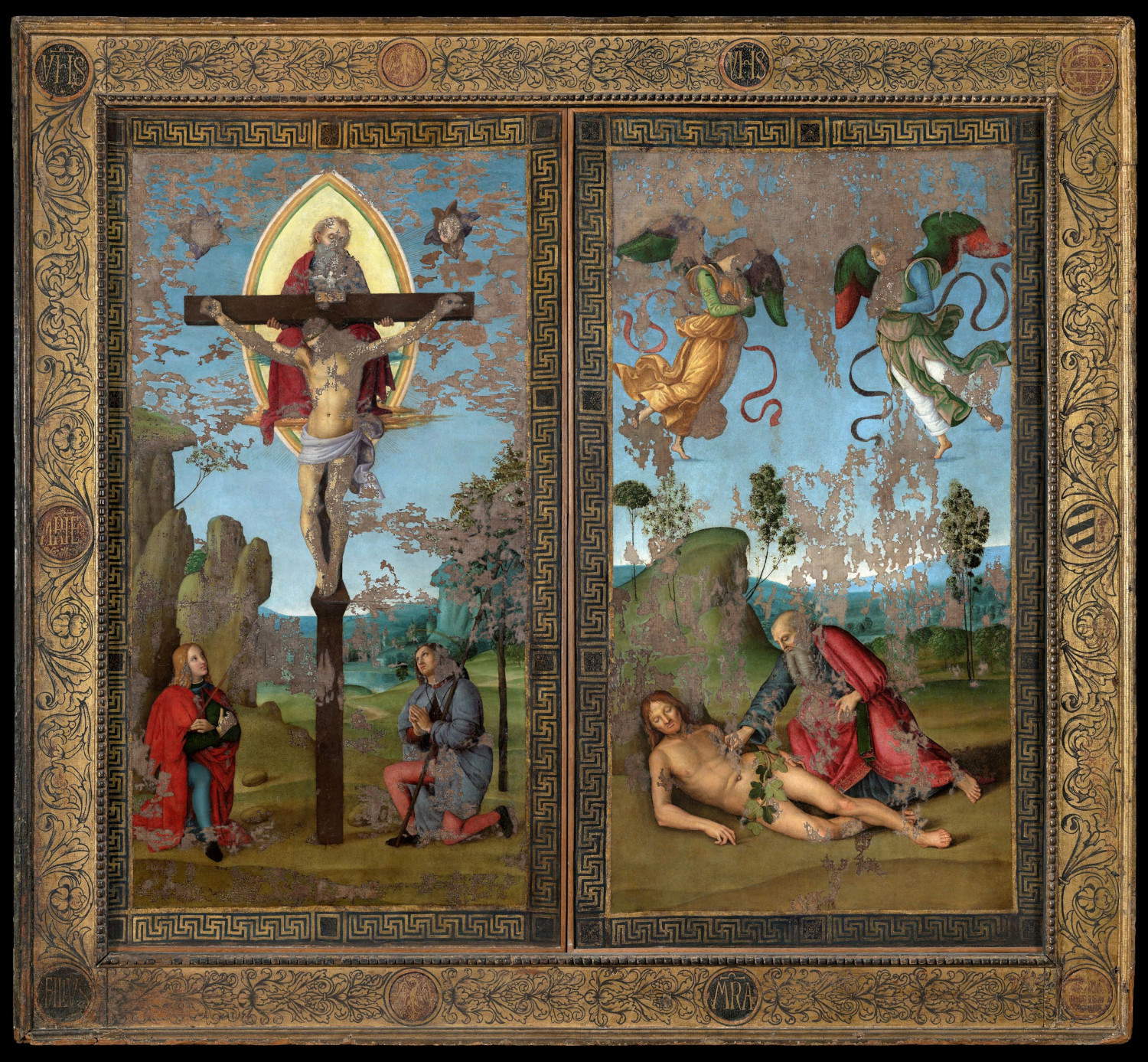
The Banner of the Holy Trinity, considered Raphael’s first work entirely in his own hand, has returned to the Pinacoteca Comunale in Città di Castello, where it is once again on display in the renovated Raphael Room. The work’s return marks the conclusion of a major restoration, research, and conservation project involving some of Italy’s leading institutions dedicated to the preservation of cultural heritage.
The work was recently the centerpiece of the international exhibition *Raphael: Sublime Poetry*, hosted by the Metropolitan Museum of Art in New York, after undergoing a complex conservation treatment carried out bythe Central Institute for Restoration (ICR). Thanks to this work, it has been possible to significantly improve the clarity of the painting and bring to light valuable insights into the creative process of the young Raphael.
The new museum layout showcases the “Stendardo” within a space dedicated to the leading figures of the Renaissance active in Città di Castello. Alongside Raphael’s masterpiece are also important works by Luca Signorelli, including the Altarpiece of Saint Sebastian and the Altarpiece of Saint Cecilia, recently attributed to the Cortona-born master.


Originally, the “Stendardo” was a single processional banner created for the Confraternity of the Holy Trinity in Città di Castello. One side depicts the Holy Trinity with Saints Roch and Sebastian, traditionally invoked against the plague, while the other side depicts the Creation of Eve, with God the Father forming the woman from the side of the sleeping Adam. The two scenes are set in a landscape inspired by the Umbrian countryside and framed by an elegant meander pattern.
Founded in 1266, the confraternity ran a hospital and an oratory and participated in the city’s major processions. The banner remained in use until 1627; the following year, the two canvases were separated and preserved first in the confraternity’s church and later at Palazzo Vitelli.
The work dates from Raphael’s first stay in Città di Castello, when the young artist was engaging with the artistic legacy of Luca Signorelli, then a leading figure in central Italy. The date is generally placed between 1499 and 1502: according to some scholars, it represents Raphael’s first commission in Città di Castello, while others place it between the Baronci Altarpiece and the Mond Crucifixion.
One of the most widely accepted theories interprets the Banner as an ex-voto created to celebrate the end of the plague epidemic that struck Città di Castello between 1497 and 1499. The presence of Saints Roch and Sebastian, patrons against plagues, and recent archival studies that date the end of the outbreak to January 1499 seem to support this interpretation. The restoration, directed by Alessandra Ferlito, head of the ICR’s Canvas Paintings Laboratory, addressed the numerous conservation issues that had accumulated over the centuries. The restoration involved a delicate cleaning process, carried out by combining traditional methods with laser technology, which made it possible to remove the altered layers without compromising the original material, restoring greater visual balance between the painted sections and the areas with missing paint.
The most significant result, however, is the recovery of a large portion of the original preparatory drawing executed by Raphael directly on the canvas. Previously hidden beneath repainting and materials deposited during earlier restorations, the sketch is now once again visible in the areas devoid of color and offers scholars direct evidence of the artist’s design phases, revealing compositional and iconographic details previously unknown.
The restoration was accompanied by a diagnostic campaign conducted by the Chemistry and Physics Laboratories of the Central Institute for Restoration. The results of the analyses and conservation work will soon be presented in a scientific publication by Campisano Editore and at a dedicated symposium.
In preparation for the loan to the Metropolitan Museum, the ICR also designed a special transport system featuring a double floating crate, equipped with an internal structure suspended by springs to absorb vibrations and ensure maximum safety during the artwork’s international transport.
“The Superintendence of Archaeology, Fine Arts, and Landscape for Umbria has wholeheartedly supported, from the very beginning, the initiative that saw Raphael’s Banner of the Holy Trinity travel to Rome to theCentral Institute for Restoration for a crucial assessment of its state of preservation and aesthetic restoration, followed by the loan that brought the work to New York for the major exhibition curated by Carmen Bambach at the Metropolitan Museum,” stated Francesca Valentini, Superintendent of Archaeology, Fine Arts, and Landscape for Umbria. “This exhibition has highlighted the value and likely the primacy of this work by the very young Raphael, which is now returning to the Città di Castello area. The work’s return to the Civic Museum of Città di Castello attests to the strong synergy between the Superintendency, the Ministry of Culture, the ABAP General Directorate, the Central Institute for Restoration, and the Municipality of Città di Castello in promoting this masterpiece within the region. This will not only enrich the cultural life of the local community, which is welcoming the work’s return, but also serve as a major cultural attraction, thanks in part to this international exhibition in New York. For this reason, the Superintendency is sincerely proud to have contributed to this scientifically grounded cultural initiative, which is entirely dedicated to promoting Umbrian cultural heritage.”
“In the 1950s, the Central Institute for Restoration experimented with the best technologies for the conservation of Raphael’s banner, which is housed in Città di Castello,” stated Luigi Oliva, director of the Central Institute for Restoration. “Today, the work returns following a restoration carried out at the Institute’s Tele laboratory, in collaboration with the Superintendence of Archaeology, Fine Arts, and Landscape for Umbria and the City of Città di Castello. Funding was provided in part by the Metropolitan Museum, which hosted the work in a major exhibition held at its New York location; today it finally returns to be appreciated following the recovery of what was thought to be lost forever—namely, Raphael’s drawing directly on the canvas. Thus, the gaps that had been preserved by previous restorations without any filling have now finally been cleaned up, and thanks to modern technology, they reveal the original drawing that Raphael created before applying the paint layer. “This is, therefore, a work that has been revitalized in terms of its beauty and visibility, and it reveals much more about the story of the young Raphael, his development, and his skills even at the very beginning of his career.”
|
| Raphael’s “Banner of the Holy Trinity” Returns to Città di Castello After Restoration |
Warning: the translation into English of the original Italian article was created using automatic tools. We undertake to review all articles, but we do not guarantee the total absence of inaccuracies in the translation due to the program. You can find the original by clicking on the ITA button. If you find any mistake,please contact us.