





After a year of restoration work in the workshops of the Opificio delle Pietre Dure in Florence, the precious processional cross—created in 1501 by Gian Francesco dalle Croci for the Church of San Francesco—has returned to Brescia. The work, which arrived at the Institute on July 29, 2025, underwent a meticulous conservation treatment that restored the clarity of its surfaces and decorative details. The project was the result of a collaboration between the Opificio delle Pietre Dure and the Superintendence of Archaeology, Fine Arts, and Landscape for the provinces of Bergamo and Brescia, as part of their joint efforts to protect and promote cultural heritage.
Crafted from cast, embossed, and gilded silver, with polychrome enamels and refined niello reliefs, the processional cross is one of the most significant examples of Lombard Renaissance goldsmithing. The commission dates back to 1501 and was made possible by the bequest of Friar Francesco Sansone de Brixia, Minister General of the Franciscan Order from 1475 to 1499. The work features a complex iconographic program linked to Franciscan spirituality. At the center of the composition are the crucified Christ and Saint Francis in the act of receiving the stigmata, while surrounding them are figures of saints and scenes from the Passion and the Resurrection.
The relationship between the two central figures is one of the work’s key elements: the closeness between Christ and Francis evokes the ideal of the saint of Assisi as alter Christus—that is, as a figure capable of conforming himself to Christ, even through the experience of the stigmata.
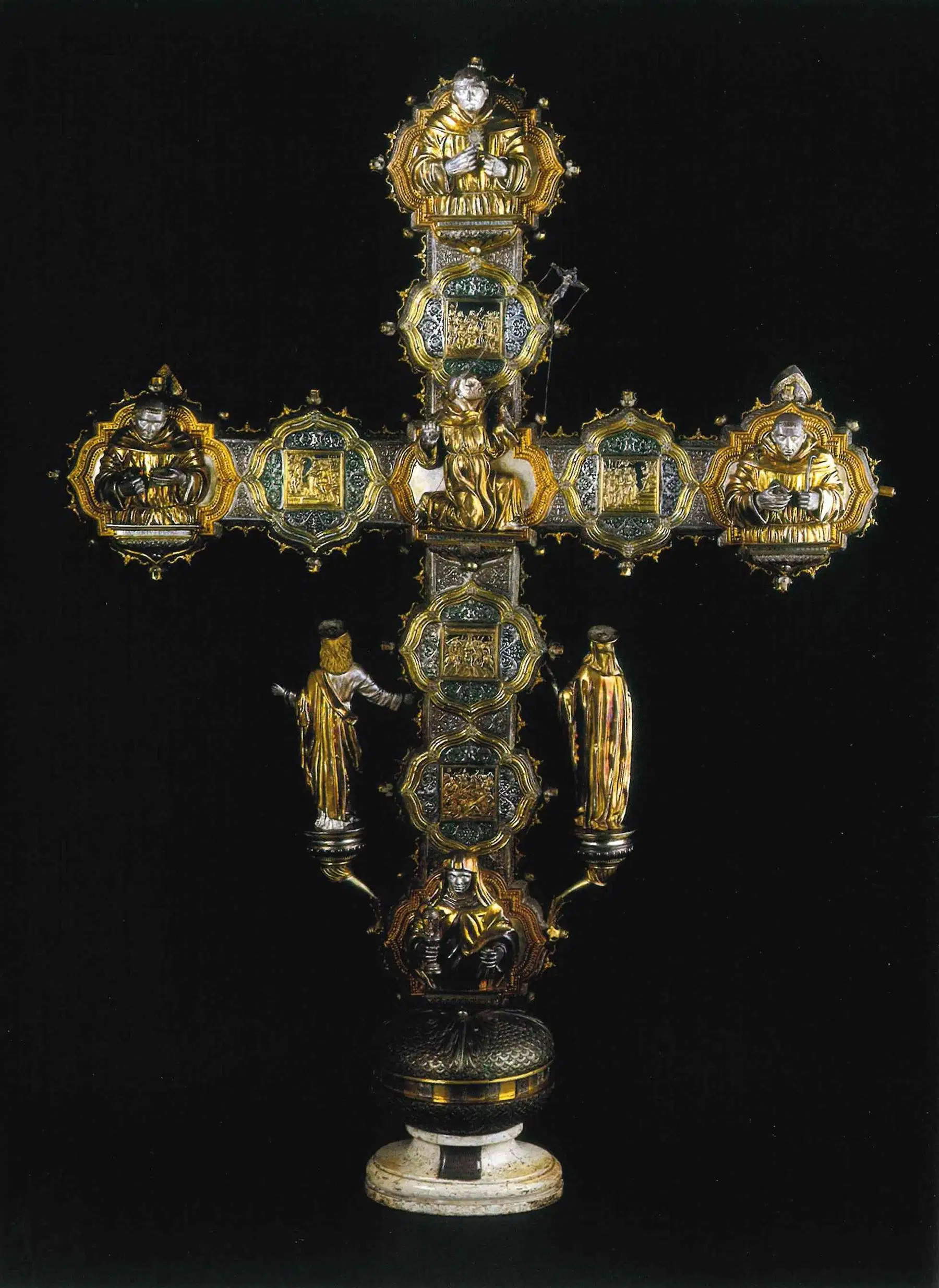
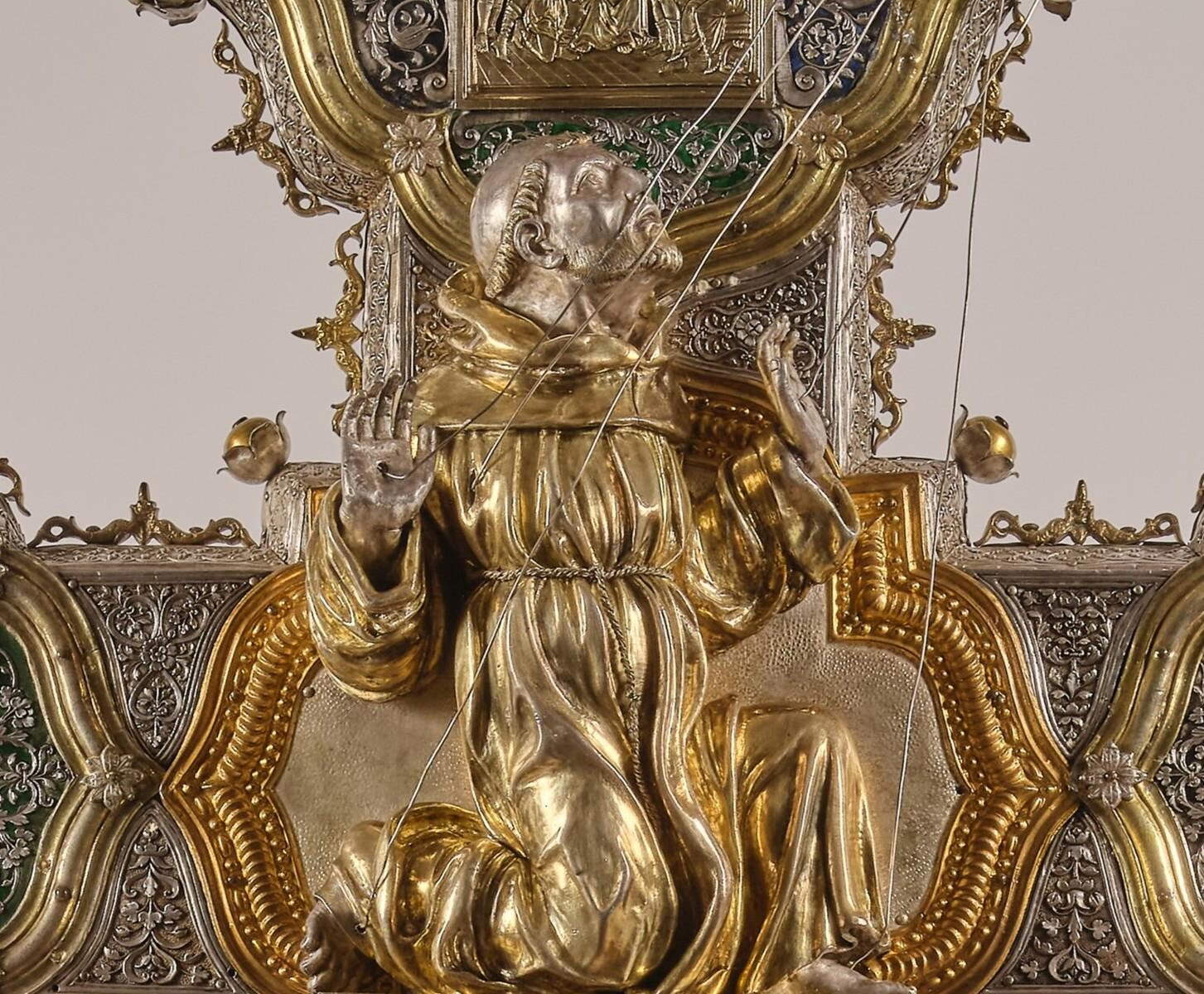
Preliminary investigations conducted by the Opificio made it possible to assess the cross’s state of preservation and to rule out the presence of structural problems or signs of deterioration severe enough to require the complete disassembly of the artifact. The restoration work therefore focused primarily on the surfaces. Over time, atmospheric particulate matter and greasy substances had accumulated on the metal parts, combining with the natural processes of sulfidation and oxidation of the silver. The result was the formation of a widespread dark patina, which altered the appearance of the materials and made both the decorative details and the refined modeling of the figures less discernible. The controlled removal of these deposits made it possible to restore greater definition to the surfaces and to once again highlight the variety of materials and techniques used by Gian Francesco dalle Croci.
The cross also provided an important opportunity to experiment with conservation methodologies. Given the work’s characteristics, the conservators applied a dry cleaning technique using abrasive erasers, which was studied in depth as part of the PNRR CHANGES project. The use of this method allowed for gradual and controlled treatment of the metal surfaces, achieving effective cleaning without compromising the original material. The technique thus improved the visibility of the work’s decorations and details while preserving the material characteristics that bear witness to its history.
Now that the restoration is complete, the processional cross is leaving the Florentine workshops to return to the Church of San Francesco in Brescia. The restoration returns to the community a work that combines the richness of Lombard sacred goldsmithing, the complexity of the Franciscan iconographic tradition, and the technical mastery achieved by Gian Francesco dalle Croci in the early 16th century.
|
| The Silver Cross of 1501 Is Restored: Gian Francesco dalle Croci’s Masterpiece Returns to Brescia After Restoration |

Warning: the translation into English of the original Italian article was created using automatic tools. We undertake to review all articles, but we do not guarantee the total absence of inaccuracies in the translation due to the program. You can find the original by clicking on the ITA button. If you find any mistake,please contact us.





















 IT
IT FR
FR DE
DE ES
ES CN
CN


