





From October 31, 2026, to January 31, 2027, a major masterpiece of the Italian Renaissance will, on an exceptional basis, leave the Prado Museum in Madrid to be exhibited at the Castelvecchio Museum in Verona. Titian ’s *Venus with a Dog and an Organist* (Pieve di Cadore, c. 1490 – Venice, 1576) will be the centerpiece of the exhibition *Titian’s Venus and the Musical Renaissance*. “Music for the Eyes: From the Prado Museum to the City of Verona” is one of the major cultural events organized to mark the centennial of the opening of the Verona museum, which opened in 1926 and has now been in operation for a century. The exhibition offers a journey that explores the relationship between the visual arts and music, addressing one of the most significant themes of sixteenth-century humanist culture. Centered around Titian’s famous painting, the exhibition weaves together painting, historical musical instruments, music books, ancient scores, and live performances, with the aim of conveying to the public the role that music played in the imagination of the Venetian and Veronese Renaissance.
The exhibition is curated by Francesca Rossi, Luca Fabbri, and Michele Magnabosco and stems from a long-standing scholarly collaboration between the Castelvecchio Museum and the Prado Museum. The relationship between the two institutions has been further strengthened in recent years, particularly in connection with the major monographic exhibition dedicated to Paolo Caliari, known as Il Veronese, hosted by the Prado Museum in Madrid in 2025. This collaboration has given rise to a new international project that brings to Verona one of the most prestigious paintings in the Prado’s collections, presenting it in an exhibition setting designed to highlight its historical and symbolic significance. The initiative is sponsored by the City of Verona, through the Department of Culture and the Civic Museums Directorate—Castelvecchio Museum—together with the Prado Museum and the Verona Philharmonic Academy, the project’s scientific partners. The “E. F. Dall’Abaco” Conservatory of Verona is also collaborating, while the Cariverona Foundation is supporting the initiative. The exhibition is co-produced by Civita Mostre e Musei.
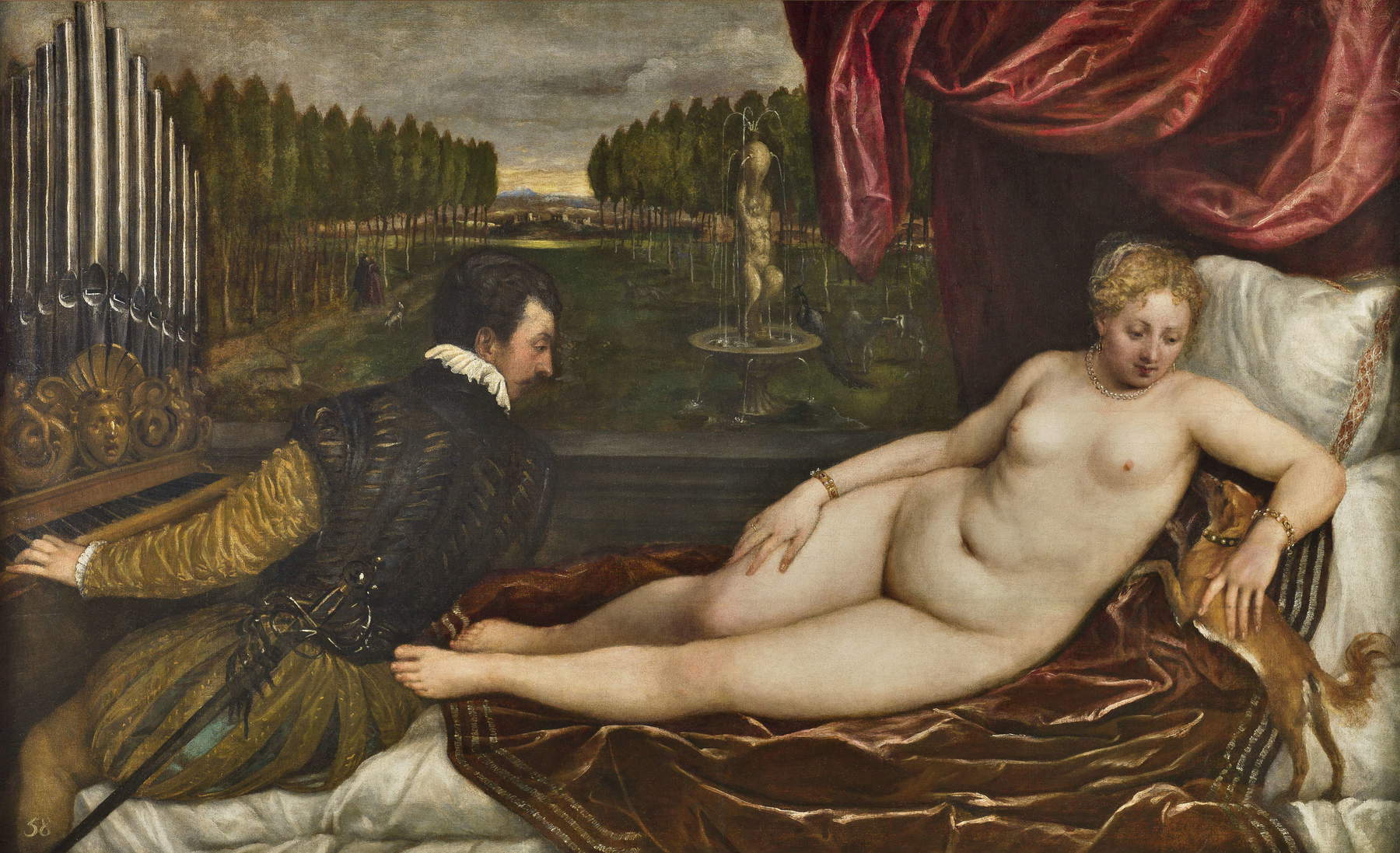
At the center of the exhibition is *Venus with a Dog and an Organist*, considered the first known version of the famous subject of *Venus with the Musician*, which was destined to become one of the most celebrated themes in Titian’s oeuvre. The painting represents one of the most refined and seductive images of sixteenth-century painting and serves as the starting point for a reflection on the relationship between music, love, and the contemplation of beauty in Renaissance culture.
In the painting, a young, nude Venus lies reclining on a bed while an organist breaks his gaze from the keyboard to contemplate her beauty. The goddess, however, does not return his gaze: she is watching a small dog approaching her, seeking her attention. This seemingly minor detail profoundly alters the meaning of the entire composition. The image no longer depicts a simple amorous exchange but becomes a meditation on desire, fidelity, and the Renaissance ideal of the contemplation of beauty.
The symbolic complexity of the work also emerges thanks to diagnostic analyses conducted on the painting, which have made it possible to reconstruct Titian’s creative process . The examinations revealed that the artist substantially altered the composition during its execution. In the original version, the female figure was also looking toward the musician. It was only later that the painter introduced the small dog and changed the direction of the protagonist’s gaze, further refining the system of symbolic references that has helped make *Venus with a Dog and an Organist* one of the most studied works of Renaissance painting.
The exhibition explores the meaning of this iconography by placing it within the cultural context of the Venetian and Veronese Renaissance. At that time, music was not merely a form of entertainment or an accompaniment to court life, but represented a language capable of expressing the principles of universal harmony, knowledge, and beauty. Music became a metaphor for the order of the cosmos and a privileged vehicle for humanistic reflection on love and the balance between sensibility and intellect. According to the exhibition’s curatorial concept, no artist succeeded in conveying this conception with the same poetic power as Titian. *Venus with a Dog and an Organist* is therefore considered the pinnacle of this reflection, synthesizing—through the relationship between the figures, their gazes, and the objects—a complex allegorical construction that continues to inspire interpretations and studies to this day.
Alongside the masterpiece from Madrid, other important examples of 16th-century Venetian painting will be on display. From the Castelvecchio Museum come Jacopo Tintoretto’s *The Contest of the Muses* and *The Pierides*, works that also explore the relationship between art and music through the language of classical mythology. Joining these is one of the most famous paintings in the Uffizi Galleries in Florence,the *Self-Portrait with a Spinet* by Marietta Robusti, daughter of Jacopo Tintoretto. She was both a painter and a musician and stands as one of the most fascinating female figures in 16th-century Venetian artistic culture.
Centered around these exceptional loans, the exhibition brings together some thirty works, including paintings, sculptures, musical instruments, music books, and original scores. The goal is to create an interdisciplinary narrative that allows visitors to understand the role of music in Renaissance visual culture through works from some of Italy’s leading institutions. In addition to the Prado Museum and the Uffizi Galleries, the project also features the Philharmonic Academy of Verona, the International Museum and Library of Music in Bologna, the Verona Civic Library, and the Verona Capitular Library. From their collections come historical musical instruments, books, manuscripts, and scores that engage directly with the paintings on display.
The contribution of the Veronese collections is particularly significant. The exhibition features illuminated pages by Girolamo dai Libri, the “Allegories of Music” by Francesco Bonsignori and Nicolò Giolfino, and a “Garden of Love” by Battista Zelotti, which is juxtaposed with the “Open-Air Concert” by the Flemish painter Ambrosius Benson. Alongside the paintings, the exhibition will feature cornets, Renaissance flutes, madrigal books, musical manuscripts, and original printed volumes from the Accademia Filarmonica di Verona, considered the oldest music academy in Europe. Visitors will thus be able to directly compare the pictorial depictions with the authentic objects used in 16th-century musical practice, gaining an appreciation of the very close relationship between visual and musical culture.
However, the experience offered by the exhibition will not be limited to the visual dimension. Thanks to a collaboration with the “E. F. Dall’Abaco” Conservatory in Verona, the project will be accompanied by a comprehensive musical program. Concerts will be held in the exhibition hall, performed by students from the Early Music Department, who will use historical instruments similar to those depicted in the works on display. At the same time, the exhibition spaces will be enhanced by an original soundscape created by students in the Conservatory’s Electronic Music class, specifically designed to accompany the exhibition itinerary. A catalog edited by Franco Cosimo Panini will be published to accompany the exhibition.
|
| Titian’s *Venus* from the Prado is coming to Verona for the centennial of Castelvecchio |

Warning: the translation into English of the original Italian article was created using automatic tools. We undertake to review all articles, but we do not guarantee the total absence of inaccuracies in the translation due to the program. You can find the original by clicking on the ITA button. If you find any mistake,please contact us.

















 IT
IT FR
FR DE
DE ES
ES CN
CN


