



by Redazione 17/11/2026


Categories: Ancient art / Disclaimer
Following their exhibition at Palazzo Creberg, the two 16th-century panels depicting *The Fall of Manna* and *Melchizedek Offers Bread and Wine* have been relocated to the Church of Sant’Alessandro della Croce. The restoration is part of the Creberg Foundation’s *Grandi Restauri* project.


Two monumental paintings by Andrea Meldolla, known as Schiavone, have returned to the Church of Sant’Alessandro della Croce in Bergamo following a restoration project sponsored by the Creberg Foundation. The works, *The Fall of Manna* and *Melchizedek Offers Bread and Wine*, were reinstalled on November 17, 2026, in their original location on the rear facade of the church, where they will once again be accessible to the public starting November 18, during the church’s regular opening hours.

The project is part of the annual activities of the “Grandi Restauri” initiative, through which the Creberg Foundation supports the restoration of works belonging to the region’s artistic heritage. Prior to their reinstallation, the two panels were on display at Palazzo Creberg throughout October as part of a free-admission event featuring guided tours and educational activities.
With the campaign scheduled for completion by the end of 2026, the total number of works restored by the Foundation from 2007 to 2026 will reach 142, corresponding to 181 paintings when the individual panels of the polyptychs are counted separately. The two panels by Schiavone thus represent two further milestones in the program to restore and return artistic heritage to their respective communities.



Born in Zadar, Dalmatia, around 1510–1515, Andrea Meldolla was the son of Simone, a native of Meldola, near Forlì, and constable of the Venetian Republic. He likely moved to Venice in the second half of the 1530s and adopted the nickname “Schiavone” in reference to his Dalmatian origins. His training is not documented with certainty, but his paintings reveal an in-depth study of Parmigianino’s works—which he likely encountered through prints as well—and a constant engagement with the Venetian tradition, particularly that of Titian and Pordenone.
As one of the leading figures in the spread of Mannerism in Venetian painting, Schiavone developed a style characterized by inventive freedom, fluid brushwork, and a distinctive sensitivity to light. He was also an engraver and draftsman: his work in the graphic arts contributed to the circulation of his inventions and models. Among his most prestigious commissions were the three tondi intended for the ceiling of the Marciana Library, completed by 1557. He died in Venice on December 1, 1563.
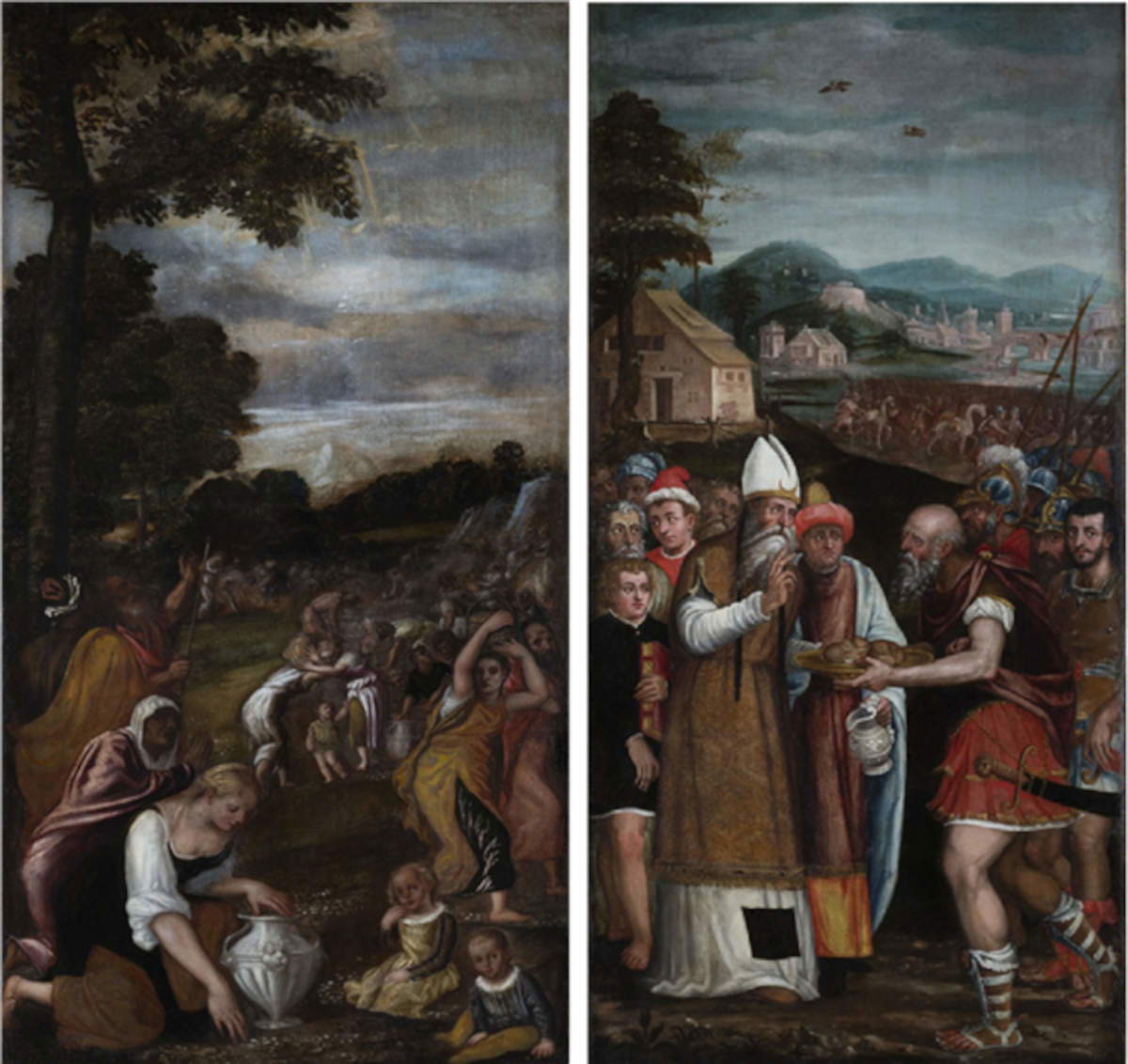
The two restored works, both oil on panel and measuring 300 x 120 centimeters, are located approximately seven meters above the ground on the church’s counter-façade. They are set in white plaster frames with decorative elements and secured using shaped wooden strips gilded with gold leaf.
The choice of subjects reflects a specific theological significance. The Fall of Manna, an episode recounted in the Bookof Exodus (16:4–15), represents the miraculous sustenance provided by God to the Israelites during their journey through the desert. In Christian tradition, manna has been interpreted as a foreshadowing of the Eucharistic bread, the spiritual nourishment of the Christian people. The episode of Melchizedek, recounted in Genesis (14:18–20), also takes on a similar meaning: the king and priest of Salem offers bread and wine to Abraham, a gesture traditionally interpreted as a foreshadowing of the Eucharistic sacrifice. Taken together, the two scenes thus form a symbolic sequence that links the Old Testament episodes to the mystery of the Eucharist.
From a stylistic perspective, the panels illustrate some of the most original aspects of Schiavone’s artistic exploration, striking a balance between the Venetian tradition and Mannerist culture. The figures, characterized by elongated proportions and dynamic poses, are defined by fluid linework and rapid brushstrokes, which tend to dissolve the contours, emphasizing the vibrancy of the paint.
In *The Fall of Manna*, in particular, the crowd of figures, the twisting of the bodies, and the diagonal lines that organize the composition evoke the vitality of Titian’s great *Bacchanalia*. This reference does not imply a direct derivation but points to a conception of painting based on movement, chromatic energy, and the rhythm of the figures. Overlaid on this Venetian influence is the influence of Parmigianino, recognizable in the elongated proportions, the artificial elegance of the poses, and the linear tension of the forms.
The frayed brushstrokes and the light, which pierces and fragments the surface, accentuate the dynamic character of the narratives. The monumental, vertical format of the panels—with an aspect ratio of approximately 2.5 to 1—also contributes to the theatricality of the compositions and suggests viewing them from the bottom up. The scenes are populated by men, women, and children dressed in 16th-century fashion, contemporary to the artist. The presence of these two paintings in the church also bears witness to the reception of Venetian Mannerist culture in 16th-century Bergamo.
The restoration was carried out by Andrea Lutti, in collaboration with Sabrina Moschitta, under the direction of Angelo Loda, an official with the Superintendency of Bergamo and Brescia.
Statements
“Fondazione Credito Bergamasco,” explains Angelo Piazzoli, President of Fondazione Creberg and creator of the Grandi Restauri project, “In addition to cultural, charitable, and scientific research initiatives (which remain at the center of our attention), this year we have continued our efforts to restore works of art in need of care belonging to local churches and institutions. Our commitment in 2026 was once again substantial, with 11 paintings restored and subject to ongoing monitoring, preservation, and public outreach.”
“Once again,” continues the President, "we are working closely with the Church of Sant’Alessandro della Croce, where we have already carried out interventions on several occasions in the past, beginning with the restoration—which took place way back in 2008— at the dawn of the Grand Restorations Project, of the altarpiece depicting the Virgin Mary Crowned by the Trinity by Giovan Battista Moroni, followed in 2010 by Lorenzo Lotto’s Trinity, in 2011, Moretto’s *Adoration of the Child*, and finally, in 2022, the restoration of the monumental paintings depicting *The Communion of Saint Stanislaus Kostka* and *Saint Bernard with the Duke of Aquitaine* by Giovanni Gerolamo Raggi.”
“The restoration work on the two works by Andrea Meldolla,” explains Andrea Lutti, “were preceded and guided by a careful study phase supported by photographic surveys—using diffused light, raking light, ultraviolet light, and macrophotography—in order to obtain an accurate and detailed assessment of the deterioration, the painting techniques, and the damage attributable to previous interventions. The first step was the pre-consolidation of the preparatory layers and the paint, with the aim of stabilizing the pictorial surface, thereby restoring adequate adhesion and cohesion of the preparatory layers to the textile support. Subsequently, a varnish solubility test was conducted, which allowed us to select a mixture of low-polarity organic solvents for the removal of film-forming substances, minimizing interaction with the original materials, and achieve an optimal and varied level of cleaning tailored to each individual background area. This delicate phase of the restoration process was monitored using a UV fluorescent lamp and a digital microscope, allowing us to verify the solubilization of the varnishes. The numerous and extensive repaintings—primarily in the sky of the Melchizedek painting and executed in oil paints—proved very difficult to remove; after some preliminary tests, they were removed using Solven Surfactant Gel, which was allowed to act for varying lengths of time depending on the specific requirements. It was sometimes necessary to repeat these applications, resulting in the significant recovery of parts of the original painting. Before the painting retouching, we filled the lacunae flush with the surface to restore the work’s material integrity, achieving a surface finish consistent with the surrounding area. The painting integration, at the conclusion of the restoration work, was carried out using restoration-grade paint, with the aim of ensuring the work’s correct and complete legibility.”
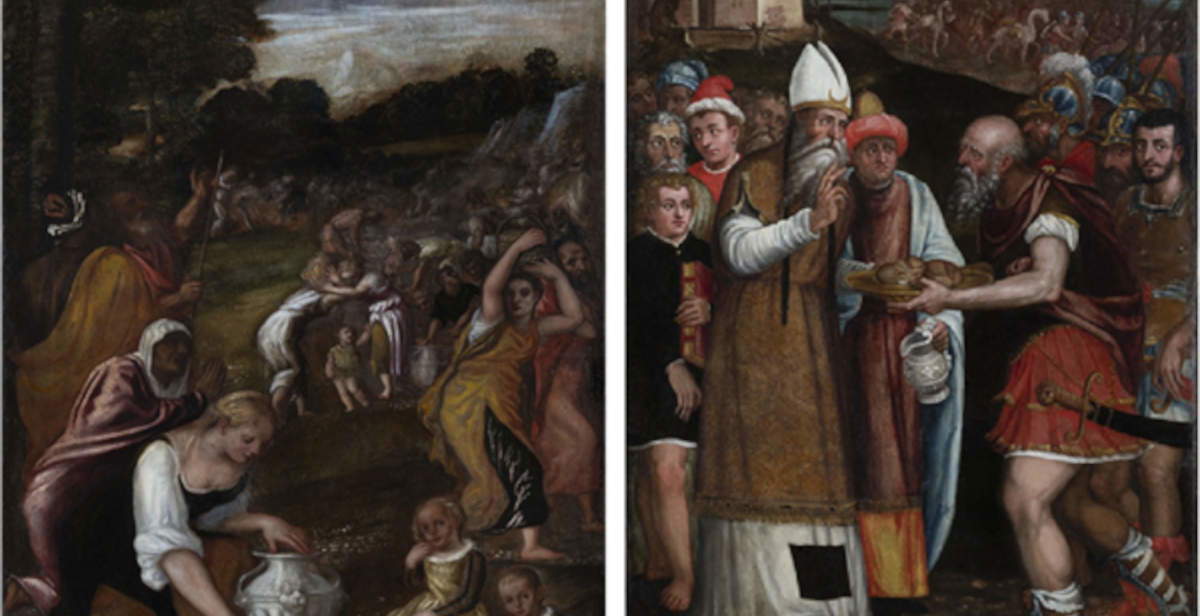 |
| Two monumental 16th-century paintings by Andrea Schiavone have been returned to their home in Bergamo |
Warning: the translation into English of the original Italian article was created using automatic tools. We undertake to review all articles, but we do not guarantee the total absence of inaccuracies in the translation due to the program. You can find the original by clicking on the ITA button. If you find any mistake,please contact us.