



by Redazione 21/10/2026


Categories: Contemporary art / Disclaimer
In Australia, Tony Albert, an Indigenous Australian artist, asked the public to donate souvenirs, tableware, and other items that depict Indigenous Australians through racist stereotypes for one of his exhibitions. Thousands of items were donated. And now these items will become part of a process of critically reexamining Australian history and culture.


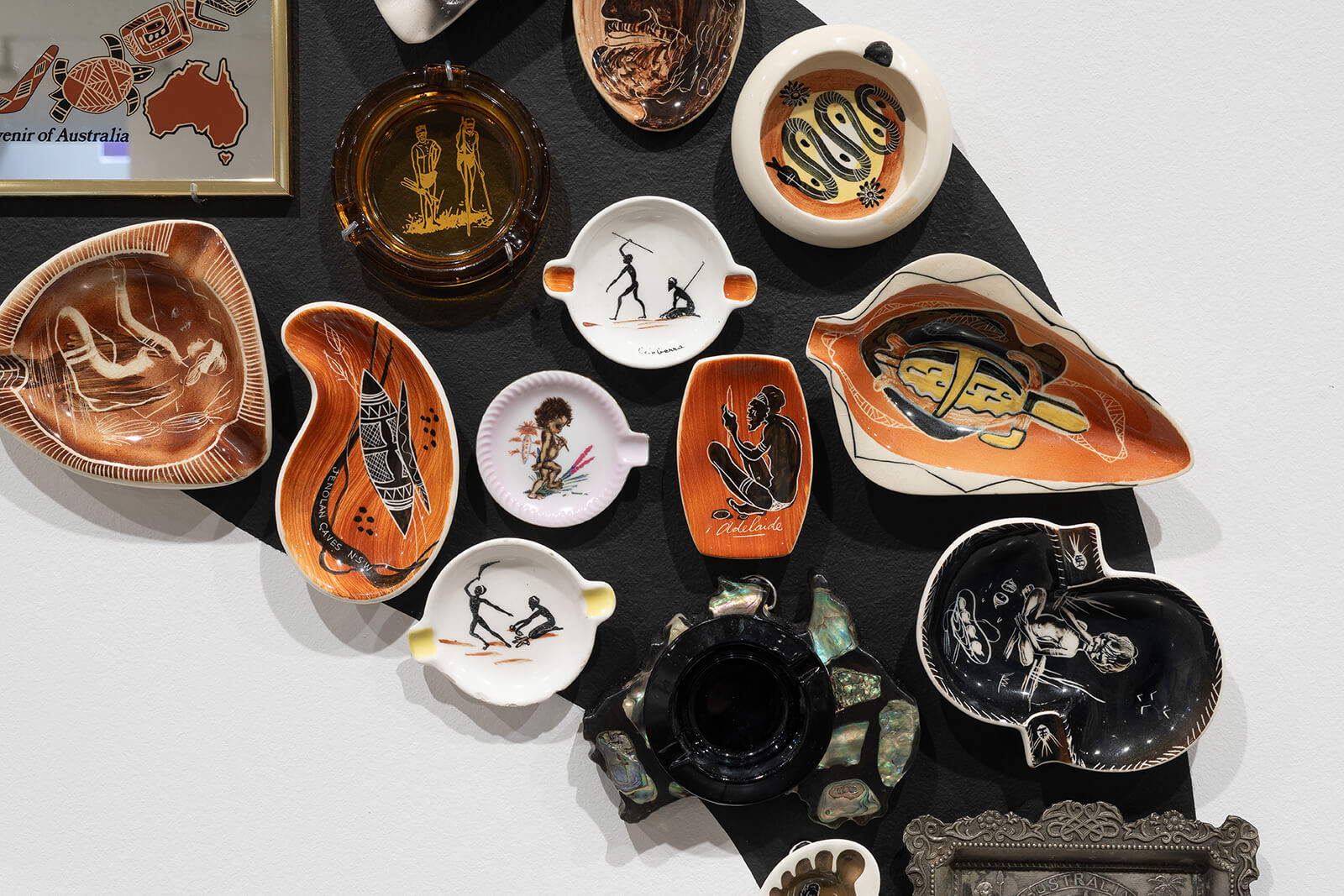
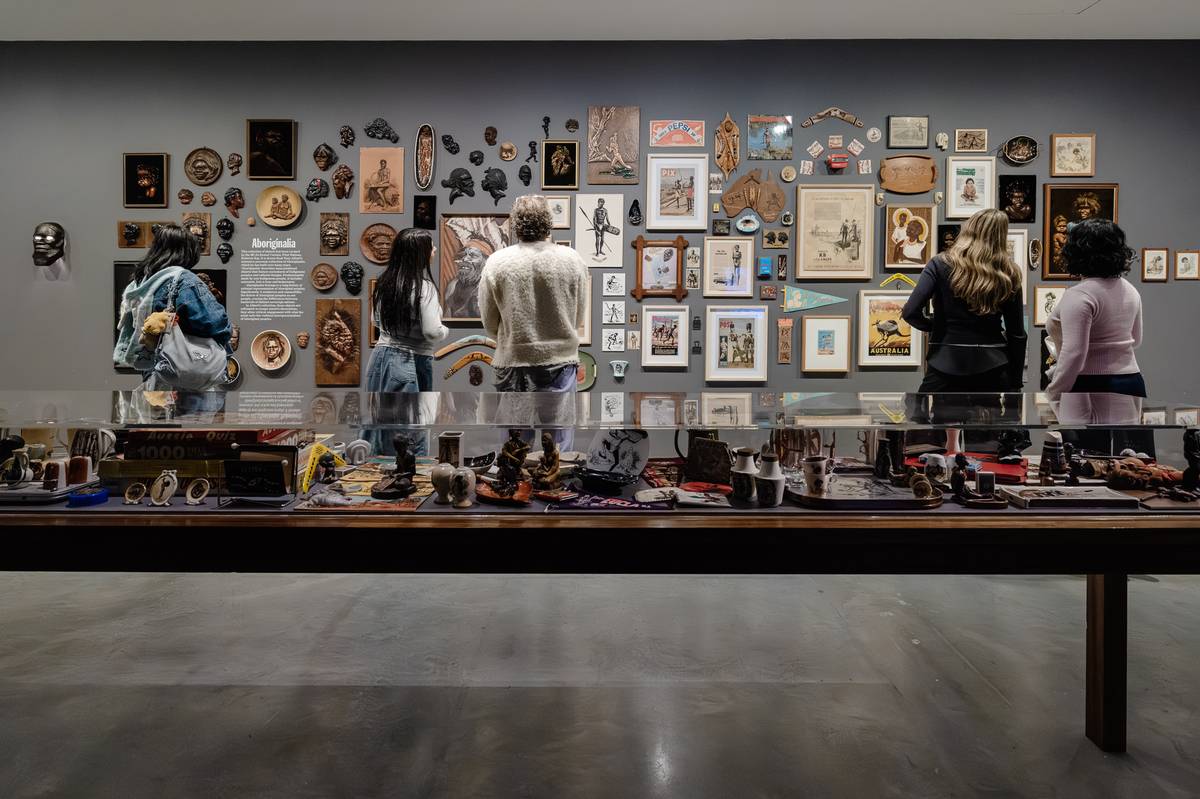
They used to be found in kitchens, on dining tables, in bathrooms, and in the windows of souvenir shops. They were mugs, plates, ashtrays, figurines, placemats, and decorative items that depicted Australian Aboriginal people through caricatures and stereotypes, often with no respect for the people and cultures represented. For decades, these items circulated in everyday life, transforming Indigenous identity into a commercial image. Now, thousands of these objects are finding a new purpose: no longer mere household items or tourist souvenirs, but material evidence of a colonial history that must be confronted and understood. Leading this transformation is Tony Albert, an Indigenous Australian artist from the Girramay, Kuku Yalanji, and Yidinji peoples. Five months ago, on the occasion of his exhibition *Not a Souvenir* at the Museum of Contemporary Art Australia in Sydney, which opened last May, Albert issued a public appeal asking people to donate to him objects that fall into the category of “Aboriginalia”: souvenirs, household items, and other artifacts that depict Indigenous Australians and their cultures through stereotypical—and often racist—representations, produced and marketed by non-Indigenous people.

The response was overwhelming, as Albert told the British newspaper The Guardian. In the final days of the exhibition, which closed on October 19, 2026, the museum found itself preparing to pack and ship approximately 2,000 items donated by the public, destined for the artist’s studio in Brisbane. The donations arrived throughout the exhibition, sometimes in surprising quantities: a single shipment included 120 plates, cups, and saucers, while another contained 200 beer coasters. Among the items received was also a statuette nearly one meter tall, depicting an Aboriginal man with a spear.


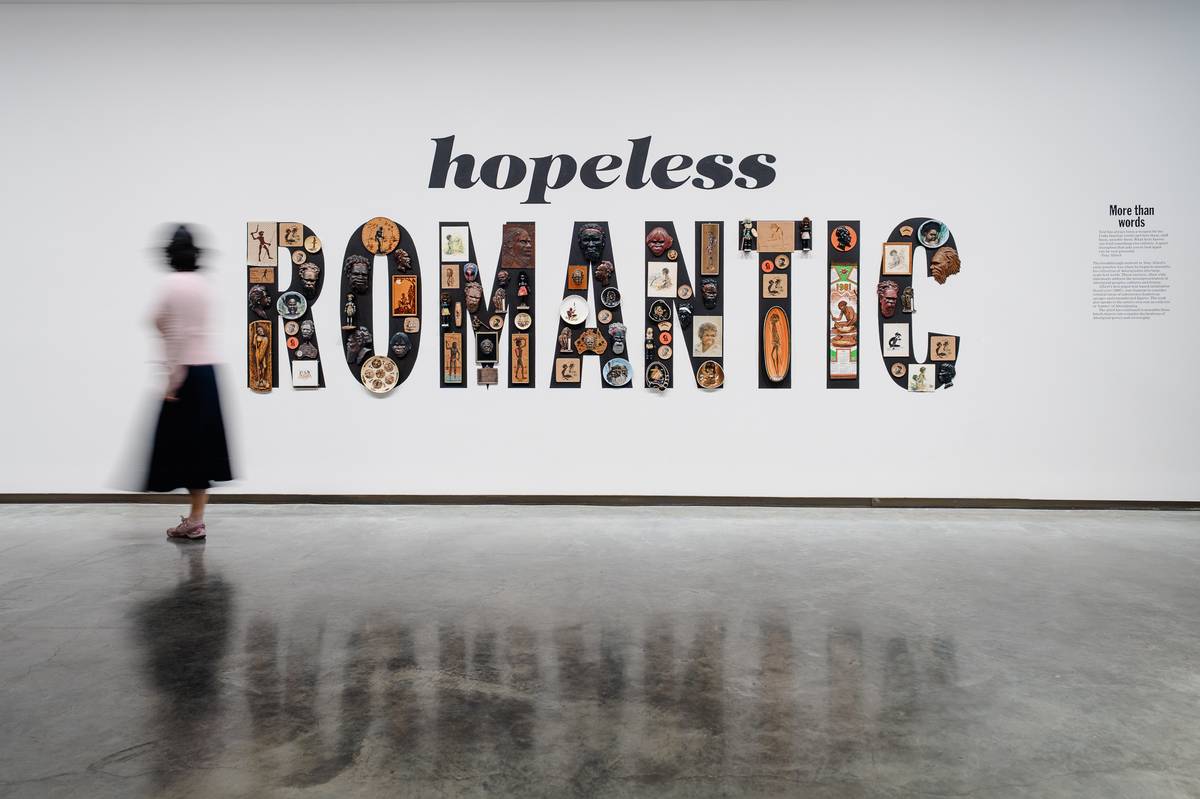
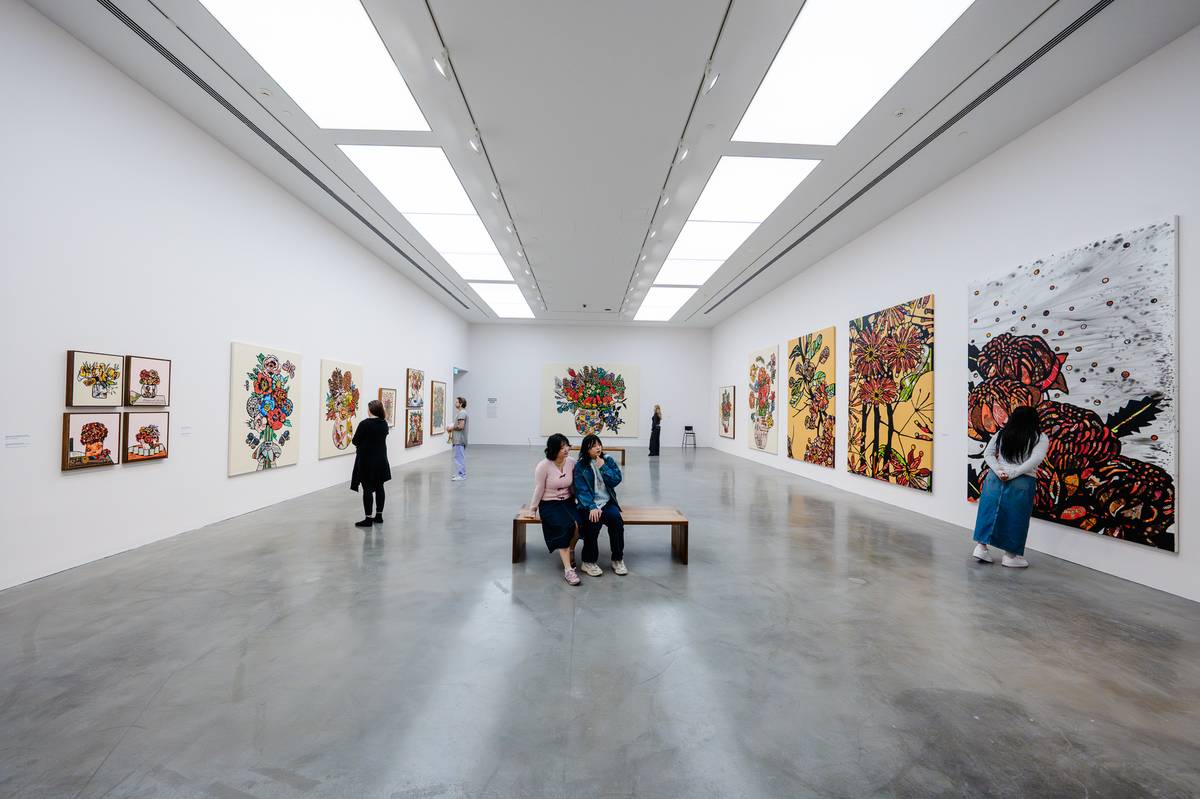
The project is part of a body of work that Albert has been developing since childhood and which found one of its most comprehensive expressions in the exhibition *Not a Souvenir *. The exhibition, curated by Bruce Johnson McLean—an Indigenous curator from the Wierdi people—brought together over 150 works from Australian public and private collections, including sculptures, photographs, installations, paintings, and assemblages, as well as new commissions. At the heart of the exhibition were objects collected by the artist over the years, evidence of a commercial imagery in which Indigenous identities have often been reduced to stereotypes.
A collection that began in a thrift store
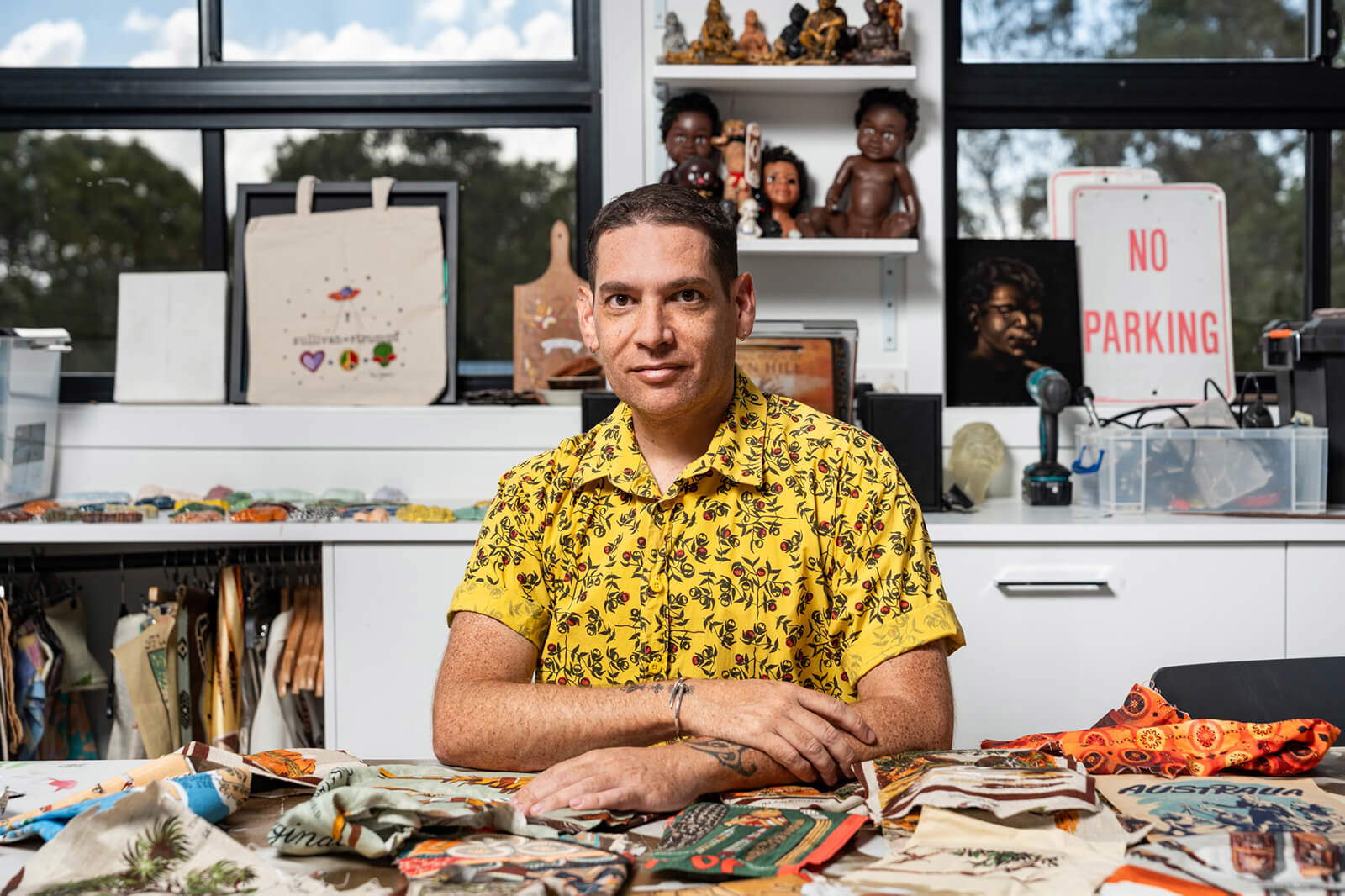
Albert’s relationship with Aboriginalia began long before his artistic career. Raised in Brisbane, the artist began collecting these artifacts as a child, searching for them in his city’s thrift stores. His personal collection gradually became a tool for examining how Aboriginal people have been represented in Australian popular culture. The artist thus began collecting mugs, plates, trays, playing cards, statuettes, and figurines, without limiting himself to any particular type of object. What began as a childhood interest has, over time, become a central component of his artistic practice.
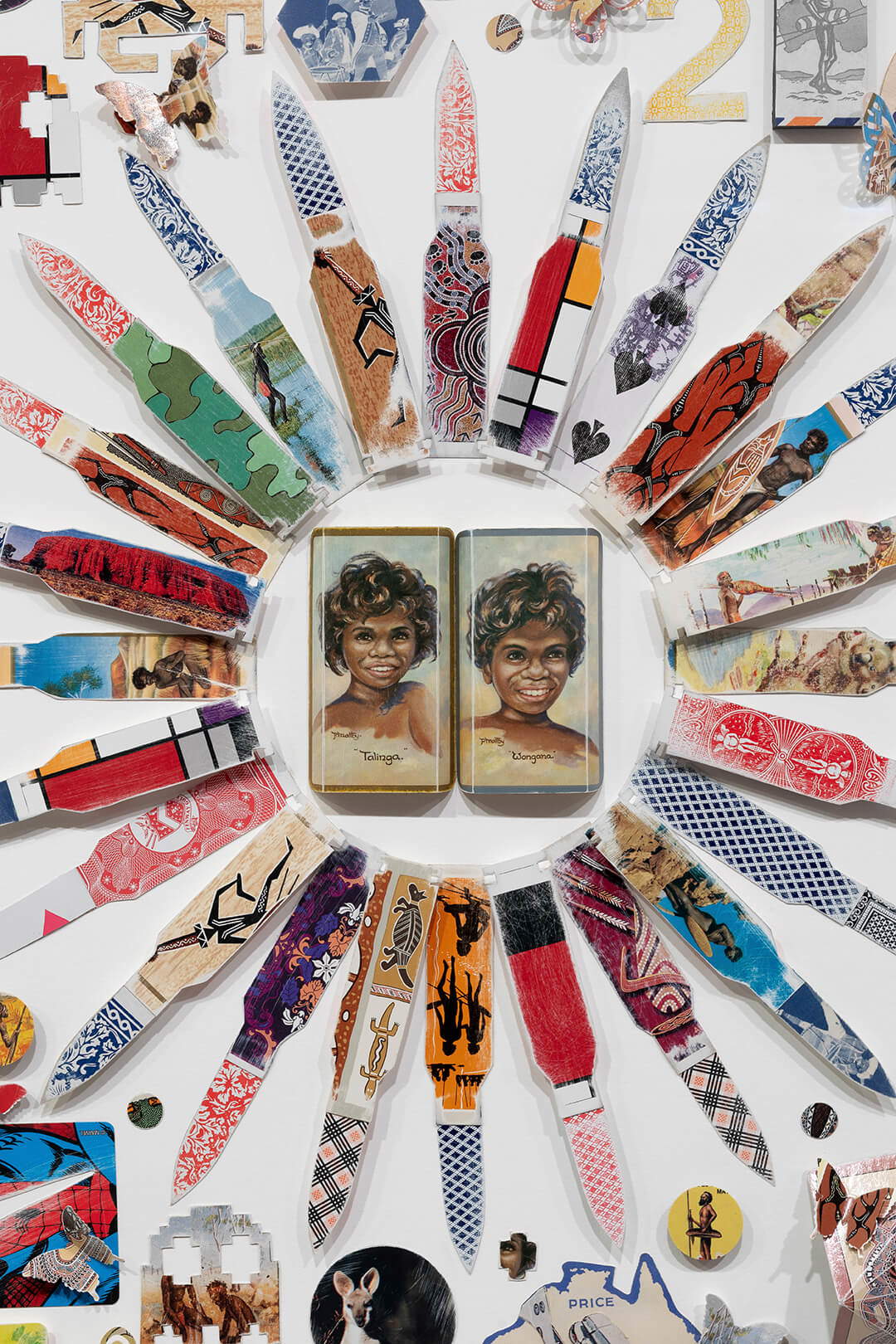
The exhibition at the Museum of Contemporary Art Australia brought together works created using various media, ranging from photography to sculpture, from installation to painting and assemblage. In these works, Albert has reclaimed images disseminated by commercial culture, stripping them of their original function and placing them in new contexts. The objects are not simply discarded or condemned: they become materials through which to examine the history of the representation of Indigenous Australians, challenge prejudices, and affirm forms of self-representation.
The museum’s director, Suzanne Cotter, summarized this tension by noting that the artist’s work addresses the power of images to inflict harm, but also to contribute to a possible healing. In her view, “Not a Souvenir” was , she stated, “a radical reexamination of Australia’s complex history,” as well as “a joyful and deeply optimistic exhibition” and “an invitation to all Australians to play an active role in telling the truth, shifting these objects from a place of private discomfort to a public space of creativity and cultural vitality.”
The collection of objects from the public expanded this exploration, bringing into the project artifacts that did not belong to the artist’s private collection. The act of donation thus became an integral part of the initiative: those who submit an object do not merely get rid of it, but help remove it from everyday circulation and make it available for a new critical interpretation.
When a Souvenir Becomes a Testimony to Colonialism
The category of “Aboriginalia” encompasses a wide variety of objects, united by the way they represent Indigenous peoples through stereotypical imagery: these are often mass-produced items, made to be purchased as travel souvenirs or used in domestic life. It is precisely this familiarity that constitutes one of the most significant aspects of Albert’s research. It is not only the images that interest the artist, but also the context in which they were produced, sold, and used. A caricature on a plate or a figurine placed in the home is not confined to the realm of representation: it enters everyday life, becomes part of the domestic environment, and helps normalize a particular way of viewing the people depicted. These artifacts, moreover, can be rare and even financially valuable. But their most interesting value, for Albert’s work, lies in what they reveal about the ways in which Aboriginal people have been depicted and the ease with which images of this kind have entered Australian homes.
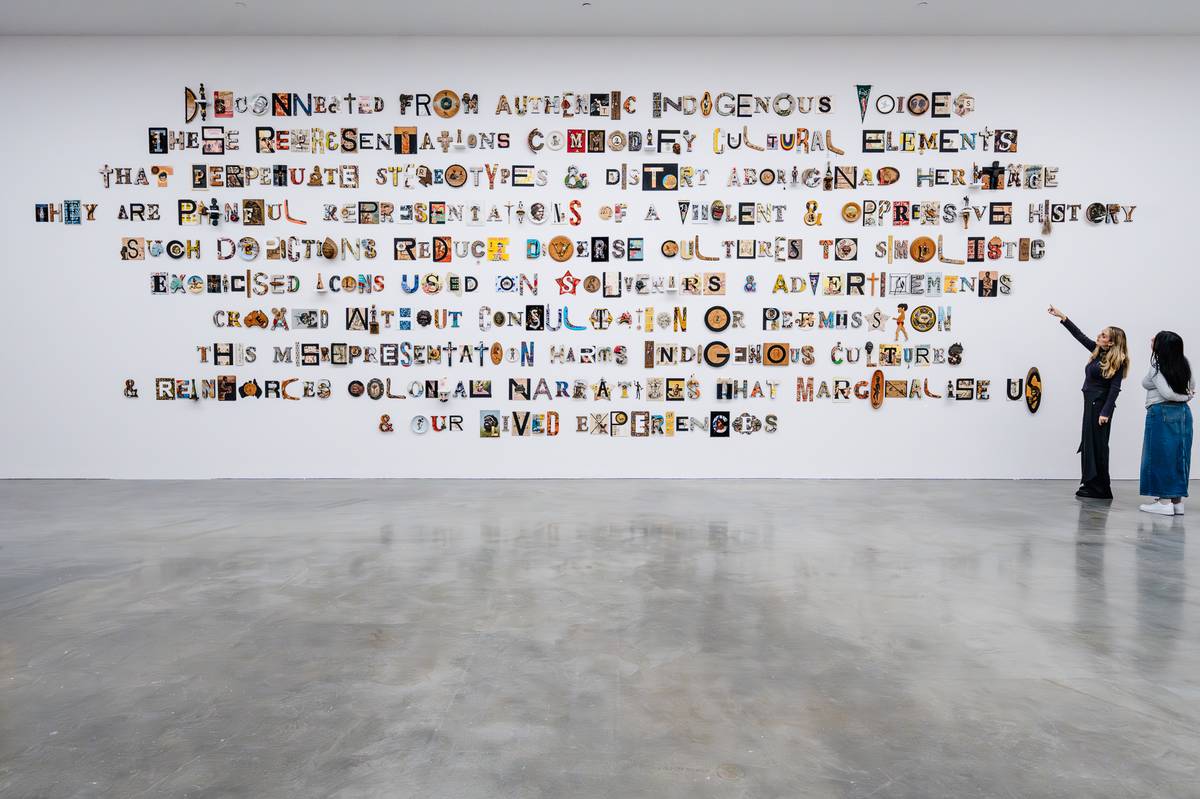
The exhibition also addressed this issue by drawing on the museum’s location. The Museum of Contemporary Art Australia is situated in the Tallawoladah area, on Sydney Harbor, near The Rocks—a site of great historical significance in the early colonial period and now associated with international tourism and souvenir culture. The contrast between the history of the site and the tourist consumption of Indigenous images is one of the central themes of the exhibition. The goal is not to erase the material traces of that past, but to transform them into tools for discussing it. Through text-based installations, photographs, and assemblages, Albert reworks the objects, bringing to light the power structures and cultural myths that have accompanied their dissemination.
Two thousand donations and not a single hate letter
When the Museum of Contemporary Art Australia launched its appeal, it was unclear how the public would respond. Antares Wells, the museum’s assistant curator, told The Guardian that she had feared the initiative might expose Albert to hostile reactions, given the political and cultural tensions surrounding the debate on Indigenous history in Australia. The response, however, turned out to be different from her initial concerns. Wells explained that she hadn’t seen a single hate letter and found people’s willingness to engage with these materials encouraging. Donations arrived daily throughout the exhibition, ranging widely in quantity and type—from individual objects to collections comprising hundreds of pieces.
The volume of donations transformed the call for submissions into a collective extension of the artist’s research. Alongside the artifacts Albert had collected since childhood, objects from homes, families, and private collections were added, each with its own story. The artist stated that he was struck not only by the number of donations but also by the stories and conversations that accompanied them. He described as significant people’s willingness to engage with this history and to entrust the objects to him, so that together they might take on new meaning.
The collection is also set to continue beyond the exhibition’s closing: although the museum’s drop-off points were removed after October 19, Wells clarified that the museum will continue to gratefully accept additional objects of Aboriginalia, which will then be transferred to Albert.
From Collection to Art
The public appeal stems not only from a desire to remove the objects from circulation. Albert’s project also involves reusing and recontextualizing them through his own work, transforming materials linked to prejudice into opportunities for critique, irony, and cultural affirmation through art. The artist told The Guardian that, if it were up to him, he would remove all these artifacts from circulation, but he also clarified that the initiative is not about guilt, but rather about what can be done based on this history: taking the objects and transforming them into something that celebrates the survival and vitality of the world’s oldest living culture, as Albert defines Indigenous Australian culture.
The objects, therefore, are not viewed merely as artifacts to be preserved at a distance, but as materials from which to craft new forms of narrative. Their reclamation brings to light images that have circulated for decades without necessarily being scrutinized, while the artistic practice places them in a context where they can be discussed.
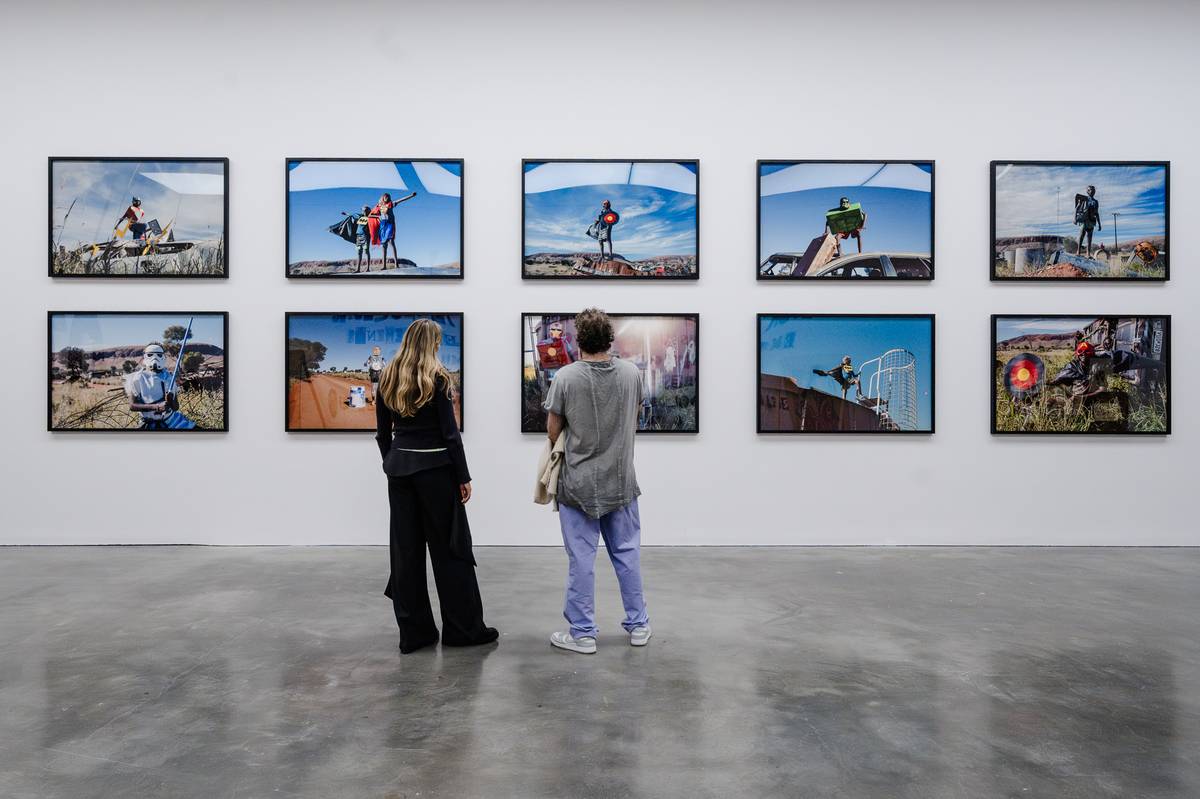
The exhibition *Not a Souvenir*, the largest ever dedicated to Tony Albert’s work, brought together works from public and private collections as well as new commissions, including his largest text-based work to date and previously unexhibited photographs from the *Warakurna Superheroes* series. The exhibition also featured an installation of Aboriginalia objects from the artist’s personal collection, curated by Rebecca Ray, the museum’s former curator of First Nations art.
With the exhibition’s closing and the arrival of new donations, the story does not end here: the thousands of objects collected will continue to fuel Albert’s research, as he considers collecting a fundamental part of his life and artistic practice. What is changing is our understanding of the narrative potential of these artifacts: to tell stories, challenge established perceptions, and create something meaningful from a difficult history. Cups, plates, figurines, scarves, and household items that once seemed like mere souvenirs thus become tools for examining collective memory. Their fate is no longer merely to be preserved or discarded, but to be reexamined, understood within the context in which they were produced and used, and transformed into testimonies of a history that continues to be debated.
|
| In Australia, an artist is asking the public to hand in racist items—and thousands are coming in |
Warning: the translation into English of the original Italian article was created using automatic tools. We undertake to review all articles, but we do not guarantee the total absence of inaccuracies in the translation due to the program. You can find the original by clicking on the ITA button. If you find any mistake,please contact us.