




by Redazione 10/09/2026



Categories: Contemporary art / Disclaimer
A work sure to spark debate: among the new works in the NIGHT exhibition at the Neue Nationalgalerie, Maurizio Cattelan presents *Dust*, which transforms an ordinary fire extinguisher into a container for the ashes of one of the artist’s friends.
Maurizio Cattelan has created a work that holds the ashes of a deceased friend. The piece is titled *Dust*, one of the new works presented as part of *NIGHT*, the exhibition that the Padua-born artist opened today at the Neue Nationalgalerie in Berlin after winning the 2026 edition of the Preis der Nationalgalerie. The work consists of an ordinary fire extinguisher that, while retaining its usual appearance (in the installation, it has in fact been placed on the floor, just like any ordinary fire extinguisher), conceals cremated human remains inside, thereby transforming a device normally associated with emergencies, rescue, and safety into an unexpected vessel of memory.
The title of the work, *Dust*, refers both to the material nature of ashes and to a passage from the Book of Genesis, according to which man is dust and to dust he shall return—an expression also echoed in the Christian funeral rite in the phrase “ash to ash, dust to dust.” The work thus evokes the inevitability of death and the idea of a cycle that brings everything back to its point of origin. By appropriating a common industrial object to turn it into a work of art—following a strategy rooted in the tradition of the ready-made— Cattelan shifts its meaning from utility to reflection: the fire extinguisher, a familiar, everyday object, thus becomes a silent memorial, capable of imbuing an ordinary item with an intense sense of presence and, at the same time, of absence. The work, as specified by the exhibition organizers, was created in accordance with the wishes expressed by the deceased, who had personally chosen this form for his own memorial. Physically, *Dust* is composed of steel, plastic, rubber, glass, and cremated human remains, and is dated 2026.



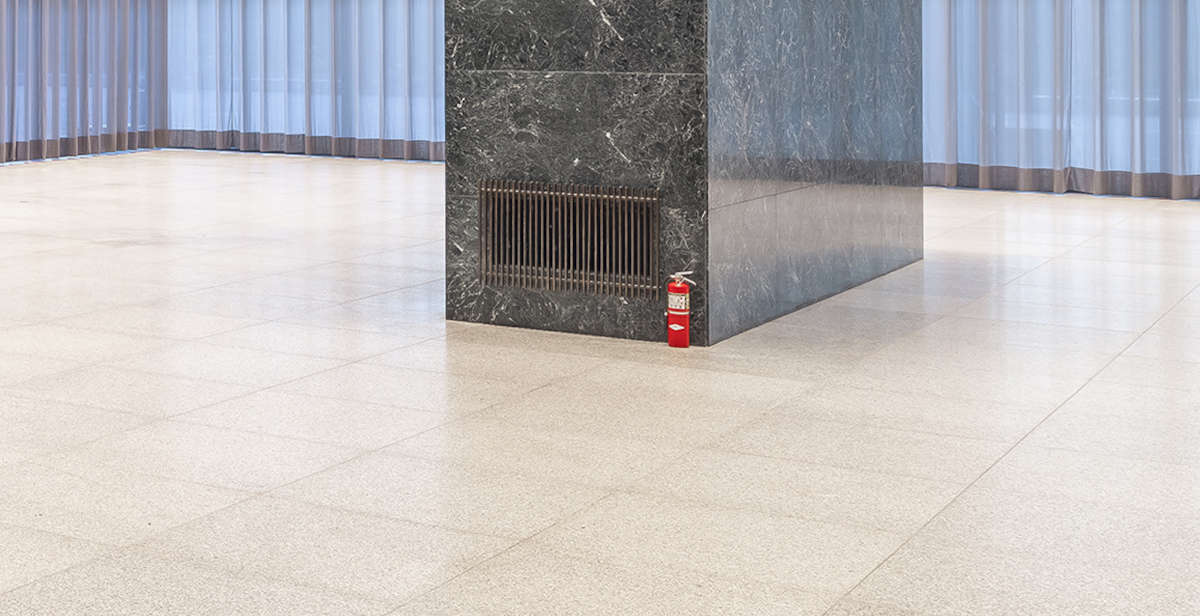
The work is part of NIGHT, the first major solo exhibition in Germany dedicated to Maurizio Cattelan, curated by Lisa Botti, curator at the Neue Nationalgalerie, together with the museum’s director, Klaus Biesenbach. The exhibition, conceived specifically for the famous glass hall designed by Mies van der Rohe, will be on view from September 10, 2026, to March 7, 2027, and brings together key historical works by the artist alongside a series of new pieces, including *Dust*. The overall installation gives the museum the character of a contemporary church, conceived as a space for contemplation, elevation, and reflection, and the entire exhibition revolves around the themes of history, power, memory, identity, and faith.
To underscore the personal and direct connection between the work and the artist’s emotional world, art critic Fabio Cavallucci also weighed in, commenting on his Facebook profile on a photograph showing him standing next to Cattelan right in front of the fire extinguisher-reliquary. In his comment, Cavallucci noted that he was with Maurizio Cattelan and another friend of the artist, whose ashes are preserved inside the fire extinguisher that has become a work of art. Cavallucci further described this situation as a “tragicomic ending, as fragile as life itself, ready to vanish in an instant if someone were to pull the lever on the device.”
Cattelan’s gesture with *Dust* thus fits perfectly into the overall logic of *NIGHT*, an exhibition that, as the artist himself has emphasized, does not concern darkness in the literal sense, but rather the loss of certainty, while remaining a temporary condition that always carries with it the possibility of a new beginning. In this context, the fire extinguisher transformed into a sort of secular reliquary becomes one of the most direct and unsettling images of the entire exhibition: an object designed to intervene in moments of danger and loss, which here instead holds what can no longer be saved of a person, offering the visitor a reflection—as intimate as it is universal—on the relationship between life, death, and what remains of an individual after the end of their existence.
Cattelan is not, however, the first artist to use the ashes of a deceased person in a work of art. There are several precedents: the American artist Bill Fink, for example, created a portrait in 1992 of a 39-year-old Californian, Bob Christensen—who had died of AIDS the previous year—using his ashes, always respecting the man’s wishes. Furthermore, the German artist Heide Hatry created a series, *Icons in Ash*, consisting of photorealistic portraits also made with human ashes. The American painter Wayne Gilbert , on the other hand, created paintings using unclaimed cremated human remains as material, which he obtained from funeral homes. Furthermore, the British artist Bea Haines used the ashes of a deceased uncle by mixing them with the pigments in some of her watercolors. Another interesting case is that of the Iraqi-American artist Wafaa Bilal, who , in the series *Ashes*, created photographs of small, ruined spaces, an allusion to the war in Iraq, replacing the human figures in the originals with 21 grams of human ashes, thereby imbuing the cremated remains with a meaning that is at once collective, political, and spiritual. Cattelan, therefore, joins this already sizable group of artists in his own way.
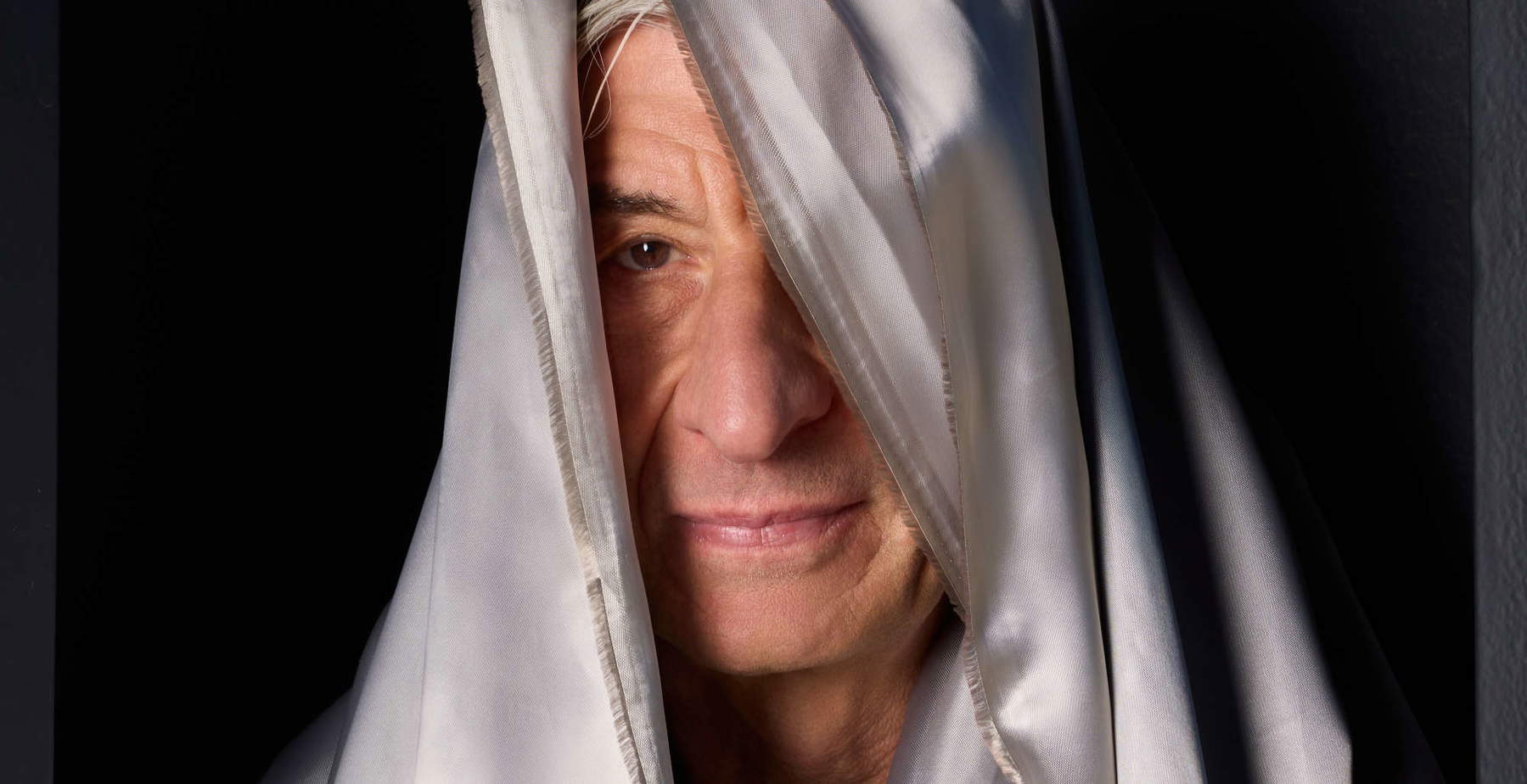 |
| Maurizio Cattelan created a work of art using the ashes of a deceased friend |
Warning: the translation into English of the original Italian article was created using automatic tools. We undertake to review all articles, but we do not guarantee the total absence of inaccuracies in the translation due to the program. You can find the original by clicking on the ITA button. If you find any mistake,please contact us.