





Like the Dadaists ’ “fausses nouvelles ”: the fake article by Umberto Eco that circulated widely on social media over the past few hours before being identified as a hoax could be considered a kind of work of art. A fake page from *La Bustina di Minerva*, the column Umberto Eco wrote for *L’Espresso*, was shared on social media: the image showed page 114 of the weekly magazine, dated April 11, 2010, featuring an article titled “The Machine That Will Have Read Everything,” written by Umberto Eco for the famous column *La Bustina di Minerva *.
Accompanied by the phrase “Umberto Eco had already understood everything—or almost everything—about artificial intelligence,” the news quickly spread across the web. For hours, readers, university professors, intellectuals, and journalists—and even a Nobel laureate like Giorgio Parisi—hailed the text as the Piedmontese semiologist’s definitive prophecy: a vision capable of anticipating—years in advance—ChatGPT, the hallucinations of language models, students’ shortcuts, and the risk that synthesized content would pollute the web. There was, however, one crucial detail: Umberto Eco never wrote that text.
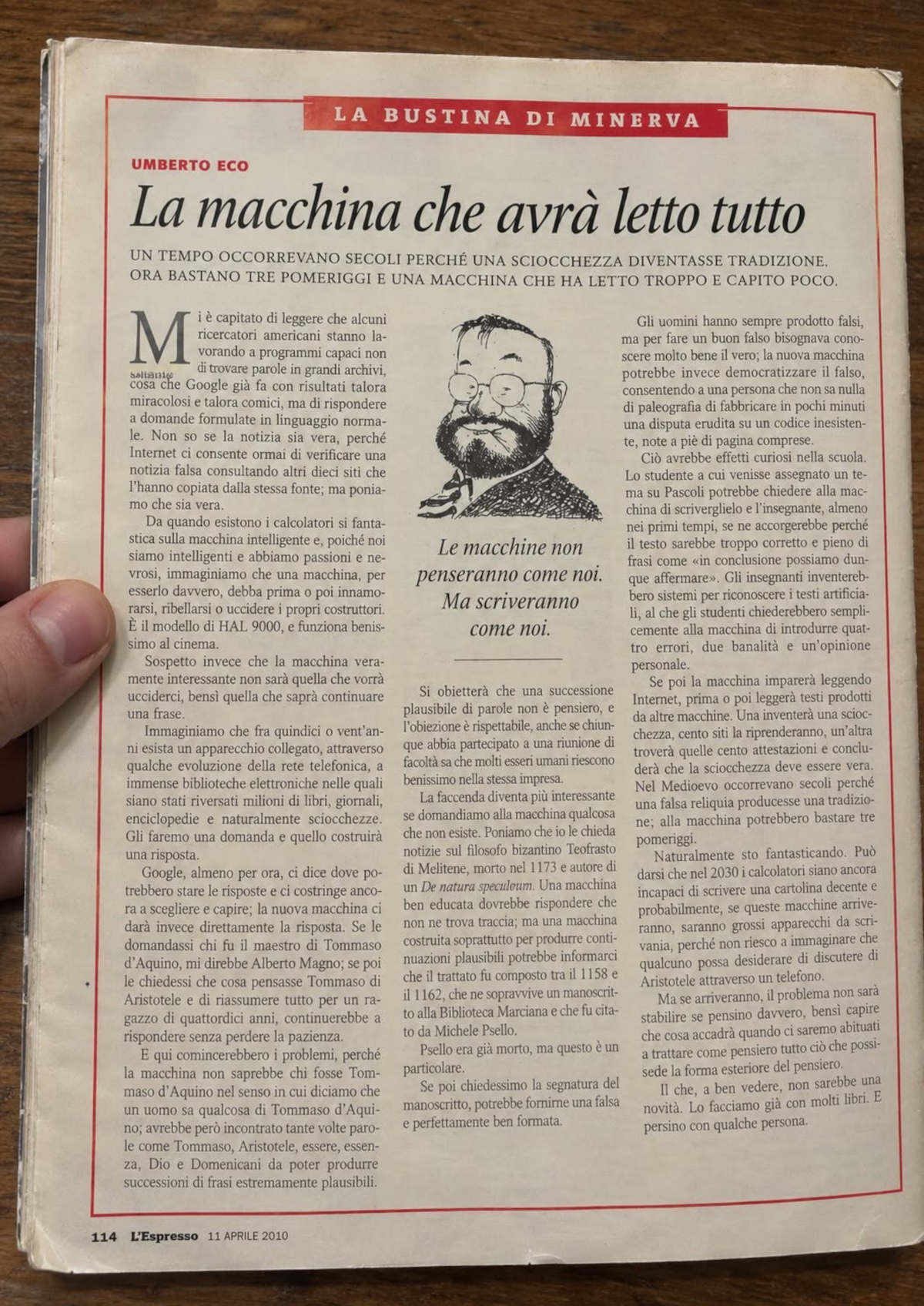
The nature of the hoax was first revealed by a series of investigations conducted by news outlets and fact-checking platforms such as Open, BUTAC, Tlon, and Mac Peer, and then by the author of the hoax himself, Ciro Ascione, who claimed it was the result of a temporary alliance between the human who conceived and circulated it and the artificial intelligence that served as the operational arm of the... performance. The image shared on Facebook, despite the credibility of the fake Eco’s style, bore an irrefutable technological trace: image analysis conducted using OpenAI tools confirmed that the layout had been generated by artificial intelligence. A clear visual clue betrayed the document’s synthetic nature: beneath the large letter “M” at the beginning of the text appeared a distorted, meaningless word—a typical graphical artifact of image generators. Added to this was a decisive chronological error: April 11, 2010, fell on a Sunday, a day when *L’Espresso* was not available at newsstands, rendering the page numbering shown completely non-existent. During the same period, on April 16, 2010, the magazine instead published an authentic “Bustina di Minerva” column by Eco, titled “Alto medio basso.”
The origin of this fabrication bears the signature of Ciro Ascione, a media scholar and former middle school teacher born in Torre del Greco in 1968, best known online for his “trollings”—as they’re called in technical jargon—that is, his provocative actions carried out via digital media. Author of books such as *La grande bottega degli orrori* (1996), *Videogames - Elogio del tempo sprecato* (1999), and *Troll - Come ho inguaiato Internet* (2006), Ascione has been known since the late 1990s in Italian newsgroups for his online provocations, including the creation of the fake Carlo Borromeo Association and the hoax regarding the death of the character Marge Simpson in 2008. On October 1, 2026, Ascione published the text of the fake “Bustina” on his Facebook page, transcribing it in its entirety and presenting it as authentic.
Beyond the visual forgery, the most fascinating aspect of the operation lies in the content of the apocryphal text and its ability to mimic Eco’s style. The passage imagines that the machines of the future will not be rebellious supercomputers in the vein of HAL 9000, but devices capable of “continuing a sentence” in a plausible way. The text prompted reflection on hallucinations and the fabrication of historical fakes, showing how machines democratize deception by allowing anyone to construct erudite arguments and nonexistent quotations. The satire also touches on the world of education: it imagines students commissioning an AI to write an essay on Giovanni Pascoli, then asking it to deliberately insert errors, platitudes, and personal opinions in order to pass their teachers’ checks. Finally, it foreshadowed the danger of “model collapse”—that is, the effect of machines learning from texts generated by other machines: whereas in the Middle Ages it took centuries for a false relic to establish a tradition, a machine needs only three afternoons.
Intellectuals and scholars believed it because the page had the credible structure of an Eco essay: erudition, references to the Middle Ages, irony about mass culture, and the final quip about human beings. In the comments and fact-checking analyses, the operation was in fact interpreted—especially by BUTAC—as an act of conceptual and situationist art. Another of the internet’s best-known trolls, Ermes Maiolica, provocatively called it a “new Sistine Chapel of trolling.” Rather than a trivial hoax, the text turned into a sort of performance in which the educated public, having fallen for the deception, became the main actors in a demonstration of the fragility of fact-checking in the digital age. A dynamic entirely consistent with the teachings of the real Umberto Eco.
“Over the past two days,” Ascione later wrote, “a fake story I produced in half an hour using ChatGPT has been setting the agenda for the national debate on Artificial Intelligence. It has been shared by Giorgio Parisi, Luciano Floridi, Loredana Lipperini, Andrés Neumann, and so many other prominent figures that if they were to organize a flash mob, it would resemble a contemporary version of Raphael’s School of Athens. Andrea Colamedici, who made a killing last year with *Ipnocrazia*, attributed to the nonexistent Chinese philosopher Janwei Xun, immediately wrote an article on Tlon to debunk the text. It’s a bit like those chubby kids who snatch the ball away if they’re not the ones taking the penalty kick. Almost everyone attributed the nonexistent “Bustina di Eco” to artificial intelligence , completely forgetting the human lurking behind the prompt. Perhaps it’s more convenient for the national cultural elite to think they’ve been duped by an evil machine like Skynet rather than by a forger who bent the machine to his will. But, to paraphrase a scene from *Boris*, it’s best to keep the discussion among a few trusted friends.”
“At the very moment in history when society is bewilderedly asking itself where we’re headed with AI and what remains of our ability to distinguish reality from simulation,” wrote Ermes Maiolica, “this page arrived like a comet on Earth, sweeping away every trace of critical thinking in a second. And this is precisely where authentic art lies. What the lazy dismiss with the hasty label of ‘trolling’ is nothing other than eternal situationism—the reactivation of the necessary conceptual act that shakes the apathy of the cultural bubble. In a system that pushes art toward the commodification of the gallery fetish object, this work demonstrates that authentic art cannot be touched, cannot be sold, and does not even need to exist physically or historically as a ‘true’ fact. […] Eco, who devoted seminal essays and novels such as *Baudolino* and *Foucault’s Pendulum* to the power of the false, conspiracy, and document forgery, would have applauded this semiotic subversion. Congratulations to Ciro Ascione on this masterpiece, which I might perhaps call “the new Sistine Chapel of trolling.”
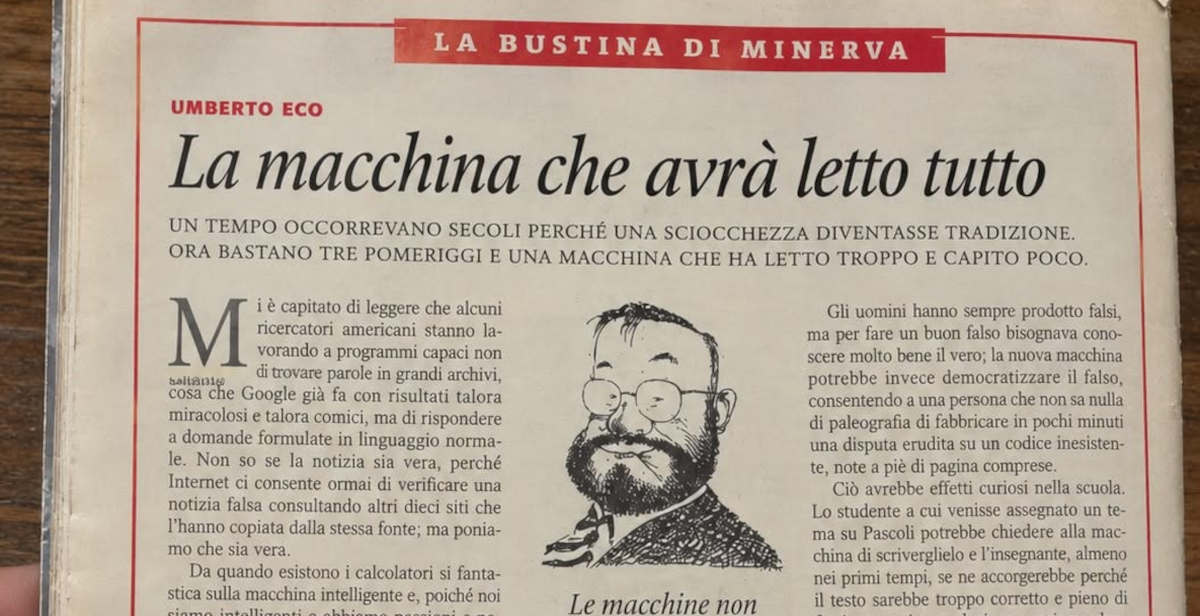 |
| The fake Umberto Eco created with AI: a performance that fooled intellectuals |

Warning: the translation into English of the original Italian article was created using automatic tools. We undertake to review all articles, but we do not guarantee the total absence of inaccuracies in the translation due to the program. You can find the original by clicking on the ITA button. If you find any mistake,please contact us.



























 IT
IT FR
FR DE
DE ES
ES CN
CN


