



by
Noemi Capoccia  @noe_capo
17/11/2026


Categories: Exhibition reviews / Disclaimer
From a Mesopotamian sculpture to Justin Bieber transformed into a contemporary relic, the exhibition “Broken” at Palazzo Strozzi in Florence explores the power of fragments. It’s an ambitious exhibition that doesn’t always succeed in weaving the works into a cohesive narrative. A review by Noemi Capoccia.


In the beginning, God created light, the heavens, and the earth; the waters were separated from the dry land, and, by divine will, vegetation sprang from the earth. Then came the celestial bodies—the sun, the moon, and the stars—called to mark the passage of time and the seasons. The waters are filled with fish, the sky with birds; animals appear on the earth, and finally, human beings, created in the image and likeness of God. This is the origin of everything: of the world, of cosmogonies, of the narratives through which humankind has sought to explain its presence on earth. God creates peoples, and these peoples—in turn, fashioned in the image and likeness of a powerful but far-from-perfect God—conquer and are conquered, plunder and are plundered, raid other lands, and vanish overnight. But they leave traces. Of what? Of their passage. A similar sense of loss is felt upon entering Palazzo Strozzi to visit *Broken*. *The Power of the Fragment*, an exhibition on view through January 24, 2027, is curated by C. D. Dickerson III, director of the Center for Advanced Study in the Visual Arts, and Andrew Sears, assistant curator of Northern European paintings, both of the National Gallery of Art in Washington. The theme is that of the fragment, explored through the history of sculpture, from archaeology to contemporary artistic practices. The exhibition is divided into ten sections and, through works, artifacts, and testimonies from different eras and places, ultimately tells a broader story: the history of the world—or at least some of the traces that remain of it, one might say. The fragment becomes a starting point, a condition from which to rethink the material and open up new expressive possibilities. The exhibition spans approximately 4,300 years, from around 2300–2250 B.C. to the present. More than four millennia of history, then, interpreted through what has been broken and what, precisely in its incompleteness, continues to tell a story.

The exhibition’s premise is clear. Sculptures have been damaged ever since they came into existence, and fragments exerta pull on usthat has psychological, aesthetic, and cultural roots: what appears incomplete can turn out to be surprisingly complete, sometimes even more intense than it was in its original, intact state. Some fragments are simply what remains after the passage of time; others, however, bear the marks of human action—whether intentional or unintentional, destructive or necessary. As Kaywin Feldman, director of the National Gallery of Art, and Arturo Galansino, general director of the Fondazione Palazzo Strozzi, observe, destruction is part of the very history of art: it is linked to artistic practice, religious devotion, and the processes of transformation and renewal within societies. But a fragment can also be the result of violence—first and foremost, thatof iconoclasm, but also the widespread and systematic violence wrought by wars, acts of vandalism, and colonialism.


The essay with which curator Dickerson III opens the exhibition catalog takes its cue from the Colossus of Rhodes. He tells us that Pliny the Elder, observing its remains scattered across the beach (between approximately 230 B.C. and 670 A.D.) after an earthquake had toppled the statue, wrote that even on the ground, the Colossus was a marvelous sight. From that observation, the curator derives the thesis underpinning the project: breakage is not a destructive force, and observing a broken statue can be just as moving as seeing it intact. According to Dickerson, the fascination with fragments is attested to by written sources and evidence dating back to prehistory, and today the cognitive sciences offer tools to explain it.

The historical trajectory outlined by the exhibition is one of gradual legitimization. In the 12th century, the theologian Ildebert of Lavardin went so far as to pay homage to Rome precisely through its ruins. A few decades later, in the 13th century, the English writer Magister Gregorius (Master Gregory) focused on the bronze fragments of an imperial colossus and recognized in the broken statues something that the intact ones could not evoke: a different emotion, linked in part to their incompleteness. In the 15th century, the Byzantine writer and diplomat Manuele Crisolora deemed them beautiful even in their mutilated state, while in the 16th century, the tension between the complete and the incomplete found its emblematic example in the Belvedere Torso, which escaped restoration thanks to Michelangelo’s protection, while nearly all other damaged statues were restored to their original state. The turning point came in 1815, when Canova refused to restore the Acropolis marbles brought to London by Lord Elgin, and was completed in the 1960s with the removal of Thorvaldsen’s restorations to the Aegina sculptures. Since then, fragmentation has been recognized as a guarantee of authenticity, and its normalization in archaeological museums has accustomed us to no longer questioning the significance of the break.
In his essay, Dickerson then points to two directions for further exploration. The first is moving beyond a Eurocentric interpretation: art historian Stanley Abe explores what a fragment means to the Buddhist cultures of East Asia, while the essays by Feldman and Sears examine the theme across cultures spanning several millennia that have placed the breaking of statues at the center of their belief systems. The definition of a fragment, it follows, is culturally relative: a perfectly intact African Bamiléké mask, for example, is in fact a fragment, because it is conceived as part of a costume. The second direction is cognitive. A dramatic fracture, such as the one that cuts the Colossal Head of a Young Man in half, prompts the brain to reconstruct the violence that caused it and to react as if faced with a real event, while mirror neurons—as described by Professor David Freedberg—drive us to simulate the pain we observe. Professor Rosemarie Garland-Thomson, however, from the perspective of disability studies, argues that this pain can be transcended and that the fragments call for compassion rather than pity. Added to these reactions is the pleasure of mentally completing what is missing—a sensation already described by Winckelmann when viewing the *Torso*—and that of focusing on details that the sculpture’s integrity would otherwise conceal, such as the hair on the *Head of a Young Man* (*Ephebe*) or the thumb of a colossal hand.
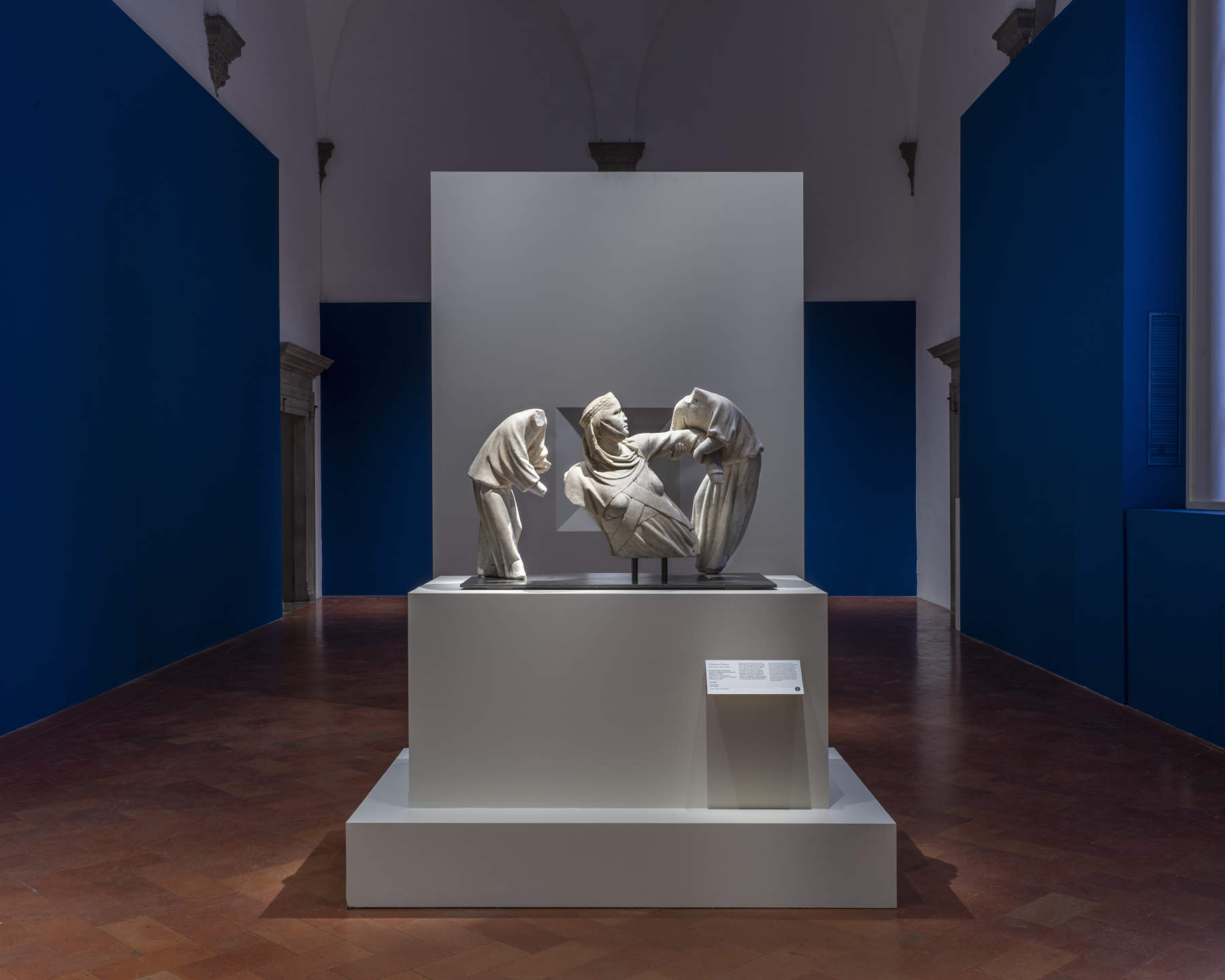
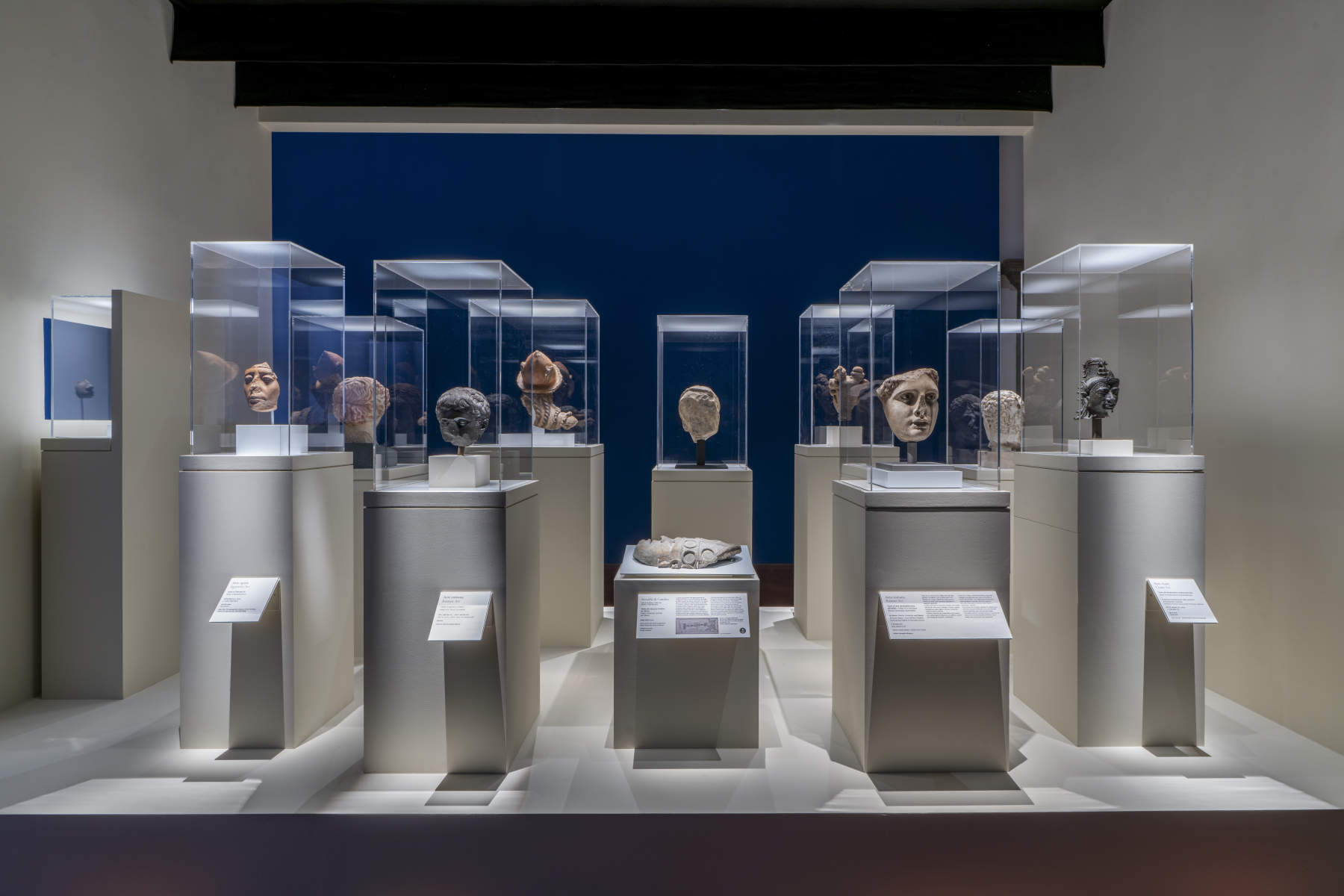
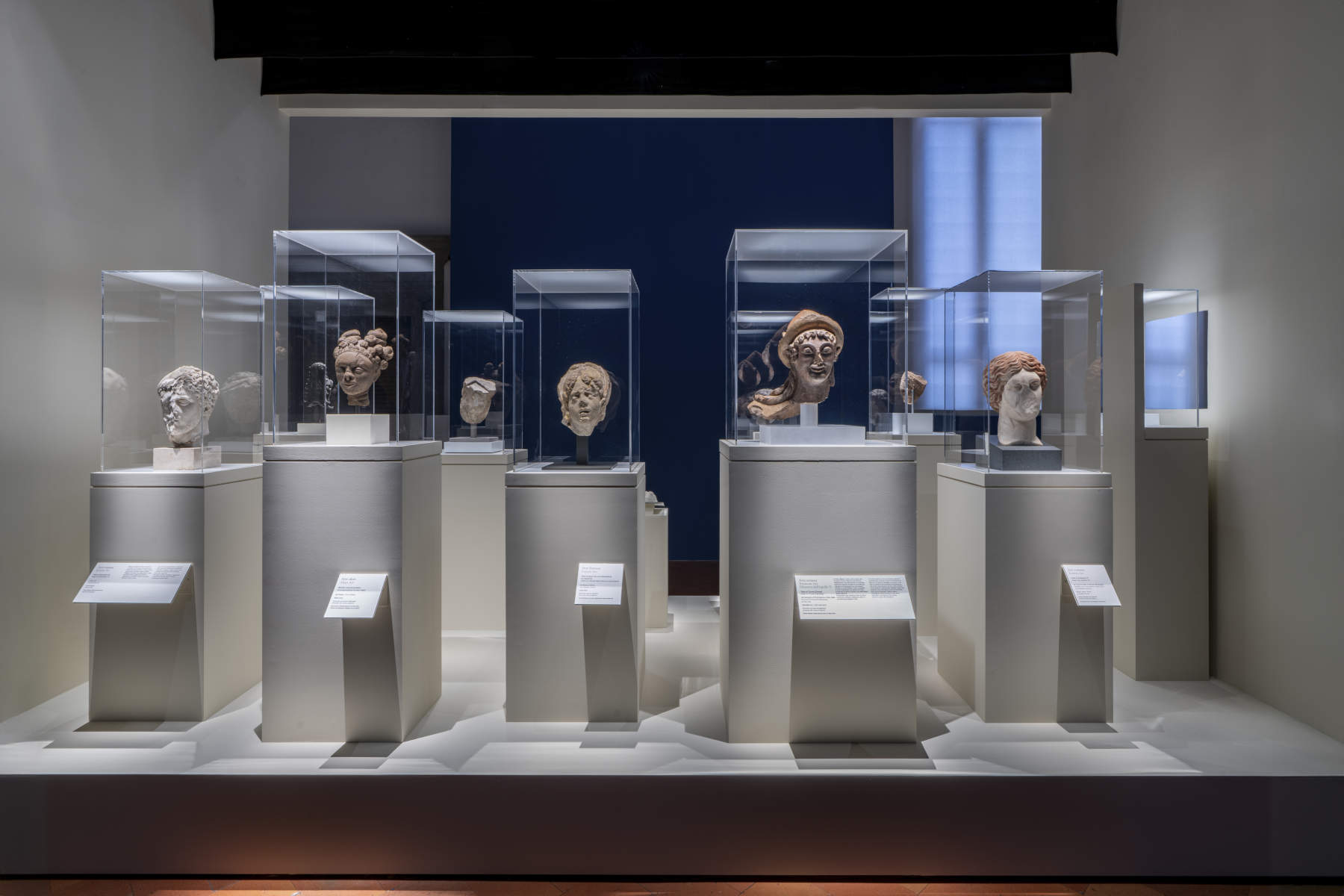
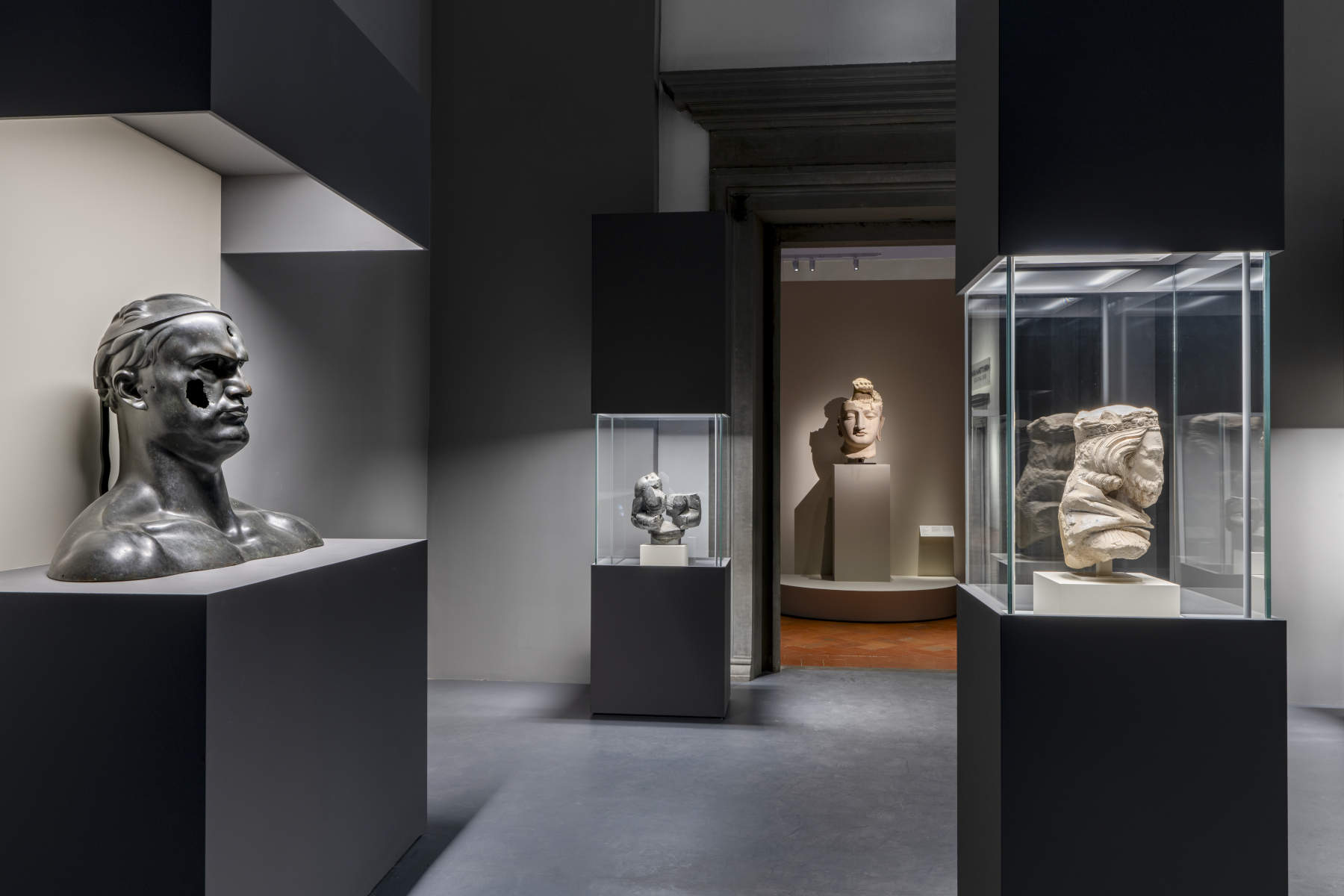
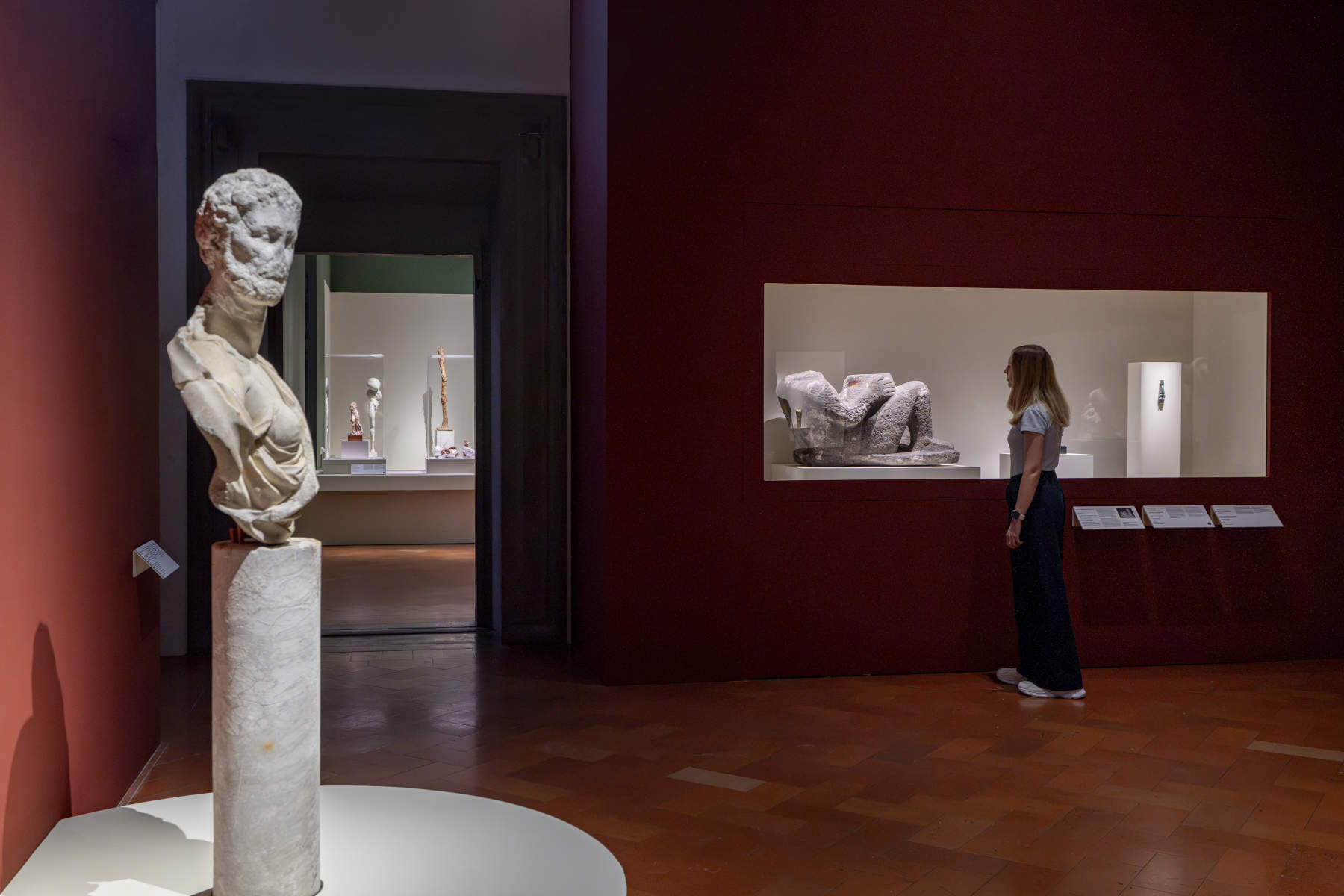
The exhibition opens with the “Faces” section, which brings together works that are very diverse in terms of era, provenance, and function, and introduces some of the themes that run throughout the entire exhibition. The fragments of Giovanni Pisano’s Funerary Monument to Margaret of Brabant serve as a starting point: faces that have survived to the present day under conditions shaped by various factors, ranging from natural erosion to political upheavals, from iconoclasm to excavations, and from looting to restoration and repurposing. Once separated from the bodies and complexes to which they belonged, these faces take on new meanings. The loss of context focuses attention on the features, expressions, and marks left by time and human intervention. In the Face of Sesostris III ( c. 1878–1840 B.C.), for example, the extraction, carving, deterioration, and finally the breakage of the material reveal the passage of millennia.
The Head of the Bodhisattva Avalokiteshvara, once part of a figure associated with the idea of infinite compassion, has instead lost its original spiritual meaning. In the Head of a Saint, from a Deposition into the Tomb, the pain expressed by the face seems to be reflected in the very mutilation of the sculpture. The section also includes works from classical antiquity, in which the fragment becomes an opportunity to ascribe new meanings to the material. The Head of a Young Man (Ephebe), mentioned earlier, which belonged to Johann Joachim Winckelmann, bears witness to the fascination that incomplete forms held in the 18th century. In the Head of a Goddess from Herodes Atticus’s Odeon, on the other hand, the oxidation of the bronze eyelashes has left marks on the cheeks that resemble tears: in this sense, an alteration caused by the passage of time is transformed into an image of intense emotional resonance.
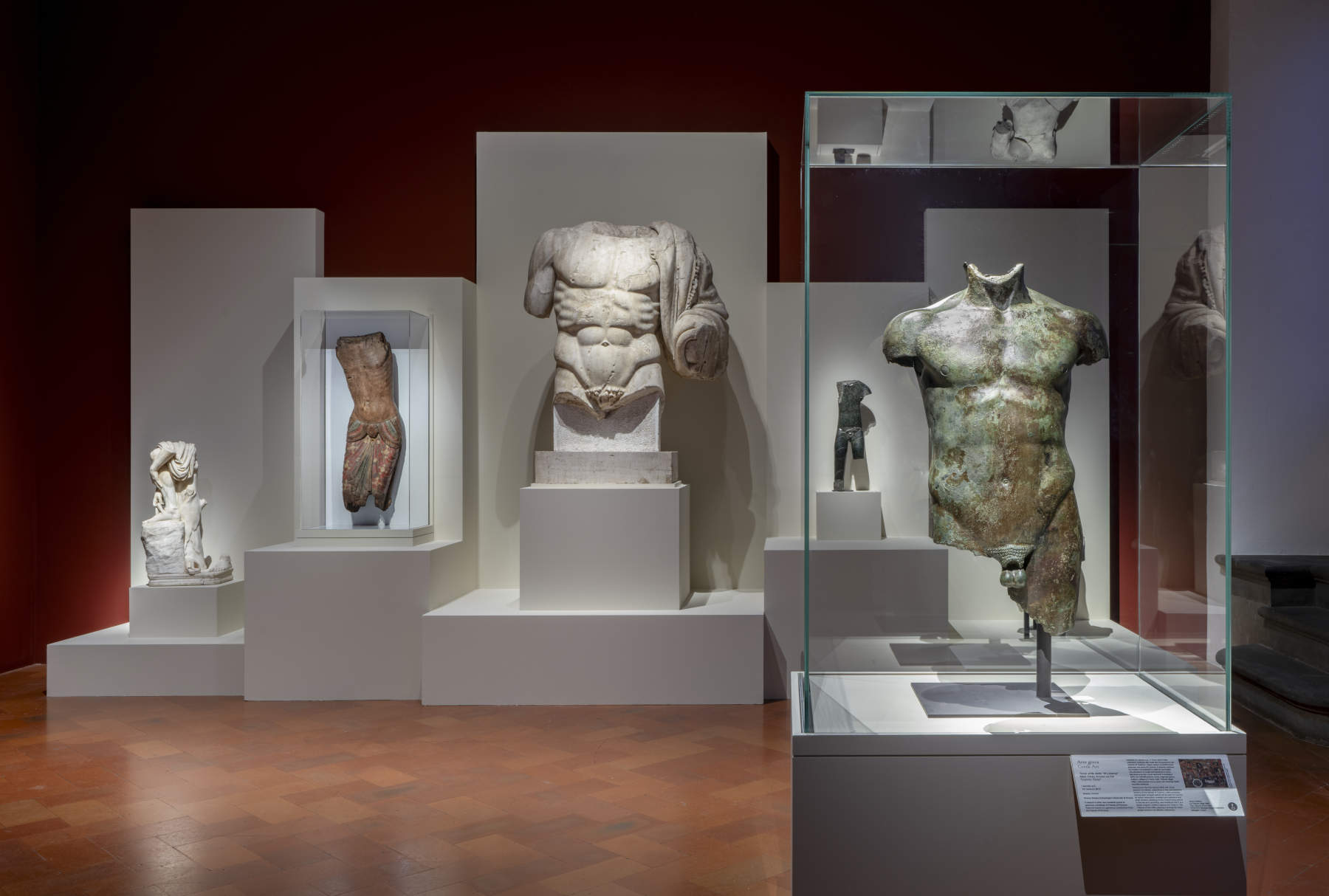
The second section, “Bodies, ” demonstrates just how varied the representation of the human figure can be and, conversely, how its integrity is anything but permanent. The Livorno Torso, the Warrior with Shield from Mont’e Prama (900–700 B.C., from Mont’e Prama, Sardinia), the Colossal Torso of Domitian as Hercules in Combat (150–170 CE), and the Scarified Woman from Tamtoc (200 CE) each tell , in their own way, a story of incomplete bodies. In this section, the fragment—rather than being the exception—ends up appearing as a condition destined to outlast the intact work.
Let’s begin with the male torso known as the “Livorno Torso.” Dating to the 1st century B.C., the sculpture entered the Medici collections in the mid-16th century at the behest of Cosimo I, after likely having been unloaded at the port of Livorno. Recent restoration has revealed encrustations and shell fragments, evidence of the sculpture’s long time spent at sea, and has provided new evidence supporting its identification as a Greek original. In the 18th century, Johann Zoffany depicted it in the Uffizi Tribune, placing it among the most precious works in the Medici collections.
In other cases, what remains of the sculpture allows us to reconstruct the gesture. In the Fragment of Hermes Tying His Sandal, the bent leg, the tilted torso, and the position of the hands are still discernible: even without the body in its entirety, the movement of the messenger of the gods remains evident, as if the figure were still about to set off. The Crouching Venus, on the other hand, retains the sensuality and grace of a well-known Hellenistic model. The pose, associated with Greek women bathing in the presence of their handmaidens, together with the remains of the swan and the cupid, evokes a scene linked to water, rest, physical pleasures, and leisure.
The Standing Figure, carved between 150 and 250 CE and originating from Teotihuacan—an important Mesoamerican center near present-day Mexico City—shows signs of intentional destruction. The head and limbs were systematically severed, perhaps during a sort of ritual killing of the sculpture or during the political upheavals that accompanied the city’s fall around 700 A.D. The fragments were then scattered, preventing the image from being reassembled and its power from manifesting itself again. Yet another story is that of the Torso of Christ from a Deposition from the Cross, found in a field in France and used as a scarecrow. The fragment thus finds itself living a new existence, far removed from the purpose for which it was created.
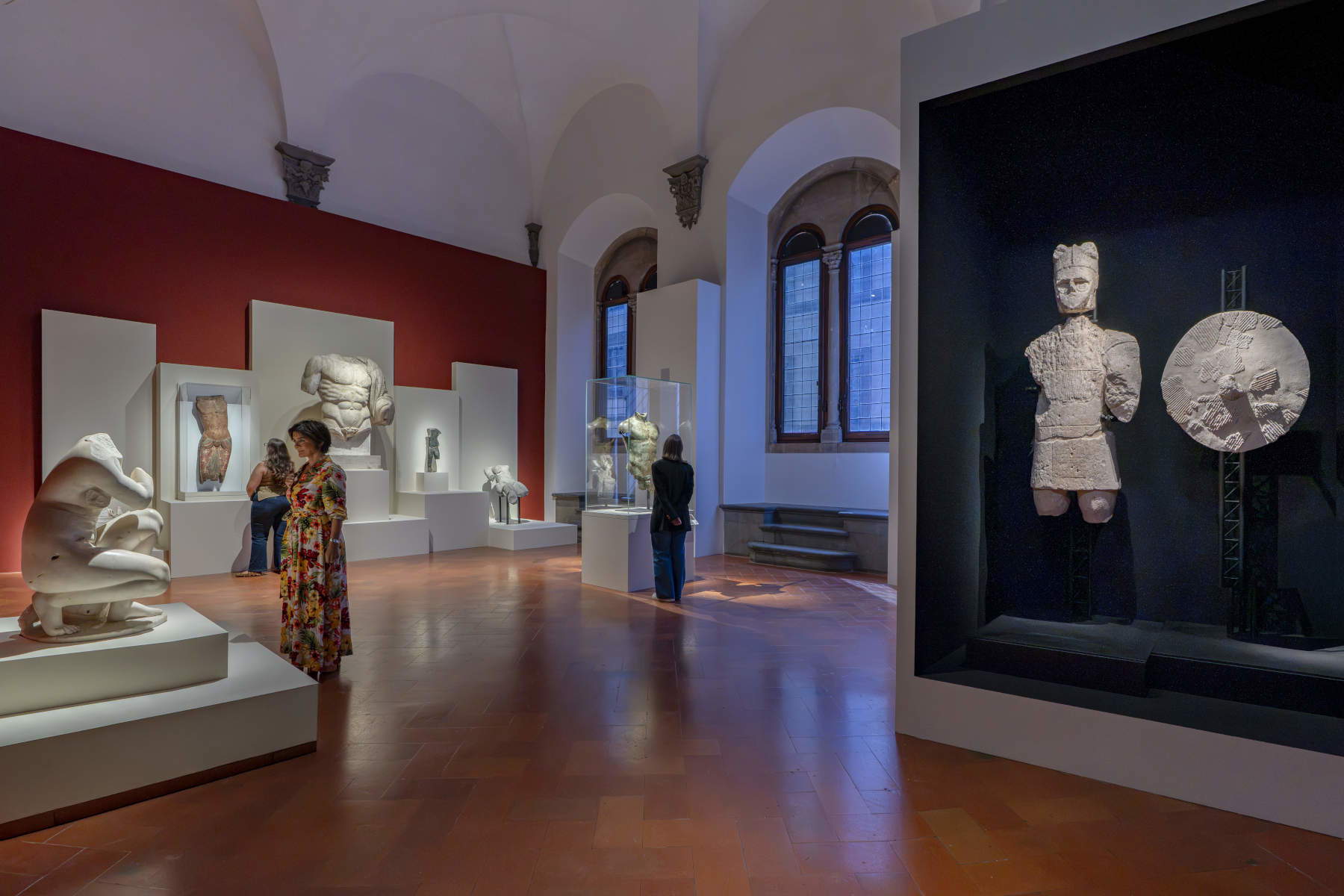
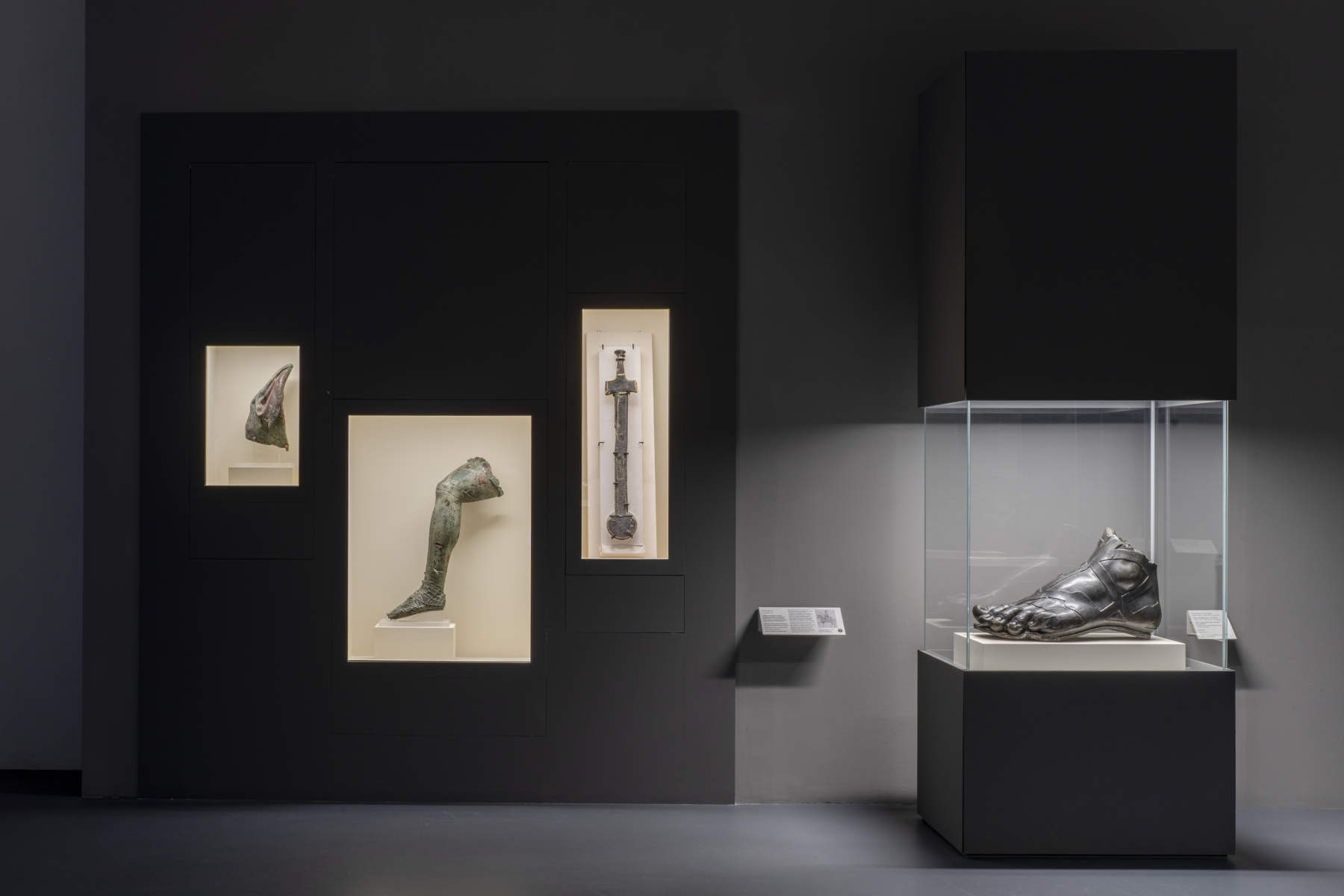
With the third section, “Iconoclasm,” the discourse takes on an overtly political dimension. Equestrian monuments are among the most powerful images of authority: erected in public spaces to honor power, they can be toppled to deny it. The fragments on display— a sword, drapery, and a leg—from the Agora of Athens may have belonged to the equestrian statue of Demetrius I Poliorcetes, erected in 303–302 B.C. and destroyed in 200 B.C. This is one of the earliest examples of a monumental type that, for over two millennia, was intended to represent power in public spaces.
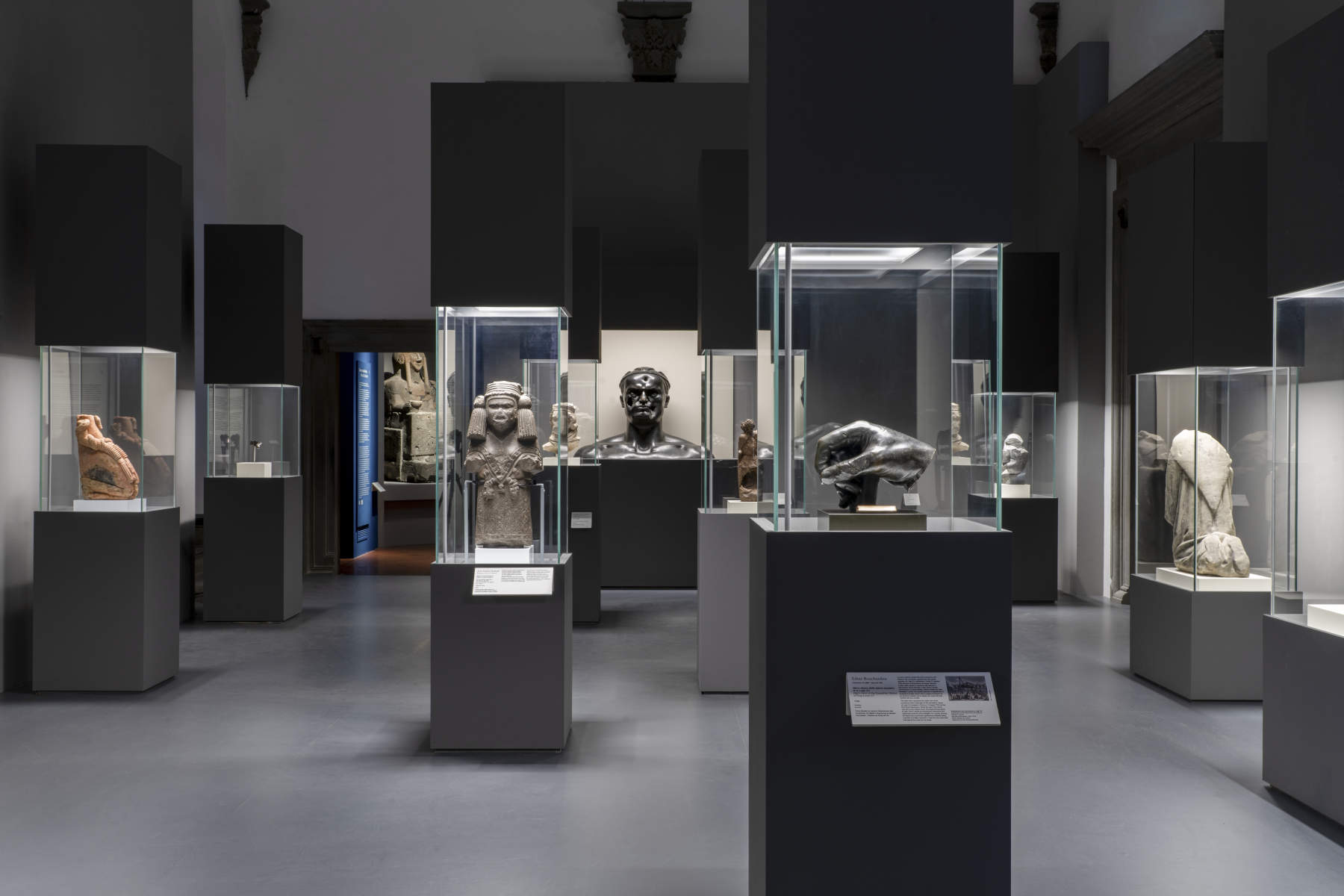
The same desire to erase a past authority led to the destruction of the equestrian monuments of Louis XIV and Louis XV during the French Revolution. Of the statue of Louis XV, among other fragments, the right hand of the king’s equestrian statue—created by Edme Bouchardon in 1758—remains. The hand, clenched around the upper part of the command staff, belonged to the monument that was toppled in Paris on August 11, 1792. While the rest of the statue was sent to be melted down, the fragment was given to Jean Henri Latude, an adventurer and memoirist, also known for having been imprisoned in the Bastille. Possessing that hand held special significance: it was, in fact, the very hand that had signed the order for his arrest.
The destruction of images takes various forms in other contexts as well. The Torso of an Akkadian Ruler from Assur, in Mesopotamia (the oldest work in the exhibition, ca. 2300–2250 BCE), reduced to hundreds of fragments, may have been destroyed by political enemies or repurposed as building material. The monumental Aztec sculpture of Coatlicue (15th–16th centuries), a Mexica goddess whose name means “she who has a skirt of snakes,” was also likely destroyed by order of the Spaniards as part of the suppression of indigenous religions. All that remains of the monument are a few fragments of the skirt, made of snake rattles, which reveal only a part of the original image. Iconoclasm, however, did not always entail the physical destruction of the works. In some cases, they were hidden or repurposed, losing their meaning and context, such as the Head of a Magus King from Notre-Dame, which was removed during the French Revolution and reused in the foundations of a building.
The theme continues in the “War and Colonialism” section, where the fragments bear witness to conflicts, bombings, looting, and forced displacement. The Neo-Hittite Seated Funerary Figure (c. 1000–800 BCE), discovered nearly intact during the Tell Halaf excavations in 1912–1913, was transferred to Berlin and exhibited at the Tell Halaf Museum. In 1943, an Allied bombing raid set the museum ablaze and shattered the sculpture into thousands of fragments, which were later reassembled during a lengthy restoration project completed in 2010.
Also on display here is Antonio Can ova’s *Bust of Religion*, created in 1815, which bears clear signs of the war. A shell struck the Gypsotheca in Possagno on Christmas Eve 1917, during the fighting on the Grappa Front, severely damaging the work. Never restored, the bust still bears the scars and traces of the explosion. Also on display in this section is the Prague Pietà, dating from circa 1380–1400, which was likely damaged by two fires—one in 1812 and another in 1945—and now consists only of the heads of Mary and Christ. The surviving faces belonged to a Vesperbild, a type of Pietà that developed in the Germanic region beginning in the 14th century: stripped of their bodies, they preserve the figures’ grief and leave it to the fragment to evoke what is no longer visible.
Colonialism and political instability, in turn, have removed works from the monumental, religious, and communal contexts for which they were created. The Buddha Head from Borobudur bears witness to the appropriation of sacred sites during colonial rule, while the Statue of Rama was looted from a Khmer temple after the Cambodian civil war and entered the international market. In other cases, the destruction was linked to the search for what the works contained. The Face and Shoulder from an Egyptian anthropomorphic sarcophagus may have been damaged in antiquity by tomb raiders searching for the precious objects placed with the mummy. The nose, too, is believed to have been intentionally removed to deprive the image of its life force and prevent the deceased from taking revenge on the desecrators.
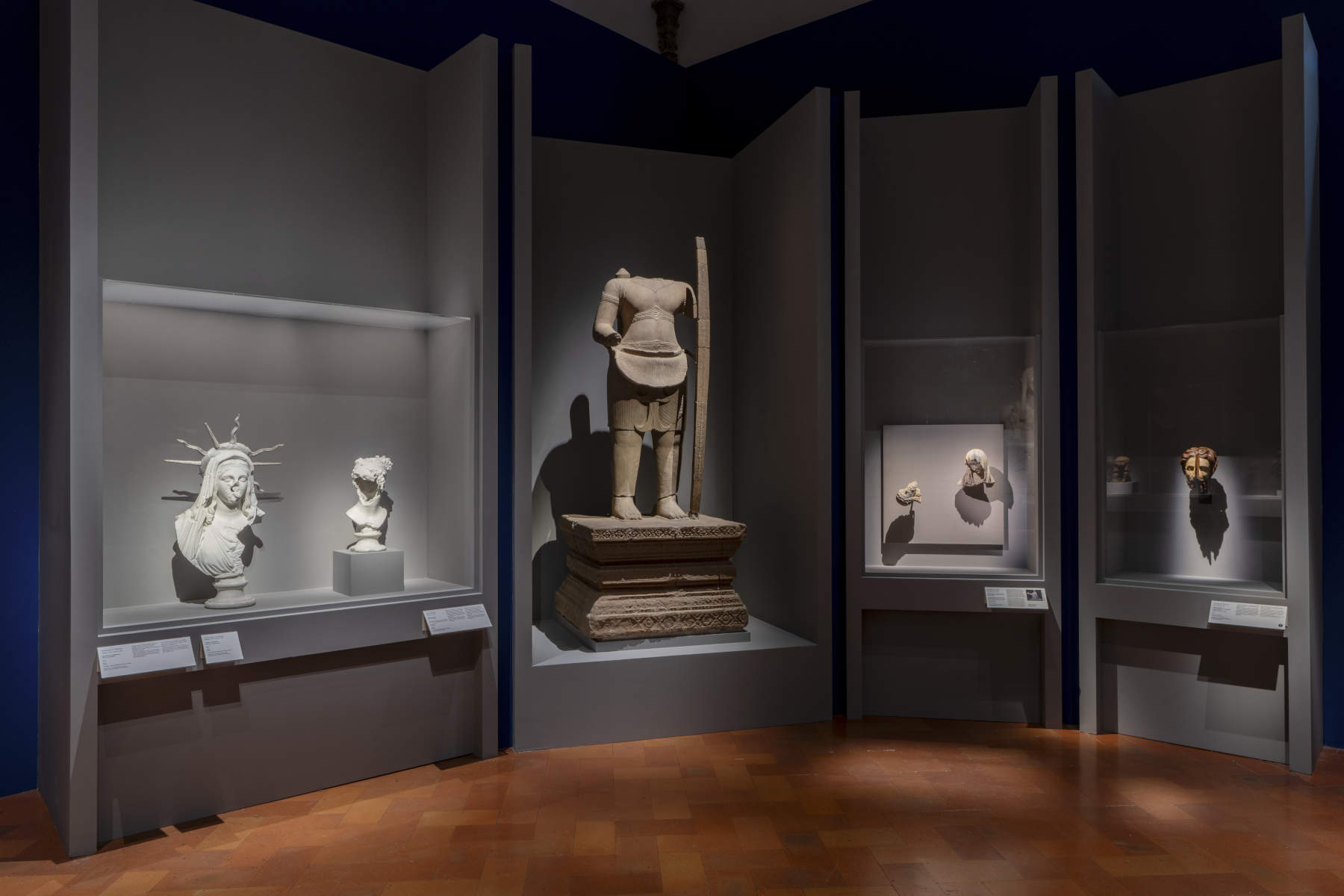
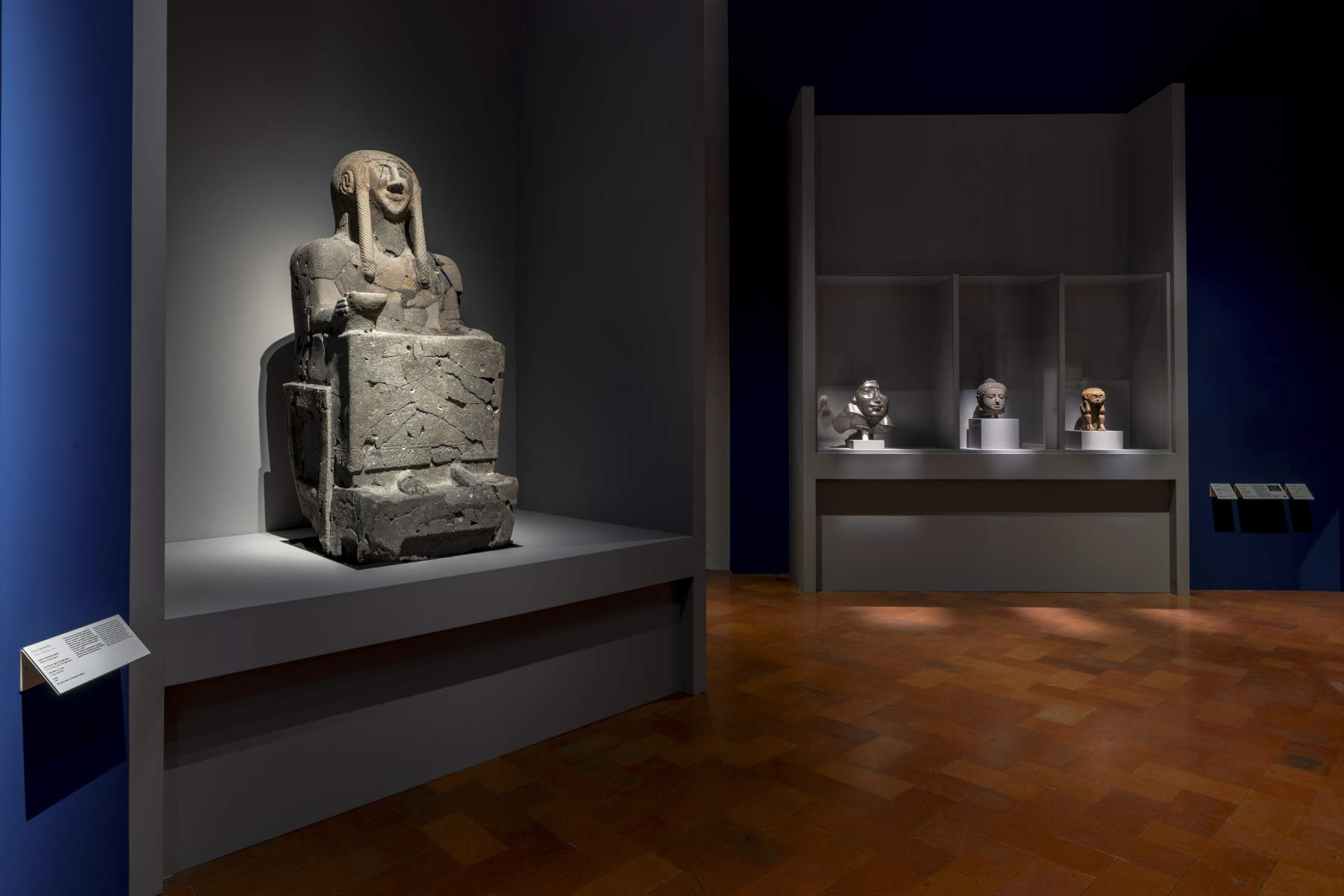
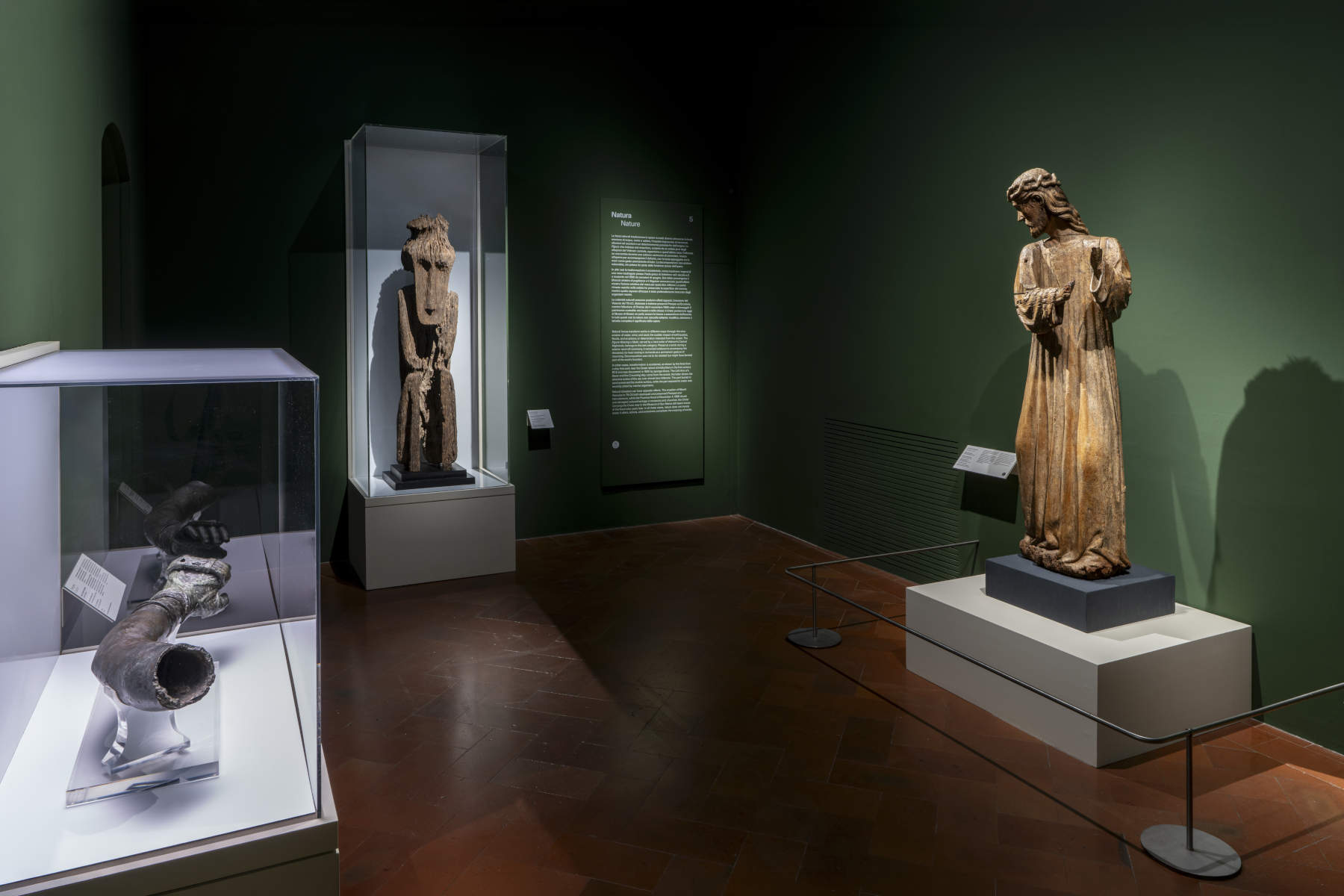
We then move on to the “Nature” section , which explores the natural forces that transform the works: the slow erosion caused by water, wind, and sand; the sudden impact of earthquakes, floods, and volcanic eruptions; or deterioration that was anticipated from the very beginning. Such is the case with the Figure Wearing a Mask, carved by a Jarai artist from the highlands of central Vietnam between the late 17th and early 18th centuries, and placed on a grave during a solemn farewell ceremony: it remained outdoors to accompany the deceased, and decomposition—far from being hindered—could have been part of the work’s very function.
In other cases, the transformation is accidental, as with the artifacts from the shipwreck off the Greek island of Antikythera in the 1st century B.C., discovered in 1900 by sponge divers. From the wreck come the Left Arm of a Boxer and the Crouching Boy, which demonstrate the selective action of the sea over nearly two millennia: the part that remained buried in the sand preserved the surface of the marble, while the part exposed to water was deeply eroded by marine organisms. Natural disasters can have opposite effects. The eruption of Vesuvius in 79 A.D. both destroyed and preserved Pompeii and Herculaneum, whilethe Florence flood of November 4, 1966, damaged the heritage of museums and churches, and the Renaissance Christ Carrying the Cross, now in the Museum of San Marco, still bears traces of it sixty years after the event. In all these cases, nature alters, selects, and sometimes completes the meaning of the works.
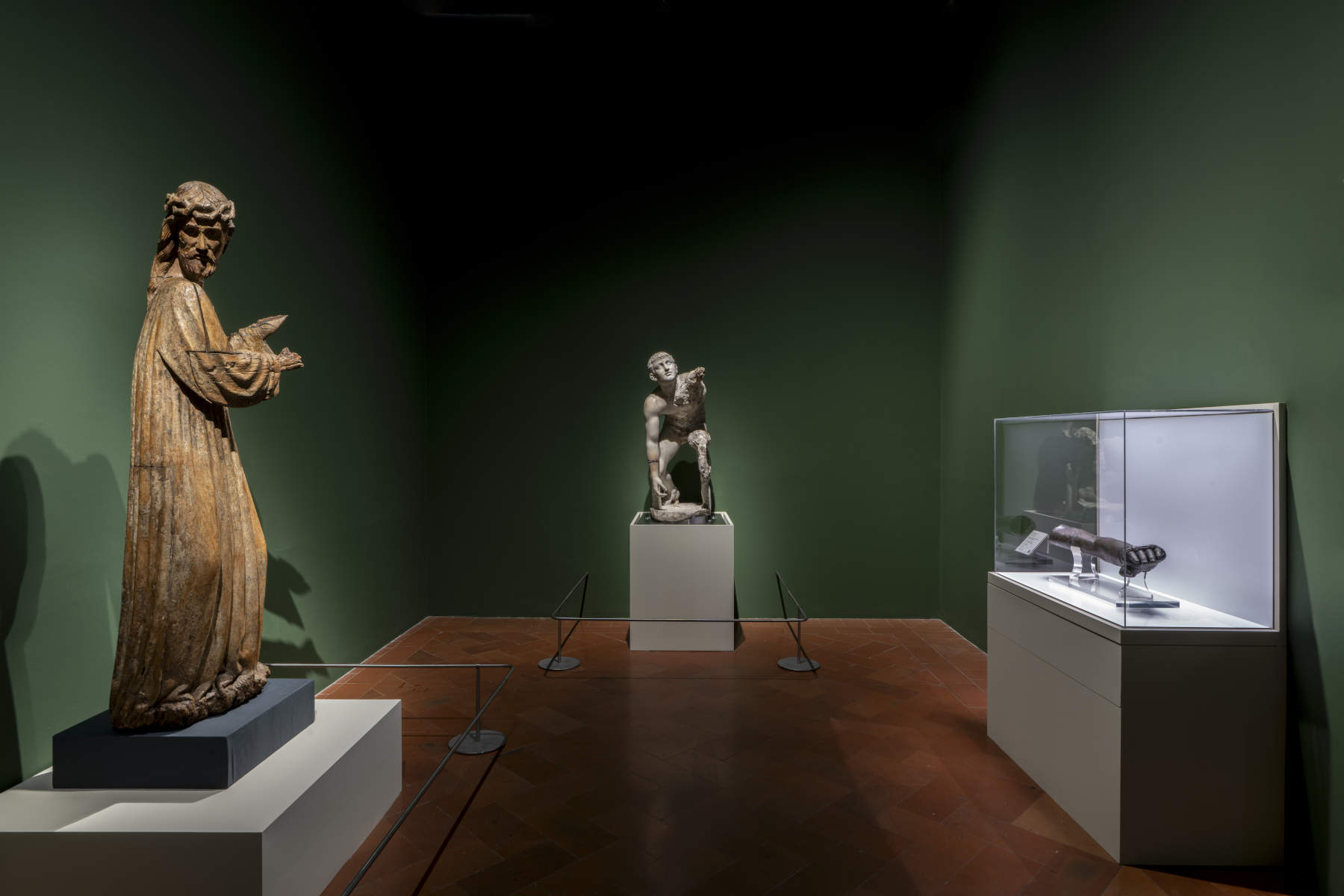
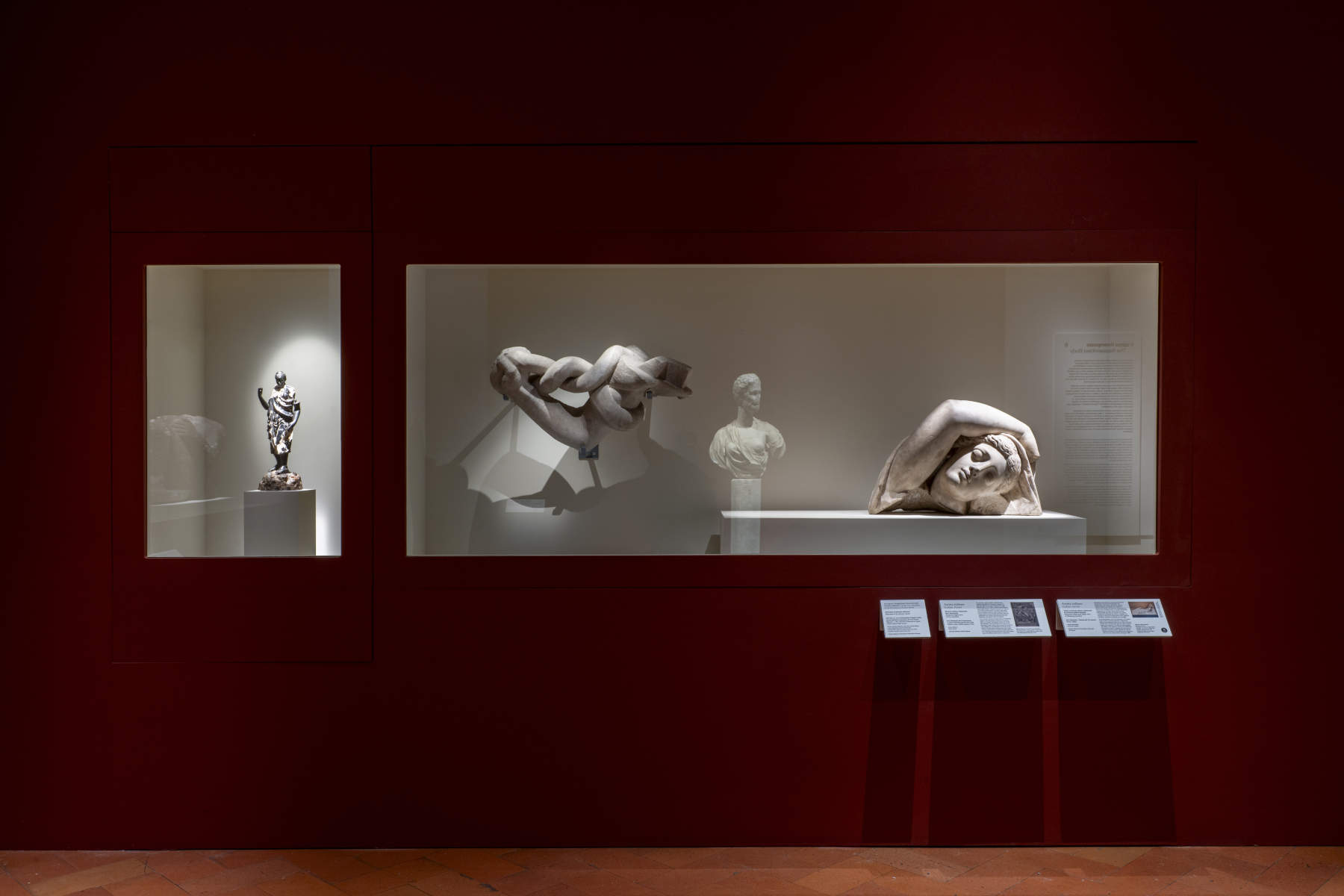
The sixth section, titled“ : The‘ ’body— —recomposed,” addresses the theme of reconstruction. Reconstructing an ancient sculpture means interpreting it and sometimes reinventing it: in Europe, beginning in the sixteenth century, with the spread of collecting, different fragments could be assembled and integrated with modern parts to restore an appearance of completeness. The Statuette of a Young African Woman stems from this practice, as a refined Hellenistic head—formerly part of a small jug—was joined in the 16th century to a body made of different materials. This reconfiguration can also open up new creative possibilities, as in Francesco Vezzoli’s *The Swan* (2023), which combines ancient fragments into a gender-fluid figure.
A single body part can also evoke the entire figure, according to the principle of pars pro toto ( part for the whole): hands and arms take on symbolic, ritual, or devotional significance in the Byzantine Reliquary of the Arm of Saint Anne, where the shape of the arm preserves and displays the relic in the style of so-called “speaking reliquaries,” modeled after the body part they contain. The Aztec Chacmool from the late 14th and early 15th centuries (or Chac Mool, a sculpture serving as an altar) reinterprets a model widespread in Mesoamerica, broken to evoke the power of the ruins the Aztecs encountered in their region; and in the Pendant with a Fragment of an Olmec Mask, a broken piece of a mask becomes a new object, with a different form and function.
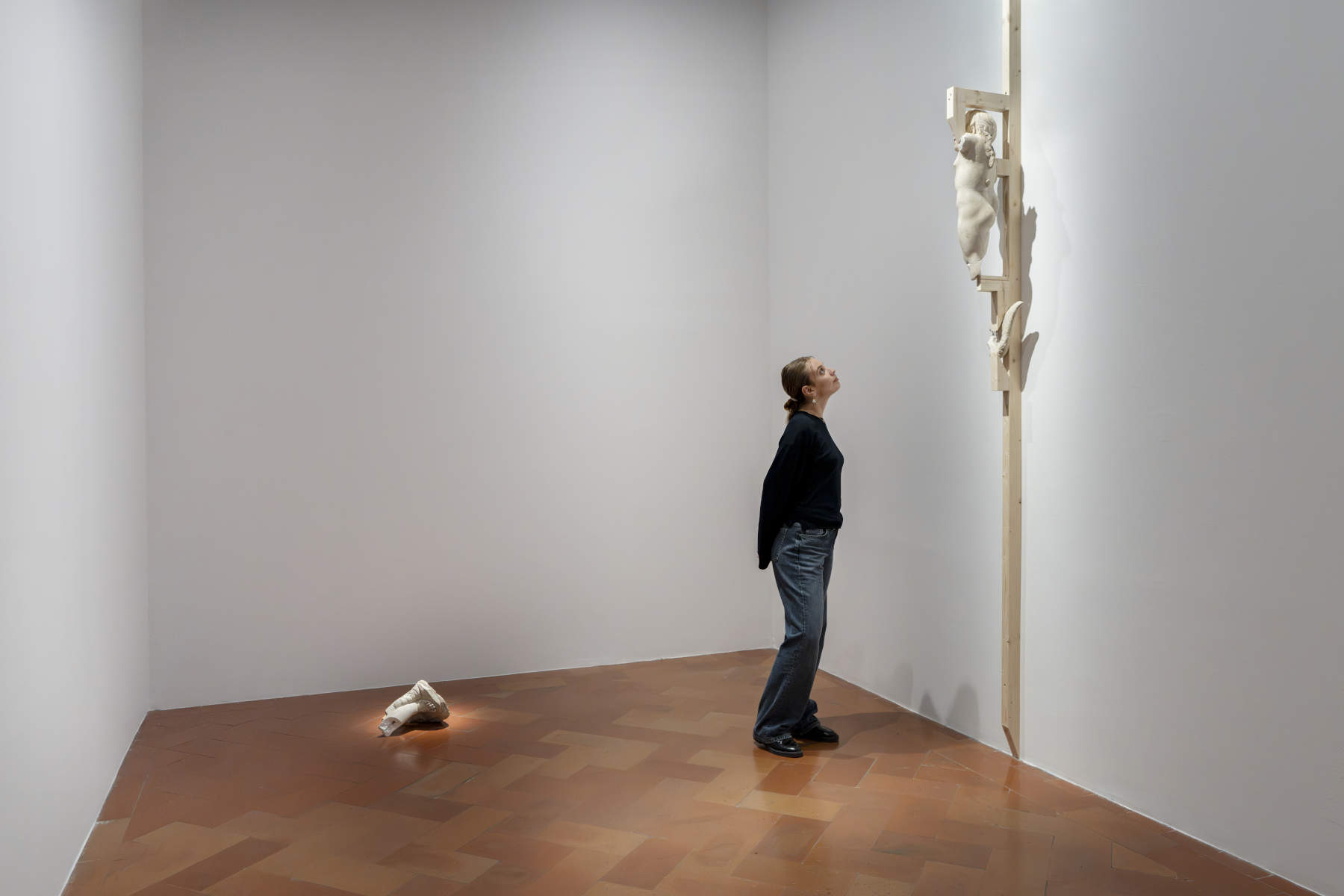
The seventh section is dedicated to Danh Vo, born in Vietnam in 1975 and who arrived in Denmark at the age of four after fleeing the country with his family on a makeshift boat. The experience of uprooting and encountering a new culture has shaped his work, which is constructed using objects, images, and documents from different eras and contexts. Roman and Renaissance sculptural fragments, photographs, letters, and family mementos are stripped of their original function and reassembled to explore identity, memory, and heritage. In the series *meat cables*, fragments of 16th-century Cupids and Roman marbles are juxtaposed with contemporary elements: a Rimowa suitcase, construction lumber, and, in one instance, a column fragment. The reference is to the circulation of artworks and the formation of European collections, but also to forced displacement and human trafficking. The suitcase recalls an episode from 2008, when Vo cut a 16th-century wooden statue of Saint Joseph into pieces small enough to carry as carry-on luggage, thereby avoiding shipping costs. In Vo’s work, what remains of an object becomes a tool for reinterpreting it and showing how identity and memory are the result of diverse, overlapping, and ever-changing histories.
The eighth section, “Sculpting the Fragment,” begins with the right hand of a colossal statue from the 1st–4th centuries CE, traditionally associated with Constantine, to demonstrate how a part can acquire its own expressive autonomy once separated from the whole. This is also the case with the Belvedere Torso (1st century B.C., Vatican Museums), admired by Michelangelo for its twisted musculature and the energy that seems to extend beyond what remains of the sculpture. From this, one can also interpret Michelangelo’s “unfinished” style, in which incompleteness becomes an integral part of the work. More than three centuries later, Auguste Rodin brought this idea into modern sculpture.*L’Homme qui marche* (1899–1900) echoes the tension of Michelangelo’s model, while the arms, hands, heads, and legs demonstrate his interest in individual body parts—isolated and then recombined.
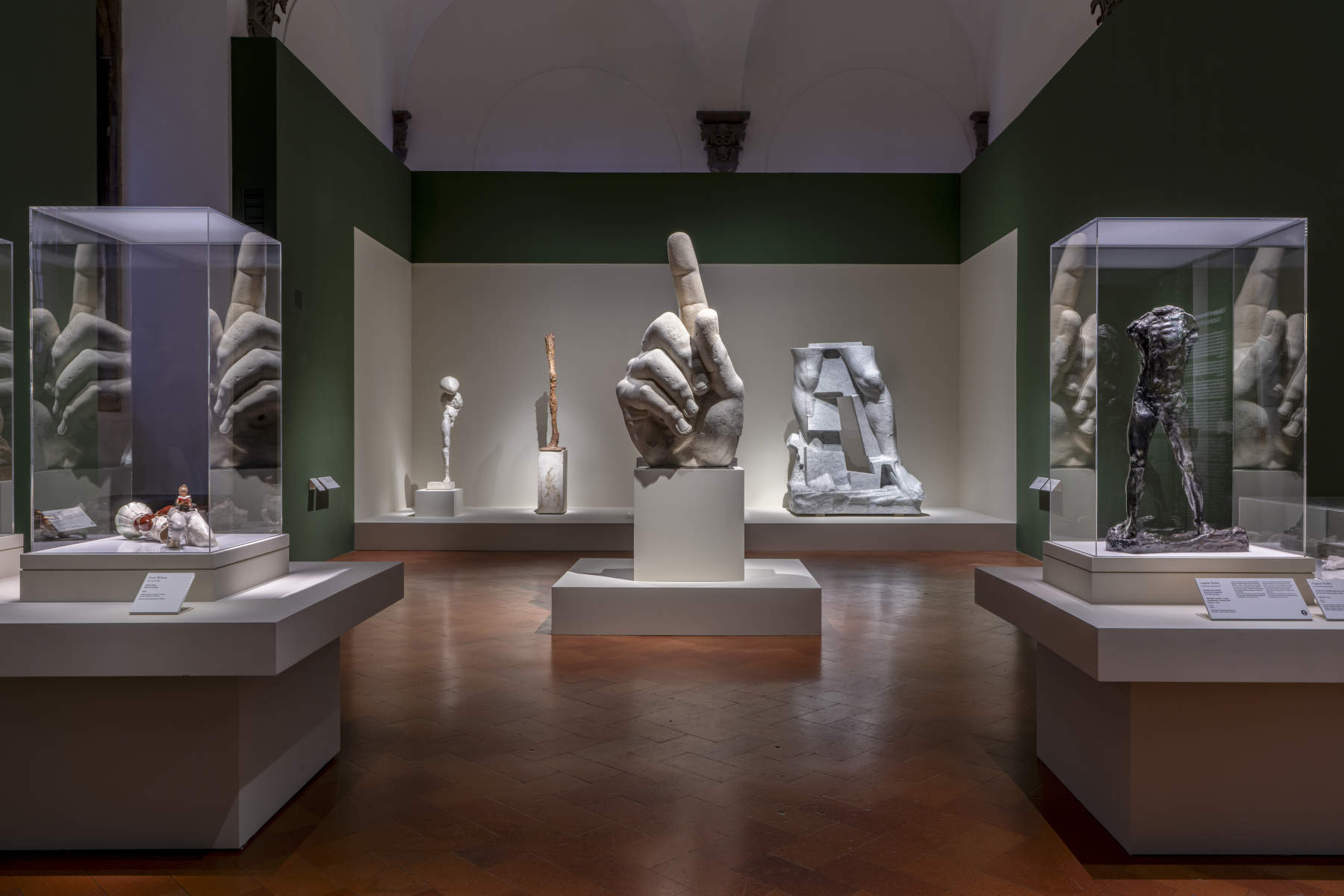
A fragment can also become a means through which to process grief. The Male Figure (Waka Sran), which belonged to a Baulé woman from the Ivory Coast, was placed in the forest by her heirs after her death and left to the elements, which continued to alter its surface over time.In contemporary art, the fragment ultimately takes on a critical dimension. In *Inside Story*, Fred Wilson breaks apart the body of a Black servant and inserts the figure of a white child reading, thereby challenging an idea of innocence built on the exploitation of others. In Alina Szapocznikow’s *Filozof*, the dismembered body, scarred by war, becomes an image of vulnerability and resistance, while the corroded surfaces of Huma Bhabha’s *Untamed* present an unstable figure, almost as if removed from time.
The ninth section continues the exploration of the fragment as a creative process: deconstructing the body to reconstruct it through autonomous parts. In the 1960s, after visiting the Capuchin Catacombs in Palermo, Paul Thek began creating sculptures resembling body parts and shreds of flesh. In *Untitled (Meat Cable)*, these wax forms are attached to a cable suspended in space and take on the appearance of remains, relics, or fragments of an abstract structure. Perishable matter thus becomes the meeting point between body and spirit, sexuality and death, the sacred and the profane. Thek’s work would also influence Danh Vo, who borrowed the title for his series*meat cables*. Robert Gober, on the other hand, starts with a recognizable anatomical form and alters it through the introduction of a foreign element. In *Untitled*, an isolated leg is paired with a candle and becomes an image of desire, vulnerability, and a reminder of the AIDS crisis.
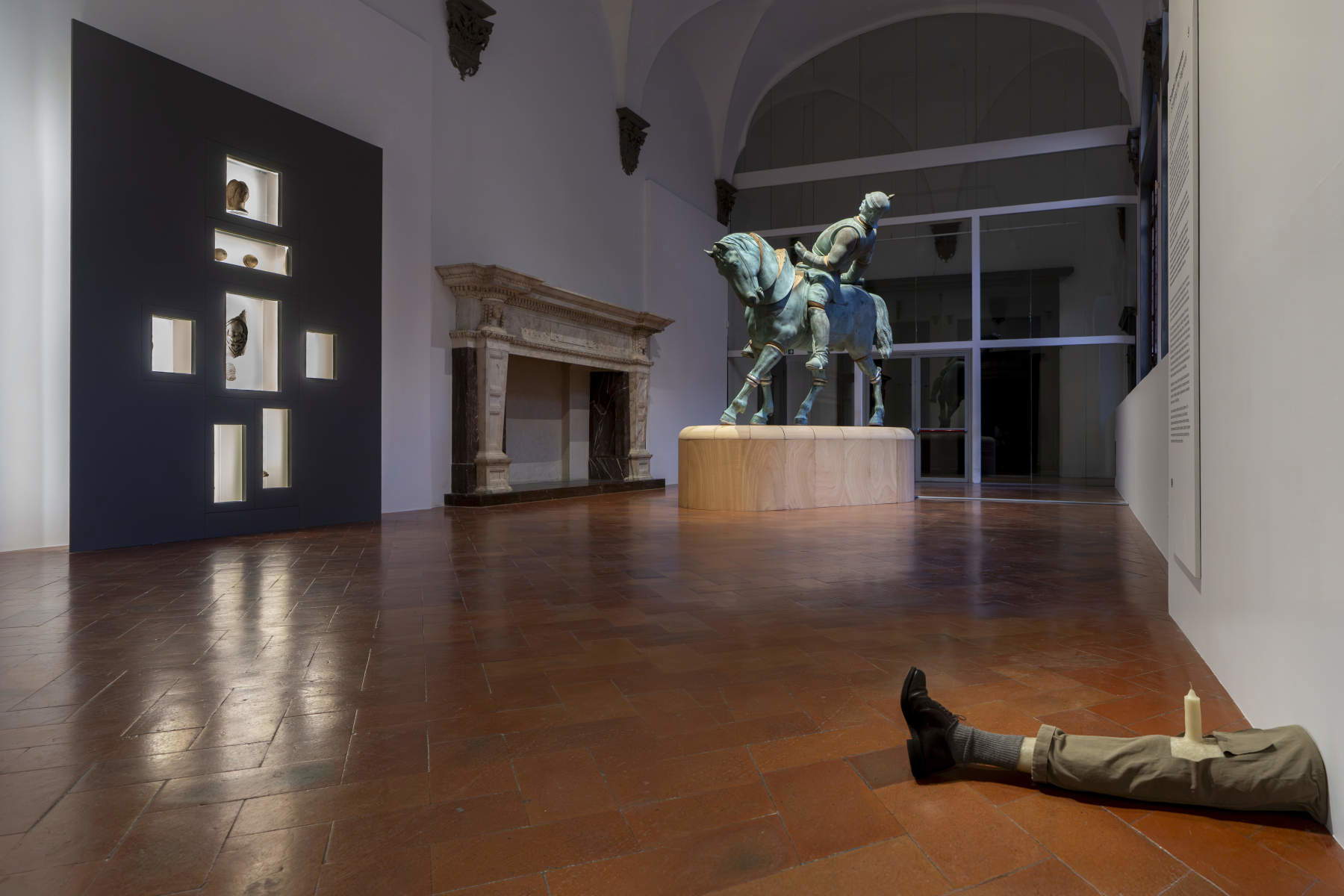
Finally, the fragment can also refer to the symbolic body of power. In *The Elephant in the Room (Otto von Bismarck) * (2023), Julius von Bismarck deconstructs and reconstructs the equestrian monument dedicated to his distant relative Otto von Bismarck, the first chancellor of the German Empire from 1871 to 1890. The figure collapses into sections and slowly reassembles itself, like a pop-up toy, transforming the celebratory monument into an unstable structure. The mechanism thus reveals the fragility of images of power and the possibility of dismantling and reexamining even the national history constructed through monuments.
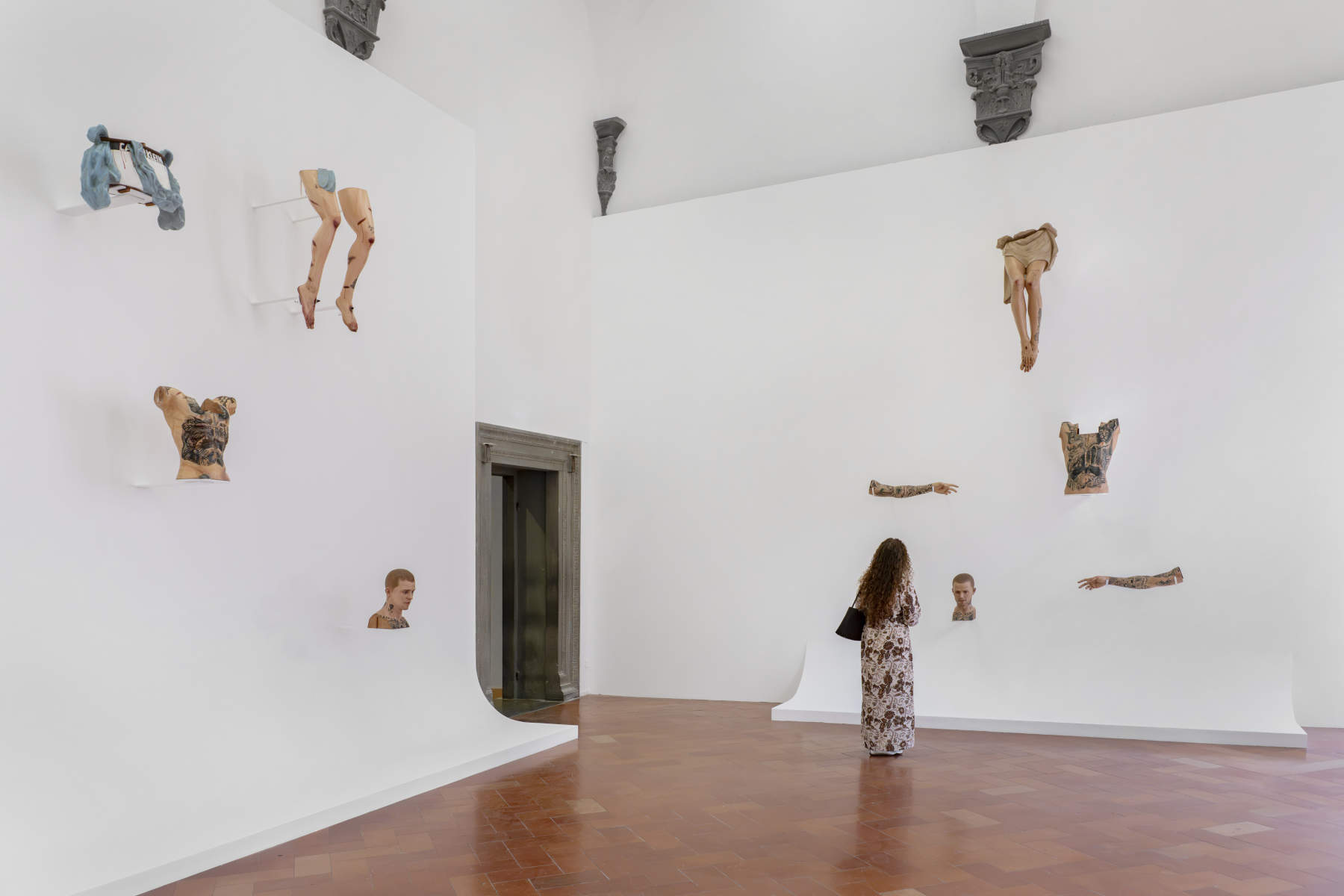
The final section is dedicated to Paul Pfeiffer, born in Honolulu in 1966, who explores the transformation of athletes and celebrities into collective images and cult figures. In his ongoing series *Incarnator*, he chooses Justin Bieber and entrusts his depiction to sculptors from Mexico, Spain, and the Philippines—countries marked by diverse colonial histories and the spread of Catholicism. Heads, torsos, and limbs are crafted separately using techniques associated with sacred imagery, particularly those of the encarnadores, specialists in making wood resemble flesh. The body parts, faithful in their features and tattoos, are never reassembled and become autonomous works. The installation thus juxtaposes religious veneration with the contemporary cult of celebrity: Bieber is transformed into a relic of the present, while the fragmentation generates a new and plural body. Finally, the collaboration of multiple sculptors challenges the idea of a single author and reflects on the processes of dismantling, assimilation, and transformation characteristic of colonial power.
If *Broken: The Power of the Fragment* thus aims to explore the fragment across civilizations and over a chronological span of more than four thousand years, it is natural to wonder why the exhibition did not also take prehistory into account. It is an era that has received little in-depth attention, both in education and in popular culture, yet it is fundamental to understanding the very origins of gesture and mark-making: it is in engraved stone, in the striking of one stone against another, and in the earliest traces left on cave walls that we find some of humanity’s most primordial gestures. That world also includes the earliest weapons, objects produced through the working of materials, the oldest forms of craftsmanship, and those expressions we now call art. An exhibition on the fragment could therefore have begun long before historical civilizations, perhaps precisely with that primordial gesture that Stanley Kubrick would transform into one of the most famous images from *2001: 2001: A Space Odyssey, featuring the primitive man holding a bone and discovering the possibility of altering its meaning through action.
If the ambition is to tell the story of the world, of civilizations, and of their actions, then the theme of the fragment could have been explored with greater linearity, starting from its very origin. It is perhaps here that *Broken* reveals its main limitation: the foundation is interesting, and all the works have obvious potential, but the narrative tends to lose its focus across the various sections. There is no real genesis to the narrative—no point of origin capable of giving meaning to what follows—and it also lacks that more human and emotional component that the fragment, by its very nature, carries with it. The exhibition proceeds primarily through data, comparisons, and juxtapositions, with an objective and at times cold approach, as if it were an analysis of human history through artifacts made of stone, bronze, and marble. The works are, in many cases, extraordinary, but the overall design does not always fully bring out the curatorial interpretation of the exhibition’s curator.
Added to this is the issue of context, which is particularly complex when dealing with fragments. A sculpture separated from the place for which it was conceived inevitably loses part of its history, and reconstructing an environment around each work would naturally be a nearly impossible undertaking. It remains difficult, however, to imagine, for example, a fragment of an Aztec sculpture (originally placed perhaps at the foot of a pyramid) within the sterile, monochrome-walled rooms of Palazzo Strozzi. The artifact retains its material form, but it does not retain the context that determined its meaning. How can we evoke a civilization like the Mexica—conquered and devoured—without at least partially restoring the political, religious, and violent context in which those images were produced? The same applies to an idol decapitated following a sacrifice or to a fragment of a Greek sculpture associated with water and the landscape: without the sound, the surface, the smell of salt, the light, or the architecture that surrounded them, part of their experience is necessarily left out of the exhibition.
It is worth noting, in this regard, that the “Nature” section—probably one of the most interesting precisely because of the possibilities it offers— features only four artifacts. The fragment produced by the action of time, water, fire, or earth could have opened up a broader field—one need only think of the sculptures recovered from the Blue Grotto and the numerous instances in which matter is altered by natural processes. Here, too, one of the opportunities that “Broken” seems to have only partially exploited emerges: that of showing how a fragment is not necessarily the result of destruction, but can instead represent a new state of matter.
Concerns also arise regarding the selection and arrangement of certain works. Following the thematic order established by the curators—who were trained in the Anglo-Saxon tradition—the pairings may possess their own internal coherence; yet, when viewed within the overall exhibition, they do not always prove equally convincing. It is difficult to understand, for example, what deeper connection could exist between the sole fragment of Akkadian art in the exhibition—an expression of one of Mesopotamia’s great civilizations— and a bombed bust of Mussolini, or between that same artifact and the bronze hand of Louis XV, which survived the destruction of the equestrian statue during the French Revolution. Conquests (rather than colonizations), violence, and destruction certainly constitute common ground, but precisely because the theme is so vast, greater rigor in constructing these comparisons would have been necessary in some cases.
The relatively limited presence of Greek art is also striking, especially considering how deeply the Hellenic world has explored the relationship between fragment, ruin, memory, and reconstruction. Virginia Woolf, in her essay “Not Knowing Greek,” wrote that one returns to Greek when one is weary of the vagueness and confusion of one’s own time. And if Greece represents one of the fundamental cores of Western culture, it would have been interesting to also address one of the deepest rifts in its history: the Persian destruction of the Acropolis of Athens.
The so-called Persian Fill would have served as an exemplary case in this regard. After the devastation of the Acropolis, the Athenians buried votive statues, architectural elements, and other objects belonging to the destroyed sanctuaries, unwittingly creating a sort of archive of destruction. The sculptures of the Archaic Acropolis—including kouroi and korai—were damaged, decapitated, or toppled along with the temples and sacred structures. The shattering was not merely physical: it struck at the heart, the symbolic center of the city, and the memory of its sacred sites. Even the decision to leave the ruins visible, rather than erasing them through immediate reconstruction, could have introduced another fundamental concept of the fragment into the exhibition: that of the ruin as a deliberately preserved testament. For this reason, it would have been interesting to also address the fragments of the Parthenon, from the perspective of loans and their circulation, and as evidence of a history of destruction, survival, and a part of memory.
An equally significant omission concerns Pompeii and Herculaneum. Herculaneum was excavated in 1738 and Pompeii ten years later, in 1748: two discoveries destined to profoundly alter our understanding of antiquity. The cities buried by Vesuvius, in fact, present the fragment in a unique context, because the destruction itself has preserved portions of a world that would otherwise have been lost. The excavation campaigns, which have continued for centuries, have unearthed buildings, objects, decorations, bodies, and tools of daily life, allowing us to reconstruct a vanished civilization through what remains. It is also through these findings that modern archaeological knowledge takes shape. I believe that including Pompeii and Herculaneum would have allowed us to address another aspect of the fragment: what destruction takes away can, paradoxically, become precisely what allows memory to survive.
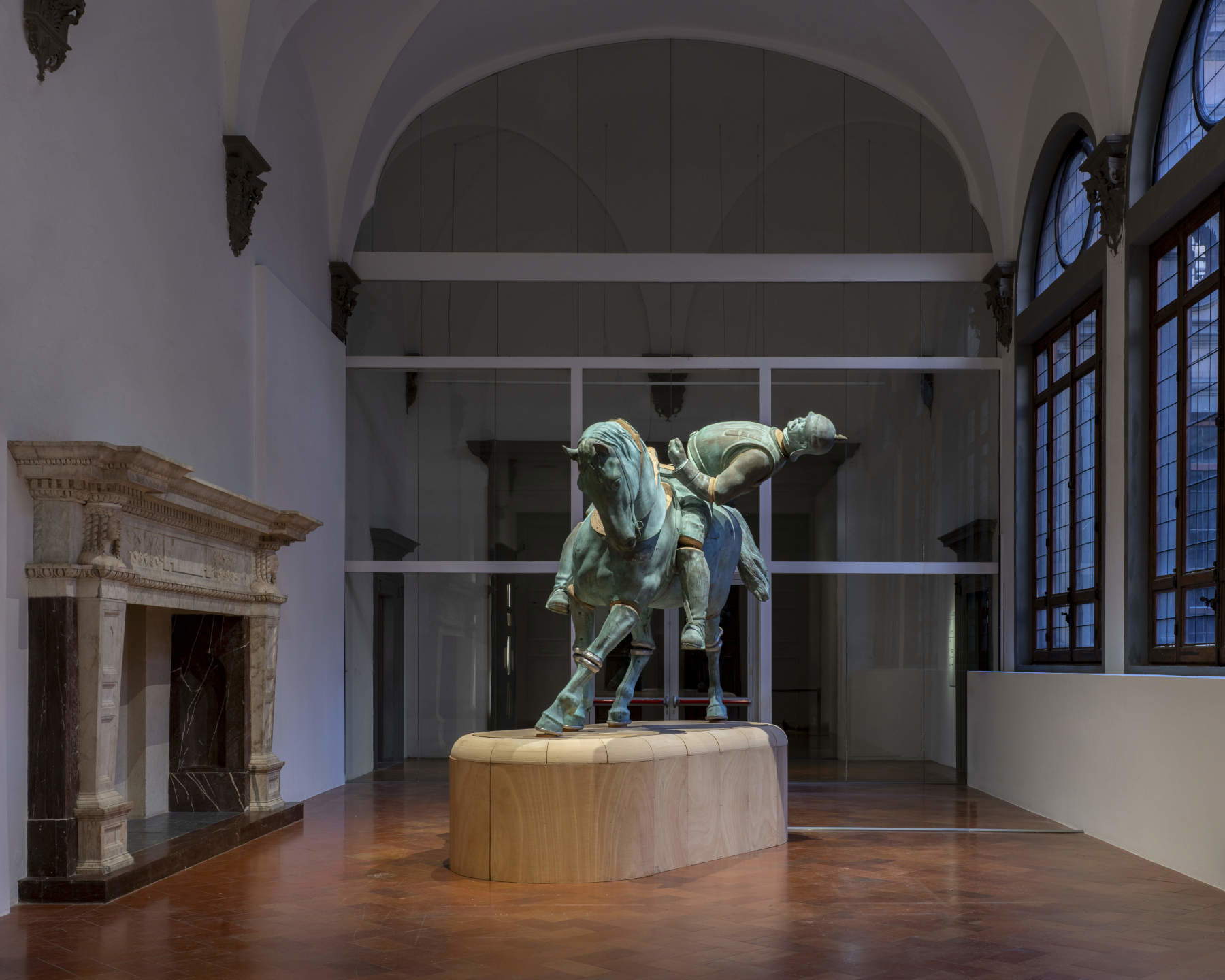
The final section, dedicated to Justin Bieber and Paul Pfeiffer’s *Incarnator* series, deserves special mention. Here, the exhibition takes on a different, almost alienating character: upon entering the room, it feels like stepping into a deconsecrated church, where the forms and codes of devotion remain, but the object of worship has changed. At times,the presentation even appears blasphemous, with the celebrity’s body treated like that of a sacred figure and its parts transformed into relics. Yet it is perhaps precisely this section that most immediately reflects the society in which we live. The cult of celebrity, the proliferation of images, and the construction of recognizable and desirable figures on a global scale are integral to our present. Bieber thus becomes a sort of contemporary saint, dismembered and multiplied into a collection of images that no longer need to be reassembled into a single body to inspire devotion.
It is moments like these that make one reflect on the unexpressed (or only partially expressed) potential of *Broken*. The theme is powerful, the works are numerous and highly engaging, and the exhibition brings together very different cultures, eras, and ways of understanding the loss and transformation of matter. The problem is that this very richness, at times, ends up fragmenting the narrative. The exhibition proceeds through effective thematic clusters, but does not always succeed in transforming them into a story capable of guiding the visitor from the origins of the artistic gesture to the present day. The fragment is displayed, classified, analyzed, and compared; more rarely does it become the lens through which to interpret human history.
This leaves us with the question from which the exhibition itself begins: what real power does a fragment possess? And what is its true function? It can preserve a memory, leave a trace, or bear witness to destruction—but it can also generate something new. It can become the starting point for another work, as happens when an artist intervenes on an incomplete form and transforms it into a different image. In this sense, the fragment does not necessarily coincide with what remains: it can be the point from which something begins anew. This is perhaps the most interesting possibility that *Broken* offers us: to conceive of the fragment as a material capable of changing its state and meaning. It is a perspective that the exhibition contains, but one that could have built a different narrative around its works.
Warning: the translation into English of the original Italian article was created using automatic tools. We undertake to review all articles, but we do not guarantee the total absence of inaccuracies in the translation due to the program. You can find the original by clicking on the ITA button. If you find any mistake,please contact us.