





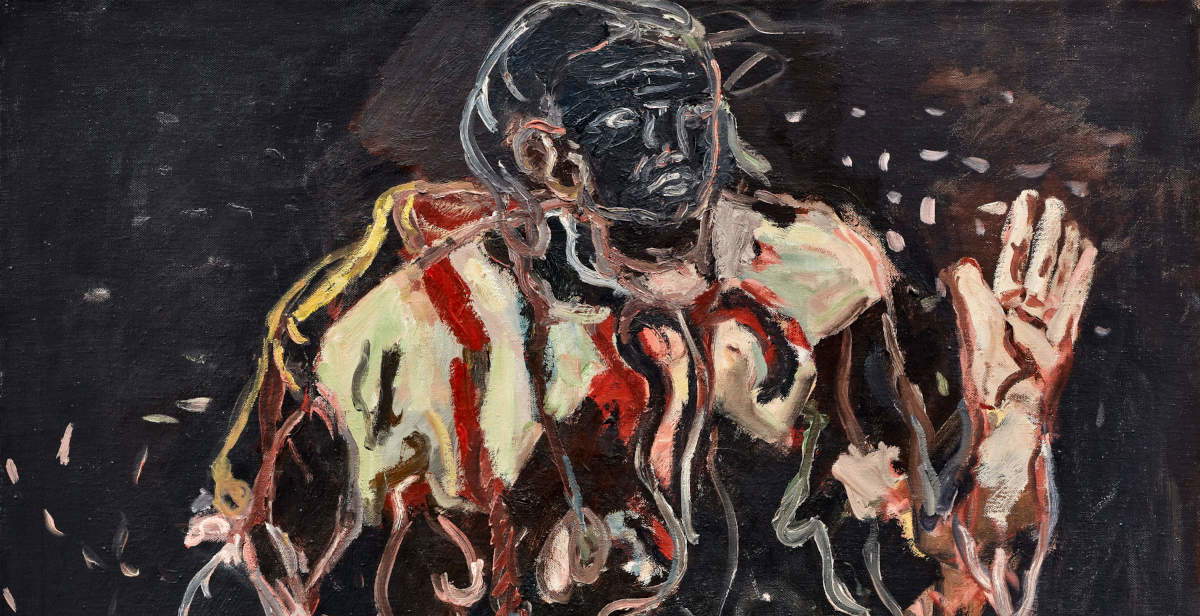
Georg Baselitz’s “Hero” series, created in 1965 and 1966, comes to London in an exhibition that brings together some of its most significant paintings. From October 13 to December 18, 2026, Thaddaeus Ropac’s Ely House will host “Georg Baselitz: The Heroes 1965–1966,” the first exhibition in the United Kingdom dedicated exclusively to this body of work. The exhibition brings together works from major public and private collections, including the Tate, the Berlinische Galerie, the Museum Frieder Burda, and the Museum Küppersmühle in Duisburg, as well as the artist’s family collection and other private collections.
The press preview is scheduled for Friday, October 9, from 9:00 a.m. to 10:30 a.m., while the opening reception will take place on Tuesday, October 13, from 6:00 p.m. to 8:00 p.m. The London exhibition focuses on an early phase of Baselitz’s career considered pivotal to the development of his subsequent artistic exploration. The paintings in this series, created when the artist was just 27 years old, address issues that would remain central to his work: representation, the relationship with German history, the role of the artist in the postwar context, and the very possibility of continuing to paint at a time when painting was considered by many to be a medium that had run its course.
The exhibition is accompanied by a catalog featuring an essay by Max Hollein, director and CEO of the Metropolitan Museum of Art in New York. The text was written for the exhibition *Georg Baselitz – The Heroes*, organized at the Städel Museum in Frankfurt in 2016, the first comprehensive museum presentation of the series. That exhibition was subsequently shown in Stockholm, Rome, and Bilbao.
Baselitz began working on the series in the summer of 1965, shortly after completing an artist residency at Villa Romana in Florence. His experience in Italy played an important role in his artistic exploration. During his stay, the artist engaged with 16th-century Mannerist prints and developed a particular interest in the distorted figuration—which he himself would describe as “excessive”—of painters such as Pontormo and Parmigianino. Upon returning to West Berlin after several months in Italy, he began creating the paintings in the “Hero” series during a period of intense productivity.
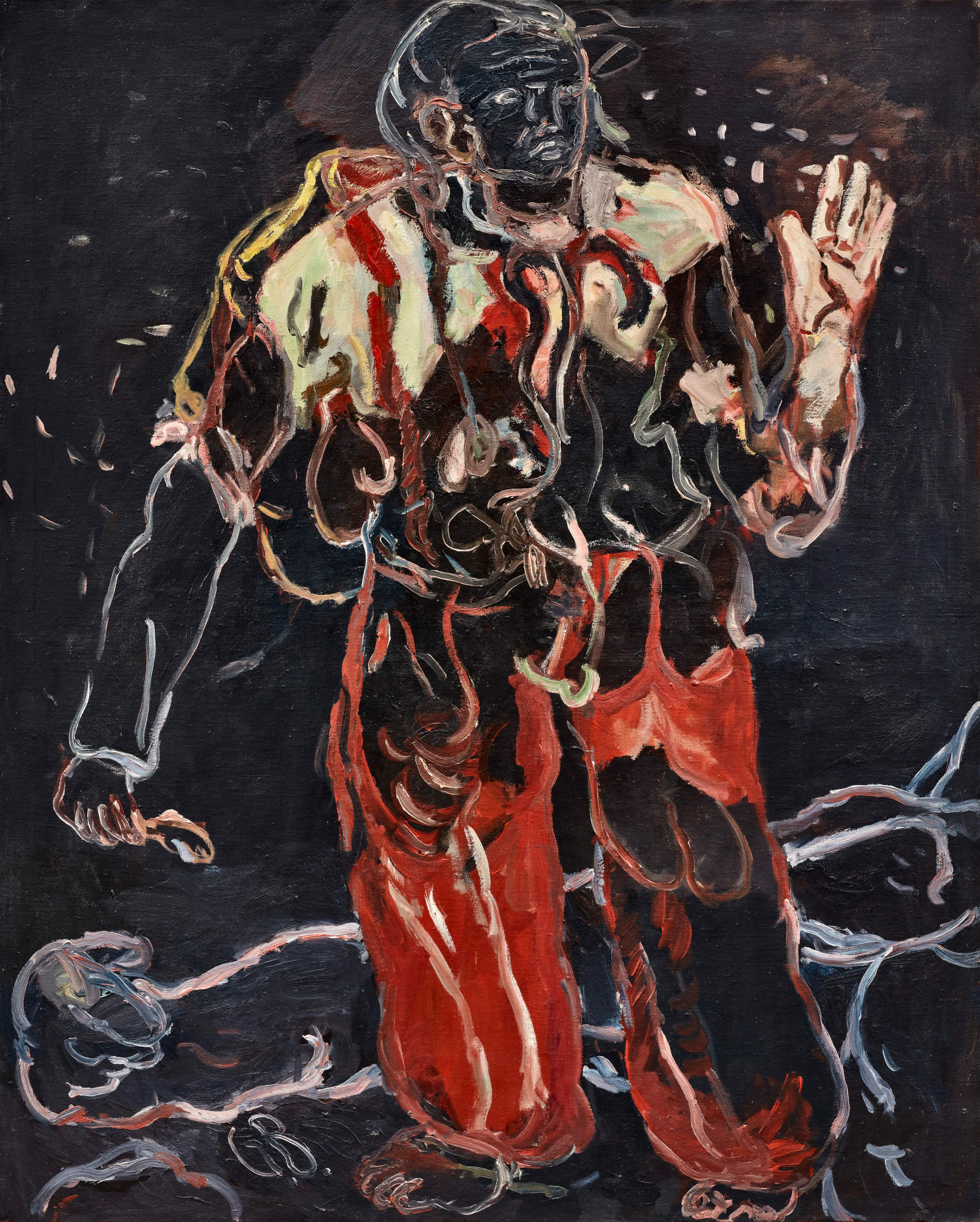
In the span of just one year, Baselitz produced approximately 60 paintings, 130 drawings, and 38 prints, building a body of work in which a solitary, monumental figure with altered proportions appears repeatedly. The figures are depicted barefoot, clad in rags or worn-out military uniforms, and set against devastated landscapes devoid of any specific location. These figures can take on different roles—from partisan to rebel, from painter to shepherd to poet—but they do not conform to the traditional idea of heroism. On the contrary, their condition is marked by vulnerability, defeat, and immobility. Some are seated, others standing, but all seem to find themselves in a sort of no-man’s-land, suspended between past and present. Their hands—often disproportionate—clench broken tools or paintbrushes, bear wounds resembling stigmata, or appear to be trapped in the ground.
“They are not heroes brandishing their fists,” Baselitz stated, “they seem destroyed, in pieces, torn, battered. And that is exactly how I wanted them.”
The choice of these figures must also be understood in light of the artist’s position in postwar, divided Germany. Baselitz had spent his youth in East Germany, where he had rejected the idealized and monumental figures of Socialist Realism. In 1957, he was expelled from the Academy of Fine Arts and Applied Arts in East Berlin on charges of “sociopolitical immaturity.” He subsequently moved to West Berlin, where he graduated from the Academy of Fine Arts in 1963 and to which he returned after his stay in Florence to work on the Hero series.
“In the midst of the German economic miracle, amid a spirit of rupture, in an era when people truly wanted to leave the past behind and believed it was already behind them,” writes Max Hollein. “In that situation, the Heroes probably appeared as figures reemerging, returning from a past that people thought they had shaken off.”
Even in this new context, his work engaged with a recent history marked by traumatic events and with an art scene in which figurative art seemed to many critics to be an anachronistic choice. In the 1960s, Baselitz deliberately positioned himself in opposition to the major international avant-garde movements, from Pop Art to Minimalism, including the various currents of Informal Art, the Zero Group, and Nouveau Réalisme that had developed in Europe.
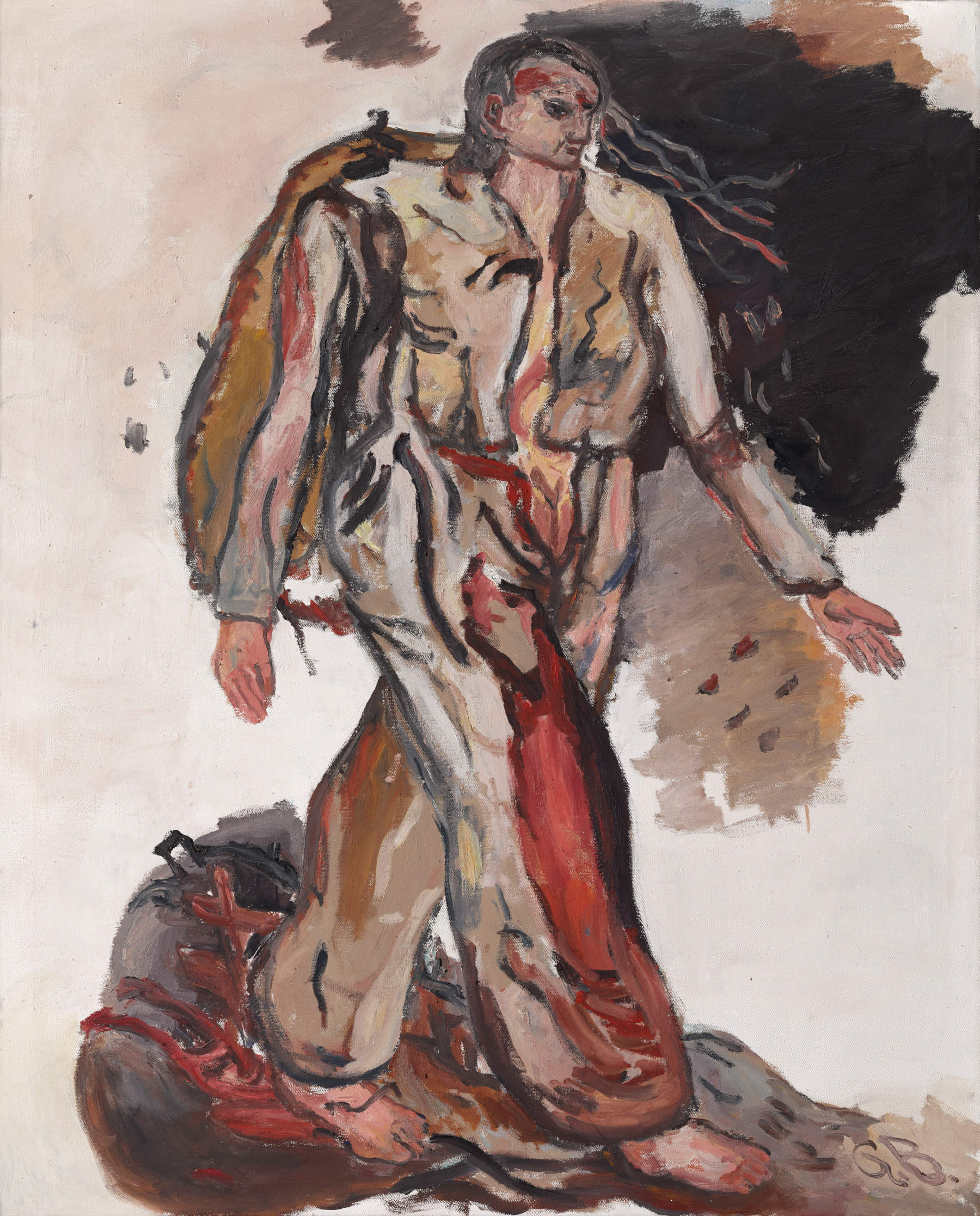
The issue concerned not only artistic language but the very possibility of continuing to paint. Painting was, in fact, considered by some to be a medium that had run its course, while realism had been compromised, according to other viewpoints, by its association with the propaganda of totalitarian regimes. Baselitz did not abandon the medium, but confronted this situation head-on by working within its history and conventions. The isolated and disenfranchised figures in the series can thus also be interpreted as projections of the artist’s position within the postwar cultural landscape: choosing painting and questioning representation meant assuming a marginal position—thatof the anti-hero rather than the hero.
Another aspect of the series also concerns the questioning of the masculine models associated with modern painting. Numerous paintings in *Hero* challenge the paradigms inheritedfrom Abstract Expressionism and the figure of the artist as the absolute protagonist of the creative act. Painters such as Jackson Pollock and Willem de Kooning had been transformed into almost titanic figures of creativity, while the canvas was conceived as an arena in which the painterly gesture took on a physical and “heroic” dimension.
Baselitz takes up this construct in order to challenge it. In *Ein moderner Maler* (A Modern Painter) from 1966, for example, the depicted painter wears rumpled and torn pants, from which—in place of the phallus—a spiral of flesh-colored paint emerges, descending downward. In *Spekulatius* (1965), the artist instead carves his initials into the hero’s horse, provocatively placing a mark of artistic origin at a point associated with sexuality and male potency.
The theme of impotence and dysfunction recurs through a series of recurring elements: severed branches, stumps, broken plows, lowered flags, and amputated limbs. The figures themselves also defy a univocal gender definition. Baselitz described them as “androgynous figures,” characterized in some cases by a marked feminine component and “women’s faces.” The disproportionately small heads, long necks, and flowing hair once again evoke Italian Mannerist figuration and, in particular, certain depictions of the female figure.
In *Mit Roter Fahne* (*With the Red Flag*) from 1965, the figure’s pale complexion set against the crimson fabric also evokes the iconography of the Venuses by Giorgione and Titian. The issue of gender ambiguity emerges even more clearly in *1. Kopf* (1. Head) from 1966, one of the rare compositions in the series in which the hero’s body does not appear.
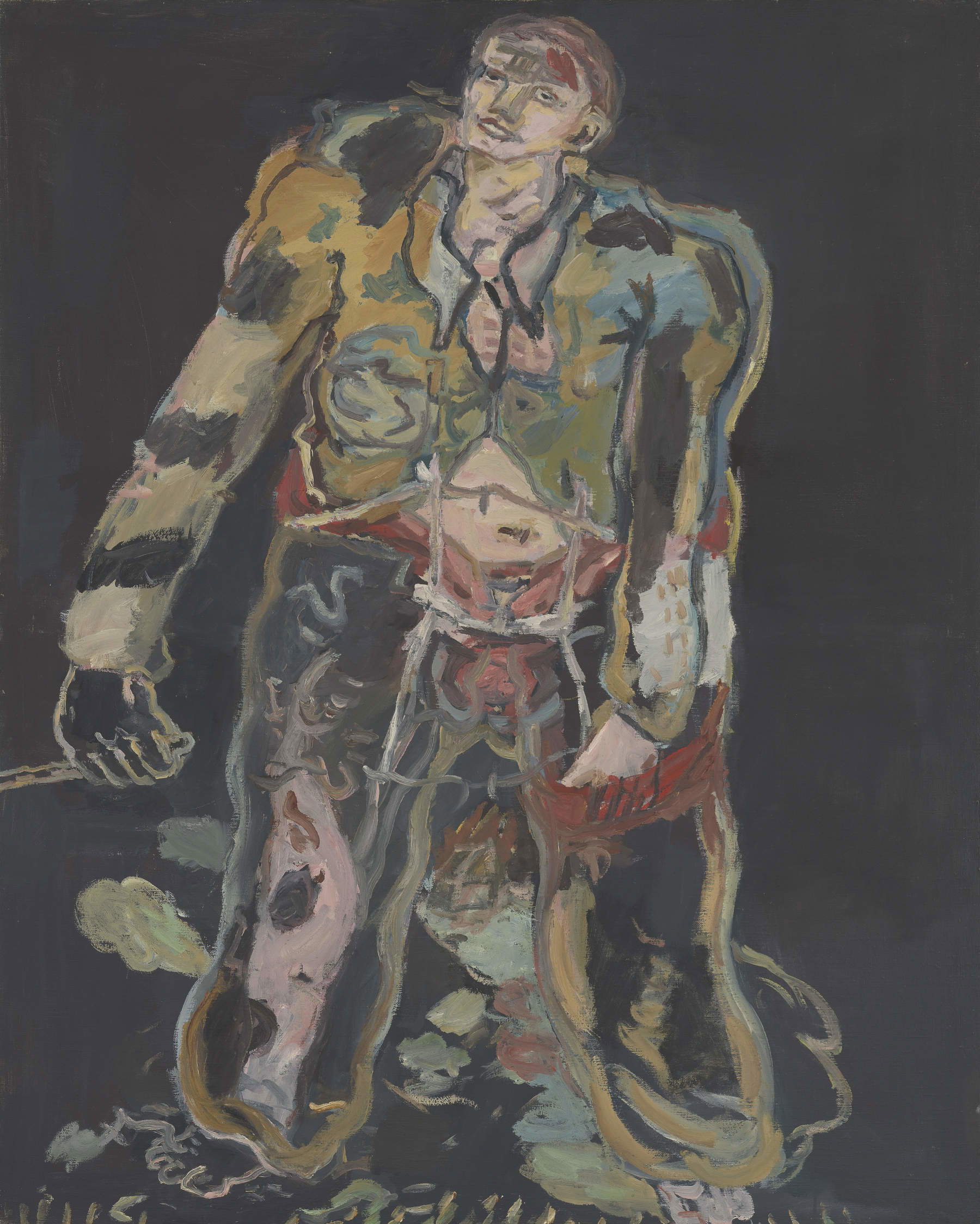
The “Hero” paintings can therefore also be seen as a reflection on painting itself. Within the compositions appear seemingly unusable tools and figures incapable of action, immobilized or frozen within the landscape. At the same time, however, Baselitz treats the paint with a fluid and expressive touch, suggesting the possibility that the medium can still transform and find new modes of existence.
This position was already explicitly stated in the text written by the artist for his first exhibition of paintings from the Hero series, held at the Galerie Springer in Berlin in early 1966. The text, titled “Why the Painting *The Great Friends* Is a Good Painting!”, emphasized painting’s capacity to contain elements that go beyond what is immediately legible in the image. Baselitz wrote that there is “more to the canvas than meets the eye” and described the painting’s principles—from color to structure and form—as “wild and pure.”
The series also represents an important turning point in the artist’s reflection on the nature of representation. Through these paintings, Baselitz came to view representation as a construct rather than a neutral rendering of reality.
“The hero becomes such only through a time-honored tradition and is—like history itself—the result of a construction subject to shifting goals and political intentions,” observes art historian Uwe Fleckner.
Baselitz had already begun developing this line of thought as early as 1966 with the Fraktur (Fracture) series, which is closely linked to Hero. In these works, heroic figures are sliced horizontally and then reassembled, calling into question the continuity of the figure and the stability of its representation. The London exhibition also includes references to this phase through works such as *Der Halbierte* (The Halved One) and *Drei Streifen – Der Maler im Mantel, Zweites Frakturbild* (Three Stripes – The Painter in the Coat, Second *Fraktur* Painting), both from 1966.
A few years later, in 1969, Baselitz would take another step that would prove decisive for his career, beginning to paint his first upside-down compositions. The inversion of the image would further challenge the relationship between subject, orientation, and representation. The paintings in the Hero series thus mark an early yet decisive moment in Baselitz’s artistic exploration. Created in the context of postwar Germany and in open dialogue with the dominant artistic trends of the 1960s, they simultaneously address the crisis of painting, the weight of history, the construction of the idea of the hero, and the artist’s position in relation to the cultural models of his time.
 |
| Georg Baselitz: “Heroes” Return to London—The 1965–1966 Series on View at Thaddaeus Ropac |

Warning: the translation into English of the original Italian article was created using automatic tools. We undertake to review all articles, but we do not guarantee the total absence of inaccuracies in the translation due to the program. You can find the original by clicking on the ITA button. If you find any mistake,please contact us.

























 IT
IT FR
FR DE
DE ES
ES CN
CN


