



by Redazione 13/11/2026


Categories: Exhibitions / Disclaimer
The Frick Collection is presenting an exhibition featuring five new paintings by artist Kent Monkman, a member of the Fisher River Cree Nation. Taking a famous painting by Vermeer as its starting point, the exhibition traces five centuries of relations between Indigenous peoples and colonial powers.


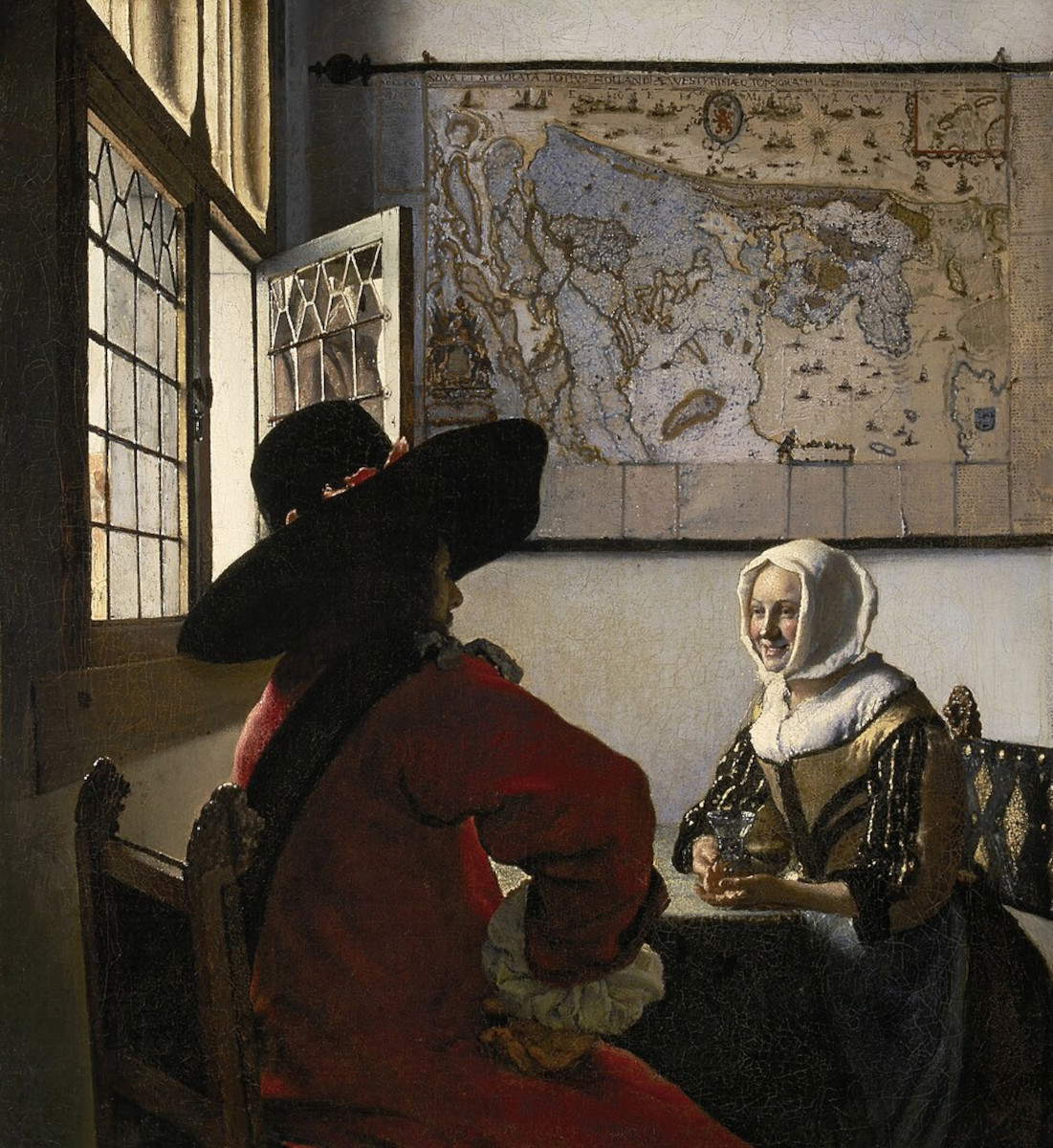
Reinterpreting a painting by Johannes Vermeer to chronicle five centuries of European colonization and restore the perspective of North America’s Indigenous peoples to center stage. This is the project undertaken by Canadian artist Kent Monkman, the focus of the exhibition *Officer and Laughing Girl*, on view at the Frick Collection in New York from November 12, 2026, to February 22, 2027. Held in the Cabinet Gallery, the exhibition features five new paintings inspired by *The Soldier and the Laughing Girl* ( c. 1657), one of the three Vermeer masterpieces in the museum’s collection.


Through his artistic practice, Monkman challenges traditional narratives of European history, demonstrating how the lives and work of 17th-century Dutch artists were closely tied to international trade networks and processes of colonial expansion. The series thus transforms an image of 17th-century Dutch society into a starting point for exploring the relationships—often marked by economic interests and power dynamics—between Europeans and Indigenous peoples.
With his recognizable style—characterized by irony, symbolic imagery, and meticulous historical research—Kent Monkman entrusts the narrative to his alter ego, Miss Chief Eagle Testickle. She is a gender-fluid time traveler whose name plays on the assonance between the English terms “mischief ” and “egoistical.” Through this character, the artist imaginesthe evolution of encounters between Indigenous and European peoples over the past five centuries, highlighting the cultural, technological, and environmental transformations that have resulted.




During the exhibition, Vermeer’s painting, *Soldier and Smiling Girl*, will be on view in the permanent collection galleries, a short distance from Monkman’s works. At the conclusion of the New York exhibition, in the spring of 2027, the five contemporary paintings will be transferred to the Beaverbrook Art Gallery in Fredericton, New Brunswick, Canada.
This initiative is part of the Frick Collection’s tradition of inviting contemporary artists to engage with its collections through exhibitions, talks, and publications. Since the museum’s opening in 1935, this practice has allowed for a fresh interpretation of historical masterpieces through contemporary sensibilities and perspectives.
The exhibition will be accompanied by an illustrated catalog and a program of public activities, including a talk by the artist, a workshop in the library, and in-depth discussions and exchanges led by the museum’s educators.
“I am grateful to the Frick for inviting me to explore shifts in perspective throughout history and to reflect on the various exchanges depicted in Vermeer’s *The Official* and *The Laughing Girl*,” said Kent Monkman. “Some of these exchanges are cultural, others relate to the commodification of the New World’s resources, and still others are more ambiguous. I hope these paintings spark curiosity and fill in some of the narrative gaps in our shared histories.”
“I have long admired the way Kent brings lesser-known stories to light through his art, which tackles complex themes while celebrating beauty, irreverence, and the deep connections between humanity and the Earth. Through a deep study of European history and art, his paintings create new and illuminating perspectives on the past and present, enriched by Indigenous history and culture,” commented Aimee Ng, chief curator of the Frick Collection. “We hope visitors will appreciate the opportunity to reconsider the dialogue at the heart of Vermeer’s iconic painting *The Soldier and the Smiling Girl * through the imaginary encounters found in Kent’s works.”
From New Amsterdam to Manhattan: Five Paintings, Five Eras
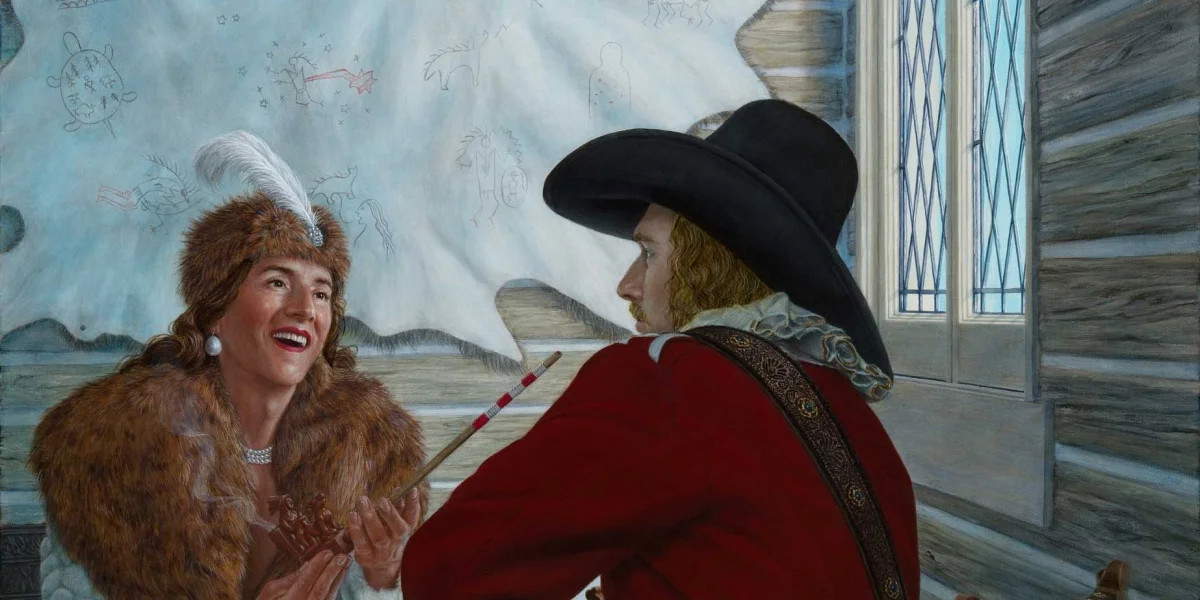
The works on display follow a chronological journey spanning five centuries, from the 17th century to the present day. In each painting, Miss Chief appears seated in a room reminiscent of the setting in Vermeer’s painting, as she hands a carved pipe to a man sitting across from her. The objects in the compositions take on special significance: they represent the various forms of economic and cultural exchange that characterized the relationships between Indigenous communities and colonial powers. The color palette also reflects this historical evolution: the cool tones of the early works gradually give way to warmer colors, alluding to rising global temperatures.
Monkman also reworks Vermeer’s original composition, reversing the positions of the figures and placing an Indigenous gaze at the center of the scene. The result is a reinterpretation of North American history that, through its richness of detail and focus on daily life, echoes the way the Dutch painter documented the society of his own time.
Just as Vermeer incorporated objects from international trade networks into his paintings—from beaver-felt hats to pearls, from Indian-veneered boxes to Chinese porcelain—so too does Monkman use artifacts that tell a story of appropriation, exchange, and exploitation. Animal skins, beads, feathers, coins, weapons, gold, commercial silver, red-dotted blankets, and crucifixes coexist with a contemporary object: a sheet of glass resembling the shape of a smartphone.
The first work, *New Amsterdam*, is set in the 17th century and bears the closest compositional resemblance to Vermeer’s model. Miss Chief and a Dutch officer sit facing each other in the city that served as the center of the New Holland settlement, in the southern part of Manhattan Island. The protagonist wears furs and pearls, while the man wears a beaver-felt hat and offers her gold coins, alluding to the commercial relations between the Dutch colonists and the indigenous peoples. In place of the map featured in Vermeer’s painting—which was copied from a 1621 map of Holland and West Friesland— Monkman inserts a Winter Count—a system for recording historical memory, common among the Lakota and other Indigenous peoples of the Great Plains, which uses pictographic images on bison hide. Each year, the community’s elders would identify the most significant event of the winter to represent it symbolically. The calendar created by Miss Chief reaches much further back in time, including events spanning millions of years, as recounted in her memoirs, excerpts of which are published in the catalog.
The second painting, *New France*, features a male figure reminiscent of Samuel de Champlain, founder of the French colony. The territory, which developed along the St. Lawrence River, was the scene of intense trade with the Algonquian-speaking peoples. The man carries a musket and gunpowder, references to the introduction of European firearms into Indigenous communities and the profound transformations that ensued in hunting practices and combat strategies. Cartography also becomes a tool of irony: the map depicted is derived from a 1722 French map of Hudson Bay, the outline of which the artist has modified to resemble the shape of male genitalia. Miss Chief, on the other hand, wears jewelry with seven beaver-shaped pendants made of commercial silver, while draped over her shoulder is a red-dotted blanket, a typical product of the Hudson’s Bay Company. Founded in 1670, this trading company was the longest-lasting in North American history and was liquidated in 2025.
With *Black Hills*, the narrative shifts to the 19th century. Miss Chief appears dressed in red, in a dress reminiscent of those worn by saloon girls of the era, seated in front of a man resembling General George Armstrong Custer. In 1876, Custer led the attack against the Lakota and Northern Cheyenne warriors, an event that went down in history as the Battle of Little Bighorn, Custer’s Last Stand, or the Battle of the Fat Grass. The general is facing both Miss Chief and a small, gold-framed portrait depicting Sitting Bull, chief of the Hunkpapa Lakota, who, together with Gall and Crazy Horse, resisted the U.S. troops. On the table lie several gold nuggets—the central element of the conflict over control of the Black Hills, known as Pahá Sápa by the Lakota and considered sacred territory.
Tensions escalated following the 1874 expedition led by Custer, during which gold deposits were discovered in the region. The U.S. government then revoked the Lakota’s sovereignty over the lands, while President Ulysses S. Grant issued an ultimatum to the Lakota Sioux, the Northern Cheyenne, and the Arapaho, demanding that they relocate to reservations. Sitting Bull, Gall, and Crazy Horse refused to comply, and in June 1876, together with over two thousand warriors, they defeated the forces led by Custer.
The 20th century is represented by *Reservation*, a painting in which gold takes on a new form: that of a crucifix in the hands of a Catholic priest. The scene evokes the history of Christian boarding schools, institutions that removed Indigenous children from their families and communities, preventing them from speaking their own languages and preserving their cultural traditions. In this composition, rendered in warmer colors, Miss Chief appears almost completely unclothed, wearing only red thigh-high boots and a shawl of the same color. Behind her is a map depicting the distribution of territories allocated to Indigenous reservations around 1900. This situation was also shaped by the General Allotment Act of 1887, a federal measure that mandated the subdivision of unceded tribal lands through a system of private ownership.
The series concludes with *Manhattan*, set in the 21st century. In a sweltering city interior, Miss Chief sits almost completely naked across from a bald man, identified by the artist as an anonymous executive in the tech industry. The man, visibly overheated, has taken off his shirt and is wearing a damp tank top, while the protagonist holds a transparent rectangle reminiscent of a contemporary smartphone. On the wall hangs an upside-down version of a work from Monkman’s own *Beauty and the Beast* series, which explores the relationship between humans and nature. This reference introduces Indigenous perspectives on the responsibility to care for the natural world and on the relationships between different forms of life.
The beaver, a symbol of colonial trade in Monkman’s reinterpretation
Another element linking Vermeer’s works to Monkman’s research is the beaver, which also features prominently in the unique wallpaper designed for the Cabinet Gallery exhibition. The decorative motif, titled “Beaver Baroque,” was conceived by the artist and hand-screen-printed by Flavor Paper, a Brooklyn-based company.
The pattern depicts beavers engaged in typically human activities: painting, dancing, or enjoying a glass of wine. This ironic choice highlights the central role this animal played in the history of trade relations between Europe and North America. Beaver pelts, in fact, were one of the most important resources extracted from New Netherland and transported to Europe by the Dutch. Intensive hunting brought the North American species to the brink of extinction in some areas. For the Dutch colonists, the fur trade was one of the territory’s main economic activities, reaching its peak in 1657—precisely during the years when Vermeer was painting *The Officer and the Laughing Girl*.
Who Is Kent Monkman
A member of the ocêkwi sîpiy tribe (Fisher River Cree Nation), Kent Monkman is a Canadian artist who lives and works between Toronto and New York. His work critically engages with traditional narratives of the colonization of North America through monumental historical paintings and a practice that encompasses painting, sculpture, printmaking, video, and performance.
His works are part of the permanent collections of major international institutions, including the Metropolitan Museum of Art, the Denver Art Museum, the Smithsonian American Art Museum, the Hirshhorn Museum, the Musée des beaux-arts de Montréal, the National Gallery of Canada, and macLYON. His works are also held in private collections such as Art Bridges, the Gochman Family Collection, the Sobey Art Foundation, and the Walker Youngbird Foundation.
Throughout his career, he has exhibited at leading institutions, including the Louvre-Lens, the Crystal Bridges Museum of American Art, the Palais de Tokyo, and the Royal Ontario Museum. In 2019, he was the first artist invited to participate in the Metropolitan Museum of Art’s Great Hall Commission. In 2025, he opened his first major international touring exhibition, *History is Painted by the Victors*, at the Denver Art Museum and the Musée des beaux-arts de Montréal; it was subsequently presented at the Akron Art Museum from April through August 2026. Monkman is also an Officer of the Order of Canada.
|
| Kent Monkman Reinterprets Vermeer at the Frick Collection: Five New Paintings Depict 500 Years of European Colonization |
Warning: the translation into English of the original Italian article was created using automatic tools. We undertake to review all articles, but we do not guarantee the total absence of inaccuracies in the translation due to the program. You can find the original by clicking on the ITA button. If you find any mistake,please contact us.