



by Redazione 11/11/2026


Categories: Exhibitions / Disclaimer
Through January 6, 2027, the Labirinto della Masone in Fontanellato is exhibiting original artwork, illustrations, and sketches by Milo Manara, ranging from *Fone* to *The Name of the Rose*. The exhibition is divided into three sections and traces over fifty years of comics through the theme of the labyrinth.


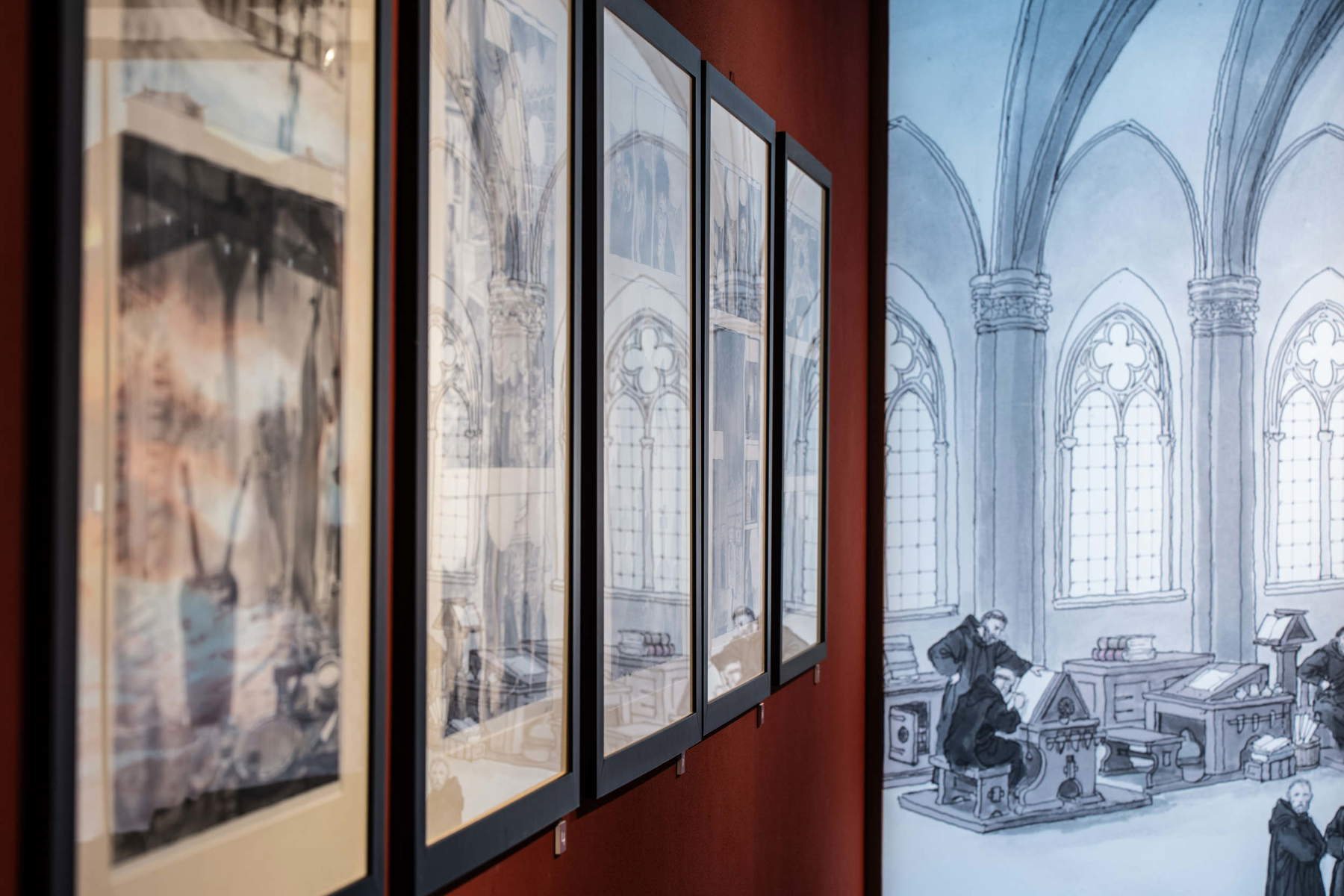
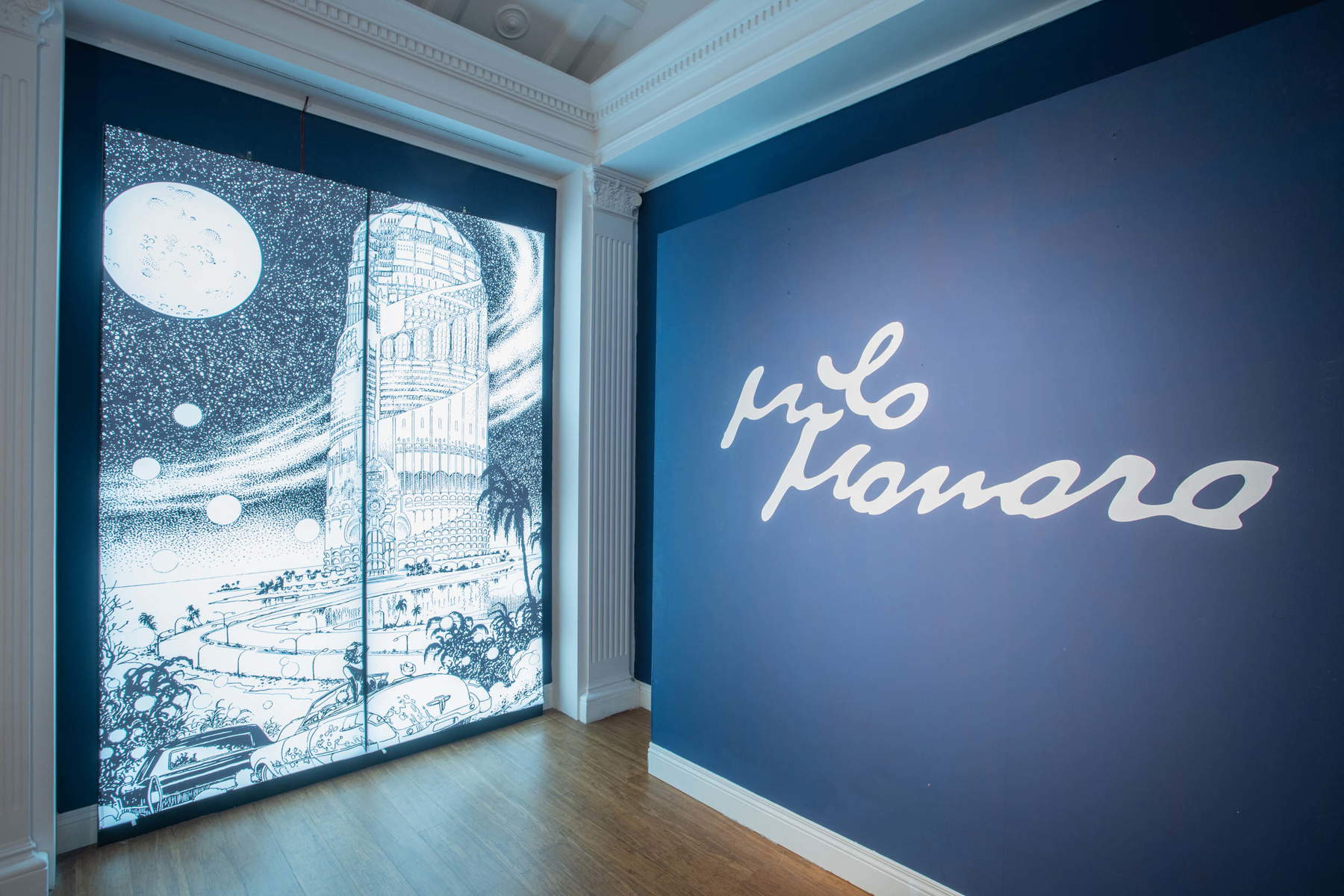
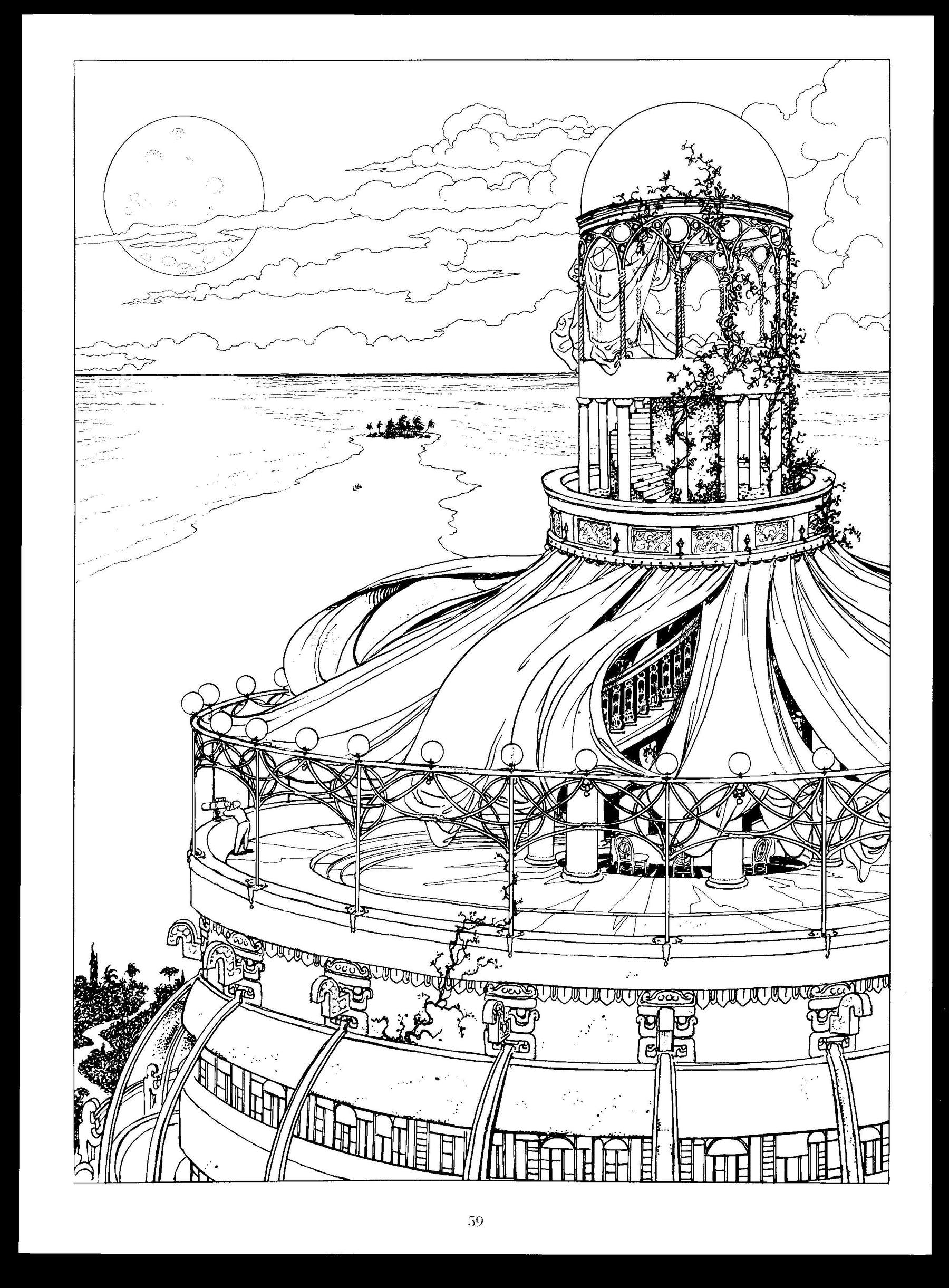
Umberto Eco had drawn the bookcases in the abbey library—the one at the center of *The Name of the Rose*—with his own hand: shelves topped by a pediment. When Milo Manara adapted the novel into a comic book, he started with that sketch. Then he changed the proportions. “I specifically drew these bookcases based on Umberto Eco’s sketch—that is, with a pediment at the top,” says the artist. “But I drew them enormous, much larger in size than Umberto Eco’s sketch: they have a vertical appearance, are very tall, and I also drew a ladder, which would have allowed the monks to reach the top shelves.” The reason lies in the narrator: the elderly Adso, who is reflecting on a week from his adolescence. “So I played a bit with memory, which distorts and exaggerates,” explains Manara, “and I drew everything on a much larger scale than it probably was in reality, in order to add an unsettling—let’s say metaphysical—aspect to these rooms, which weren’t exactly all identical like Borges’s cells.”


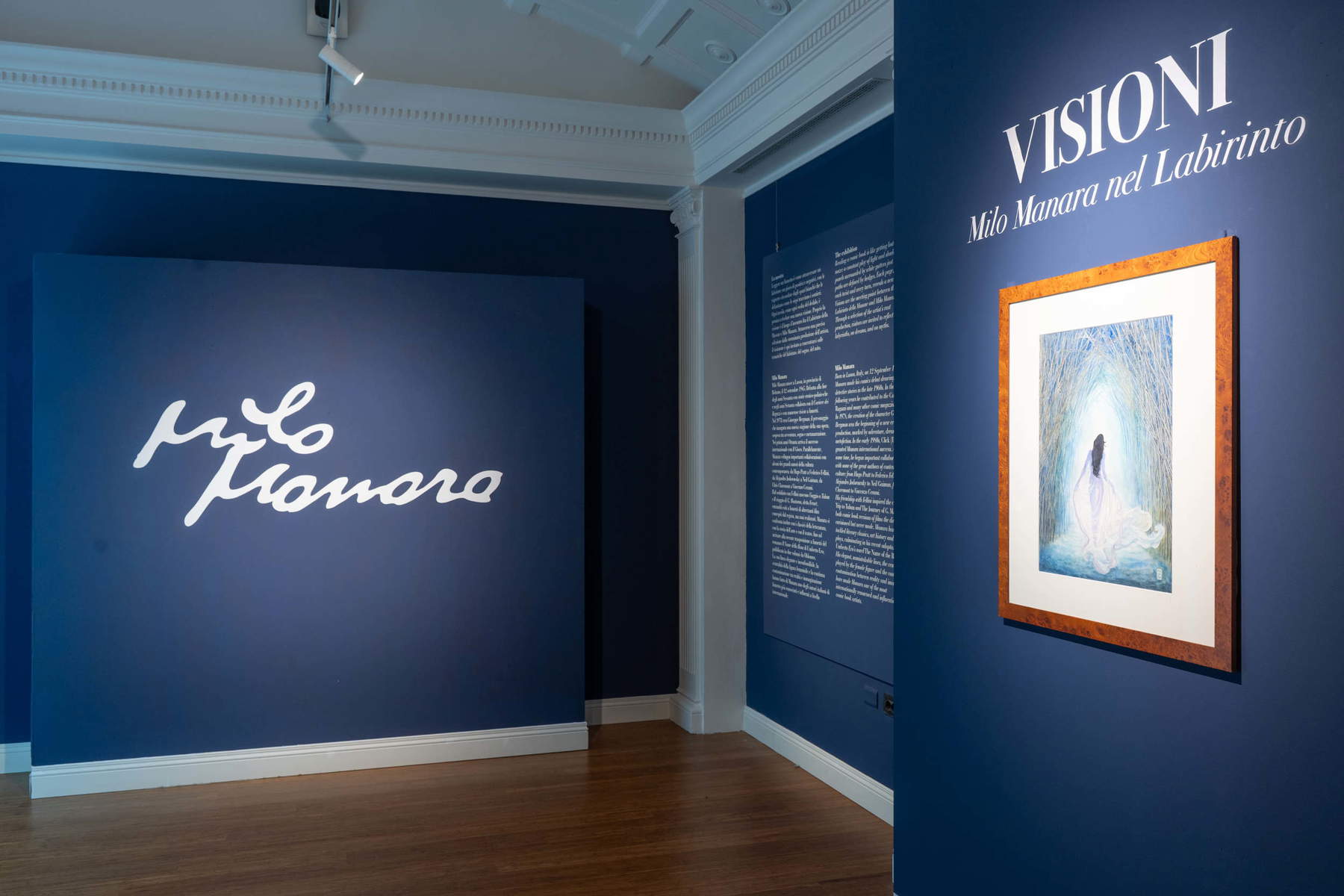
Those panels, along with many others, are on display through January 6, 2027, at Franco Maria Ricci’s Labirinto della Masone in Fontanellato, in the province of Parma, where the exhibition VISIONI. Milo Manara in the Labyrinth, which is sponsored by the Franco Maria Ricci Foundation and organized in collaboration with COMICON. The exhibition brings together original artwork, illustrations, and preparatory materials drawn from the artist’s archive, private collections, and international lenders. This is not a retrospective in the usual sense: the exhibition follows a thematic thread that runs through much of Manara’s work—the labyrinth, understood as a space of imagination, myth, and inner exploration.


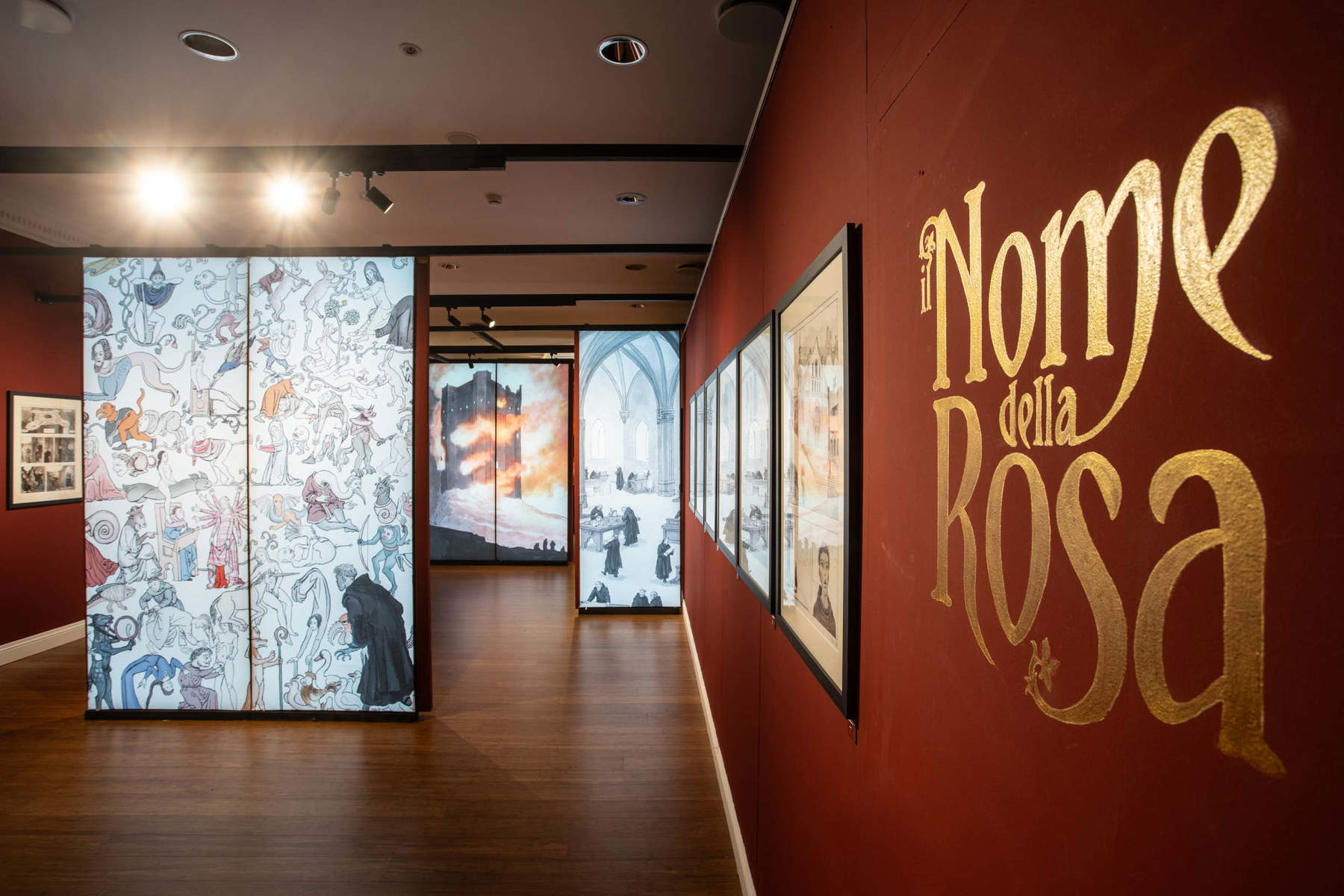
The venue explains the choice: the Labirinto della Masone, a star-shaped bamboo maze with three kilometers of paths, was born out of the friendship between Franco Maria Ricci and Jorge Luis Borges. In the catalog for Milo Manara’s exhibition, Pietro Mercogliano recalls the episode that started it all: in the 1970s, Borges was a guest of Ricci’s at his estate, and the publisher promised his friend—who had always been fascinated by the theme of the labyrinth—that he would build the world’s largest labyrinth there. The Argentine writer replied that this was impossible, because the largest labyrinth already existed: the desert. For Borges, the labyrinth was, in fact, a mental and narrative construct—a symbol of infinity, knowledge, and the possibilities of storytelling—but this did not stop Ricci from creating an architectural interpretation of this concept. Manara has offered his own interpretation of this concept in comics and illustration, constructing worlds in which reality, imagination, and memory are constantly intertwined. The exhibition stems precisely from this triangle.

Manara, born in Luson, in the province of Bolzano, in 1945, is one of the leading figures in contemporary comics. Over more than fifty years, he has built a visual universe that engages with literature, cinema, and the Western artistic tradition. When it comes to the theme of the labyrinth, however, he is keen to distance himself from philosophical abstractions. “But my labyrinth doesn’t reach the dizzying heights of Borges, for whom the labyrinth is a metaphor for existence itself: I, on the other hand, understand the labyrinth simply as a labyrinth,” he says in his conversation with Mercogliano published in the exhibition catalog. Even the exhibition’s title, for him, should be taken literally: “The title, Visioni, seems very fitting to me since I am, in fact, a visual artist—that is, I rely on vision: mine is not literature, but it is drawn literature.” Claudio Curcio, who has been working on the artist’s archive for over twenty years, also reverses the perspective in the catalog and finds the labyrinth within the comic itself: “But come to think of it, what is a comic page if not a kind of labyrinth?” You navigate the page one panel at a time, like the bamboo corridors of Fontanellato, without knowing what lies beyond the next turn.
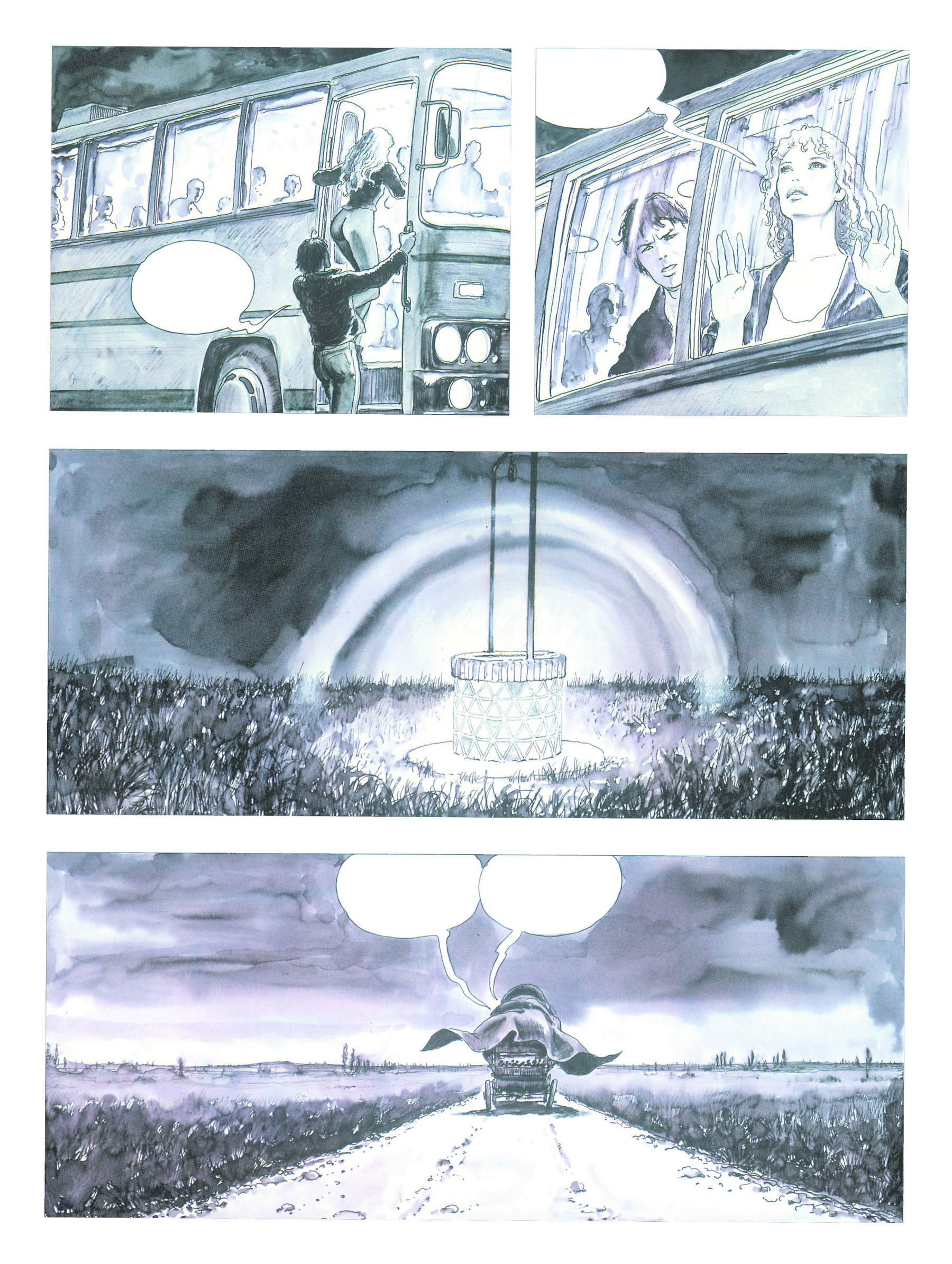
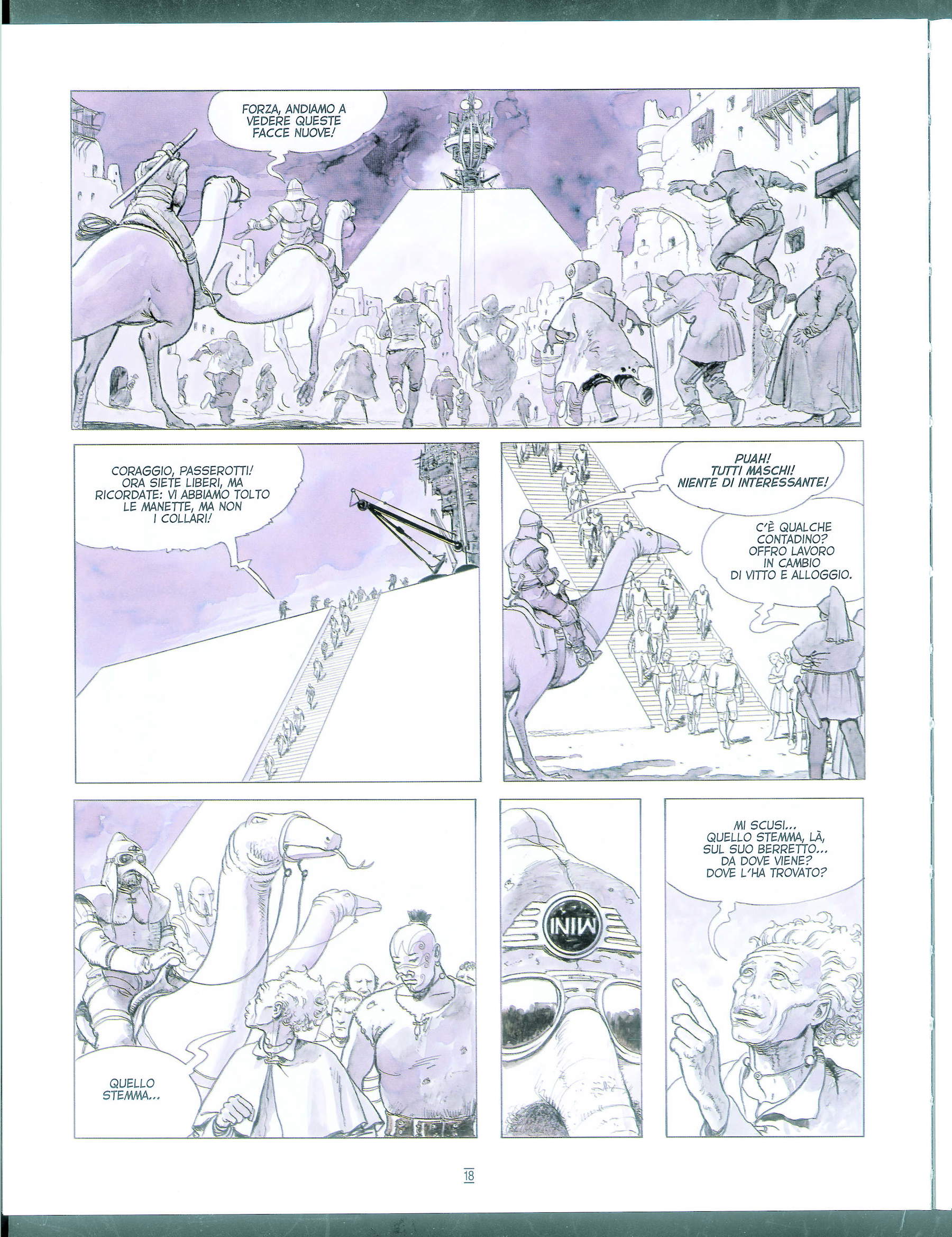
The first section of *Visioni* explores the labyrinth as a metaphor for the subconscious and the imagination. It brings together works on inner exploration and the construction of narrative, in which the relationship between dream and reality, the author’s identity, and the mechanisms of storytelling recur. There is *Fone*, a 1981 science fiction story published in the Italian edition of *Metal Hurlant*: it is an explicit homage to Borges’s *Library of Babel*, as well as to Moebius, whose atmosphere it recreates almost faithfully. Several original art panels from *Fone*, drawn from Pietro Alligo’s private collection, are on display alongside printed reproductions of the originals. Then there is Giuseppe Bergman, the character who, in 1978, became Manara’s first major success—entirely conceived, written, and drawn by him. The name was suggested to him by another great comic book artist and illustrator, Hugo Pratt: Manara found it perfect for its contradiction—a Mediterranean first name paired with a Nordic last name—suitable for a man who seeks great adventure but never manages to experience it.
Also on display in the same room is *Viaggio a Tulum*(Journey to Tulum), the story by Federico Fellini that appeared in 1986 in *Corriere della Sera* with illustrations by Manara, who later turned it into a comic. The exhibition features several panels from 1986–1987, drawn in ink and Ecoline. His collaboration with the great filmmaker from Rimini began in 1984 with a short story inspired by one of Fellini’s dreams, *Il cinese all’aeroporto* (*The Chinese Man at the Airport*). Fellini saw it and invited the artist to Cinecittà. For *Viaggio a Tulum*, the director even went so far as to draw the entire storyboard for the comic. Even one of the actors most closely associated with Fellini— Marcello Mastroianni—as Manara recalls, was surprised to find himself in the panels: “I’ve become a comic character!” he would say. The section concludes with *Fuga da Piranesi*(Escape from Piranesi), a 2002 science fiction story named after the author of *Carceri d’invenzione* (Prisons of the Imagination), Giovanni Battista Piranesi. On the planet Piranesi, prisoners are subjected to a genetic manipulation program designed to eradicate all aggression within them. The planet thus becomes, as Mercogliano writes, both a labyrinth and a Minotaur—a prison and a monster. For Manara, the prisons from which one must escape have a specific origin: “Perhaps this urge to flee and escape stems from the fact that when I began drawing comics—it was 1968—there was a great deal of prejudice, indeed a sort of haughty contempt, toward escapist fiction.”
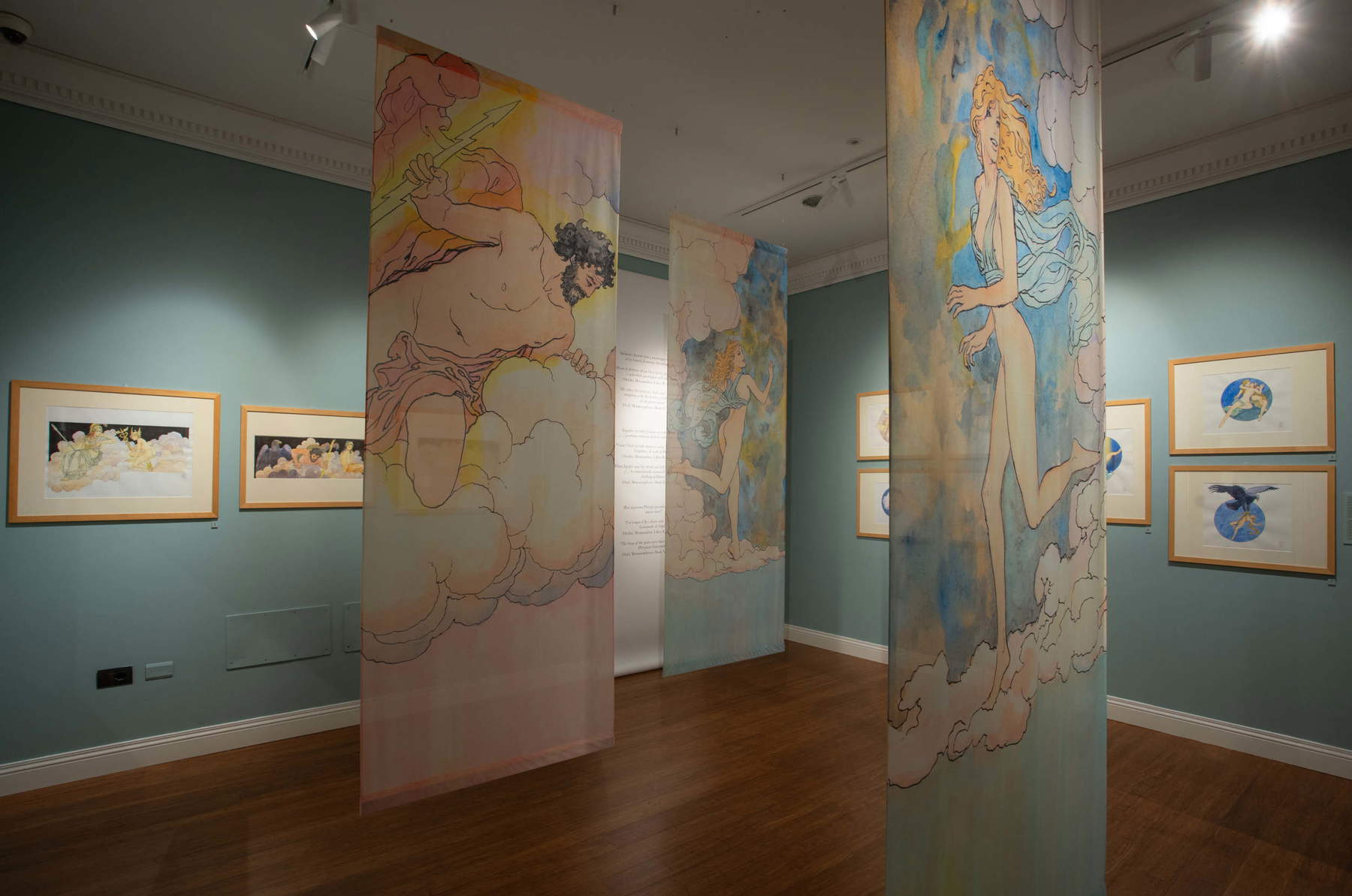
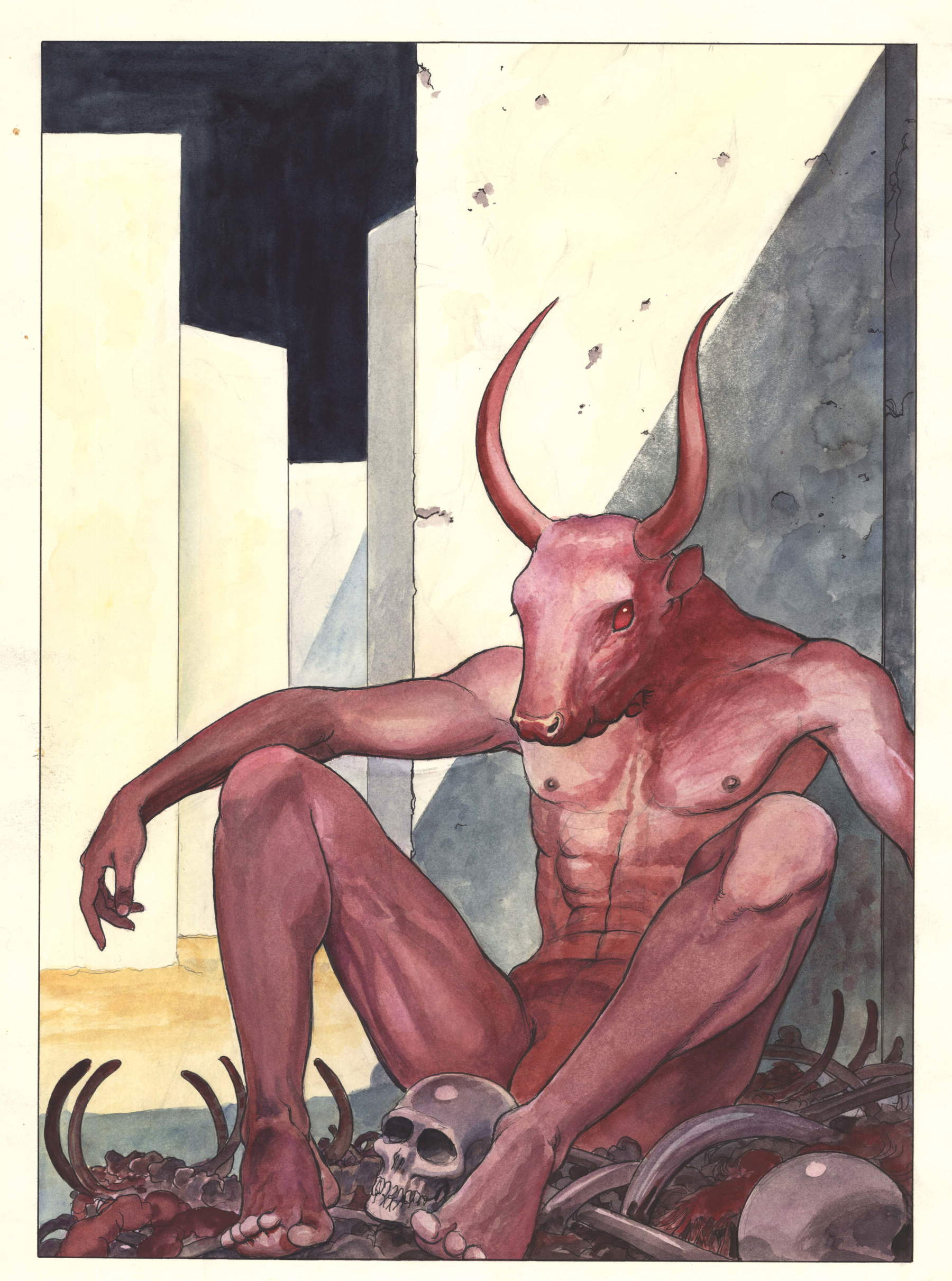
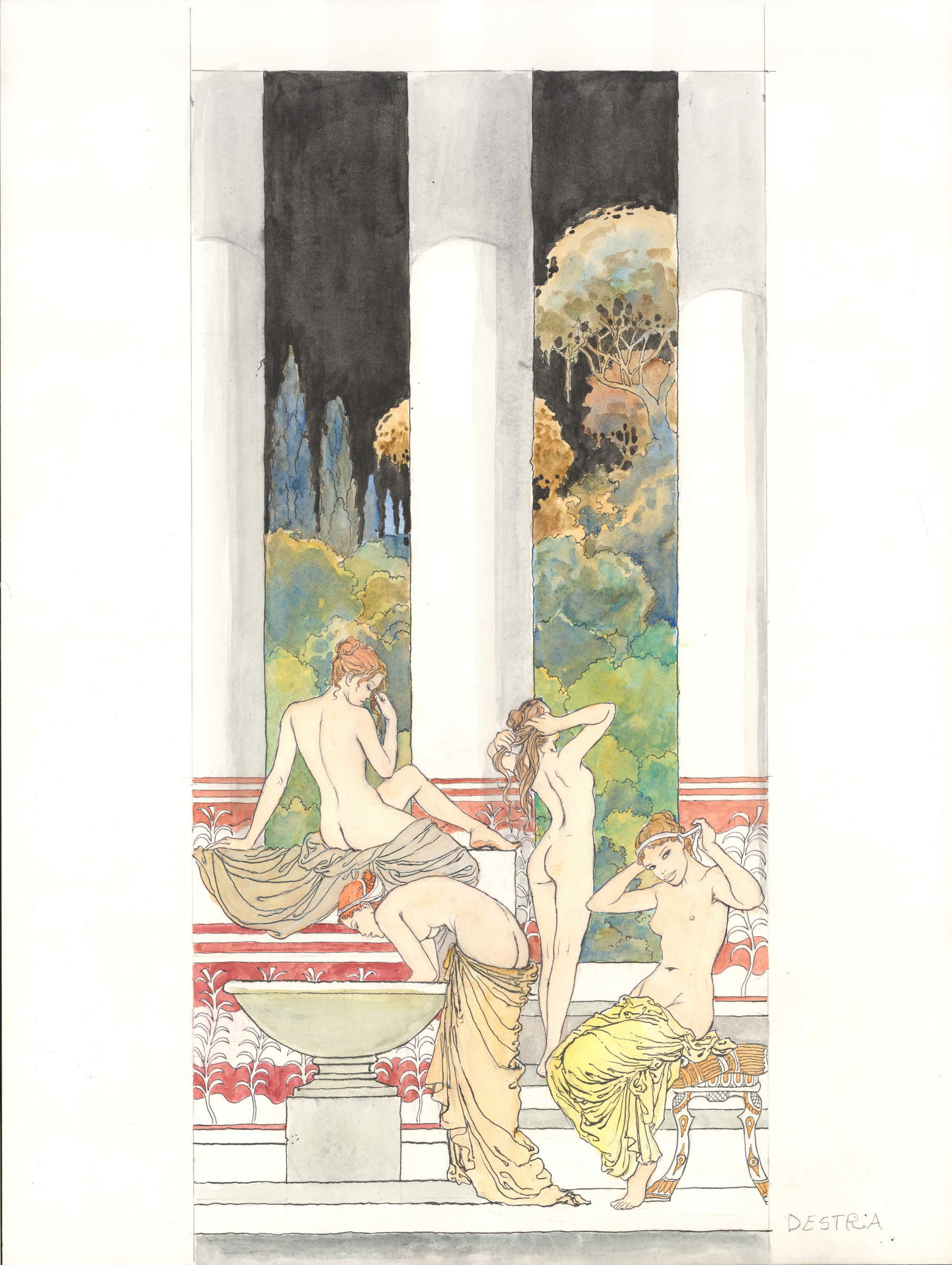
The second section, “The Labyrinth as a Place of Myth,” takes the visitor to the theater. This chapter of the exhibition features a selection of set designs that Manara created in 2023 for Mozart’s *Così fan tutte*, in a production directed by Stefano Vizioli. The opera is not set in 18th-century Naples but in a lush Olympus, populated by mythological figures, deities, and metamorphoses in the Ovidian tradition. “Così fan tutte is based on disguise, on misrepresentation for erotic purposes,” explains the artist. “The idea was that these frescoes would depict the *Così fan tutte* of Olympus—that is, Zeus’s habit, little quirk, or vice of disguising himself and transforming himself to seduce the various nymphs, mortals, the young Ganymede, and so on.” This also gave rise to the watercolor series *Metamorphoses*, featuring Jupiter and Juno, Leda and the swan, Europa and the bull, and Io and the cloud. Alongside these are the stage backdrops depicting Diana and the Nymphs and *The Bath of the Nymphs*. Here, the labyrinth becomes a symbolic place of desire, deception, and transformation—themes that recur in ancient mythology as well as in Manara’s images. At the center stands the Minotaur, an emblem of the connection between myth and the labyrinth. Among the works on display is also the watercolor painted in 1995 for *Romanzo musicale*, the show by Nicola Piovani and Vincenzo Cerami: a porphyry-colored creature, seated among the bones of its victims. “So I tried to interpret this Minotaur not so much by highlighting his terrible and terrifying appearance but by attempting to illustrate his loneliness and melancholy,” Manara explains.
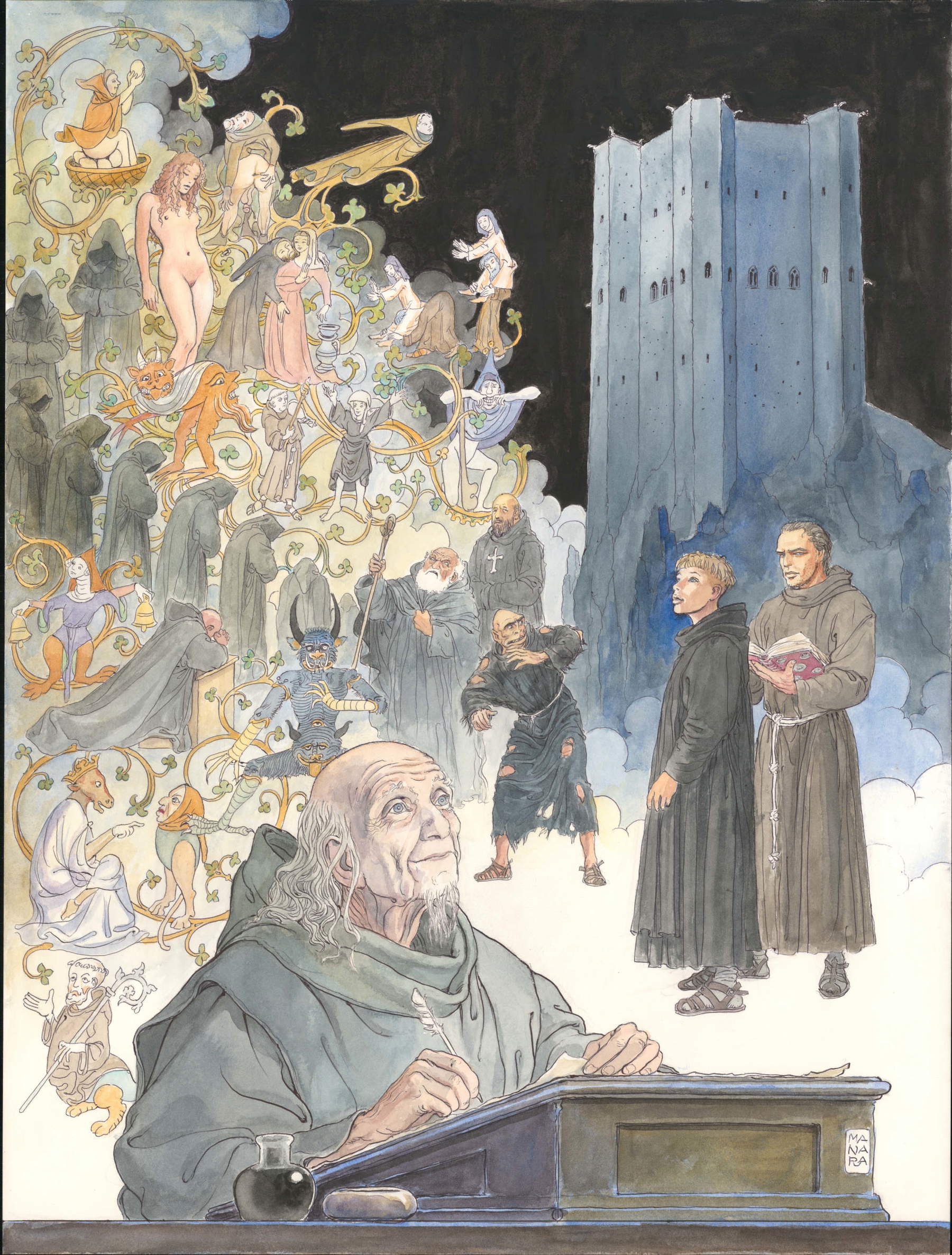
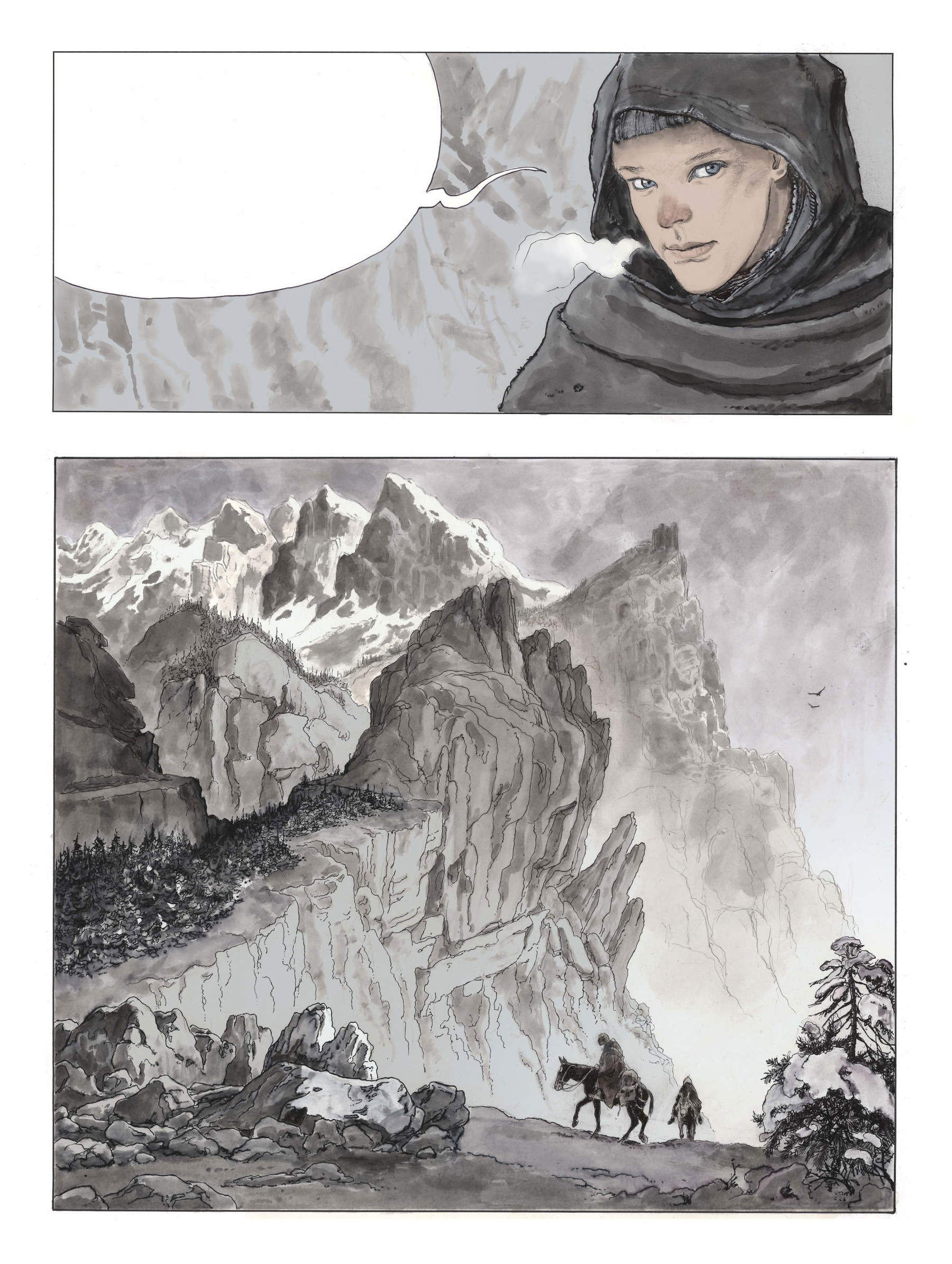
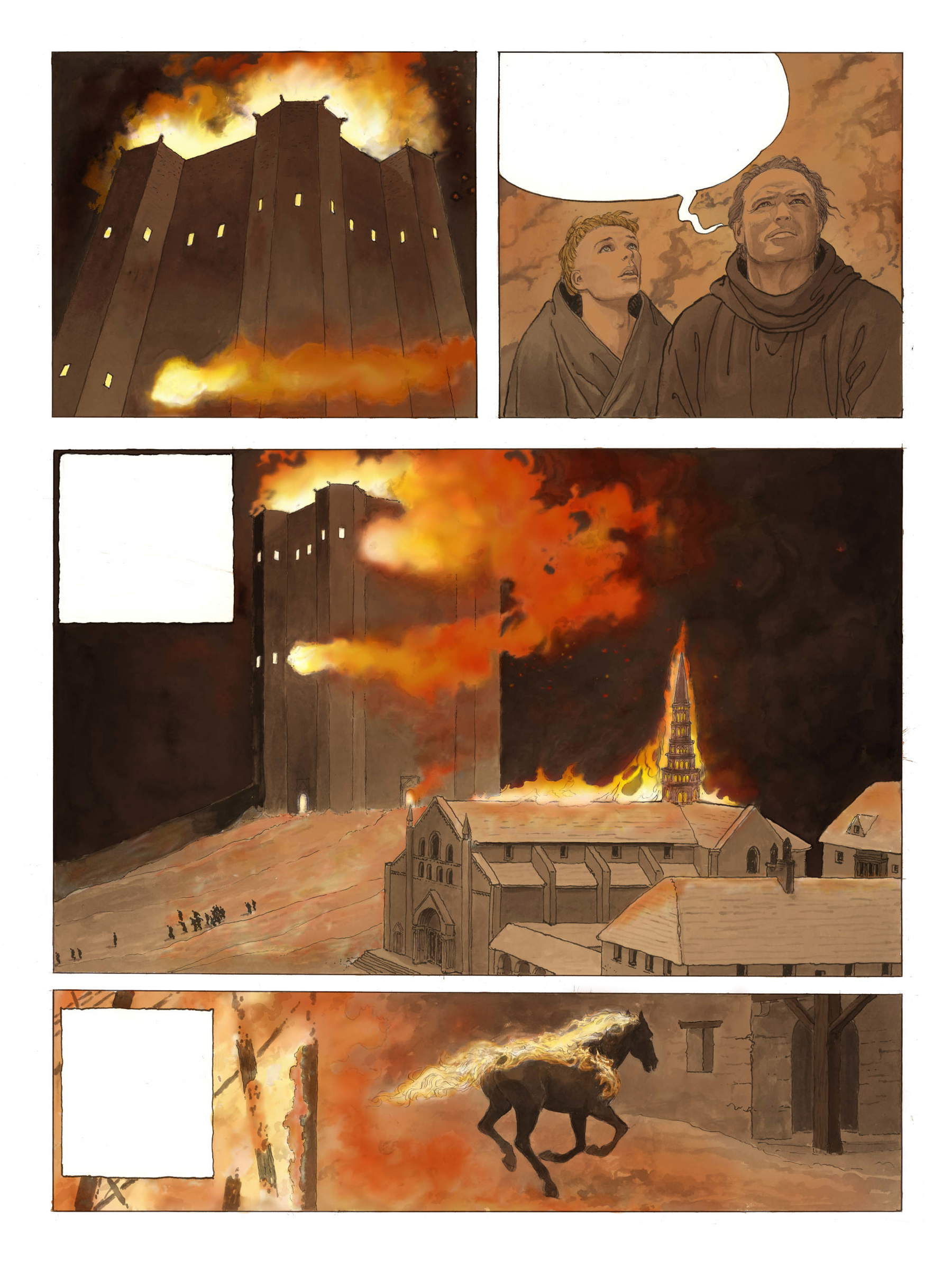
The third room, “The Inner Journey,” is dedicated to *The Name of the Rose*, and it is where Manara, Borges, and Franco Maria Ricci come into closest contact. Eco’s novel pays explicit homage to the Argentine writer through the character of Jorge da Burgos and builds its plot around the labyrinth of the abbey library. The connection to Ricci also stems from a book. As the catalog notes, Eco had edited a volume for the publisher on the Blessed of Liébana—the commentary on the Apocalypse preserved in an early medieval Mozarabic manuscript. The page featuring the woman clothed with the sun later appears in the novel, cited by William of Baskerville. Manara also drew on those images for his adaptation, published in two volumes in 2022 and 2025. The illustrations selected for the exhibition also share many visual similarities with the Labyrinth of the Masone, evident in their geometry, perspectives, and spatial organization.
In these pages, every detail serves a purpose. Manara explains that he initially considered omitting the small table that Eco places in the center of every room in the library, as it seemed superfluous to him. Then he realized it wasn’t: “But in the end, the blind old man stumbles right into the small table and knocks over the lamp that was on it, and that’s what starts the fire, because the lamp falls onto the books that had fallen off the table: so the small table did have a role.” In the catalog, the artist compares his version—which he tried to keep as faithful as possible to the novel’s description—with Jean-Jacques Annaud’s film. In the film, the library resembled Dracula’s castle, full of staircases suspended over the void. For Manara, however, the anguish of that labyrinth is of an intellectual and metaphysical nature.
For the occasion, Manara also created an original, previously unpublished illustration dedicated to the Labirinto della Masone. It is a tribute to the venue hosting the exhibition and brings the dialogue between the artist and the space to a close. During the same period, starting October 2, the Labirinto museum is exhibiting *Babele Fantasma*, a zoetrope (one of the best-known devices of so-called “pre-cinema”—that is, experiments with moving images that preceded the invention of cinema: it was a device used to view moving images), created specifically for this exhibition by Virgilio Villoresi. The filmmaker and visual artist has been working for years on artisanal experimentation with the image. Here , he has given the zoetrope the shape of the Tower of Babel, a figure closely linked to Franco Maria Ricci’s imagination and his universe of labyrinths, impossible architectures, and fantastical visions. Inside the tower, figures inspired by Alberto Martini—an artist particularly dear to Ricci—move about: enigmatic characters who inhabit it like ghosts and seem to lead the viewer ever deeper. As the zoetrope spins, the motionless figures come to life, and the tower becomes a small machine of optical illusions. It is a nod to the origins of cinema and phantasmagoria, when light, movement, and the persistence of vision were enough to make ghosts appear.
As is customary for exhibitions at the Masone, the show is accompanied by a book of the same name published by Franco Maria Ricci Editore, with texts by Pietro Mercogliano and Claudio Curcio. After Fontanellato, the project will continue elsewhere: in the spring of 2027, the exhibition will be restaged at the Fondazione Cassa di Risparmio di Alessandria under the title *Milo Manara in Umberto Eco’s Labyrinth*.
VISIONS. Milo Manara in the Labyrinth remains open at the Labirinto della Masone in Fontanellato (Parma) through January 6, 2027. The exhibition is open daily, including holidays, except on Tuesdays: through March 30, 2027, opening hours are from 9:30 a.m. to 6:00 p.m., with last admission at 4:30 p.m.
|
| Milo Manara and the Labyrinths of Borges, Eco, and Fellini: The Cartoonist’s Visions at the Labirinto della Masone |
Warning: the translation into English of the original Italian article was created using automatic tools. We undertake to review all articles, but we do not guarantee the total absence of inaccuracies in the translation due to the program. You can find the original by clicking on the ITA button. If you find any mistake,please contact us.