



by
Federico Giannini  @federicogiannini1
04/11/2026


Categories: Interviews / Disclaimer
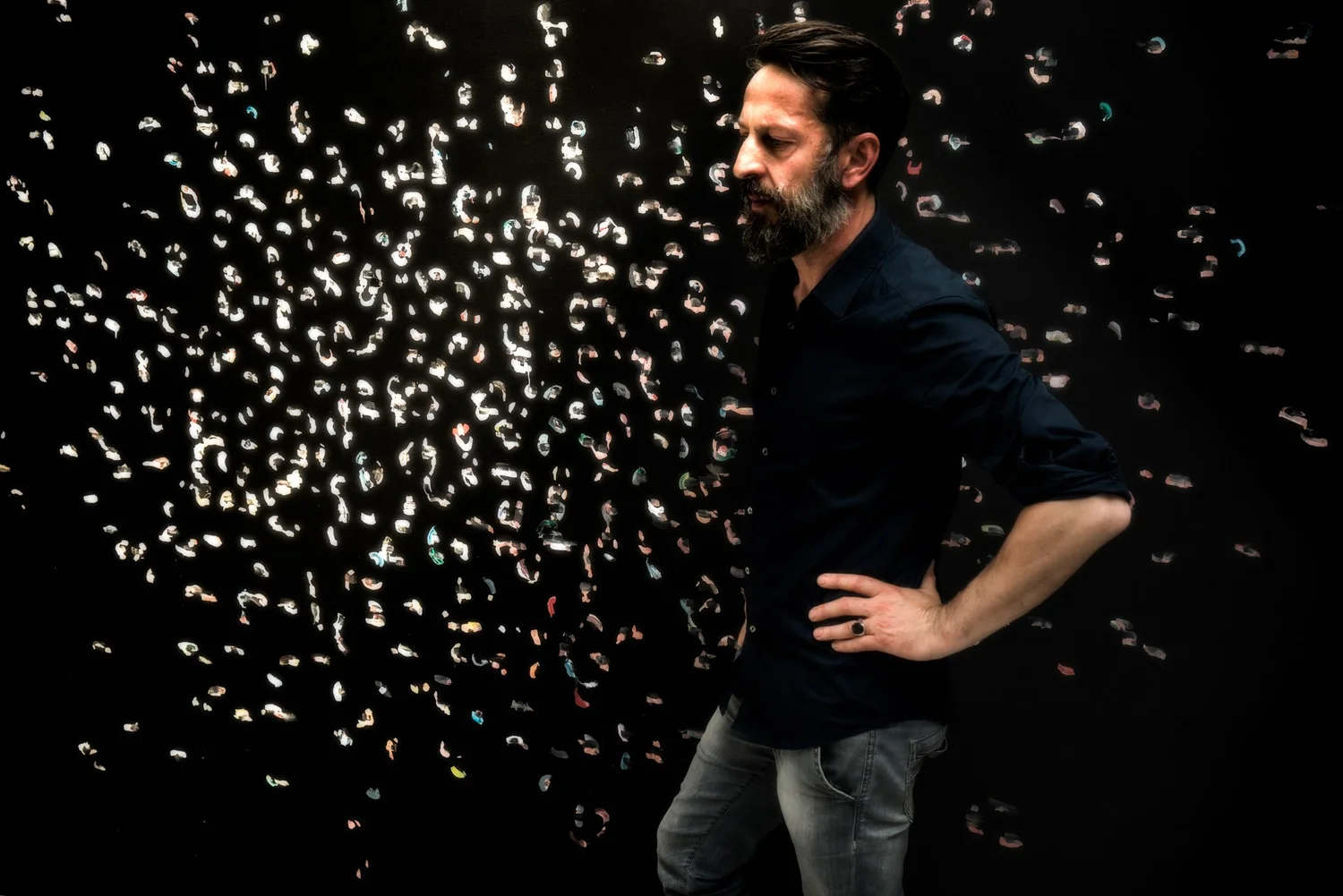
What does one of Italy’s leading contemporary painters think about art fairs and the art market? We discuss this with Daniele Galliano, who, in this interview with Federico Giannini, explains why buying art isn’t a privilege reserved for the few (and the same goes for understanding art) and why, first and foremost, we need to learn to look at art and choose what we like.

What does one of Italy’s leading contemporary painters think about art fairs and the art market? We discuss this with Daniele Galliano (Pinerolo, 1961), one of the most interesting figures in contemporary Italian painting. Active on the Turin art scene since the early 1990s, he has developed a personal painterly language over the course of his career—one capable of traversing different imaginaries and sensibilities, in constant dialogue with cinema, literature, comics, and music. From his first international exhibitions—including those at the National Gallery in Rome and the Annina Nosei Gallery in New York in 1996—to his participation in the Venice Biennale, his career has spanned major institutions and collaborations with leading figures in visual and musical culture. In this conversation with Federico Giannini, beginning with a reflection on Artissima and the transformations of the art market, Galliano addresses some of the central issues in the contemporary art debate. From the difficulty of recognizing a young artist’s talent to the role of painterly quality, from the gradual marginalization of painting within the institutional system to the cultural function of art fairs and galleries, his gaze focuses on the contradictions of a world in which economic dynamics and mechanisms of legitimization sometimes risk taking precedence over the value of the works themselves. But the discussion also broadens to include the relationship between art and the public, the need to make the aesthetic experience accessible, and the particular vitality of Turin’s art scene. What emerges is a conception of art that is far removed from both speculation and self-referentiality: an experience to be cultivated through visiting exhibitions, training the eye, and the pleasure of discovery. Because, as Galliano points out, a work of art is not merely an object to be owned or an investment, but something capable of entering daily life, accompanying it, and even changing it.


FG. What did you think of Artissima this year?


DG. I don’t know—I’m not one of those artists who follows everything methodically, because that just confuses me. Not to mention that you stop every minute to say hello to someone, so you don’t really get to see much. Anyway, I usually just wander around, waiting for some beautiful work to catch my eye.

And what caught your eye at this year’s edition? Did you find anything interesting?
Well, this year I went there for an interview and then for the presentation of the Luca Beatrice Prize, so I didn’t get a chance to take a thorough look around. What did I see? I saw a De Chirico, some Parmiggiani, some Paladino. There was probably a lot of new painting there too, but I couldn’t say for sure. I’m not the best person to answer these questions, because I’m so easily distracted (and I think that’s also one of my strengths) that I can’t look at things methodically.
However, the very fact that you mention a De Chirico, a Paladino, and a Parmiggiani as the most interesting works seems to me very indicative of the overall quality of the new offerings—let’s call them that.
And yet Artissima was also conceived as an experimental fair, focused on young artists. And when the economy was doing better (not great, but still a little better than now), there was a real incentive to buy: everyone went home with something, and those who didn’t buy there ended up buying at Paratissima or elsewhere. There were some pieces that were inexpensive.
But what about now?
Now the key to collecting is knowing how to identify an artist who has potential, a future, and whose work is valuable and groundbreaking. It’s not for everyone, but those who succeed buy works for next to nothing, and within a few seasons, they can sometimes yield surprising results and performance.
How do you know when a painting by an artist—whom you may have never seen before—is worth your attention?
Personally, I’ve had some incredible opportunities that I didn’t follow through on. I remember that many years ago I had the chance to buy a painting by Schifano when it was still inexpensive... but I kept putting it off, telling myself, “I’ll do it later,” “I’ll do it later,” and then eventually he died, and now it’s no longer easy to find his important paintings at a low price. And back then, I could have even traded for another piece… ! Anyway, to tell you the truth, I’ve become more of a collector of photography than of painting, and when it comes to photography, I haven’t missed a beat: for example, I bought works by Shirin Neshat and Wolfgang Tillmans when they were still inexpensive. Then I bought works by Manuel Ocampo (I have a beautiful painting of his), by Stanley Whitney; I have photographs by Richard Billingham and Zwelethu Mthethwa; I have lots of photos by Schifano—the ones he later messed up (it’s not like having a beautiful painting, but still…). In short, I had an eye for it. I mainly picked up pieces that were similar to my own work: I was painting the very things Tillmans was photographing at the same time, even though we’d never met… things like backstage at concerts and clubs. They were artists I had an affinity with, and who might even have crossed my path, and with whom I’d later become friends.
Today, if you went to an art fair, how would you tell if a painter—say, a young one—has talent?
Well, you just see it. We witnessed the case of Nicola Samorì: he was successful almost immediately. At first, he was just another painter, but you could tell right away that he was a supernatural phenomenon.
And what is it, in your opinion, that makes a painter a supernatural phenomenon?
The quality of the painting.
Meaning?
It’s hard to say. Just talking about something that has to be seen is, in itself, a bit of a contradiction, isn’t it? But I realize that, among my collectors, the most discerning ones—those who immediately recognize which painting is cooler than another—are the ones who’ve more or less tried their hand at painting a bit. Because if someone has absolutely no idea what it’s all about… I also taught at the Academy, and I tried to explain to my students that only hours and hours of work and total dedication can yield results: that’s how you learn to understand the brushes and what you can create with them. You only get there after a lot of hard work. And it’s that work that then allows you, too, to understand the effort behind a painting—even one done in two minutes. As Picasso replied: “I didn’t do it in a minute; I did it in forty years and a minute.” Because you can make just two brushstrokes when you have years and years of painting experience behind you.
What do you think of the state of painting in Italy today?
For starters, we have a Biennale where there isn’t a single Italian artist—except for the Italian Pavilion, where they still feature an Italian, though perhaps that will change eventually. It’s an absolute disgrace… as if we had no painters—or rather, no artists—in Italy, when in fact we have them in abundance. In recent years, painting has proven its worth, in the sense that it has demonstrated an ability to depict reality (and to do other things as well) more than any other medium. Just think—even looking beyond Italy—of the power of Neo Rauch, Sasnal, and that whole group of truly extraordinary painters, while elsewhere we keep seeing repetitions of the 1970s that are sometimes downright embarrassing.
Would you care to name a few Italian painters who you think are worthy of attention today?
I just organized an exhibition here of Giuseppe Mulas, a very talented young painter. Then, among the younger artists, I’d say Davide Serpetti, Silvia Negrini, and Silvia Paci. These are the ones that come to mind off the top of my head.
Getting back to the art fair: do you think it’s useful for the public? I mean the people who go, look around, and don’t even ask for a price… in short, the public that goes to the fair just to… look but not touch?
Definitely. It sharpens your eye for beauty a bit, so it’s good for you. Then there’s also a certain kind of art (which maybe isn’t really my thing)—conceptual art—that, instead of giving you answers, poses questions and makes you think. Yes, it’s useful. In my opinion, it’s very beneficial.
So for you, the fair still serves a cultural purpose, as well as a commercial one.
At the fair, for better or worse, you see the trendy artists as well as the classics—a bit of everything: it gives you a sense of the current scene, of what’s out there. A prime example is Art Basel. Sure, you might go to the Biennale, but all the highlights of the Biennale are represented there—and not just that—because you can compare them to Picasso, Dubuffet, and the great masters, so it’s very useful. Also because certain things imposed by force by the establishment galleries sometimes don’t resonate with the public… and rightly so, because they’re things that don’t communicate anything to anyone. Painting, on the other hand, is a universal language, like music. Paradoxically, barriers have been erected along the lines of “there’s no point in painting anymore”—completely nonsensical notions that likely signal a shift in perspective: instead of a perspective that tends toward the absolute, toward the heavens, one has adopted a perspective that stares at one’s own asshole. And you don’t get very far with that.
And so the idea takes hold that contemporary art is something only a few can understand, when in reality it’s the exact opposite. Or is it not?
It’s the exact opposite, yes! And paradoxically, this also applies to the most abstruse works: I’m thinking, for example, of certain installations by Anselmo that are nonetheless very evocative, very powerful. A good artist is always good, regardless of the medium.
Then there are other barriers as well. For example, many people think that art is something only a few can afford, but in reality, many people can now buy a work of art; many can take a tour of Artissima and find something affordable—something they can buy for a few hundred euros.
Yes, contemporary art is accessible to all budgets because, as I mentioned earlier, you can buy a young artist’s work when they’re just starting out, and generally a young artist’s work costs 500, 1,000, or 1,500 euros. I remember that in 1993 or 1994 I saw a Tony Oursler installation for the first time at a French gallery—I don’t remember the name—that had a beautiful installation, which also included a VCR and a projector. I went to ask the price, and he told me it cost one and a half million lire. Instinctively, I asked the gallerist, “But do you also include the video and the projector?” It was all included. Imagine that: you could buy that stuff for practically nothing. And it’s always been that way, even now. To give you another example, I remember that in the 1980s there was a railroad worker who was a collector—with an average salary (I don’t know exactly how much it was, but in any case, an average salary)—who bought works by young artists and made a fortune. Always at those prices.
Of course, if you’re buying with the intention of making money, you should also have an eye for recognizing when an artist has potential...
Yes, that’s essential. But above all, painting still speaks to the gut, to the spirit, because you can understand it on your own. With a certain type of art, however, that’s not the case: you need someone to make it accessible to you, otherwise you won’t get it. Then there are those who might trust the gallery that’s showcasing it… “If they’re showing it, then it must be good”…
How are prices determined? Even for your own paintings…
Well, the initial price is set when you join a gallery that has an established market, and it’s the gallerist who tells you how much your painting costs, because they have the professional expertise to determine what a fair price might be. From there on, as you do prestigious exhibitions, you can raise the price: a couple of exhibitions, an exhibition at a museum, a showing at the Biennale… and the price goes up.
And how did things go with your gallery owners?
I’ve always dreamed of being an artist, and when I finally made it, I was happy to have met the people who gave me the opportunity to turn that dream into reality. The city of Turin has also given me so much. Of course, with any gallerist—since money is involved—there are sometimes disagreements, but everyone takes their own risks. And meeting a gallerist who’s willing to take a risk on you is always a good thing: you have to iron out the issues, try to understand each other’s perspectives, and then you embark on a journey together.
When you first started out, was art more expensive?
No, the prices of artworks were always more or less the same. The problem is that there’s no money anymore.
You told *Repubblica*, which interviewed you during a tour of Artissima , you said thatmany people don’t even go into galleries, fearing it would be pointless. How can we convince them to overcome this barrier?
Let me give you this example. With my students from the Academy, I did a project on a wall here in a square. The work was titled *The Turinese We Liked: Portraits by Luca Beatrice, Giuseppe Culicchia, Luciana Littizzetto—all the Turinese figures who’ve become famous*. A taxi drivers’ association—which usually organizes small cultural events as part of their business—saw it and proposed that we reproduce each portrait on a taxi, in exchange for free tickets to the Pinacoteca dell’Accademia Albertina. This was because the project had been carried out in collaboration between the Accademia Albertina and the Augusta Taurinorum association. Well, I was moved. I thought, “How wonderful—they’re asking to see an exhibition, along with their families.” So there are lots of people who go to see exhibitions and who, at first, are far from being able to buy anything. But then, over time, they become friends with an artist or a gallerist, and maybe that friend gives them a good price. And there are many Turin residents who are regular exhibition-goers simply for the pleasure of broadening their cultural horizons and experiencing beauty.
So, in your opinion, to convince people who might not even expect that buying a work of art is something anyone can do, we need to persuade them to constantly engage with art—or with “beauty,” as you put it.
It should become a habit. Anyway, if you go to the GAM in Turin—which always puts on great exhibitions and also has an amazing collection where absolutely nothing is missing—you can’t even get in on Sunday mornings. And there, on Sunday mornings, you don’t see the usual crowd: it’s just people who are simply out for a stroll.
Turin, however, has a relationship with culture, with art, and with contemporary art that’s perhaps different from what you see in other parts of Italy. Having spent some time in Turin (though my perspective will never be as in-depth as yours, since you’re from Turin—so at most I can ask you to confirm or refute it), I believe there’s… how can I put it? A closer relationship between the residents and art. Or is that just my impression?
There’s a tradition of engaging with it, because it’s a city that’s always had an incredible array of cultural offerings. Turin was also chosen by students from Chile and Argentina (who then ended up working as bartenders to make ends meet) who came to attend art school because they saw Turin as a city where it was possible to take their first steps in the art world, even on a commercial level. Until recently, there were plenty of exhibitions organized by the Region and the City; exhibition series were held in many venues, and works were actually sold. So the artists who came here were also able to make a living from their art. Even Turin’s lawyers, for example, were famous for being collectors, so even a young lawyer would start buying art right away—perhaps in different fields—and then move up the ladder. In short, it was a city with exhibitions and events where many people had this experience. Things have slowed down a bit now, but I’m pleased to see that as one gallery closes, another opens, and that there are always young people willing to invest money because they believe in it. And anyway, yes, it’s a city that has always had so much to offer, so a certain habit has developed.
What would you suggest to someone who knows nothing about it but wants to start buying contemporary art?
To go check out the events. Usually, for example, I invite people to exhibitions, point out artists to follow, and suggest they go see this or that. Then you realize it can even become addictive. And then, the advice I can give is always to buy what you like. That way, you’re always happy, without ever having to think about anything else. The people I know have never thought about selling the things they own, because owning them is a source of satisfaction. A work of art isn’t just a photo or a painting you hang on the wall: it’s something of incredible power that changes your life. Sure, it decorates your home, but it’s also great company, and I believe it changes your life—in a spiritual sense—it lifts your spirit. Art does that, too.
Warning: the translation into English of the original Italian article was created using automatic tools. We undertake to review all articles, but we do not guarantee the total absence of inaccuracies in the translation due to the program. You can find the original by clicking on the ITA button. If you find any mistake,please contact us.