




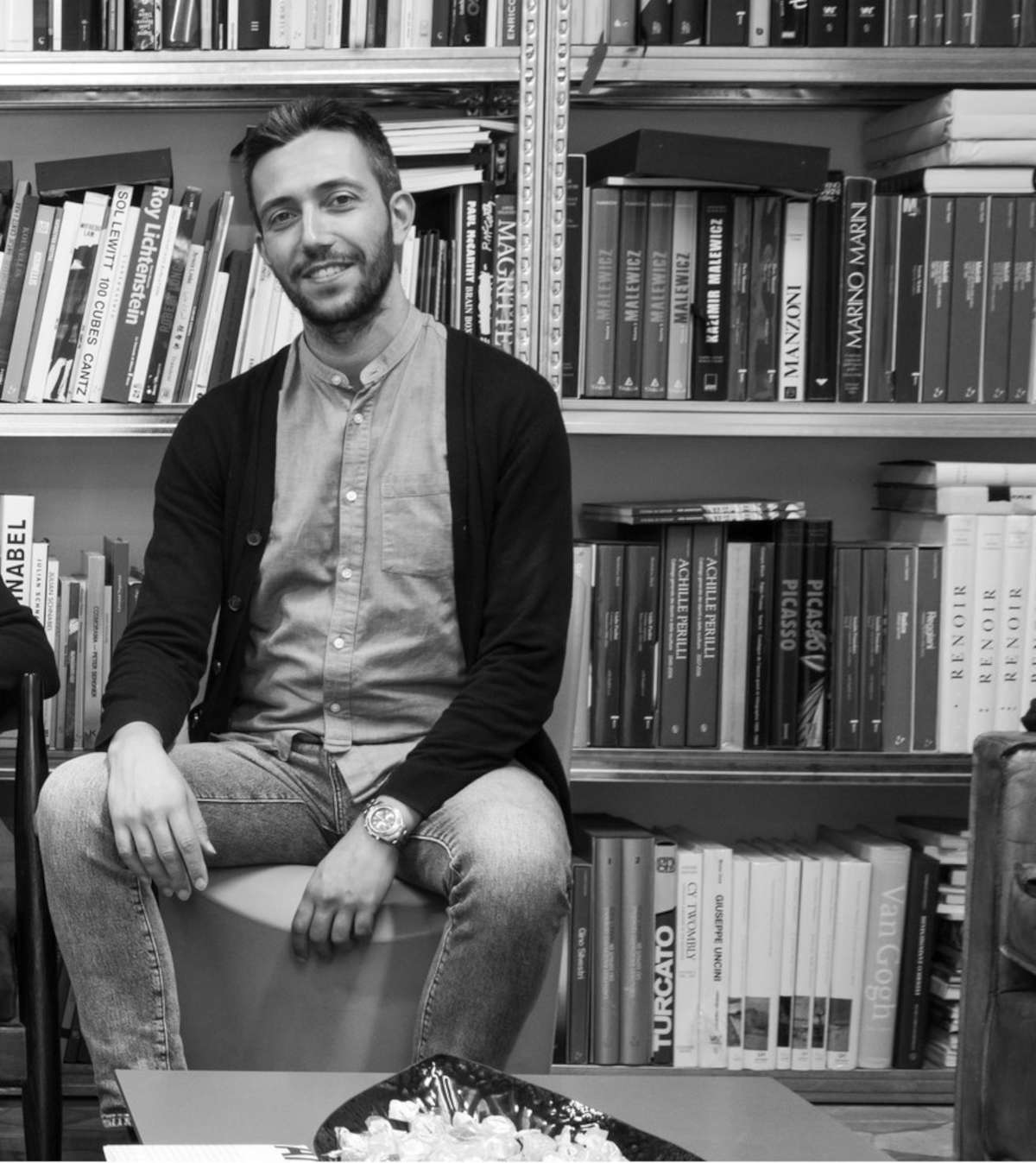
Living on the threshold, without having to choose which side to take. This is perhaps the image that best captures the way Gabriele Salvaterra views curating, art, and even his own role within the art system. As a curator, critic, and museum professional, Salvaterra views his work as a practice rooted in listening, research, and connections—one in which there are no definitive conclusions, but rather threads to be drawn between seemingly disparate elements. At the heart of his reflection lies an idea that recurs in many of his experiences and writings: that of the surface. Not as a synonym for superficiality in a negative sense, but as a place where things happen, meet, and acquire meaning through the gazes that rest upon them.
In this conversation with Gabriele Landi, they discuss curation and art criticism, painting and its potential scope for freedom, the relationship between interpretation and the artwork, as well as Lucio Pozzi, Susan Sontag, Umberto Eco, and Italo Calvino. A dialogue in which the exploration does not aim to find definitive answers, but rather seeks to keep the questions open. Born in Tione, near Trento, in 1984, Salvaterra currently works at the MART in Trento and Rovereto in the Collections Department and serves on the jury of the Artivisive San Fedele Prize in Milan. He has curated dozens of exhibitions featuring emerging, mid-career, and established artists, while also overseeing the publication of the accompanying catalogs for both institutional and gallery exhibitions. In addition to these activities, he contributes as a correspondent for various specialized art magazines, both print and online. He has published a monographic catalog on the work of Armida Gandini with Skira. In 2023, his essay *Sulla superficie* was published by Polistampa.
GL. To begin this conversation, I’d like to start with a recent piece you sent me for *Az Autoritratti Alfabetici*. The piece, which began with the letter B, concluded with this reflection: “Who knows where I’ve positioned myself between this world and the next—perhaps I’ve never made up my mind and have preferred to dwell on the threshold.” So: does this choice to dwell on the threshold also reflect itself in your curatorial decisions?
GS. Good evening, namesake. From a certain point of view, you’ve hit the nail on the head. In that passage, I felt as if I were quoting Calvino, when, in *Palomar*, he wondered where the world was—and, relative to it, the self: on this side or that side of a hypothetical window through which to look? Calvino concludes, leaving the question open: “Perhaps the ‘I’ is nothing other than the window through which the world looks at the world.” I think that’s true for me as well. We stand in the middle between two realms—the inner and the outer—which we cannot fully comprehend. Between these mysterious places, there we are: a diaphragm that stands between them, welcoming or allowing fragments from both universes to become entangled. To inhabit this threshold in curatorial practice is to accept the complexity and contradiction of a non-profession—a role that is never clearly defined, straddling the organizer, the writer, the critic, the exhibition designer, the curator, the would-be artist, and the envious observer of those who truly create and put themselves on the line. At first, drawing on my early experiences in museum education, I liked to call myself a cultural mediator; that idea, too, involved standing on a threshold between an object to be interpreted and its audiences to be understood—and, deep down, nothing has changed.
So is the curator a kind of filter that acts by focusing on situations without losing sight of their complexity—indeed, by expanding that complexity through dialogue with other situations?
Your question already touches on two aspects of curation and critical practice that I find important: on the one hand, focusing on the subject you’re discussing or presenting; on the other, broadening the discourse to include new, different, and unexpected elements. Centrifugal force and centripetal force. In general, however, initiating parallel discourses that have their own autonomy but also a distant connection to the object of critique—for me, these are always texts with their own autonomy. To use another metaphor, the curator draws lines, pulls threads, and establishes connections between elements of knowledge that are seemingly distant from one another and unable to communicate.
There’s something enchanting about this act of pulling threads. Is there something magical about the practice of curating?
More than magic, there are aspects that have to do with craftsmanship—chiseling out phrases, discourses, and words. Retrieving old texts read millennia ago. Discussing, debating, exchanging opinions, keeping quiet, and listening. There was an artist—I don’t remember who—who said that the best critics were those who, instead of walking into the studio and parading their own repertoire, preferred to sit quietly and listen to the simple, practical things the artist told them (Carla Lonzi also teaches this, in this sense). Deep down, I’m very attached to Susan Sontag’s *Against Interpretation* and other similar open-minded approaches (Hans-Georg Gadamer, Umberto Eco, Lucio Pozzi). Perhaps there’s something of the diviner in all this: a search that is more a process and a performance of this activity than an actual discovery. I search; I don’t know if I’ll find anything.
What do you mean when you say “staging”? Can you explain that better?
Perhaps I used the wrong words. I just meant to say that I prefer to show an ongoing process of searching for meaning, rather than limiting myself to reporting final, definitive conclusions. There’s never really a conclusion, in reality. Come to think of it, perhaps it’s worth emphasizing—in response to your previous question—that the magical, transformative aspect lies, if anywhere, in the artist’s work; I deeply believe in this. You are truly magiciens de la terre!
What other aspects do you consider important besides the two mentioned above?
I’d say, once again, the ability to listen and a kind of rigorous inventiveness. Even critical and curatorial work has its own creative dimension, even though it draws on other existing artistic texts, which it, in a way, builds upon. But there is certainly an element of invention in this practice; the important thing is not to let it become gratuitous or arbitrary, but to keep it within the boundaries of the subject at hand. It requires a form of respect stemming from the fact that the curator or critic works “in the service” of something else—a work, an artist, a movement, a slice of history—and cannot, under these premises, do exactly whatever they want. There are therefore shifting boundaries within which to develop one’s creativity.
Now, as is the case for everyone, there are certain forms of expression that, for various reasons, one prefers over others. Which ones are yours?
I’m absolutely a traditionalist in this regard. I love painting and drawing—the so-called traditional mediums —as well as sculpture, even though it’s objectively harder to find examples of it around. I try, however, to avoid all the rhetoric about comebacks, resistance, and nostalgia. That said, every artistic language is valid for what it has to say—or doesn’t say. At the last Biennale, the works I liked best were performative, for example (especially the Belgian Pavilion with Dries Verhoeven, *The Fortress*), but I realize I interpret everything through the lens of painting. Even a performance is nothing more than painting in time and concrete space.
“Losing Painting” is the title of a recent essay of yours. Why “losing”—in relation to what or to whom is painting losing?
Compared to world history, success, politics, the news, current events, and slogans. I think painting always exists in a peripheral and superfluous condition. Thanks to this marginality, it has plenty of room to maneuver and unexpected linguistic possibilities. It is allowed to do anything, and it is one of the few voices that can express itself in an alternative, defiant, and uncalculated way. But there can be no heroism in any of this, which is why I am annoyed both when this language is pompously celebrated and when the opposite rhetorical device is used—highlighting its supposed weakness only to then praise it even more. I’m interested in a group of artists who explore this idea of painting as loss and failure in relation to the expectations of a world that speaks a different language. I have tried to identify its exponents in artists such as Giovanni Blanco, Lorenza Boisi, Lorenzo Di Lucido, Massimiliano Fabbri, Domenico Grenci, Michele Parisi, and Eugenia Vanni. Painters—both men and women—dedicated to cultivating minimal gestures, a detached subjectivism, and uninteresting themes. However, the movement does not seem destined to suffer the same fate as the Transavantgarde!
Well, the Transavantgarde presented itself in a completely opposite way, adopting all those attitudes that don’t seem to interest you. Perhaps today, bringing together a group of artists by uniting them around a particular attitude or way of looking at things is more complicated. After all, the artists themselves seem reluctant to engage in such a dynamic, more inclined to highlight their differences than to emphasize their similarities. I believe that if we’re going to talk about a group, it must arise from an authentic dialogue among artists and critics… at least that’s my impression, but how do you see it?
Yes, certainly from a network of relationships, power, and even interest. Not from the grassroots level and, all things considered, independently, as is often attempted. I don’t want to sound too cynical, but when money and interest are lacking, it’s often difficult to create dynamics that transcend narrow circles. But perhaps it’s also important simply to cultivate these bonds of moderate proximity, just as we’re essentially doing now and as you continue to do through your commendable work! In any case, what’s needed first and foremost are ideas and content; without them—in my view—it’s difficult to keep the “house of cards” standing.
A few years ago, you published the book *On the Surface: Superficial Thinking in Contemporary Art and Culture*. I’d like to ask you to talk about it…
“On the Surface ” has been and remains my obsession, as I’m convinced it’s an incredibly fascinating semantic field, rich in implications for interpreting art and today’s reality. I believe that the surface is the best concept for defining both our times and the world around us; in fact, this is confirmed by the countless philosophers, artists, writers, and intellectuals who, since the late nineteenth century, have engaged with the risk of superficiality in their thought and practice. It has therefore been a major undertaking—spanning nearly a decade—of research and archiving, carried out voluntarily, without specific aims or objectives, which ultimately gave rise in 2023 to this beautiful volume published by Polistampa, Florence. I quote Alessandro Mendini, with whom much of this began: “The word ‘cosmetics’ in this case is not a negative term; it indicates the acceptance that our relationship with things and with life is very often superficial. It translates into a horizontal focus, not a deep exploration; yet even superficiality has its own depth if it is experienced and accepted as a profound difficulty of human life.” In this sense, my essay has emerged as something profoundly superficial or, conversely, superficially profound. Which brings us back to *Palomar*…
In *Palomar*, Calvino argues that a deep understanding of reality stems from a meticulous analysis of its surface, transforming the observation of details into a fundamental and potentially infinite act of exploration, just like the surface itself. How do you intend to continue this exploration, and what means do you believe are best suited to carrying it forward?
Yes, the surface allows for an examination in breadth, seemingly sacrificing a focused delve in favor of an analysis of much greater scope. It is certainly a way of operating that mirrors that of today’s society, even in its undeniably simplistic and negative excesses (I’m thinking of the classic example of politics and know-it-alls). How to proceed? I wouldn’t mind moving forward with a more concise essay in which I could synthesize some new themes that have been added to the discussion in recent years, although, I must say, the 2023 publication already covers much of what can be said on the subject. Certainly, I always keep this theme in mind—perhaps a bit selfishly, considering it my “specialty”—and every time I find myself talking about art, I use it as a tool for understanding, asking myself, for example: “What kind of spatiality—superficial, deep, illusory, concrete, hypothetical, absent, excessive, temporal, instantaneous—is postulated by this visual proposition?” Furthermore, among the various projects I have in the works, there is also an exhibition project on contemporary artists who explore the surface in a significant way; but, as we know, it’s not always easy to bring such initiatives to fruition.
This approach of yours—working on the surface of things—inevitably brings you face-to-face with color when compared to painting. It seems to me that you’ve already moved in this direction in the past, working with shades of gray. Can you tell us about that experience?
It was a small exhibition hosted at the Galleria Area 35 in Milan during one of the most unfortunate periods in recent history. Suffice it to say that I was in Milan setting it up on March 8, 2020—the day Lombardy became a red zone. It featured artists such as Giulia Dall’Olio, Lorenzo Di Lucido, Ettore Pinelli, Debora Fella, Andrea Mangione, Michele Parisi, Giovanni Pasini, and Rolando Tessadri. The idea was to explore the chromatic spectrum of gray—something undeniably visual and external—as a barometer of a broader, deeper, more complex, and layered poetic sensibility. Continuing along these lines, we’re currently working on an exhibition that might seem even more superficial, dedicated to the color pink…
Can this exploration of colors that are victims of clichés and sociocultural stereotypes be interpreted as the projection of a dizzying sensation onto their caressing surface?
For Hegel, all reality is appearance; there is no depth behind the visible. Thus, even colors are nothing more than screens and backdrops onto which our perceptual, social, and cultural expectations are projected.
Do you feel the same way?
Absolutely; I’m a superficial curator, and I believe that the interpretation of a work says more about the person interpreting it than about the work itself. Or rather: through its presence, it reflects the thoughts of others that revolve around it, like the gazes directed at it. That’s why we could continue to discuss art and aesthetics even when it comes to objects produced millennia ago and already thoroughly analyzed by historiography. There is no immutable core within them to be unearthed, but communicative texts exist within the superficial flow of aesthetic and cultural exchanges that people project onto them. And all of this ranges from the simplest level of taste judgment—namely, “I like it/I don’t like it/I’m indifferent”—to the most complex historical-critical exegesis.
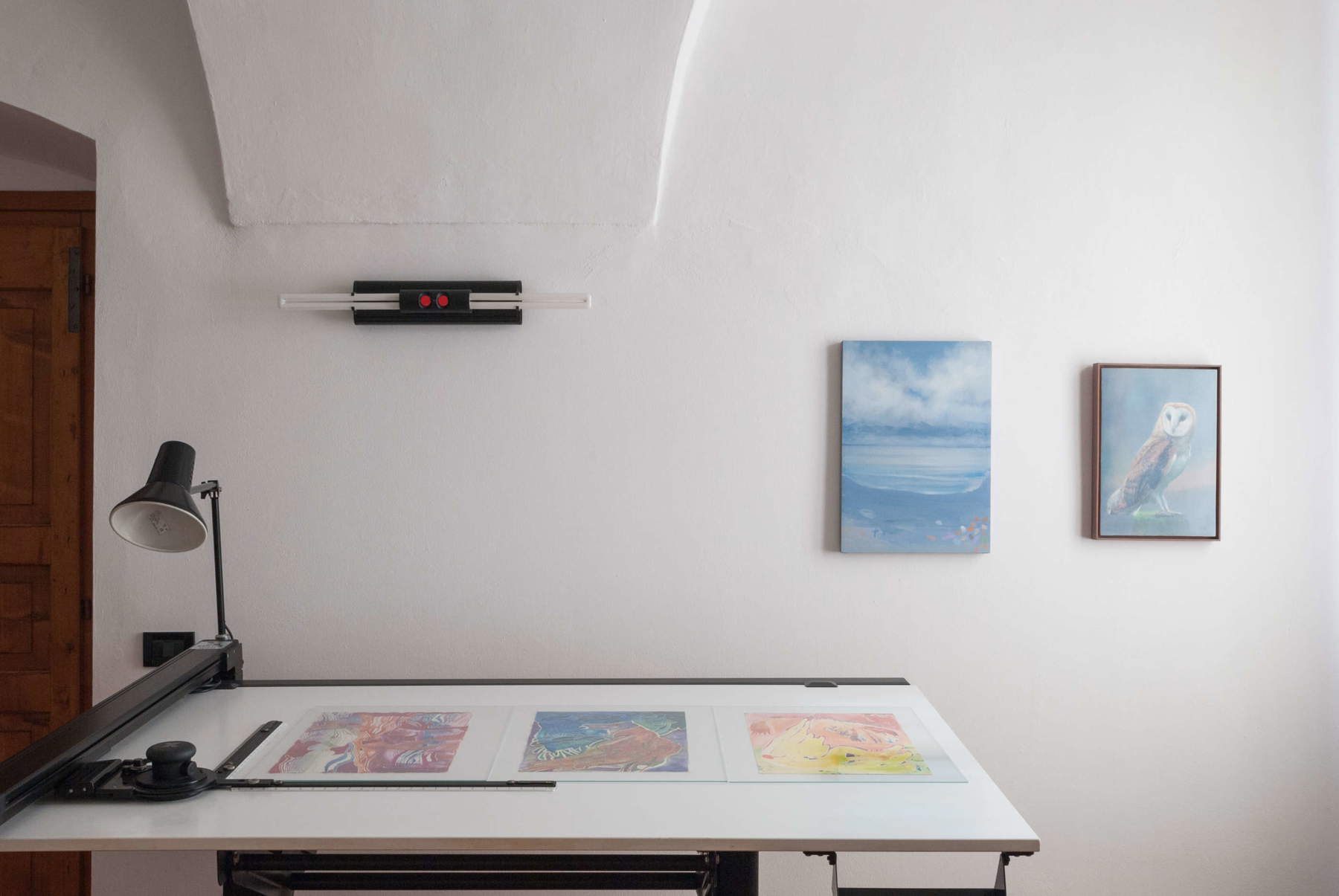
Personally, I believe the crux of the matter lies in the ineffability of what we call art. Humans need to name, define, categorize, catalog, and organize in order to understand, interpret, and make sense of the world and the phenomena surrounding them. As an artist, I am content simply to experience them; I watch them come to life around me with wonder, and I feel alive through them.
And in fact, by pigeonholing things, we spoil them—just as when trying to capture a butterfly, we risk ruining the fragile, dust-like beauty of its wings. You used the term “ineffable,” which reminds me of the conversations I’ve been having lately with Lucio Pozzi about this term and many issues concerning existence and expression. The word, however, in its American English form, corresponds to “unfathomable,” which, as you teach me, is even less: not only is it intangible but also inexplicable, incomprehensible, and elusive. I say “infra-subtle,” drawing on what the genius of Duchamp ambiguously defined. Something that is not only subtle but also fitsinto the “infra-minimal” realm hidden within the subtle itself, as if one could manage to split the thickness of a sheet of paper of the finest weight in two. What you’re saying is very beautiful; it has to do with that which cannot be defined and is useless—that which makes us live and in which lies the very element that sets us apart from animals or non-sentient beings… perhaps…
How did you come into contact with Lucio Pozzi?
It was truly a matter of pure chance. I was familiar with his work, which was cited in some of Rosalind Krauss’s seminal texts, published in *The Originality of the Avant-Garde* and primarily related to the work he did alongside other artists such as Gordon Matta-Clark, John Baldessari, and Daniel Buren in the first exhibition at PS1 in New York in 1976. This spring, I was contacted by the Abbondanza/Bertoni Dance Company to develop a piece (which at that point was still entirely in the planning stages) intended to enhance their headquarters in Rovereto. For this project, they had specifically enlisted Lucio Pozzi, with whom the company has long shared a relationship of mutual respect. He had already decided to step back from direct creation, preferring instead to coordinate a dynamic group of students from the Libera Accademia di Belle Arti in Brescia. On that occasion, I met him in person. A few months earlier (another coincidence), the Mart had acquired—through a generous donation from the Panza Collection—a significant collection of his works from the 1970s and 1990s. We therefore had plenty to discuss, and his approach to things truly opened my mind, confirming certain perspectives that I already felt were my own. A few days after that first meeting, he was supposed to return to New York and Hudson for a solo exhibition, along with his partner and talented painter Lorenza Sannai, but an injury forced him to stay in Valeggio sul Mincio. So, I took advantage of this change of plans to visit him and exchange further thoughts. A lengthy interview is taking shape, and it would be wonderful to see it published somewhere. He is truly a figure who embodies and expresses fundamental aspects of twentieth-century art—and he’s far more lively and stimulating than many twenty-five-year-old artists!
Earlier in this same interview, you compare Pozzi to Gadamer, Eco, and Susan Sontag in terms of their approach—which runs counter to traditional interpretation—by speaking of “open frameworks”: I’d like to ask you to explain that further.
Having now lost a shared narrative regarding the meaning of art, its function, and the content of its individual propositions, we can do nothing but try to situate this meaning within the immediacy and variability of the communicative flow in which our encounter with it takes place. There is nothing new in all this; the semantic and aesthetic work of the twentieth century has moved in this direction (the avant-garde movements, Duchamp, the superficial aspect in which form and content coincide, contextual art, andthe happening)—or consider even just the fact that we cannot fully understand or articulate the most important things that happen to us in life. This should encourage us not to impose assumptions, too many words, or dogmas on the interpretation of art; even if, increasingly, perhaps driven in part by legitimate educational needs and the desire to bring the general public closer to art, we risk falling into pre-packaged discourse, labels, and descriptive captions. I’m also thinking of when Mary Moore (Henry Moore’s daughter) criticized Damien Hirst’s approach, saying that his work tended to set art back a century or more by placing it back within a narrative framework. For her—and rightly so—aesthetics “is strictly about exploring the object before you.” I couldn’t agree more.

The author of this article: Gabriele Landi
Gabriele Landi (Schaerbeek, Belgio, 1971), è un artista che lavora da tempo su una raffinata ricerca che indaga le forme dell'astrazione geometrica, sempre però con richiami alla realtà che lo circonda. Si occupa inoltre di didattica dell'arte moderna e contemporanea. Ha creato un format, Parola d'Artista, attraverso il quale approfondisce, con interviste e focus, il lavoro di suoi colleghi artisti e di critici. Diplomato all'Accademia di Belle Arti di Milano, vive e lavora in provincia di La Spezia.Warning: the translation into English of the original Italian article was created using automatic tools. We undertake to review all articles, but we do not guarantee the total absence of inaccuracies in the translation due to the program. You can find the original by clicking on the ITA button. If you find any mistake,please contact us.























 IT
IT FR
FR DE
DE ES
ES CN
CN


