




New York is preparing to host one of the most significant events in the recent history of the Japanese print market. Christie’s has announced that on September 15, 2026, at its Rockefeller Center location, the auction *Hiroshige: Colors of the Four Seasons, the Alan Medaugh Collection, the first in a series of three auctions dedicated to what is considered one of the most extensive and important collections ever assembled of works by Utagawa Hiroshige ( Edo, 1797 – 1858), the great Japanese master of woodblock printing. The works will be on public view from September 11 to 14, in the days immediately preceding the auction.
The collection to be offered at auction bears the name of Alan Medaugh, an American entrepreneur who, over the course of some fifty years, built—sheet by sheet—a collection that today comprises over 600 prints. It is not merely an impressive collection in terms of numbers: the uniqueness of this collection lies above all in the quality of the works it comprises, many of which stand out for their absolute rarity, their exceptional state of preservation, and, in particular, the fact that they are among the earliest impressions made from each block—those in which the colors are the most vivid and brilliant. For the first of the three scheduled auctions, Christie’s has selected more than 180 prints, a collection that spans the artist’s entire career and, according to the auction house, reflects the extraordinary breadth of his creative journey.
Even during his lifetime, Hiroshige was considered one of the greatest printmakers Japan has ever known, an absolute master of theukiyo-e technique—the polychrome woodblock printmaking that for centuries has represented one of the most original and recognizable artistic languages of Japanese culture. The artist’s fame was built primarily on three distinctive elements of his work: his compositional skill, his choice of unusual and unconventional viewpoints, and above all, his rich and powerful use of color, which endowed his images with an expressive force unprecedented in the Japanese printmaking scene of the time.
His prints played a decisive role in ushering in one of the most fruitful periods in the history of Japanese printmaking, but their influence did not stop at Japan’s borders: they ultimately had a profound impact on Western art as well. Hiroshige’s works—and in particular his most famous series, One Hundred Famous Views of Edo—exerted a fundamental influence on nineteenth-century European painting, leaving a recognizable mark on the work of Impressionist artists such as Claude Monet and James Abbott McNeill Whistler, who absorbed his compositional and chromatic ideas and reworked them into their own painterly languages. The relationship between Hiroshige and Vincent van Gogh deserves a chapter of its own; van Gogh did not merely draw inspiration from Hiroshige’s prints but went so far as to create detailed copies—paintings that faithfully reproduced the Japanese master’s compositions. Some of these copies are now preserved and on display at the Van Gogh Museum in Amsterdam, serving as concrete and enduring testimony to the extent to which Hiroshige’s influence was absorbed and reinterpreted by one of the foremost figures in modern Western painting.
What makes the Medaugh Collection a particularly significant example within the field of Japanese art collecting is, first and foremost, its extraordinary comprehensiveness. In fact, the core collection assembled by Medaugh includes not only the most famous and universally recognized images from Hiroshige’s oeuvre—those that have become icons of Japanese visual culture and, more broadly, of art history—but also early and lesser-known works created during the initial stages of his artistic career. It is precisely this coexistence of established masterpieces and rarer, lesser-known works that enables the collection, in its entirety, to provide a complete account of Hiroshige’s artistic journey—from his beginnings to his full maturity—and to do so, moreover, through prints that are in particularly well-preserved condition.
To understand the value of such a collection, one must bear in mind an intrinsic characteristic of Japanese woodblock prints: namely, the fact that they are, by definition, serial works—multiples. Precisely for this reason, collectors in this field focus their attention on seeking out the finest examples available on the market—those that best convey the original intent of the artist and the woodblock carver. This requirement becomes even more crucial when one considers that the woodblocks used to produce the prints deteriorate rapidly as they are used to print on paper, print run after print run. This is why collectors place a particularly high value on the earliest impressions—those produced in the first print runs from a given block: these are prints that feature sharper, more defined contours and, in some cases, retain compositional details that are gradually lost in subsequent print runs as the wood of the block wears down.
In addition to the age of the print, another key factor in evaluating a Japanese print is its condition. Sunlight, in particular, is one of the most aggressive factors affecting this type of work on paper: prolonged exposure to light causes a gradual fading of colors, irreparably compromising the chromatic brilliance that characterizes the finest prints. In building his collection, Alan Medaugh has devoted extraordinary attention to these two factors, systematically seeking out the oldest and most detailed prints available, always prioritizing examples in optimal condition that are still capable today of conveying the original chromatic richness intended by the artist. A particularly significant example of this collecting strategy concerns the famous series *One Hundred Famous Views of Edo*, of which a deluxe edition existed, produced during the early stages of the series’ printing and characterized by a greater number of color passes than the standard print runs. Medaugh focused much of his collecting efforts specifically on acquiring prints from this deluxe edition, which is rarer and more valuable in terms of color than the standard versions of the same series.
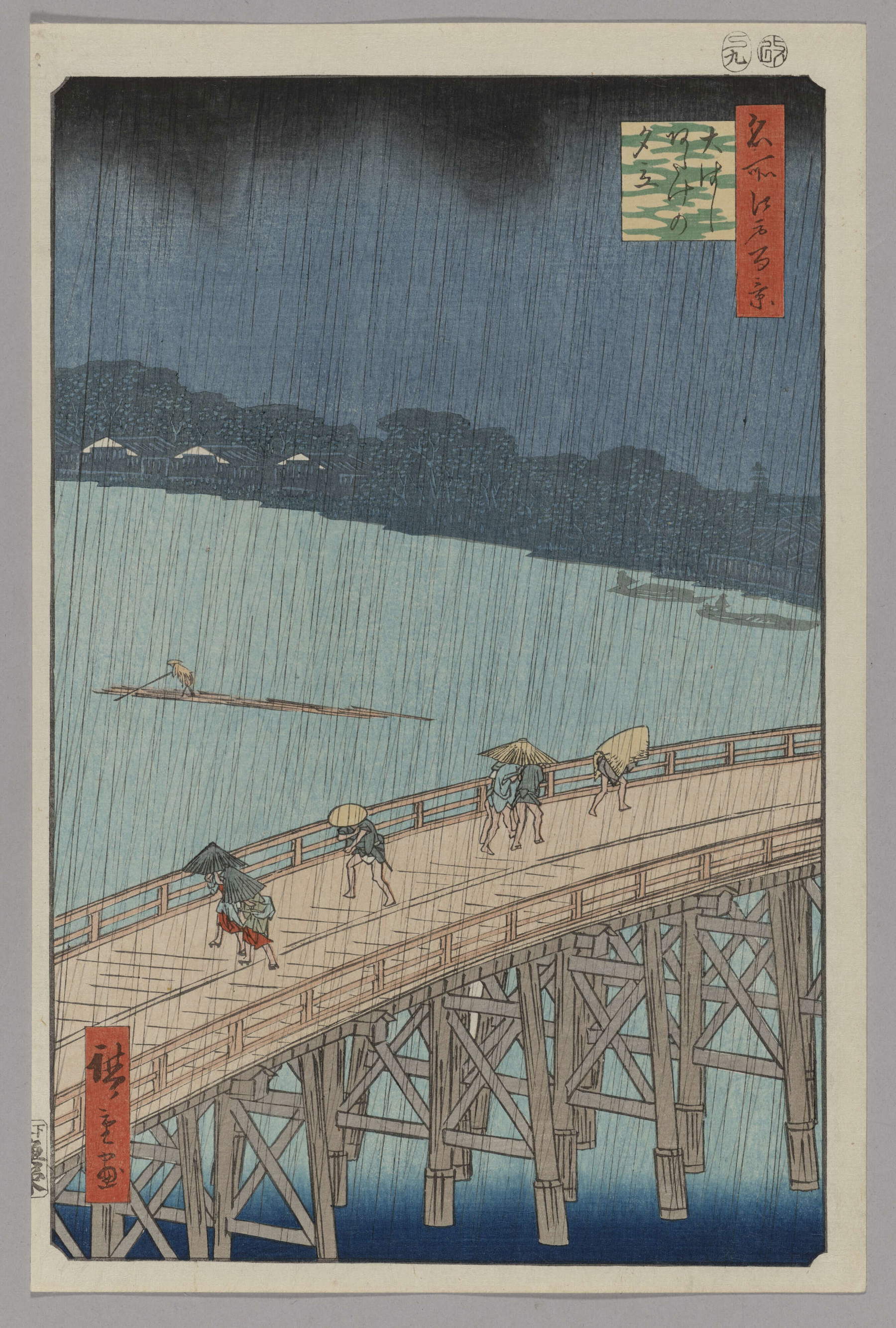
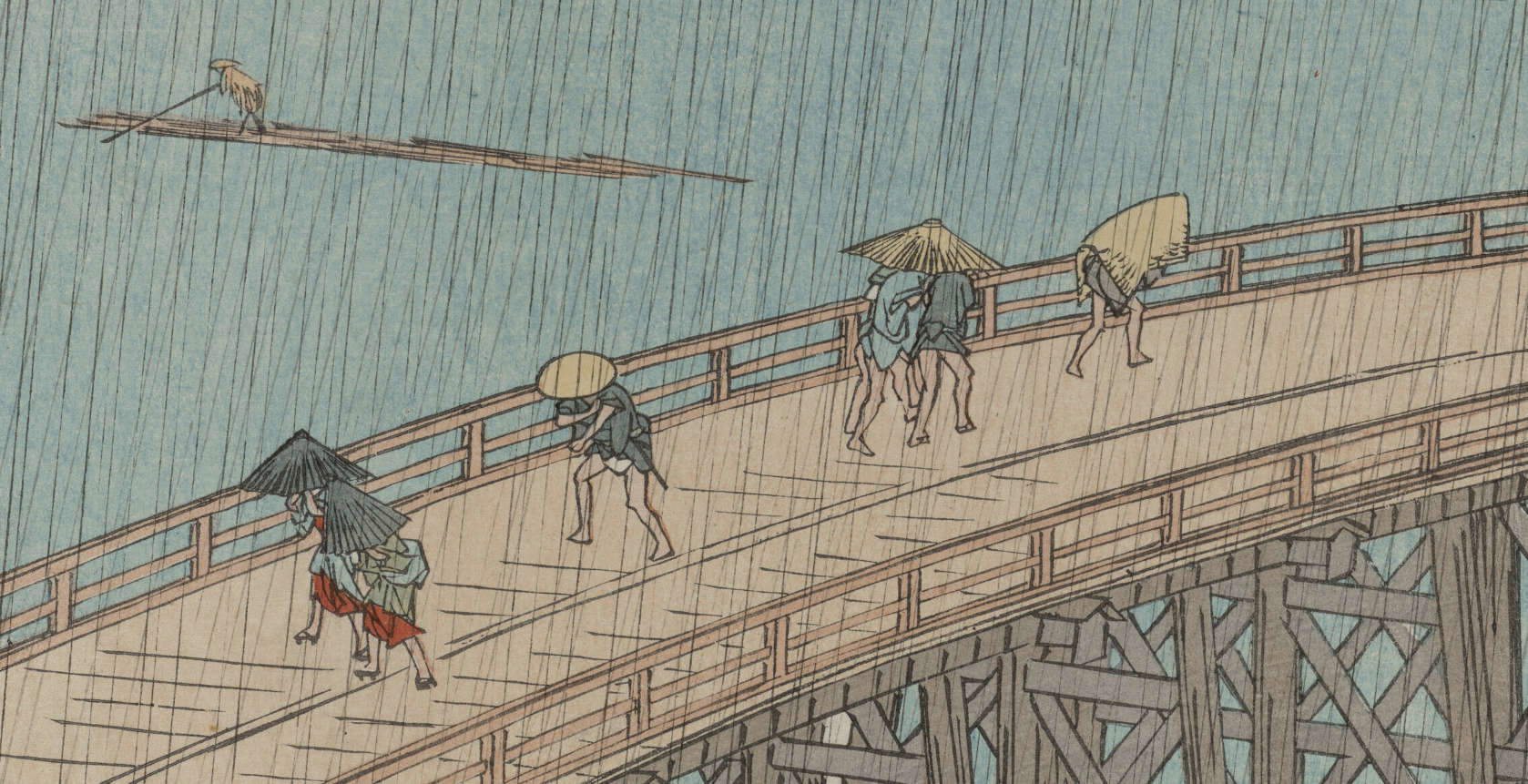
Among the highlight lots of the September 15 auction is *Ohashi Atake no yudachi*, “Ohashi Bridge under a Sudden Downpour at Atake,” a work that, according to Christie’s, perfectly embodies what makes the Medaugh collection so special. The image, crisscrossed by the diagonal lines of rain falling across the entire composition, is one of Hiroshige’s most iconic works. The print up for auction is in nearly perfect condition, with the colors still intact and showing no signs of fading. It is also an early print, as evidenced by the still-visible presence of the two boats situated along the opposite bank of the river: a detail that gradually disappears in subsequent print runs as the wooden block wears down with use.
Another highly significant lot in the sale is *Kameido ume yashiki*, the “Plum Orchard at Kameido,” also an early print and particularly rich in color, hailing from the deluxe edition of the Edo Views series mentioned earlier. Among the other prints that stand out for the rarity of their condition are Awa, Naruto no fuha, or “Wind and Waves at Naruto,” in Awa Province, and Wild Geese Flying Before the Full Moon, both significant examples of the thematic variety and technical quality that characterize the entire Medaugh collection.
 |
| One of the most extraordinary collections of Hiroshige prints is set to go up for auction at Christie's |

Warning: the translation into English of the original Italian article was created using automatic tools. We undertake to review all articles, but we do not guarantee the total absence of inaccuracies in the translation due to the program. You can find the original by clicking on the ITA button. If you find any mistake,please contact us.




















 IT
IT FR
FR DE
DE ES
ES CN
CN


