





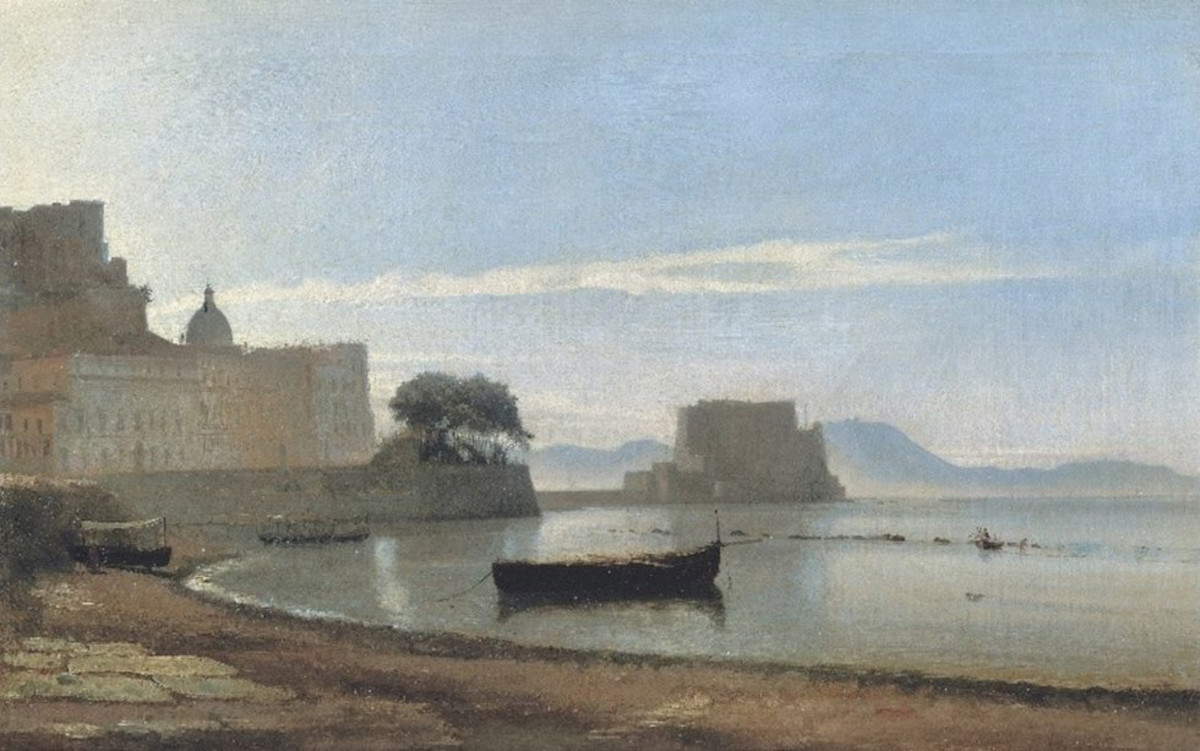
An important painting by Jean-Baptiste-Camille Corot has been added to the collections of the Capodimonte Museum and Royal Park in Naples. The painting is *The Bay of Naples with Castel dell’Ovo*, dated 1828, acquired by the State through the export purchase procedure for 600,000 euros. The proposal was put forward by the Florence Export Office and culminated in the purchase decree signed on June 30, 2026, thereby ensuring that the work would remain part of Italy’s public heritage.
The painting dates back to Jean-Baptiste-Camille Corot’s first stay in Italy, which took place between 1825 and 1828—a pivotal period in the French painter’s development. During this journey, the artist developed the pictorial language—based ondirect observation of nature —that would characterize his entire body of work, refining a unique sensitivity in rendering light and subtle atmospheric variations. It was precisely in Italy that Corot developed that silvery light destined to become the hallmark of his painting. Working often outdoors and favoring the early morning or late afternoon hours, the artist revitalized the tradition of classical landscape painting inspired by Nicolas Poussin and Claude Lorrain through careful observation of nature.
Corot arrived in Naples in the spring of 1828, drawn in part by Stendhal’s accounts, in which he described the city as “the most beautiful in the world.” During the approximately seven weeks he spent in the Neapolitan capital, he produced numerous studies from life, captivated by the light of the Gulf and its unique atmosphere.
The Bay of Naples with Castel dell’Ovo stands as one of the most significant testaments to this experience. The work combines rigorous observation of the landscape with a refined poetic composition, transforming a real-life view into a timeless vision. The boats barely visible on the horizon, the rocks that punctuate the composition, and the silhouette of Castel dell’Ovo convey the city’s daily life, while the rendering of the early morning light captures all of Corot’s atmospheric sensitivity. The hazy sky and the calm waters capture on canvas the effects of the morning winds and the stillness that precedes the city’s full awakening.
During the nineteenth century, Naples became one of the most beloved destinations for European artists, drawn by the extraordinary luminosity of the Gulf and the richness of the landscape. It was in this context that the Posillipo School was founded by the Dutch painter Anton Sminck van Pitloo, a movement destined to revolutionize the way nature was depicted. The dialogue between Corot and Pitloo holds particular significance in the history of European art. The exchange between the two artists contributed to the spread of a new conception of landscape painting, based on working en plein air, direct observation of reality, and attention to the changing effects of light. Corot also experimented with innovative techniques, such as oil painting on canvas-lined paper mounted on canvas or cardboard, choosing lightweight supports that allowed him to work quickly outdoors and capture the atmospheric variations of the landscape in real time.
The addition of *The Bay of Naples with Castel dell’Ovo* to the collections of the Capodimonte Museum and Royal Park represents an acquisition of particular historical and artistic significance, since, on the one hand, it restores to Italy’s public heritage an extraordinary view of one of Naples’ symbols, and on the other, it documents the deep connection between Corot and Italy, a country that played a decisive role in the painter’s development. The work also bears witness to the cultural dialogue between France and Italy in the first half of the nineteenth century and confirms Naples’ role as an international crossroads of landscape painting.
|
| A masterpiece from Corot’s first stay in Italy was purchased for 600,000 euros for the Capodimonte Museum |

Warning: the translation into English of the original Italian article was created using automatic tools. We undertake to review all articles, but we do not guarantee the total absence of inaccuracies in the translation due to the program. You can find the original by clicking on the ITA button. If you find any mistake,please contact us.





























 IT
IT FR
FR DE
DE ES
ES CN
CN


