





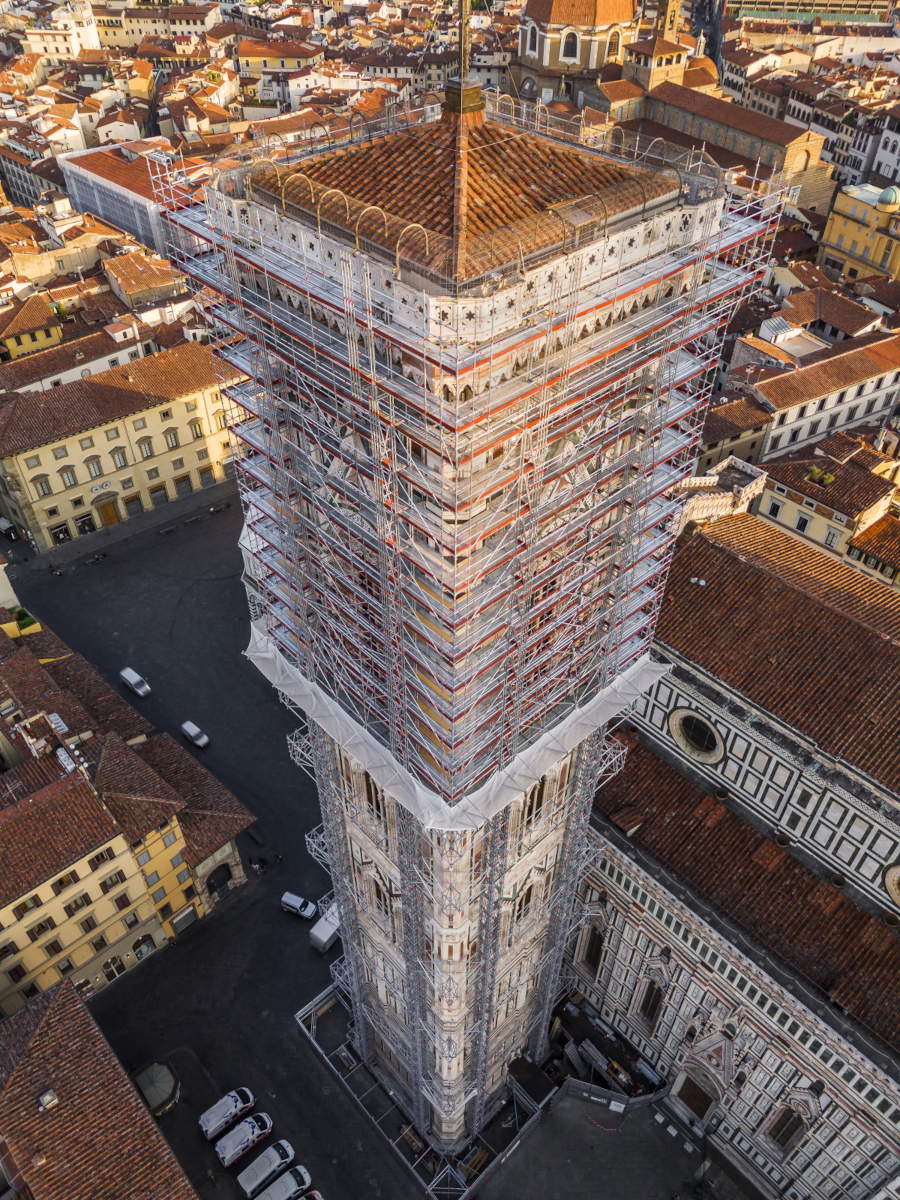
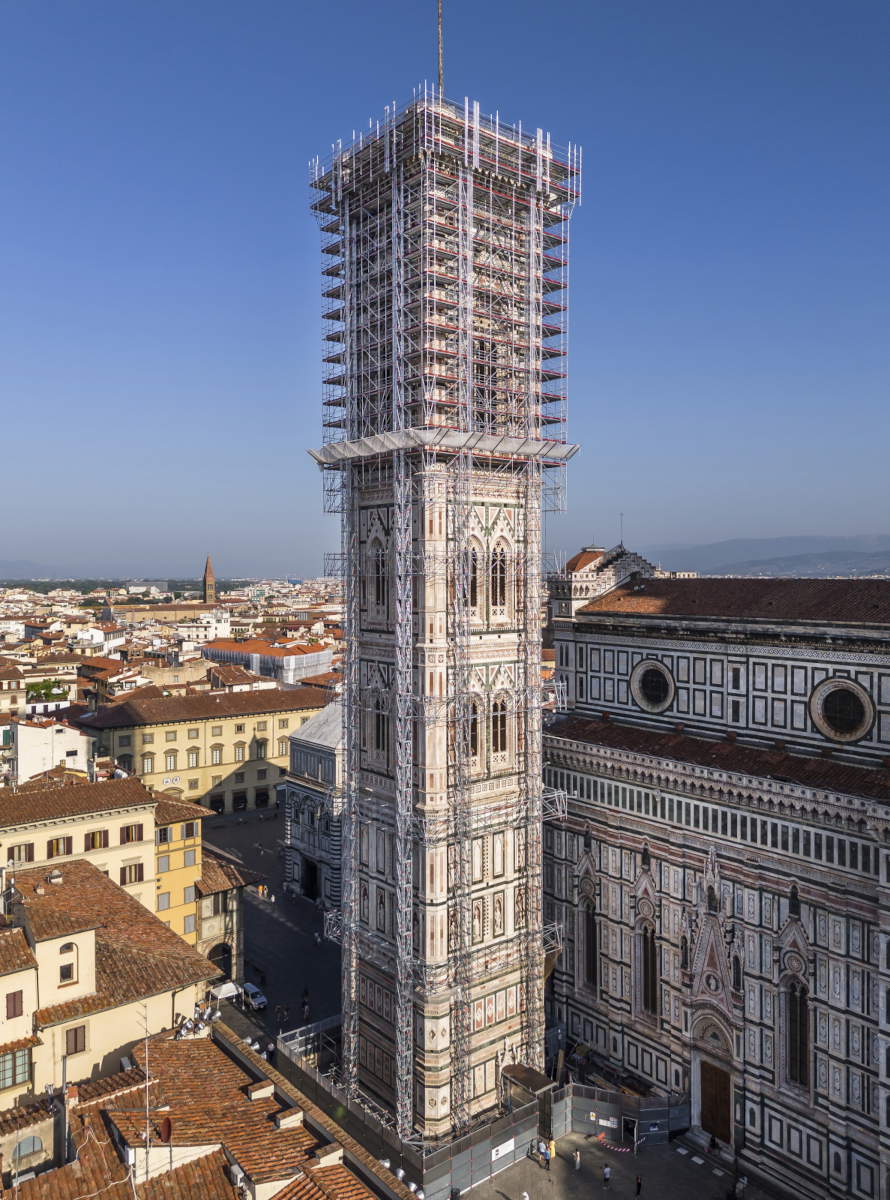
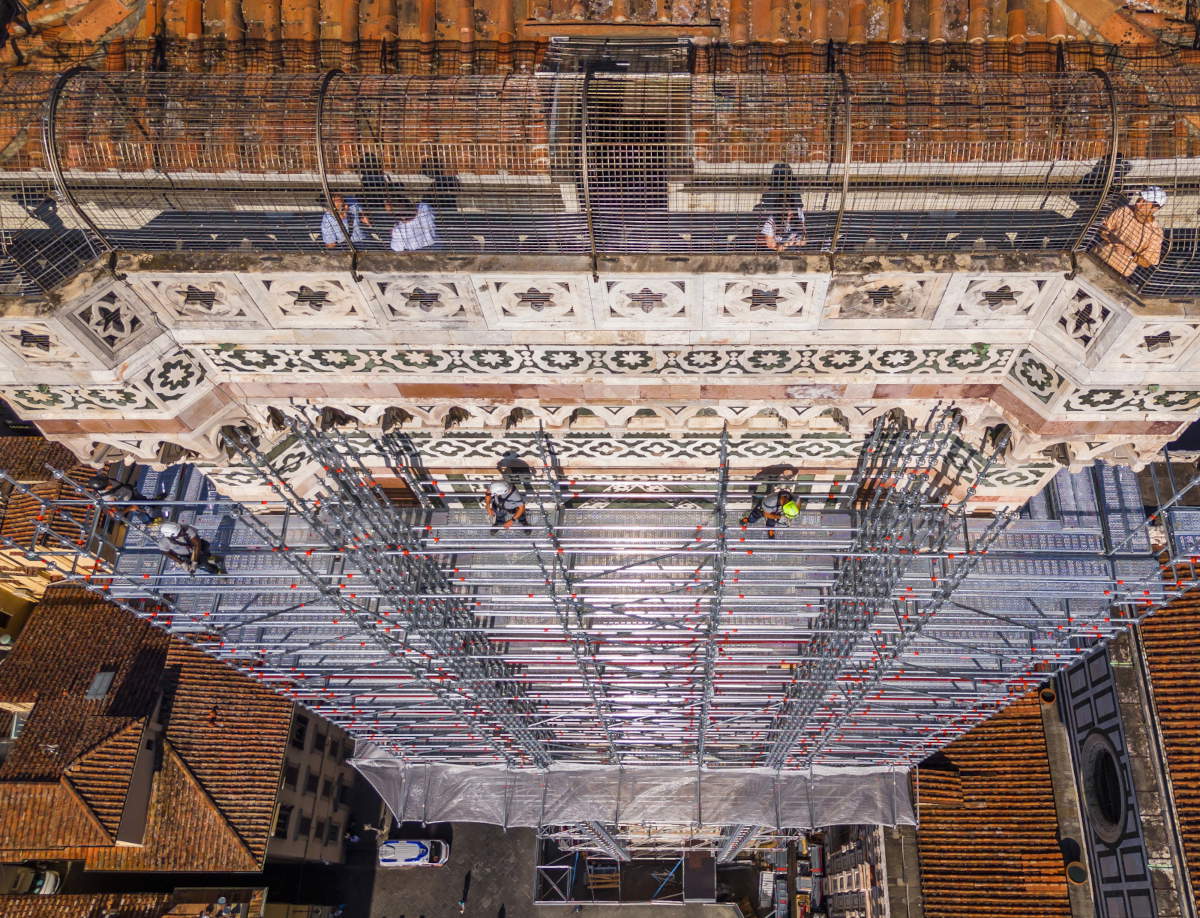
The scaffolding for the restoration of Giotto’s Bell Tower in Florence has been completed; the structure was designed with particular attention to both engineering considerations and the need to minimize the visual impact on the monument. The solution adopted will, in fact, allow tourist visits to continue during the restoration work and, at the same time, enable the restoration to proceed in phases, from top to bottom, gradually revealing the sections that have already been restored. The scaffolding reaches a height of 86 meters, while Giotto’s Bell Tower stands at 89.20 meters—or 109 meters when including the cross. The construction of the temporary structure took just over four months. The construction site project was managed bythe Opera di Santa Maria del Fiore in collaboration with Tecno System Appalti and Layher S.p.A.
The restoration of Giotto’s Bell Tower will be subject to the oversight of the Superintendence of Archaeology, Fine Arts, and Landscape for the Metropolitan City of Florence and the provinces of Prato and Pistoia. The work is expected to take five years, with an investment of over 7 million euros, fully funded by the Opera di Santa Maria del Fiore. This is an unprecedented project for the monument: for the first time, in fact, the Bell Tower will undergo a comprehensive restoration that will address both its exterior surfaces and interior spaces.
Throughout the 20th century, various interventions were carried out—documented as early as 1939—but these were always limited to individual parts of the structure. The new project, however, stems from the need to address the monument’s deterioration in a comprehensive manner and to ensure its safety and preservation. Particular attention will be paid to the exterior surfaces, which feature cladding in white marble, Verde di Prato, and Rosso di Cintoia. Signs of deterioration are particularly evident in the projecting elements of the summit terrace and in various components of the decorative elements.
One of the key features of the new restoration project is the ability to proceed with the restoration while maintaining the visitor experience at the monument. The plan has been designed to minimize visual impact as much as possible, allowing the public to continue visiting the Bell Tower throughout the project.
The decision to proceed from top to bottom will also make the already restored surfaces progressively visible as work progresses. The construction site design is based on a multidisciplinary approach, in which structural engineering, monitoring technologies, and safety systems all contribute to managing this particularly complex project.
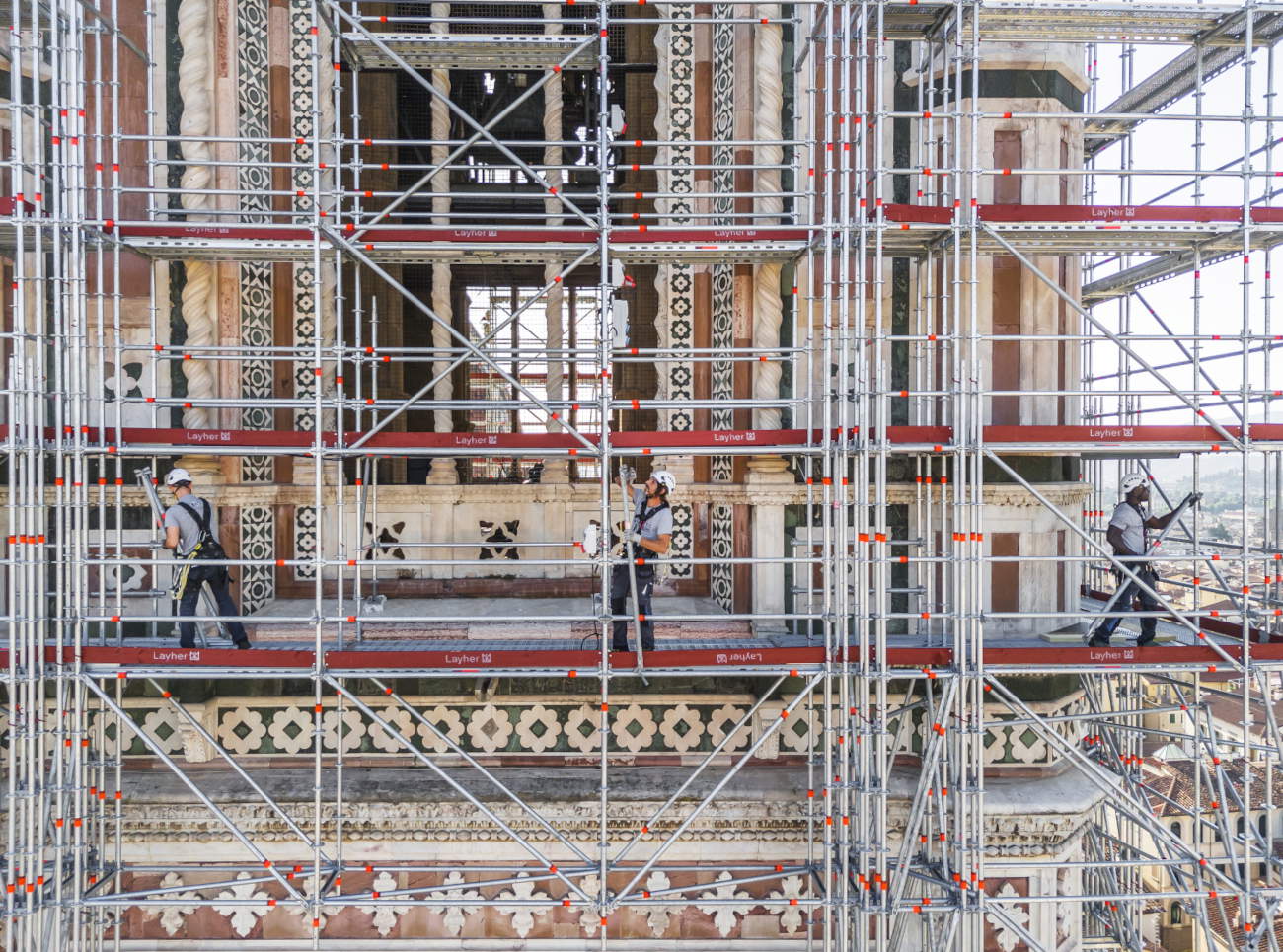
At the center of the structure is the Layher modular steel scaffolding system, chosen for its ability to adapt to the Bell Tower’s irregular geometry and the numerous projections that characterize the monument. Compared to traditional scaffolding made of tubes and couplers, the modular system allows for the configuration of work platforms tailored to the various needs of the restoration. This ensures ergonomic working conditions and enables restorers to move with greater freedom and safety.
The construction of the site also required special measures to protect the wildlife that, over the years, has chosen the Cathedral’s monumental complex as a nesting site. In collaboration with LIPU and experts in the field, the Opera di Santa Maria del Fiore implemented specific measures to protect the nesting of birds and, in particular, the pair of peregrine falcons that have made their home on the monuments of Florence’s Duomo since the mid-2000s. The species’ breeding season coincided with the scheduled construction of the scaffolding. For this reason, a photographic survey was conducted of the 149 scaffolding holes in Giotto’s Bell Tower to check for the presence of nests before proceeding with the work. The monitoring revealed a female peregrine falcon incubating eggs inside a scaffold hole located at the top of the bell tower’s western side.
In light of this discovery, the Opera decided to adjust the scaffolding installation schedule to avoid any interference with the nesting process. This decision allowed the breeding season to conclude successfully: three chicks hatched from the clutch, and once they had grown, they left the nest and took flight. The new construction site thus marks the start of the first comprehensive restoration of Giotto’s Bell Tower, a project expected to last about five years and aimed at ensuring the monument’s preservation through a work plan designed to combine conservation, safety, technology, and uninterrupted visitor access.
“The goal was to create a construction site that would not alter the static equilibrium of Giotto’s Bell Tower or obscure its beauty,” explains Samuele Caciagli, head of the Technical Office for the Opera and Construction, “using materials and equipment designed to be fully recovered and reused on future construction sites.”
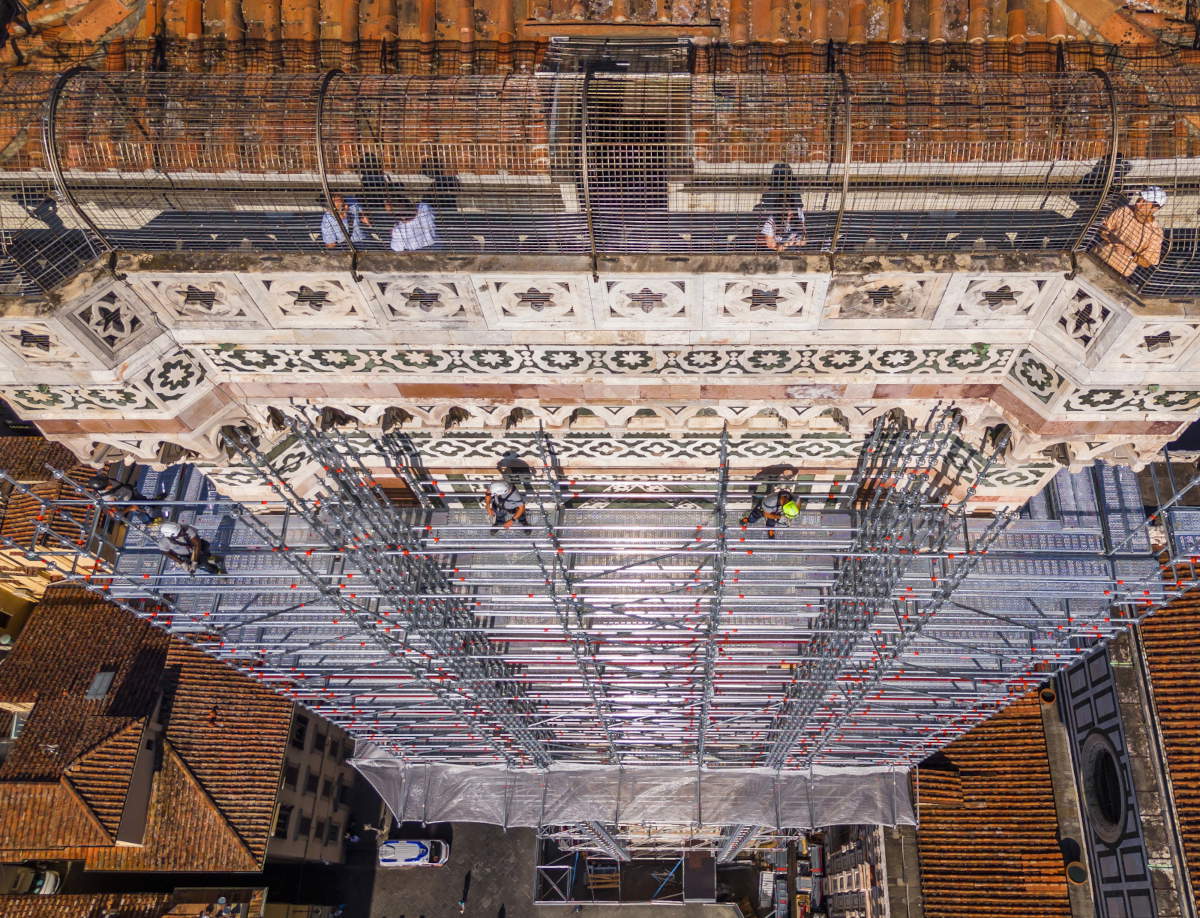
“Giotto’s Bell Tower currently exhibits an advanced state of deterioration in its exterior cladding surfaces, affecting in particular the white marble, Verde di Prato, and Rosso di Cintoia,” explains Beatrice Agostini, head of the Opera’s Restoration Office. “The damage is particularly evident on the most exposed and projecting elements of the top terrace, such as the corbels, and on the decorative elements. The state of preservation is determined by the combined action of various factors, including air pollution, acid rain, solar radiation, biological activity, mechanical vibrations, the characteristics and construction methods of the anchors, the varying nature of the materials used, and thermo-hygrometric variations. The main forms of deterioration include color changes, surface deposits, encrustations, and black crusts, attributable in particular to the accumulation of atmospheric particulate matter and the sulfation processes affecting the marble. There are also physical-mechanical phenomena, such as disintegration, exfoliation, loss of sculptural detail, and detachment of stone material, which manifest in different ways depending on exposure to runoff and water infiltration. The cracking pattern includes cracks, fractures, and microfractures, some of which may be attributable to structural issues and therefore require further investigation, particularly regarding the monument’s seismic behavior.” “The north and west facades deserve particular attention,” Agostini continues, “as they have not undergone significant restoration work during the 20th century. These sections of the monument are subject to particularly unfavorable microclimatic conditions. The north facade, in particular, is characterized by a reduced capacity for moisture evaporation, a condition that promotes the accumulation of surface deposits, recurring wet-and-dry cycles, salt crystallization, the formation of black crusts, and the development of biological colonization. The interior spaces also present a complex conservation situation. Along the routes most heavily trafficked by tourists, signs of human-caused wear and traces of graffiti are also visible. The situation is further characterized by the presence of stone restorations resulting from previous interventions, identifiable by differences in color, texture, and the associated degradation processes compared to the original elements.”
“The approach to the restoration project,” he concludes, “includes a particularly detailed preliminary phase aimed at gaining an in-depth understanding of the monument and defining the most appropriate operational procedures. The activities include the preparation of the necessary temporary measures and the creation and progressive updating of maps detailing the state of conservation and the restoration work. These activities are complemented by a survey of damage and the cracking pattern, as well as a series of diagnostic tests conducted both on-site and in the laboratory. The interventions will address biological deterioration, surface deposits of varying density, black crusts, calcareous encrustations, rust stains, and marks attributable to acts of graffiti vandalism. The choice of techniques will be based on the test results, ensuring respect for the original material and historical patinas. A further phase will involve the removal of grout and metal elements that are no longer suitable. Consolidation operations will include both surface and deep treatments on the stone materials, using specific products and injection techniques. Reintegration and reconstruction will primarily involve the repositioning of fragments, the grouting and sealing of gaps and joints, and, where necessary, the reconstruction of missing parts. For this purpose, mortars made from lime and marble powder will be used, appropriately formulated to match the color, grain size, and characteristics of the original materials. Upon completion of the work, where deemed compatible and necessary based on the results of preliminary tests, water-repellent and consolidating protective treatments will be applied to enhance the durability of the restoration and reduce the vulnerability of the most exposed surfaces. Particular attention will be given to elements exhibiting the most advanced stages of deterioration, through solutions specifically tailored to the characteristics of the various rock types and exposure conditions. The project as a whole is therefore based on a methodological approach focused on the preservation of the original material, the compatibility of materials, and the recognizability of the interventions, combining knowledge derived from tradition with the most up-to-date diagnostic and conservation methodologies.”
 |
| Florence: Restoration of Giotto's Bell Tower Begins; the 86-meter-high scaffolding also protects the peregrine falcons |

Warning: the translation into English of the original Italian article was created using automatic tools. We undertake to review all articles, but we do not guarantee the total absence of inaccuracies in the translation due to the program. You can find the original by clicking on the ITA button. If you find any mistake,please contact us.























 IT
IT FR
FR DE
DE ES
ES CN
CN


