





For Greek Prime Minister Kyriakos Mitsotakis, the exhibitionof the Bayeux Tapestry at the British Museum provides an opportunity to reignite one of the longest-running controversies over European cultural heritage: the issue of the Parthenon Marbles, which are housed at the British Museum. In an op-ed published on September 24 by The Guardian, Mitsotakis argues that the return of the tapestry—on loan from France as a complete work and destined to return to its country of origin—demonstrates, by contrast, just how different the situation is for the Parthenon marbles. According to the Greek prime minister, in fact, it is not simply a matter of determining who owns the works or what their legal status is: the issue primarily concerns the possibility of reuniting a monumental ensemble originally conceived as a single whole. It is on this principle that Mitsotakis once again calls on the United Kingdom to reach an agreement on the reunification of the sculptures in Athens.
The comparison with the Bayeux Tapestry serves as the starting point for his remarks. The tapestry, nearly seventy meters long, has returned to Great Britain for the first time in nearly a thousand years and is presented by the prime minister as a clear example of how a historical artifact continues to exert a strong appeal on the public even in the age of screens and social media. “There are striking similarities between the two works,” writes Mitsotakis. “Both were conceived as single works, intended to be viewed and understood in their entirety. In the case of the Parthenon sculptures, this relationship is also architectural: they were created as inseparable elements of the monument itself. No one would seriously consider cutting what remains of the tapestry in half and exhibiting one half in London and the other in Bayeux, arguing that this is an adequate way to understand it. Yet this is exactly what happened to the Parthenon sculptures. A single masterpiece has been divided, and its surviving parts are now mainly divided between London and Athens.” For Mitsotakis, proposing the tapestry loan as a model for a solution regarding the sculptures would therefore mean comparing two situations of opposite nature.
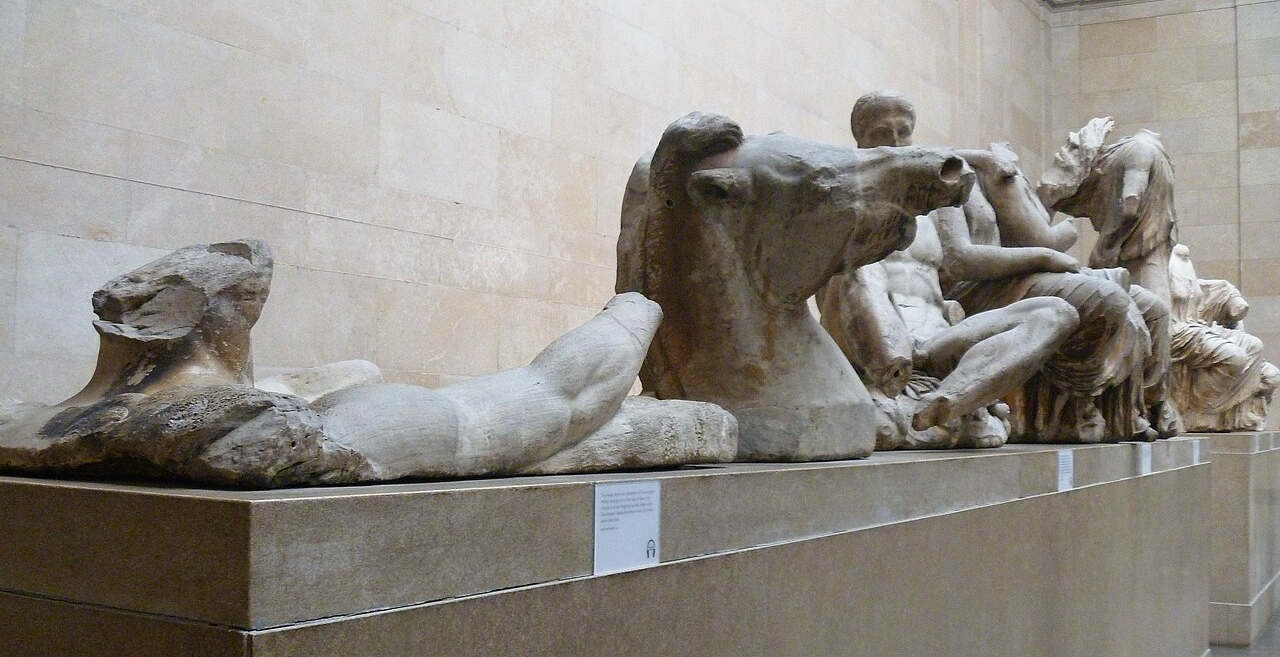
The issue concerns a portion of the Parthenon’s sculptural decoration, created in the 5th century B.C. in classical-era Athens. Mitsotakis emphasizes in particular the significance of the frieze, which he sees not only as a representation of deities and heroes but also as a depiction of the city’s civic life. The monument, the prime minister argues, constitutes in this sense a testament closely linked to the political and religious history of ancient Athens.
It is precisely the unified character of the whole that, according to Mitsotakis, forms the basis of the Greek request: the surviving sculptures should be viewed together and in visual relation to the monument for which they were created. To this end, the prime minister notes, the Acropolis Museum in Athens was designed to include a gallery dedicated to the Parthenon marbles. The Greek government’s position, however, remains incompatible with a solution that would involve the British Museum acknowledging ownership of the sculptures. Mitsotakis further states that Athens would not accept an agreement in which Greece would merely be the recipient of a loan of the parts of the monument preserved in the United Kingdom.
In his article, the prime minister also cites the prevailing sentiment among the British public. He cites a national poll published in 2025 according to which a majority of respondents would favor the return of the sculptures to Greece, and 72% believe they are best understood as part of a single whole with the Parthenon. Mitsotakis uses this data to argue that the Greek request would find growing support even in the United Kingdom.
The reference to the Bayeux Tapestry also comes after years of talks between the Greek and British governments and between Greece and the British Museum’s leadership. Mitsotakis states that he was surprised by the British museum’s recent proposal to use the Bayeux loan as a possible model for an agreement on the Parthenon Marbles. His response is clear: the two cases are not comparable. In the case of the tapestry, in fact, an intact work is temporarily transferred and then returned in its entirety. In the case of the Parthenon, however, Athens’ stated goal is the permanent reunification of elements that were part of the monument’s decoration.
Mitsotakis also invokes UNESCO, recalling the repeated calls by the Intergovernmental Committee for the Return of Cultural Property to its Countries of Origin for the United Kingdom and Greece to address the issue through a dialogue conducted in good faith.
In his remarks, the prime minister also attempts to shift the focus of the controversy from the issue of restitution to that of cultural cooperation. A potential reunification, he argues, could serve as the starting point for a new collaboration between Greek and British cultural institutions, involving exhibitions, research, conservation, and exchanges between museums in both countries.
The proposal is also linked to a 2023 statement by current British Prime Minister Andy Burnham, who had advocated for the return of the sculptures to Greece “no strings attached”—that is, unconditionally—presenting it as a possible tool for changing the world’s perception of Great Britain.
Mitsotakis concludes his statement by framing the issue in terms of the historical significance attributed to the Parthenon. “At a time when democratic principles are being challenged around the world,” he writes, “restoring the unity of a monument so closely linked to the birth of democracy itself would send a strong signal. Greece is ready. What is needed now is the political will and the courage to take the decisive step, to reunite the sculptures, and to transform a historical dispute into a singular act of cultural friendship.”
|
| Parthenon Marbles: Mitsotakis to the United Kingdom: “It’s time to reunite them” |

Warning: the translation into English of the original Italian article was created using automatic tools. We undertake to review all articles, but we do not guarantee the total absence of inaccuracies in the translation due to the program. You can find the original by clicking on the ITA button. If you find any mistake,please contact us.
























 IT
IT FR
FR DE
DE ES
ES CN
CN


