





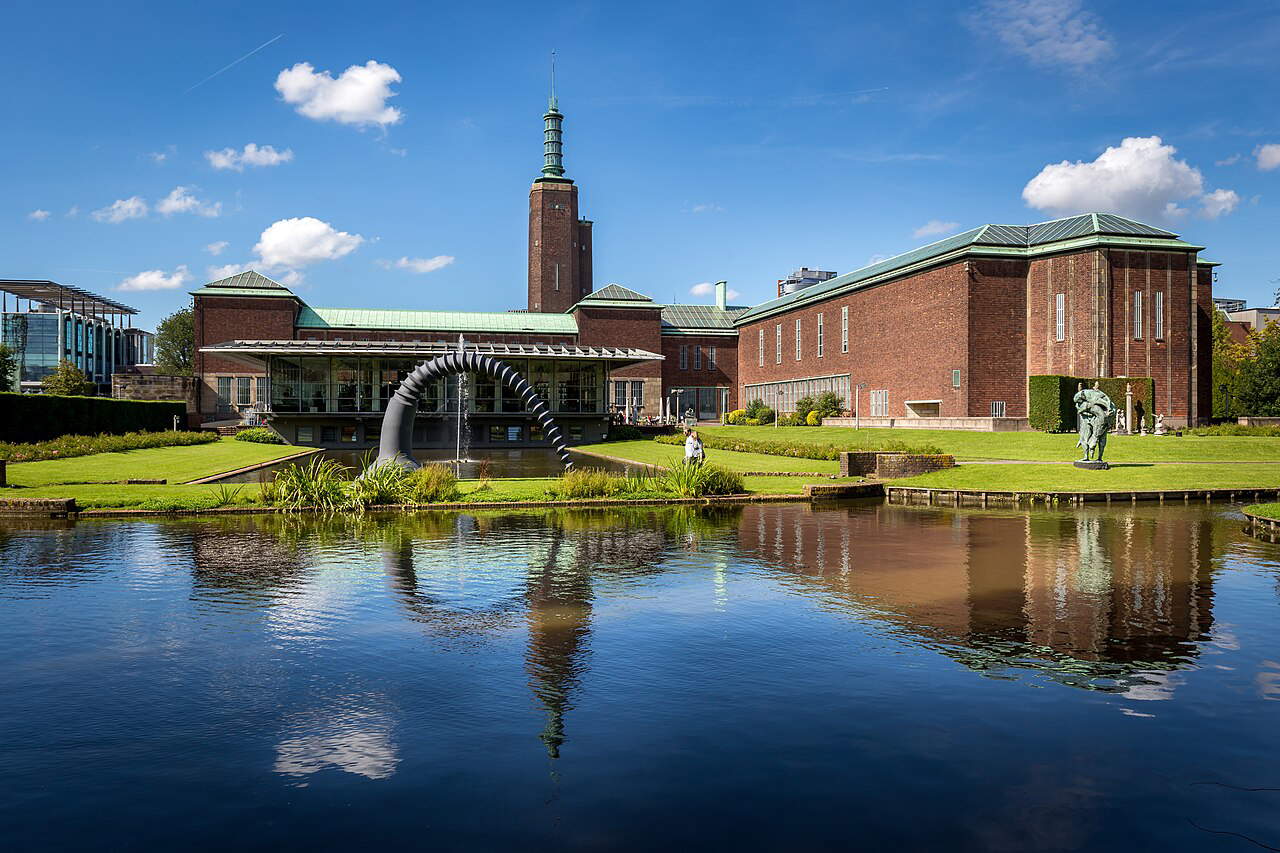
The Boijmans Van Beuningen Museum in Rotterdam, one of the Netherlands’ most important cultural institutions and often cited as a global model for the way it has recently managed its collection storage facilities, is now embroiled in a corruption investigation that has led to the dismissal of two city officials in Rotterdam. The investigation concerns alleged irregularities in the awarding of public contracts for construction work, including asbestos removal projects carried out inside the museum itself.
The Dutch daily newspaper NRC provides a detailed account of the affair. The two dismissed employees were part of a group of three officials who came under scrutiny by investigators after suspicions arose that certain municipal contracts had been approved at prices inflated beyond their actual value. Of the three officials involved in the investigation, one has already retired, while the other two were initially suspended from duty and have now been permanently removed from the city administration. According to NRC, the Rotterdam city administration informed the city council in a letter dated mid-July—which had gone largely unnoticed until now—that it had summarily dismissed the two officials over the summer on charges of corruption. According to the investigation, the two allegedly accepted gifts from companies that, in exchange, were given preferential treatment in the awarding of municipal contracts.
The dismissal came after the Dutch public prosecutor informed the municipal administration on July 6 of an ongoing criminal investigation into incidents of corruption and fraud among public officials, linked in particular to construction projects promoted by the municipality. The two employees are suspected, among other things, of corruption and forgery of public documents.
Information provided by the prosecutor’s office revealed that the conduct of the two officials is “substantially more serious” than what the municipality itself had determined in a previous internal investigation. Moreover, this is not the first case of this kind for the administration: as early as late 2023, another municipal official—who is also under investigation as part of the same ongoing criminal inquiry—was forced to step down from his position. That case came to light following a journalistic investigation also published by the daily newspaper NRC.
The newspaper had revealed at the time that the official, a project manager, was receiving money through a company registered in his name—officially dedicated to managing young soccer talent—from a contracting firm with which he had a business relationship on behalf of the municipality. The project manager played a key role in overseeing the renovation of several municipal buildings used for cultural purposes, and his responsibilities included supervising the asbestos removal at the Boijmans Van Beuningen.
The same journalistic investigation had also revealed that, beginning in 2020, some municipal officials had already reported possible signs of fraud and corruption linked to the renovation work on these cultural institutions, yet the municipality did not take any concrete action at that stage to investigate the matter further.
Following the publication of the investigation, the project manager was forced to step down from his position—formally through early retirement—and a criminal investigation was launched, leading to searches of homes and business premises in other cities. In February of the following year, additional searches were conducted in various locations, including Capelle aan den IJssel, Nieuwerkerk aan den IJssel, and Middelburg, as well as at a demolition company based in Sint-Oedenrode. Subsequent investigations by the NRC newspaper revealed that the municipality had overpaid the company responsible for asbestos removal at the Boijmans Van Beuningen Museum by several million euros. The lawyer for the company involved stated that he would not comment until the investigation was concluded.
The Dutch public prosecutor’s office confirmed the existence of suspicions against the officials and companies involved. A spokesperson for the prosecutor’s office clarified, in response to a request for clarification, that a total of eleven people—including the three municipal officials mentioned above—and six companies are currently under investigation. Sources close to the investigation have reported that the companies under suspicion allegedly managed to include fictitious costs in the construction projects with the collaboration of the municipal officials involved.
In recent years, the city of Rotterdam has already faced several incidents of corruption and other integrity violations by its officials, but the current investigation appears to be larger in scope than previous cases. In 2017, a city council inquiry was conducted into the so-called “Waterfront” case, during which it emerged that the city had paid millions of euros for renovation work that was never actually carried out on a building intended for music events and parties. Following that incident, a council member and a director, among others, stepped down from their positions, while one official was fired. One of the two officials fired in this new incident had also been implicated in the Waterfront case, but at the time, it had not been established that he had actually violated the rules.
Last year, the city also announced the dismissal of the coordinator of a program for the homeless, who was found to have housed family members and friends for years—free of charge—in accommodations that were supposed to be reserved for the homeless. Finally, in mid-July, two former Rotterdam city officials were again convicted on appeal for corruption involving construction contractors and for money laundering, in a separate proceeding that nonetheless fits within the same context of growing scrutiny of public procurement practices in the Dutch city.
The Boijmans Van Beuningen Museum has not publicly commented on the matter, but it should be noted that responsibility for the maintenance of the buildings lies with the municipality. The museum is currently closed, and its collections, along with its storage holdings, can be viewed at the Depot Boijmans Van Beuningen, a large facility opened in 2021 capable of housing over 150,000 works. The museum’s main building is scheduled to reopen in 2029, following renovation work that also included the removal of asbestos—which has come under scrutiny by investigators.
|
| Rotterdam: The Boijmans Van Beuningen Museum Is Under Investigation for Corruption |

Warning: the translation into English of the original Italian article was created using automatic tools. We undertake to review all articles, but we do not guarantee the total absence of inaccuracies in the translation due to the program. You can find the original by clicking on the ITA button. If you find any mistake,please contact us.




























 IT
IT FR
FR DE
DE ES
ES CN
CN


