





The Chapel of San Massimo, commissioned by Bishop Pietro Donato (1390–1447) in the Bishop’s Palace in Padua, has been rediscovered and restored. The chapel was officially unveiled on Tuesday, September 29, 2026, following a major restoration project that began three years ago, after initial consultations with the Superintendency. The chapel will once again serve as a place of prayer for the bishop and the community of priests residing in the bishop’s residence, in accordance with the patron’s original intention. On the occasion of the inauguration, however, visitors will have the exceptional opportunity to tour the chapel and also access the bishop’s apartment. Special public openings are scheduled for Saturday, October 3, and Sunday, October 4, 2026, with four guided tour sessions at 10:15 a.m., 11:45 a.m., 3:15 p.m., and 4:30 p.m. Reservations are required, and the ticket, priced at 20 euros, also includes admission to the Diocesan Museum. The Chapel of San Massimo will also be open to visitors every Sunday in October and November 2026, with a single tour at 4:30 p.m., also by reservation only. Proceeds from the tours will be entirely donated to the project “Mi sta a cuore. Per Tiepolo e san Massimo,” aimed at restoring three paintings by Giambattista Tiepolo created for the Church of San Massimo in Padua.
The restoration of the chapel inside the Bishop’s Palace in Padua and the discovery of a portion of the frescoes that once decorated its walls—dating back to 1437—add an important chapter to the history of painting between Padua and Venice. This rediscovery brings to light a particularly significant testament to the delicate transition from the figurative culture of the International Gothic style to the early Venetian Renaissance. One of the most significant aspects of the project concerns the discovery—albeit fragmentary—of the fresco cycle that the Paduan physician and humanist Michele Savonarola had praised in 1446 for its beauty, describing it as capable of “delighting the eyes of men beyond measure.” The frescoes are the work of Giovanni da Ulma, whose identification with Giovanni d’Alemagna—a German painter residing in Venice at the time—represents a further point of interest. The biographical correspondence between the two figures is thus further confirmed. Giovanni d’Alemagna would later become the brother-in-law and collaborator of Antonio Vivarini, with whom, a few years later, he would work on the decoration of the Ovetari Chapel. The frescoes in the Ovetari Chapel were lost due to bombing, making the work now recovered in the Bishop’s Palace all the more precious. The paintings in the Chapel of San Massimo constitute, in fact, a unique record of Giovanni d’Alemagna’s work prior to 1440 and allow us to appreciate not only their decorative aspect but also a distinct artistic personality and a recognizable stylistic signature.
The restoration has made it possible to return the space, as far as possible, to its original configuration. The Chapel of San Massimo consists of two square bays with cross vaults, supported by elegant corbels decorated with foliage motifs. Those in the center feature the coat of arms of Bishop Pietro Donato. To the east, the space ends with a small semicircular apse. The original flooring was made of terracotta, while the southern wall once had two windows. Over the centuries, however, numerous alterations have profoundly changed the chapel: three round-arched doors and a window were opened in the center of the apse, while a painted partition wall was demolished. These transformations have had a severe impact on the decorative elements, resulting in the loss and damage of various parts.
The structure of the chapel dates back to 1432, as evidenced by the inscription still visible on the lintel, which indicates the patron saint, the date, and the name of the patron: “MAXIMO SANTISSIMO PATAVIAE SECVNDO PRESVLI PETRVS / DONATVS EPISCOPVS PADVANVS FECIT MCCCCXXXII”.
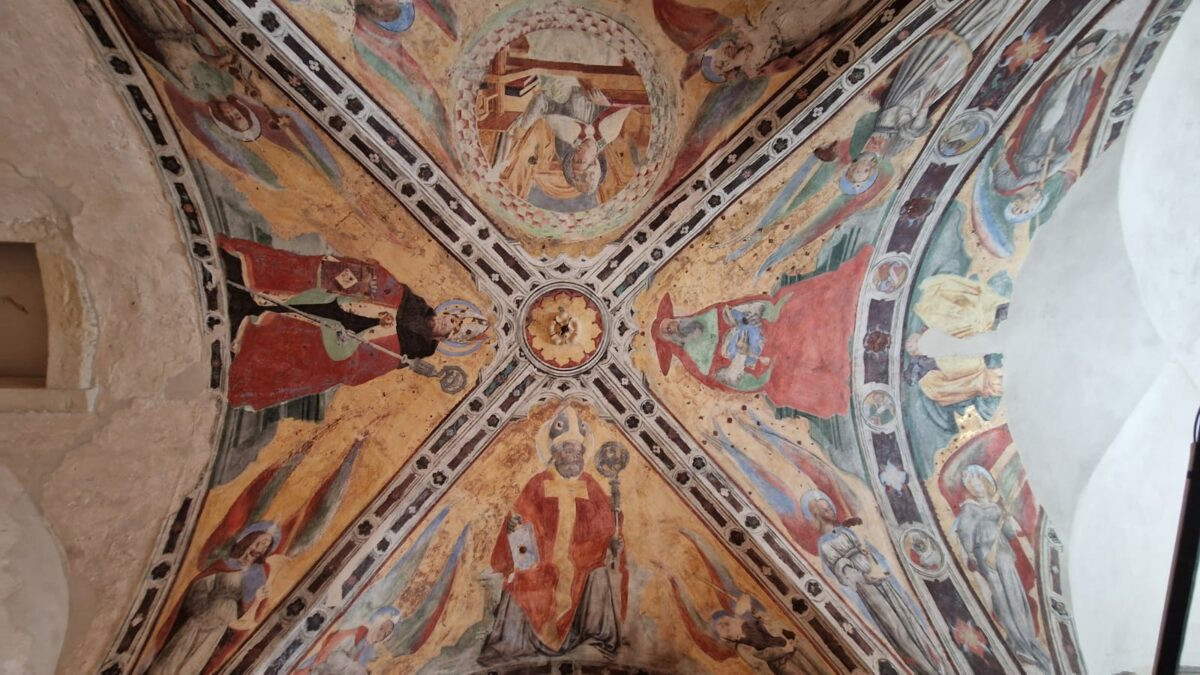
The painted decoration was completed several years after the chapel’s construction. Bishop Pietro Donato, who was often away from Padua due to his diplomatic duties, commissioned Giovanni da Ulma to decorate the chapel under a contract signed on February 25, 1437. The agreement provided for a fee of 120 ducats and stipulated that work would begin on April 4, after the conclusion of the Easter festivities. The surviving portions of the frescoes, preserved on the vault and in the apse, depict episodes from the life of Christ, distributed across the lunettes and along the walls. The ribs of the arches, on the other hand, are embellished with floral motifs. The arch separating the two vaults features seven clipei depicting an equal number of prophets. Some can still be identified thanks to the cartouches: Daniel, Obadiah, Haggai, Ezekiel, and Zephaniah are recognizable.
In the first cross vault, the one closest to the entrance, four Church Fathers (Gregory the Great, Ambrose, Jerome, and Augustine) appear, accompanied by pairs of angels. The second cross vault, on the other hand, most likely once featured the four Evangelists, also flanked by angelic figures. The apse, too, preserves significant traces of the original decoration. It features Bishop Donato’s coat of arms, floral motifs, and monochrome figures representing the virtues. Of these, only Fortitude is recognizable today. A refined painted veil, resembling a red brocade fabric decorated with a thistle motif, must have completed the apse’s circumference: the fabric appears draped and secured with rings. The traces still visible in the apse basin also suggest the presence of figures of Saints Peter and Paul against a gold background. Christ must have been at the center, flanked by four seraphim beside his face. The composition seems to recall the ancient iconography of the Traditio Legis.
On the side walls, the decoration was divided into three overlapping bands. The upper band featured lunettes depicting scenes from the life of Christ; the band below depicted the so-called “hystorie pizole,” likely inspired by episodes from the Old Testament. The lower band, on the other hand, was characterized by square panels with faux marble surfaces and “strafo” decorations.
The restoration of the Chapel of San Massimo was made possible thanks to collaboration among various institutions and professionals. Andrea Nante, director of the Diocesan Museum, played a key role; as early as 2007, he had identified the spaces of the ancient chapel within the Bishop’s Palace. Also participating in the project were the Diocesan Service for Sacred Art and Ecclesiastical Heritage, the Superintendence for Archaeology, Fine Arts, and Landscape for the provinces of Padua, Treviso, and Belluno, Giordano and Guglielmo Passarella, and the restorers Fabio Dupré and Stefania Scabia of Passarella Restauri srl. The restoration of the chapel and the frescoes was funded through the “8xmille” donations to the Catholic Church. Several companies and professionals also contributed to the restoration by providing their services free of charge or at a reduced rate: Antica Fornace Carraro of Piove di Sacco; Borin comm. Dino & Figlio Arte del Restauro of Arquà Petrarca; Cacco Serramenti of Padua; photographer Mauro Magliani of Padua; Studio Associato 7 11 Progetti of Piove di Sacco; and Exenia Illuminazione of Calenzano (Florence).
“While the figure of Giovanni d’Alemagna remains elusive and complex even today,” stated Andrea Nante, director of the Diocesan Museum, in an essay to be published in the latest issue of *Arte Veneta* 82/2025, “this cycle allows us to begin to understand the artistic style of the German painter in the mid-1930s, his references and models, and, consequently, what his role and contribution may have been in Vivarini’s workshop.” “The evidence emerging from the frescoes in the Chapel of San Massimo,” Nante continues, “reveals the profile of a multifaceted artist, receptive to the new trends present in Padua and Venice at the beginning of the fourth decade of the fifteenth century; a painter who was by no means backward-looking or archaic, as critics had regarded him until a few years ago, solely in relation to the period corresponding to his collaboration with the younger Antonio Vivarini, since none of his work prior to 1440 was known to assess Giovanni d’Alemagna’s artistic profile.”
Although damaged, the pictorial cycle represents a fundamental testament to the transition from the International Gothic to the early Renaissance: “The gilded backgrounds and the shimmering metallic ornamentation found in the figures of the three Church Fathers—Jerome, Ambrose, and Augustine—and in the angels with their flaming wings,” he noted, “reveal a culture still deeply influenced by the International Gothic style. But in the scenes on the walls, the moods of an embryonic Renaissance shine through more clearly: the skies become atmospheric, though tinged with gold; the rocky terrain that defines the planes in the landscape views reveals a new sense of spaciousness; and the painted architecture breaks free from Gothic forms, updating its visual language; the bodies, in their volumes and gestures, regain a sculptural construction recognizable precisely in later works by Giovanni d’Alemagna and Antonio Vivarini. Likewise, the inscriptions in Gothic round script accompany the epigraphic dedication written in proto-humanistic capital letters.”
“About three years ago,” commented Bishop Claudio Cipolla, “I allowed myself to be persuaded to launch the restoration project for the Chapel of San Massimo, motivated in part by the desire to provide the bishop’s residence with a place of prayer for the community of priests who live with the bishop. And so began the extraordinary adventure of the renovation. For me, it was an experience of constant daily discoveries, but also an opportunity to learn from the passion and patience of the restorers the precision required for ‘surgical’ work. The restoration process became a sort of inner pilgrimage through history and beauty, a tribute of grateful and devout remembrance to one of the first holy bishops of our diocesan Church, but also to Bishop Donato, who commissioned it. The Chapel of St. Maximus, in the heart of the Bishop’s Palace, is not merely a relic of the past, nor simply an artistic treasure to be preserved with respect. It belongs to those places where the history of the Church of Padua, beauty, and prayer come together and mutually illuminate one another.”
|
| The Chapel of San Massimo in Padua Unveiled: Giovanni d’Alemagna’s Frescoes Come to Light |

Warning: the translation into English of the original Italian article was created using automatic tools. We undertake to review all articles, but we do not guarantee the total absence of inaccuracies in the translation due to the program. You can find the original by clicking on the ITA button. If you find any mistake,please contact us.


























 IT
IT FR
FR DE
DE ES
ES CN
CN


