




by Redazione 08/09/2026



Categories: News / Disclaimer
On Thursday, September 10, at 12:15 p.m., the 14th-century masterpiece from the Giotto-Rimini school, which has been closed for about ten years, will once again be open to the public in the Basilica of St. Nicholas. The ceremony will feature civil and religious authorities and a lecture on art history.

On Thursday, September 10, at 12:15 p.m., the Basilica of St. Nicholas in Tolentino (Macerata) will officially reopen the Cappellone to the public, following the completion of restoration work made necessary by the 2026 earthquake. The consolidation and restoration work—which has been underway for several months on this 14th-century masterpiece of the Giotto-Rimini school—has now been completed. After being secured, the chapel had not been fully accessible to worshippers and tourists for about a decade.
Several civil and religious authorities will take part in the reopening ceremony: the mayor of Tolentino, Mauro Sclavi; Father Massimo Giustozzo, prior of the Augustinian Community of St. Nicholas; Monsignor Nazzareno Marconi, bishop of Macerata and Tolentino; Guido Castelli, special commissioner for the 2016 earthquake, Father Gabriele Pedicino, provincial superior of the Augustinians, and Francesco Acquaroli, president of the Marche Region. Following the official greetings, technical presentations will be given by Ilaria Persico, project manager, and Katiuscia Faraoni, sole project manager for public works for the Municipality of Tolentino. The event will conclude with a lecture by Marta Paraventi, professor of Medieval Art History at the Academy of Fine Arts in Macerata and councilor for Culture for the Municipality of Ancona, titled “The Rediscovered Middle Ages: The Great Chapel of St. Nicholas Speaks Once More.”


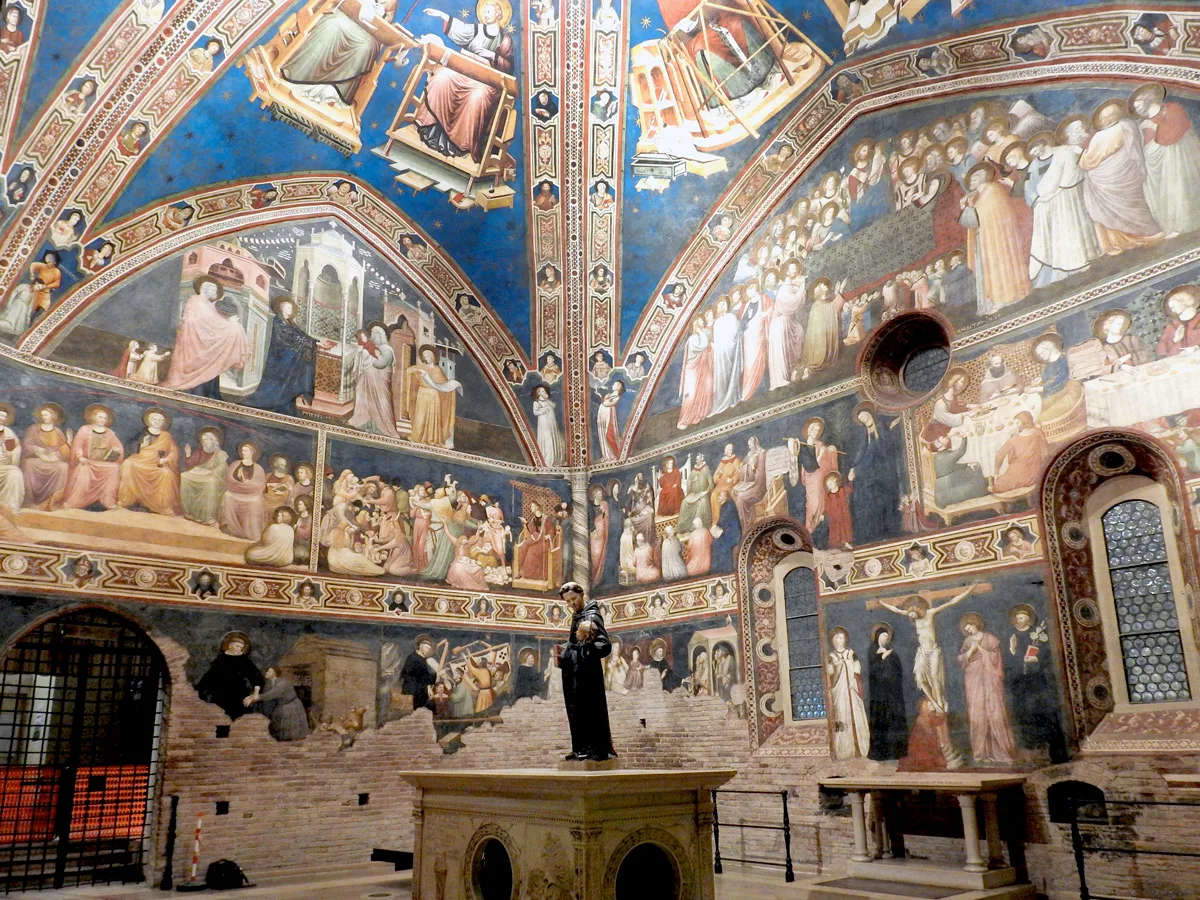
The Great Chapel of St. Nicholas houses a remarkable cycle of 14th-century frescoes characterized by intense colors on a blue background, featuring depictions of the four Evangelists—each accompanied by one of the Doctors of the Church—along with scenes dedicated to the lives of the Virgin Mary, Jesus, and St. Nicholas of Tolentino himself. The entire decorative scheme culminates in the scene of Christ’s crucifixion, which is located directly above a small marble altar placed beneath the painted depiction. The cycle is considered one of the most important examples of 14th-century mural painting that have survived to the present day.
As for the dating of the work, while it was initially believed that the frescoes were created after 1325—the year the saint’s canonization process began—they are now dated to the first two decades of the 14th century. The canonization process for Saint Nicholas of Tolentino, in fact, was suspended for a long period, and his canonization did not take place until 1446—a circumstance that makes it unlikely the decoration was created during a time of uncertainty regarding the saintly status of the figure depicted. According to most scholars, it seems more likely that the cycle was created after the saint’s death in 1305, amid the wave of enthusiasm sparked by the miracles progressively attributed to him, including the famous Miracle of the Ship, depicted with great skill and dynamism on the walls of the room. The influence of Giotto’s style is particularly evident in certain panels, where figures are shown from behind—a technique used to lend dynamism to the composition—or where circular elements are employed in an attempt to convey the three-dimensionality of space.
The entire cycle of paintings has been attributed to the Rimini school since 1905: it is in fact evident that the entire project was conceived by a single artist and subsequently executed by a large number of collaborators, following the organizational structure of a workshop. The quality of the various scenes appears rather uneven, ranging from works of the highest caliber to depictions of more modest quality, especially in the lower register dedicated to scenes from the life of Saint Nicholas, which can be attributed to less experienced collaborators. Following the recent restoration, the attribution has been more confidently directed toward the workshop of Pietro da Rimini, although tradition continues to attribute the cycle to an unidentified Maestro da Tolentino.
|
| Tolentino: The Cappellone di San Nicola Reopens After Post-Earthquake Restoration |
Warning: the translation into English of the original Italian article was created using automatic tools. We undertake to review all articles, but we do not guarantee the total absence of inaccuracies in the translation due to the program. You can find the original by clicking on the ITA button. If you find any mistake,please contact us.