





Over the course of his ten-year artistic career, Vincent van Gogh signed a surprisingly small number of paintings: of his 840 known works, only 133 bear his signature, accounting for about 15%. This finding comes from the first systematic study of the artist’s signatures, conducted by the Van Gogh Museum in Amsterdam. Researcher Julia Engelmayer compiled all known authentic signatures on Van Gogh’s paintings into a database and published the results in the article “Simply ‘Vincent’: An Overview of Van Gogh’s Signed Paintings.” The title of the study refers to a distinctive feature of his signature: the artist almost always used only the first name “Vincent.” Outside the Netherlands, in fact, his last name could be difficult to pronounce and remember.
The reasons why Van Gogh chose to sign only some of his works are revealed primarily in his letters. The artist’s correspondence shows just how strict and critical he was of his own work. Throughout much of his career, Van Gogh regarded many of his works as exercises, experiments, or preparatory steps toward future artistic maturity. This perspective helps explain why he did not sign any paintings before 1884, even though he had begun painting in oils as early as 1881. He had, however, previously signed some of his drawings. The situation changed when he moved to Paris, where his professional and commercial ambitions grew. At the same time, the number of signed paintings also increased.
Another change occurred shortly after his arrival in Arles. Still influenced by the Parisian art market and the aspirations he had developed in the French capital, Van Gogh began signing his paintings more regularly. However, the frequency of his signatures seems to have decreased dramatically as his mental health progressively deteriorated.
The Van Gogh Museum’s study highlights an interesting relationship between the practice of signing works and the artist’s personal circumstances: the decision to sign a work could reflect ambition, pride, confidence in one’s abilities, or, conversely, growing insecurity. Van Gogh’s letters show that the artist tended to sign mainly those paintings he considered particularly successful. Among these is *The Potato Eaters* from 1885, now in the Van Gogh Museum, which the artist regarded as his first true masterpiece. The signature is located on the back of the chair on the left, although it is now almost illegible.
Another famous example is *Sunflowers* (1889), also housed at the Van Gogh Museum, to which the artist attached particular value. Van Gogh also frequently signed works intended as gifts for family and friends. A different trend, however, can be observed in the paintings he created based on prints by artists such as Jean-François Millet, Rembrandt, and Eugène Delacroix, which were generally not signed. There is, however, one significant exception: the *Pietà* (after Delacroix) from 1889, now housed in the Vatican Museums. Van Gogh signed this work because he had created it as a gift for his sister Willemien.
Another circumstance in which Van Gogh signed his works was when exchanging pieces with other artists. A particularly curious case is that of the 1886 still life *Three Pairs of Shoes*, now housed at the Harvard Art Museums/Fogg Museum in Cambridge, United States. Van Gogh exchanged it with the Australian artist John Peter Russell, and the painting has an unusual feature: two signatures. The first, small and almost imperceptible, is inscribed directly onto the canvas in a manner typical of Van Gogh. The second, however, is located in the upper right corner of the canvas, in large capital letters and in a handwriting very similar to Russell’s. It is not known why Russell personally added this second signature. He may not have been able to read Van Gogh’s signature or may have considered it too discreet, thus choosing to make his friend’s name more prominent. A similar gesture also appears in the portrait of Van Gogh that Russell painted that same year, in 1886, now housed at the Van Gogh Museum.
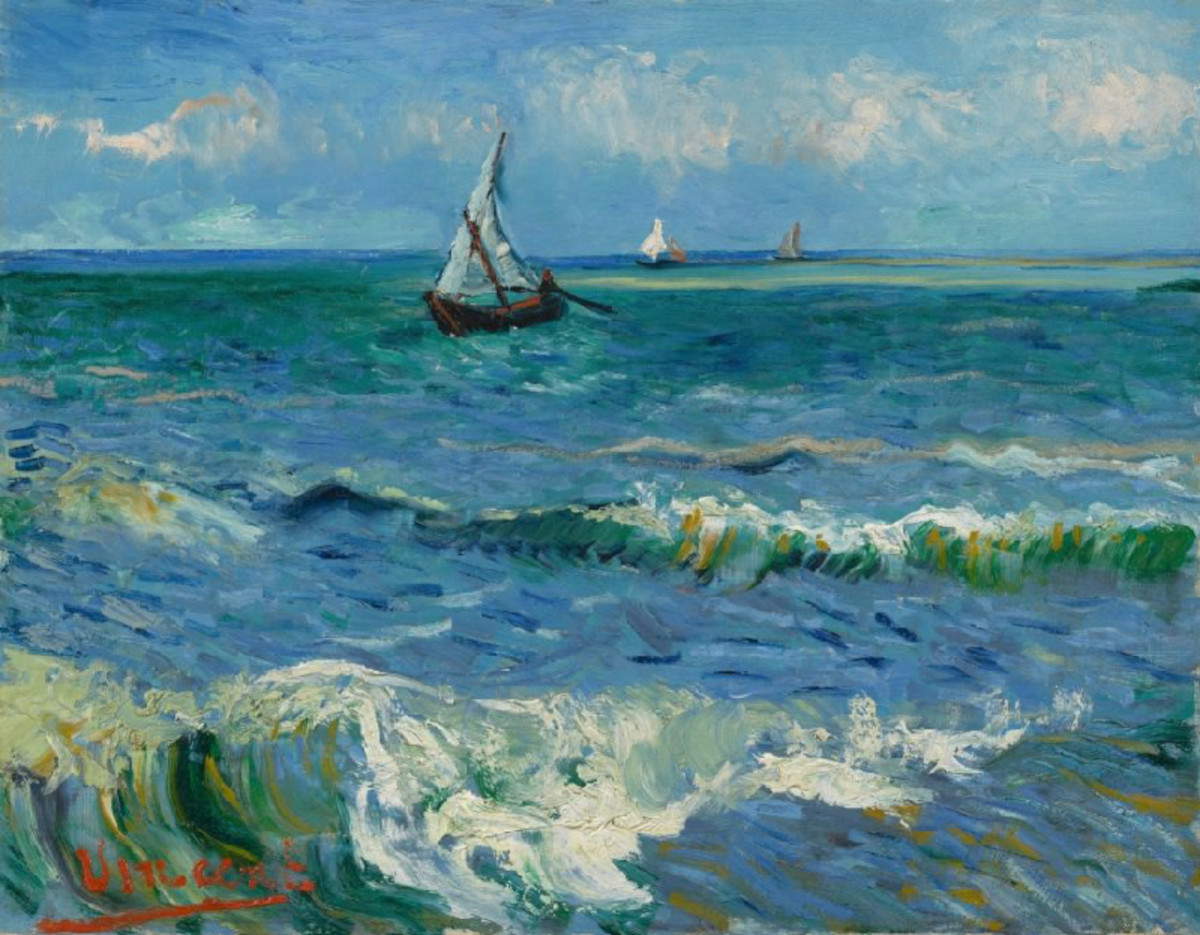
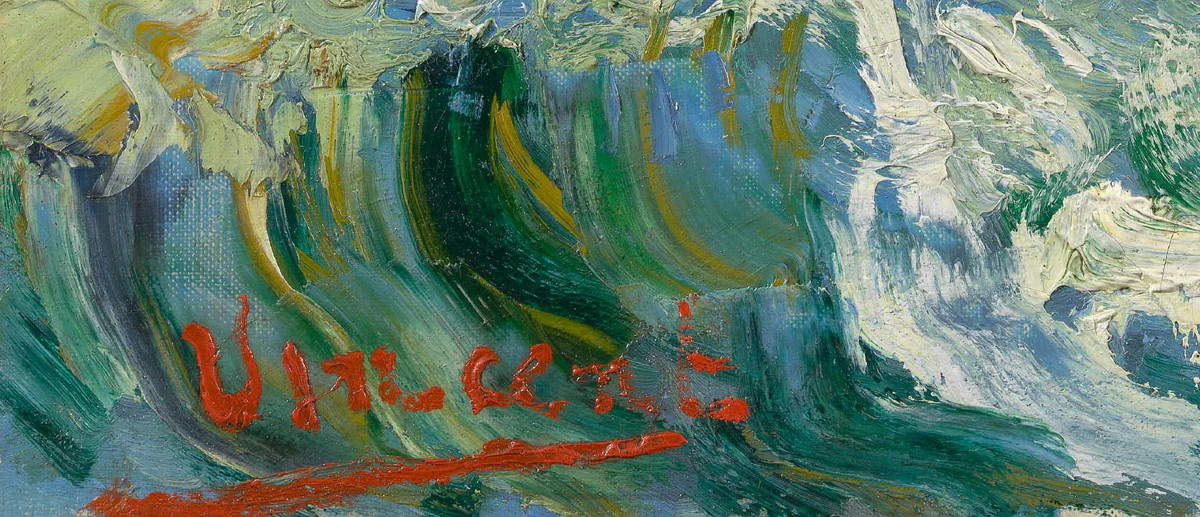
On a few rare occasions, Van Gogh also used his signature as an actual compositional element of the painting. This is the case with *Marina near Les Saintes-Maries-de-la-Mer*, painted in 1888 and now housed at the Van Gogh Museum. The artist was not fully satisfied with the color scheme of the work and decided to intervene by adding a red signature in the lower left corner. As he explained to his brother, he wanted to introduce a touch of red into the green composition. The signature thus takes on a function that goes beyond mere identification and becomes an integral part of the work’s chromatic balance.
Studying signatures reveals that even the absence of a signature can carry meaning. Many of the masterpieces from the final phase of Van Gogh’s career are, in fact, unsigned. After his admission to the asylum in Saint-Rémy in 1889, the artist’s confidence in his own abilities gradually diminished, and the frequency with which he signed his paintings decreased even further. In Auvers-sur-Oise, where he spent the last months of his life, Van Gogh signed a painting on only one occasion. It is the portrait of Adeline Ravoux, painted in 1890 and now in a private collection. The work was given to the model herself and is the last known example of a painting by Van Gogh signed in Auvers.
The systematic analysis conducted by the Van Gogh Museum demonstrates how a signature can offer valuable information not only about the author of a work but also about his relationship with his own artistic output. In Van Gogh’s case, the presence or absence of his name seems to reflect the evolution of his aspirations, his perception of his own work, and the different phases of his life. The 133 known signatures thus become a sort of parallel record of his artistic output: small marks that reveal when Van Gogh felt ready to acknowledge a painting as his own—worthy of being exhibited, given as a gift, or remembered.
 |
| Van Gogh and His Signatures: The Van Gogh Museum in Amsterdam Reveals What They Tell Us in Its First Systematic Study |

Warning: the translation into English of the original Italian article was created using automatic tools. We undertake to review all articles, but we do not guarantee the total absence of inaccuracies in the translation due to the program. You can find the original by clicking on the ITA button. If you find any mistake,please contact us.

















 IT
IT FR
FR DE
DE ES
ES CN
CN


