



by
Ilaria Baratta  @ilaria.lilly
11/11/2026


Categories: Opinions / Disclaimer
It is possible to admire a great artist and yet not appreciate an exhibition of his or her works: an artist’s name is not, in fact, a guarantee of quality for the exhibitions dedicated to him or her. This is not, in fact, a matter of questioning the artist’s value or the emotions his or her works may evoke; rather, it is a matter of evaluating the quality of the curatorial project. An editorial by Ilaria Baratta.


The announcement of an exhibition featuring a great artist from the recent or distant past always generates a great deal of anticipation and high expectations; it’s understandable that this is the case, but a universally recognized name does not necessarily guarantee a high-quality exhibition. In other words, the equation “great artist equals great exhibition” does not always hold true. Let me explain: it’s important to distinguish between two aspects that visitors often confuse—namely, the artistic abilities of the artist themselves and the quality of the curatorial project underlying an exhibition about that artist. When we talk about Caravaggio, Van Gogh, or Edvard Munch, we certainly aren’t questioning their artistic approach or the role they’ve played in art history; rather, what can and must be questioned is the way their work is presented and contextualized within an exhibition.

If we were to reason solely on the basis that a great artist always guarantees a great exhibition, it would be superfluous even to write exhibition reviews. What would be the point? What would be the purpose of reviewing an exhibition if the very fact that it focuses on a great artist were already, in and of itself, a guarantee of success ? From this perspective, all exhibitions dedicated to the great names in art history would have to be considered valid, successful, and satisfactory regardless, rendering any evaluation superfluous.


A review serves to critically assess—positively or negatively—the exhibition project: how it was conceived and developed, how it is organized, which works and masterpieces were included or excluded, whether there is a solid curatorial concept, whether there is a sound scholarly framework, whether the exhibition design effectively guides visitors toward understanding the artist, whether the exhibition itinerary and selection of works are consistent with the underlying premises, whether the exhibition offers something new, whether it highlights little-known aspects or creates comparisons that can be useful for a deeper understanding of the artist’s work. Because, in my opinion, an artist should never be considered completely isolated from his or her context. An artist is, in fact, part of a specific historical period, engages with a social, political, and cultural environment, may be influenced by other artists or movements, may have been a student of another artist or, in turn, a teacher to another, just as they may have influenced subsequent generations in some way. Taking these relationships into account, whenever possible, means offering the public additional tools to understand an artist’s work and situate it within a broader context.


This does not mean, of course, that an exhibition built exclusively around the works of a single artist is necessarily weak or uninteresting. On the contrary, it can prove to be a high-quality exhibition, provided it is based on a strong curatorial framework: it can, for example, develop a specific thesis, explore a lesser-known aspect, or propose an original interpretation. What matters, in any case, is the soundness and strength of the project and its ability to give meaning to the exhibition’s narrative, going beyond a mere succession of works.
What I do notice, however, is a fairly widespread tendency to automatically consider an exhibition beautiful, unmissable, and successful when its protagonist is a universally recognized artist. As if the prestige of the name were enough to justify any curatorial choice and exempt the project from a less-than-positive evaluation. But this is not the case: one can deeply love an artist and, at the same time, leave an exhibition dedicated to him or her feeling somewhat disappointed. The two things are by no means contradictory.
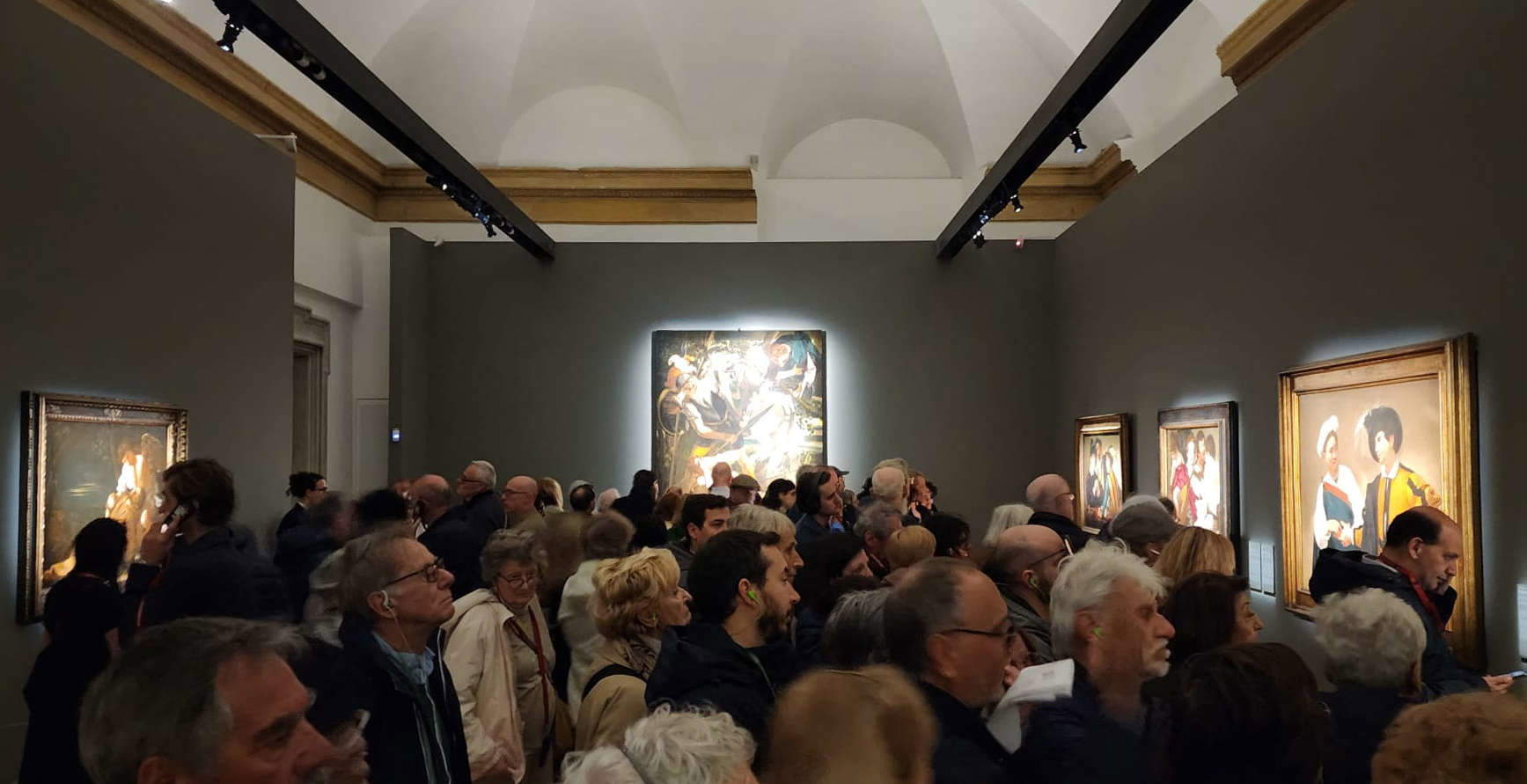
A few examples: it is not blasphemy to judge an exhibition on one of the greatest painters of modern art as unsuccessful because, in the reviewer’s opinion, it does little good to reduce Edvard Munch’s career to a repetitive narrative overly focused on clichés, lacking comparative works despite the intention to provide a more concrete understanding of the cultural context in which the artist worked, and which fails to explore in depth the few interesting insights it does present to the public. It is not blasphemous to give a less-than-positive review of the “Caravaggio 2025” exhibition in Rome because it resembled a triumphal parade, a procession of icons, not to mention that visiting the exhibition itself in the halls of Palazzo Barberini was nearly impossible due to the overwhelming crowds.
Let it be clear, however, that being able to admire in person the works and masterpieces of a great artist (and not only!) is always a precious opportunity, a source of enrichment and knowledge. And bringing them all together in one place is never an easy task. But the quality of an exhibition also depends on which works have been chosen to give shape and coherence to the curatorial project, as well as on the design choices. It’s not enough to simply place more or less famous paintings and masterpieces side by side to create an exhibition. It’s the critical eye that often seems to be lacking. Then, of course, if you visit an exhibition simply for the pleasure of seeing a few works by your favorite artist in person, that’s perfectly fine too. But it’s an entirely different matter.
Warning: the translation into English of the original Italian article was created using automatic tools. We undertake to review all articles, but we do not guarantee the total absence of inaccuracies in the translation due to the program. You can find the original by clicking on the ITA button. If you find any mistake,please contact us.