




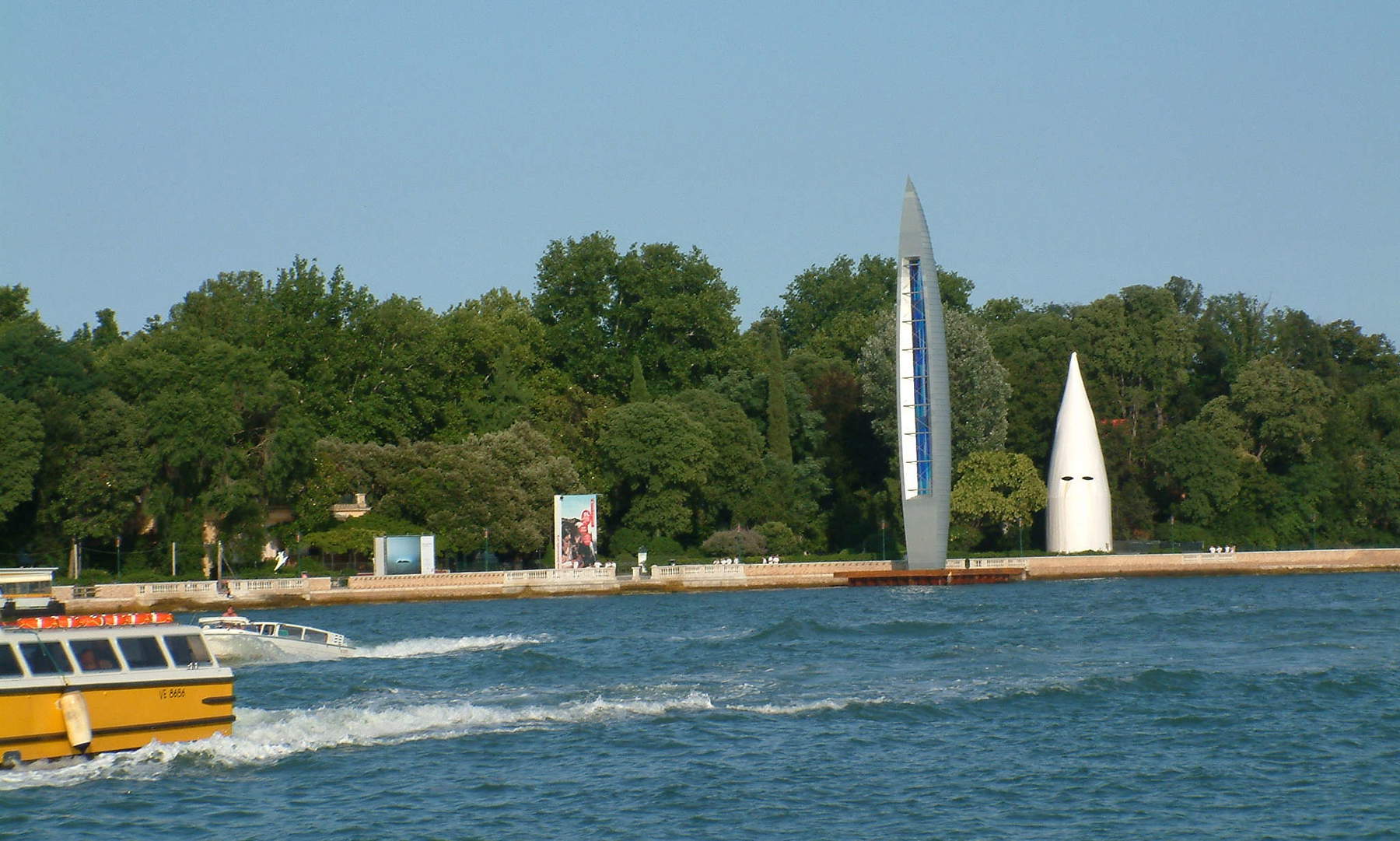
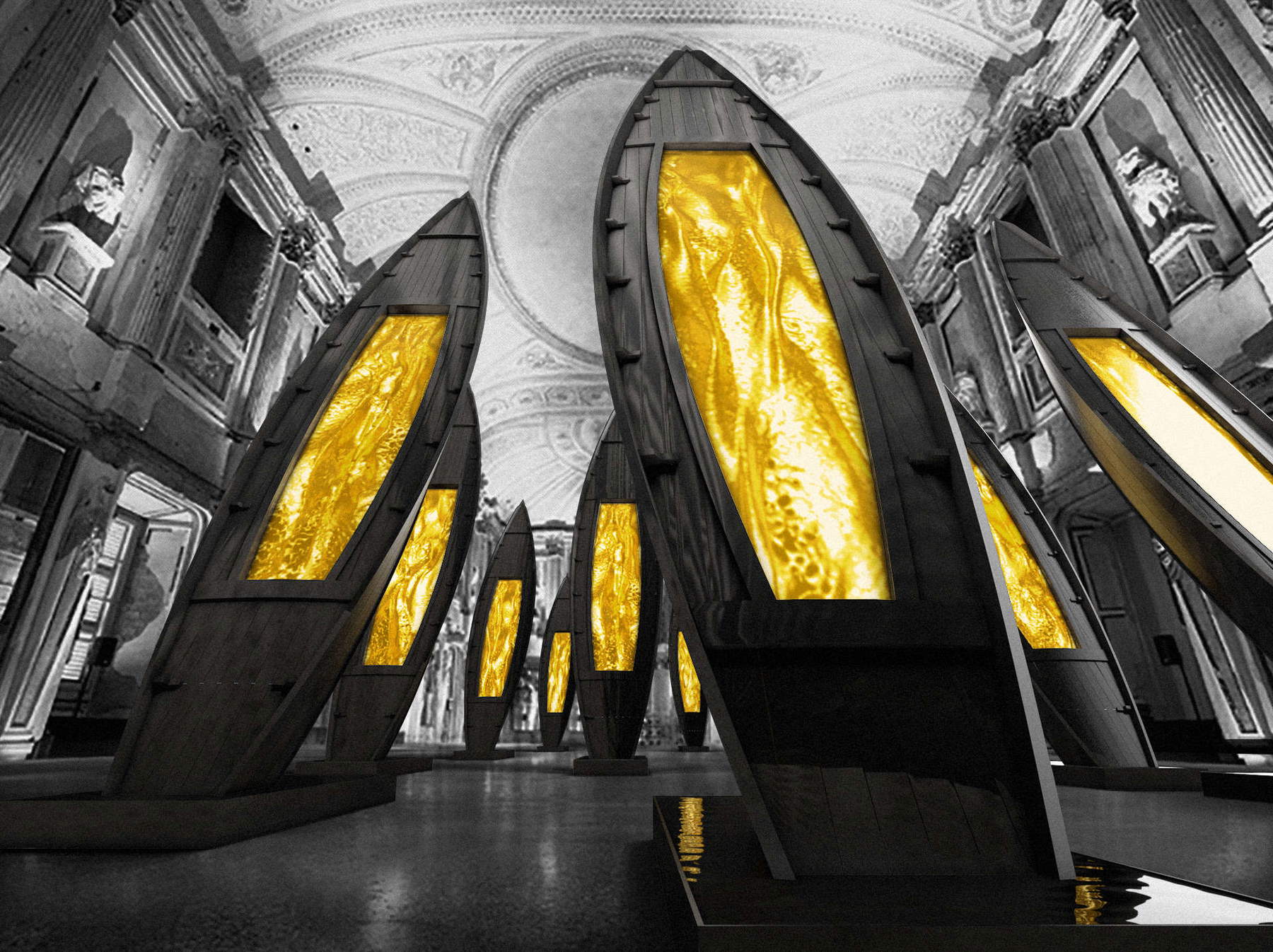
Fabrizio Plessi (1940 – 2026) inaugurated the newly restored Venice Pavilion in the Biennale Gardens in 2011 with a large and magnificent installation consisting of 12 vertical wooden boats, tilted by a few degrees, through which cascades of “electronic water” flowed. The work, in turn, expanded upon Plessi’s towering, perfectly vertical boat, which had been installed at the opening of the 2005 Biennale at the entrance to the Giardini’s avenue, on a platform positioned at water level: a sculpture that illuminated Venetian nights like a lighthouse signaling the paths of art. In 2023, the same Venetian boats were then placed in a large installation in Milan’s Sala delle Cariatidi, and this time, instead of water, a stream of liquid gold flowed through them—which, of course, was also digital. Though unlit and silent, the works exuded a haunting, hypnotic, and majestic magic, capable of transforming themselves into a theater within the theater of the ruins of the bombed-out Caryatids.
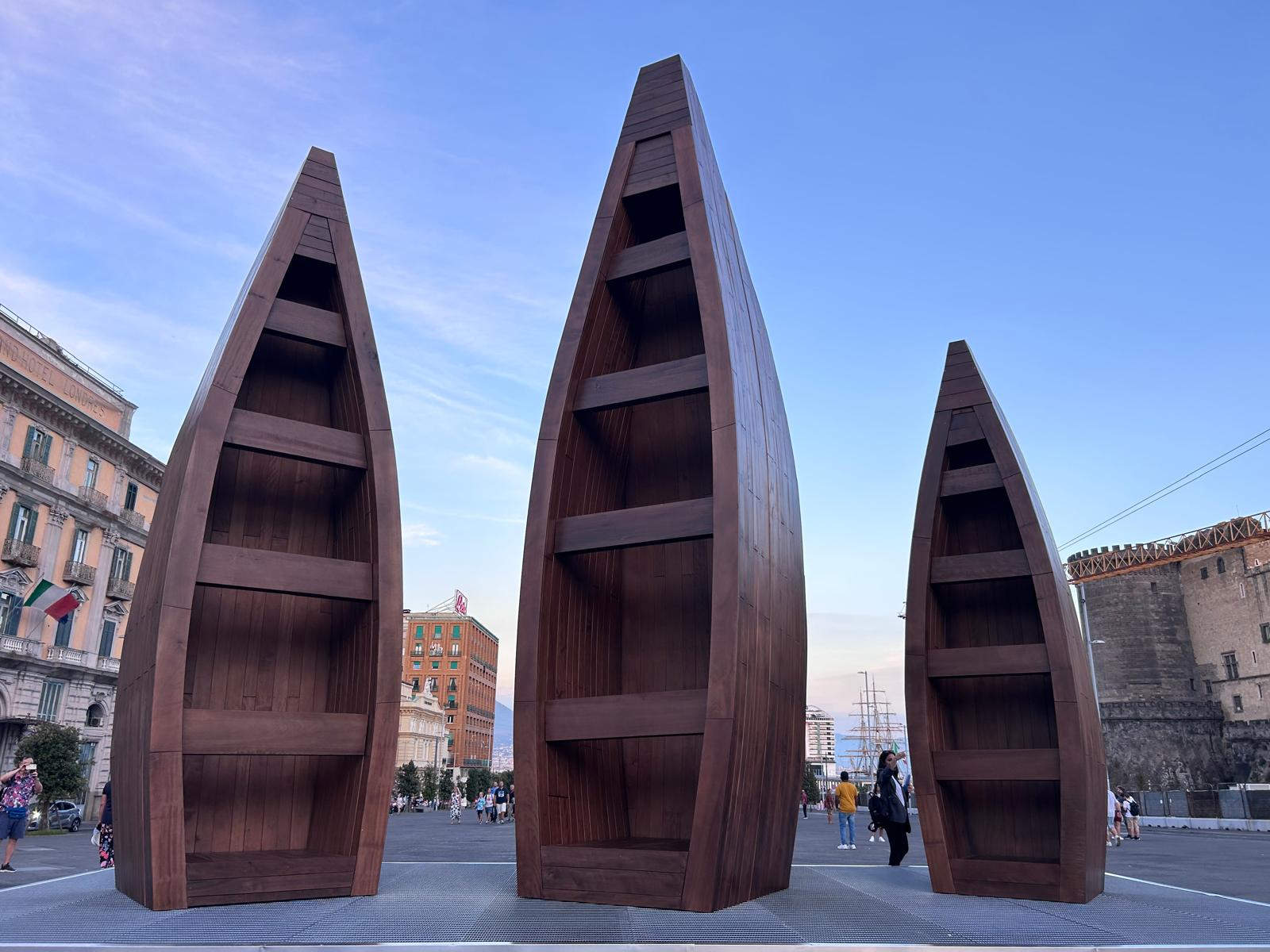
In short, the occasions on which Plessi exhibited his boats and his vertical seas were numerous, captivating, and on full display for all to see. Seeing now the three far more inert and bare wooden boats (Plessi’s were 12 meters each)—also vertical, though not tilted but cut at the base—titled *Voyageur* by Ibrahim Mahama and placed in Naples’ Piazza Municipio, prompts some reflections. Works of art are made up of ideas that generate other ideas, and this has always been the case. In the most striking instances, we’ve seen outright plagiarism, such as Andy Warhol, who, for his *Flowers* or his *Brillo Boxes*, reproduced images created by others (he had to pay the photographer of the original flowers a substantial sum and cede rights to the sales of the works to avoid a lawsuit) or Jeff Koons, who has been convicted of plagiarism on several occasions for literally translating images by other photographers into sculpture, as in the case of *Fait d’Hiver* or *String of Puppies*.
Of course, there does not appear to be a case of plagiarism between Mahama and Plessi, but we might still ask whether it was appropriate to install a work that would inevitably bring to mind one of the most iconic sculptures by one of Italy’s best-known contemporary artists (who, incidentally, passed away very recently), an artist who has practically made the vertical boat his trademark. Although the project’s curator states that the iconography of boats “is part of a broad and layered genealogy, stretching from Géricault and Cézanne to the chronicle of the present,” wouldn’t it have been more accurate to say at least “up to Fabrizio Plessi,” as well as Hidetoshi Nagasawa or Claudio Parmiggiani (even if, in these two cases, the boats were not vertical)?
In any case, *Voyageur* allows us to define a boundary that is more relevant today than ever: the one between a work of art that aspires to be absolute, spectacular, metaphysical, and visionary—as Plessi’s work has been and remains—and one that must justify itself by invoking the suffering of others (migrants, responsibility, and “repressions surrounding every crossing”), even though no shipwreck is depicted in these three wooden structures (which aren’t even made from reclaimed materials and look as if they’ve just come off a furniture factory assembly line).
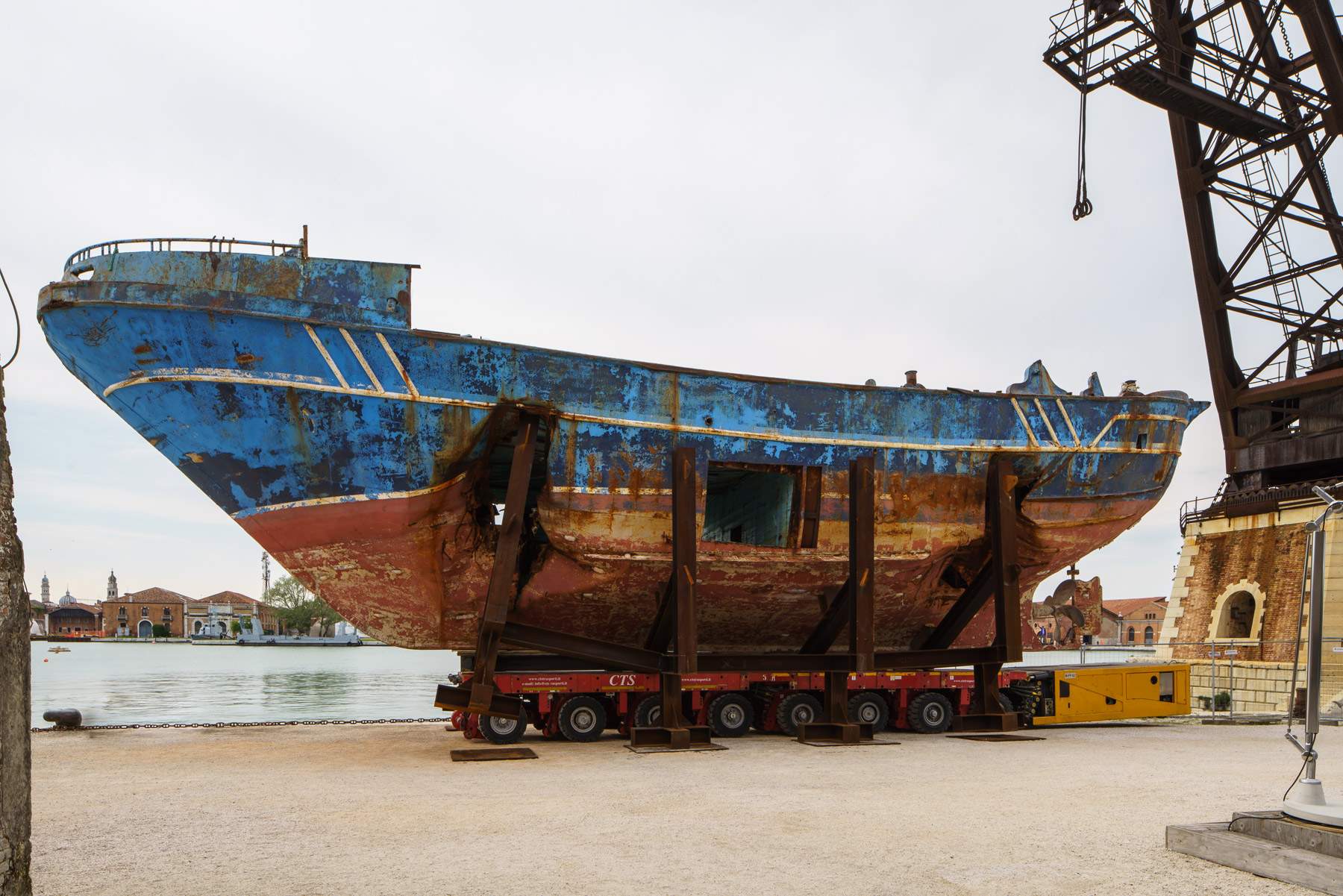
While the first type of artwork is unaffected by the avalanche of “woke” and politically correct trends and by Western guilt complexes—often self-inflicted (an avalanche that is subsiding on its own, partly driven by enlightened African and African American thinkers)— the second is justified solely on that basis, precisely because it has no aspirations to conceptual originality or formal invention. Assuming that Plessi’s “vertical seas” could not possibly have been unknown or unseen—whether in person or in Italian newspapers and magazines—would it not have been more appropriate, from a curatorial standpoint, to conceive or suggest a different type of installation to the artist? Christoph Büchel’s “real migrant boat” exhibited at the 2019 Biennale (“Barca Nostra”), resting on the same reparative premises, at least had the force of raw reality to sustain it, even though it was a genuine—and by no means insignificant—reclaimed ready-made.
Mahama’s large canopies made from sewn-together recycled sacks (works that have made him famous in the world of contemporary art), even if they may closely remind the colonizers of our art system of those by Alberto Burri (of whom the large 1969 stage backdrop for *L’Avventura di un povero cristiano*, preserved at the Seccatoi in Città di Castello, is an illustrious precursor), they possess at least a physical drama whose poverty and beauty manage to convey a poetic vision. The boats of *Voyageur*, precisely because of what Plessi was able to achieve (not sixty years ago, but as recently as a few years ago), are already a relic of a history of contemporary art that is now increasingly ignored, as long as the spectacle continues in the public square.

The author of this article: Marco Tonelli
Marco Tonelli (Roma, 1971), critico e storico dell’arte. Dopo la laurea in Storia dell’Arte presso l’Università La Sapienza di Roma (1996), ha conseguito il diploma di Specializzazione in Archeologia e Storia dell’arte (2000) e un Dottorato di Ricerca in Storia dell’Arte (2003) presso l’Università degli Studi di Siena. È stato assessore alla Cultura del Comune di Mantova, caporedattore della rivista Terzo Occhio e commissario inviti della XIV Quadriennale di Roma. Dal 2015 al 2017 è stato direttore artistico della Fondazione Museo Montelupo Fiorentino per cui ha ideato la rassegna Materia Prima e ha curato il progetto annuale Scultura in Piazza a Mantova. Dal 2019 al 2023 è stato Direttore artistico di Palazzo Collicola e della Galleria d’Arte Moderna di Spoleto. Attualmente è Curatore scientitico della Fondazione Progetti Beverly Pepper di Todi. Insegna all'Accademia di Belle Arti di Venezia.Warning: the translation into English of the original Italian article was created using automatic tools. We undertake to review all articles, but we do not guarantee the total absence of inaccuracies in the translation due to the program. You can find the original by clicking on the ITA button. If you find any mistake,please contact us.




















 IT
IT FR
FR DE
DE ES
ES CN
CN


