



by Federica Schneck 10/11/2026


Categories: Opinions / Disclaimer
In museums, accessibility for the blind often takes the form of Braille panels, audio guides, and tactile reproductions added to tours designed for sighted visitors. But the problem runs deeper: there is still a lack of a culture of co-design with blind people. Federica Schneck’s perspective.


Every now and then, in some well-lit museum, there’s a room where you can touch the artworks. It’s usually just one room, at the end of the exhibition, with a few relief reproductions and a sign inviting you (finally!) to get your hands on them. It’s almost always a somewhat shabby room, with that slightly different light characteristic of things added later, of second thoughts. A room that says, without saying it: this is where the real exhibition ends and the exhibition for others begins.

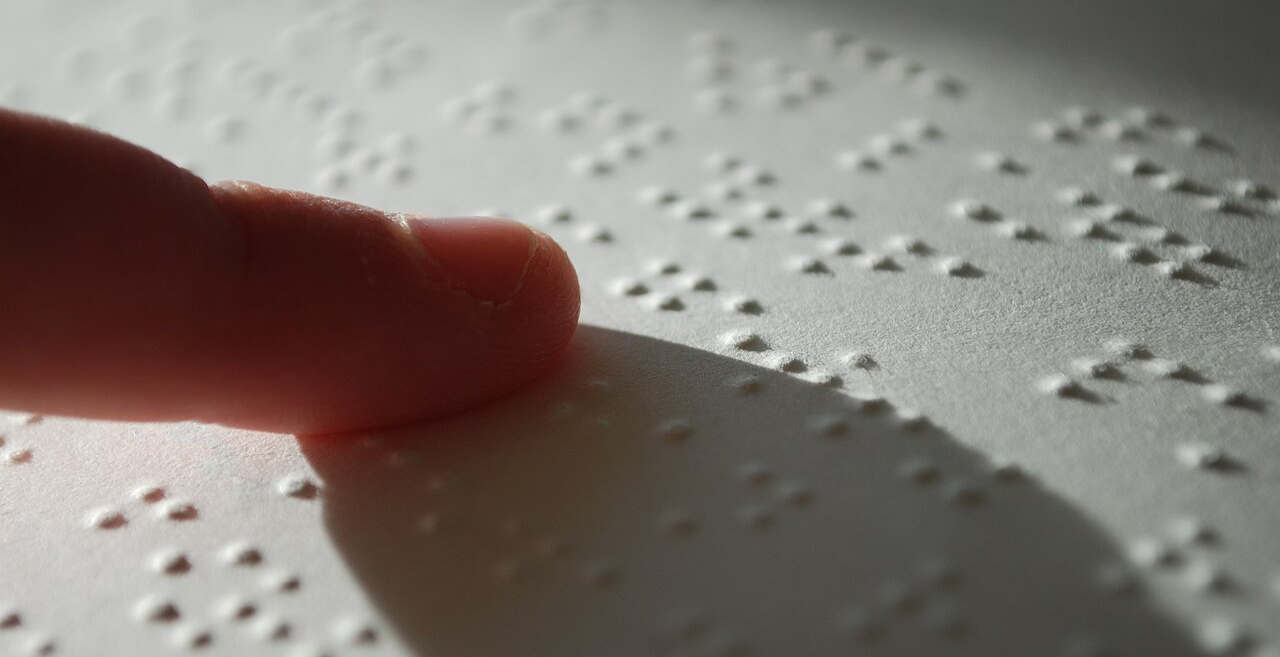
That room is the most honest metaphor for how the art world understands inclusion. There is an archetype of an exhibition accessible to the visually impaired that anyone working in the art world recognizes immediately, even if they rarely name it so clearly. It works like this: you take an exhibition that has already been conceived, designed, and installed for a sighted audience, and you add a layer of accessibility. Panels with Braille text next to the standard captions, a few tactile reproductions of the most important works (almost always raised surfaces that reproduce, with varying fidelity, the composition of a painting), an audio guide that describes what there is to see, and, in some more ambitious cases, a guided tour with a docent, a dedicated visit, or a slot in the educational program. The result is an exhibition with an appendix—a standard exhibition with an addition conceived elsewhere, at a later stage, by people who, in the vast majority of cases, are not visually impaired. Accessibility is treated as a technical problem to be solved after the fact, like an elevator installed in a historic building: necessary, appropriate, but external to the architecture. Not part of the design, but a correction to the design.


The difference is not semantic; it is structural. A work conceived from the outset to be experienced through touch, sound, temperature, weight, and presence in space is a different work from a painting accompanied by a tactile reproduction. The tactile reproduction does not convey the artwork itself: it conveys only an approximate idea of its visual composition, filtered through the interpretation of someone who decided what was relevant to convey. It is a map, not the territory. And it is a map drawn by those who can see the territory, for those who cannot.


There is something specific about the way the art world addresses the issue of visual impairment that is worth mentioning without too much diplomacy: it is paternalism. Not the overt and aggressive kind of paternalism—the kind that’s easy to identify and criticize. It’s the paternalism of good intentions—the kind that manifests when you decide what’s best for someone without asking them what they want, and even feel virtuous for having done so.
Exhibitions designed about disability rather than with people with disabilities are the norm, not the exception. Co-design processes—in which blind people participate in the conception of the exhibition, not just the final testing phase—do exist, but they are rare enough to be cited as exemplary cases whenever they occur. This means that everything else works differently. It works with a group of sighted people (curators, artists, designers, accessibility coordinators) who decide how a blind person will experience the exhibition, what information they will receive, which works they will be able to touch and which they won’t, how long the audio guide will last, and in what tone of voice it will be recorded.
In this model, the blind person is not a participant but a recipient—and for those who experience it, the difference is not subtle. The most convenient response when discussing accessibility in museums is the issue of resources. There’s no funding, no expertise, and no time. It’s a partially true answer that’s almost always used dishonestly, because it hides a matter of priorities behind a matter of availability. Museums and galleries that have sought to integrate accessibility from the design phase onward have done so—and not always with extraordinary budgets. What they had was a different understanding of who their audience was and what it meant to design for that audience.
What is lacking, in most cases, is not money but imagination. The imagination to envision what an exhibition might look like—one designed not for an abstract, sighted visitor, with blindness treated as a variation to be accommodated, but for a plurality of ways of perceiving space and the artworks. A sound installation that functions on its own, without being the audio version of something visual. A sculptural work conceived to be touched, not protected under a glass case with a sign that says “do not touch.” A space designed so that its topography is readable through movement and orientation, not just through sight. These things exist, here and there. They are not the norm, and they will not become the norm as long as accessibility is viewed as a requirement rather than an integral part of the design.
There is a deeper reason why inclusive exhibitions often aren’t truly inclusive, and it has to do with the way the art world constructs its imagined audience. The typical visitor that museums have in mind when designing an exhibition—the one for whom they choose the height of the panels, the font size, the sequence of the route, and the level of complexity of the texts, is a sighted visitor with good visual acuity, of average height, and without significant mobility limitations. This is an abstraction, and like all abstractions, it excludes by definition everything that does not fit the model.
As long as the imagined audience remains that way, accessibility will always be an afterthought. Because an afterthought is exactly what it is: something tacked onto a project designed for someone else. Changing this logic does not mean sacrificing the complexity of the works or lowering the level of discourse. It means stopping treating perceptual diversity as an exception to be managed and starting to treat it as one of the ordinary conditions of human experience—which, incidentally, is simply reality.
There is one last thing worth mentioning, and it is the most uncomfortable. Today, the Braille panel has become a sort of symbol of accessibility in the art world. It is visible, it is tangible, and it can be photographed for the annual report on inclusive activities. But it is also, in most contexts, almost useless: blind people do not wander through galleries running their hands along the walls in search of Braille panels. They navigate using a cane or a guide dog, orienting themselves in space in ways that the Braille panel does not help in the least. The Braille panel isn’t accessibility; it’s a sign that someone has thought about accessibility—that it’s different. Just like the photo of the museum director at the opening ceremony (with the tactile path, a smile, a hand on the artwork, and the press release already prepared)—which is a sign that the museum has communicated inclusion, not that it has actually practiced it.
True inclusion is slower, more expensive, more complicated, and less photogenic. It requires involving people who are blind before the project even exists, not after. It requires listening to what they say rather than interpreting what we think they need. It requires accepting that some of the choices made for the sighted public might be wrong—or at least incomplete—and being willing to change them. It requires, in essence, letting go of the idea that inclusion is a gesture and starting to treat it as a responsibility. Which, for a system accustomed to turning everything into communication, is probably the most difficult challenge of all.
Warning: the translation into English of the original Italian article was created using automatic tools. We undertake to review all articles, but we do not guarantee the total absence of inaccuracies in the translation due to the program. You can find the original by clicking on the ITA button. If you find any mistake,please contact us.