



by
Federico Giannini  @federicogiannini1
15/11/2026


Categories: Opinions / Disclaimer
From the Jesuit Church in Venice to Fiumicino Airport: Is the relocation of Tintoretto’s *Assumption* truly a way to showcase the artwork, or does it merely serve to turn an altarpiece into a distraction to pass the time while waiting for a flight at the airport? An editorial by Federico Giannini.


It’s a curious concept of “promotion” (a term that every city councilor is dying to apply to any activity even vaguely related to a work of art—and thus a term that has now been stripped of its meaning and rendered meaningless, but let’s pretend for once that it still has some significance): you take some random old piece of art—the better if it’s a masterpiece (in this particular case,Tintoretto’s *Assumption* , which is normally housed in the Jesuit Church in Venice)— and take it to a random location, provided that said random location enjoys a flow of human traffic deemed sufficiently substantial for the purpose (in this particular case, Rome-Fiumicino Airport). The Venetian Sixteenth Century in the passenger terminal, then. Where might one begin? To point out that the temporary relocationof Tintoretto’s *Assumption* to Fiumicino Airport is an initiative designed to promote a rather crude form of cultural awareness would be a trivial exercise of little practical use. Incidentally, the organizers themselves have already underscored the crassness of the initiative by staging a ceremony complete with a purple drape and trumpeters; thus, any further commentary would be an afterthought. We won’t even bother discussing the fact that the work is best appreciated in its natural setting ( the *Assumption* has been there for three centuries—though if you don’t count the fact that the Jesuits had the Church of the Crociferi, for which the altarpiece was intended, destroyed and rebuilt, one could say it’s been there forever) than inside an airport. You can easily get there on your own. It’s true that you can see it up close at the airport, but you have to put up with the logos of Eataly, Illy, and various shops plastered on the backs of the apostles, who now look like Triestina soccer players (for this stroke of genius, they chose reflective glass). And if you don’t sense something off yourself, just take a look on Instagram, and you’ll see that this time even those holding a lavalier mic and speaking into their phone’s front-facing camera, instead of the usual “it’s beautiful” (or its Milanese alternative: “it’s crazy”), prefer a more cautious “tell us what you think.”


Of course, it’s also pointless to discuss technical details, hygrometric parameters, transport conditions, temperature control, and so on: I think that the General Directorate for Archaeology, Fine Arts and Landscape—which is responsible for authorizing the movement of works of cultural interest exceeding three meters in height—have addressed this issue before any other commentator, so I imagine they have verified that all the necessary requirements have been met at Fiumicino. And the same applies to the so-called “abstract criteria,” since the internal regulations include, among the reasons for lending, the possibility—and I quote from the documents—of “contributing [...] to an interesting educational project or one that engages new audiences.” Of course, one could argue for days on end about the idea of “an interesting educational project or one that engages new audiences”: clearly, the General Directorate disagrees with those who believe that removing a four-and-a-half-meter artwork from its church to display it to our compatriots going on vacation and to tourists returning home is not much of an educational program. Of course, one could argue that transporting a work of art is always a risk, but the same argument applies, for example, to the frescoes from the Chiostrino dei Voti that were moved to the Scuderie del Quirinale for the Pontormo exhibition, a move about which few had anything negative to say (even though, in that case as well, the frescoes were better off where they were, and even though a few pieces of plaster came away along with the works).


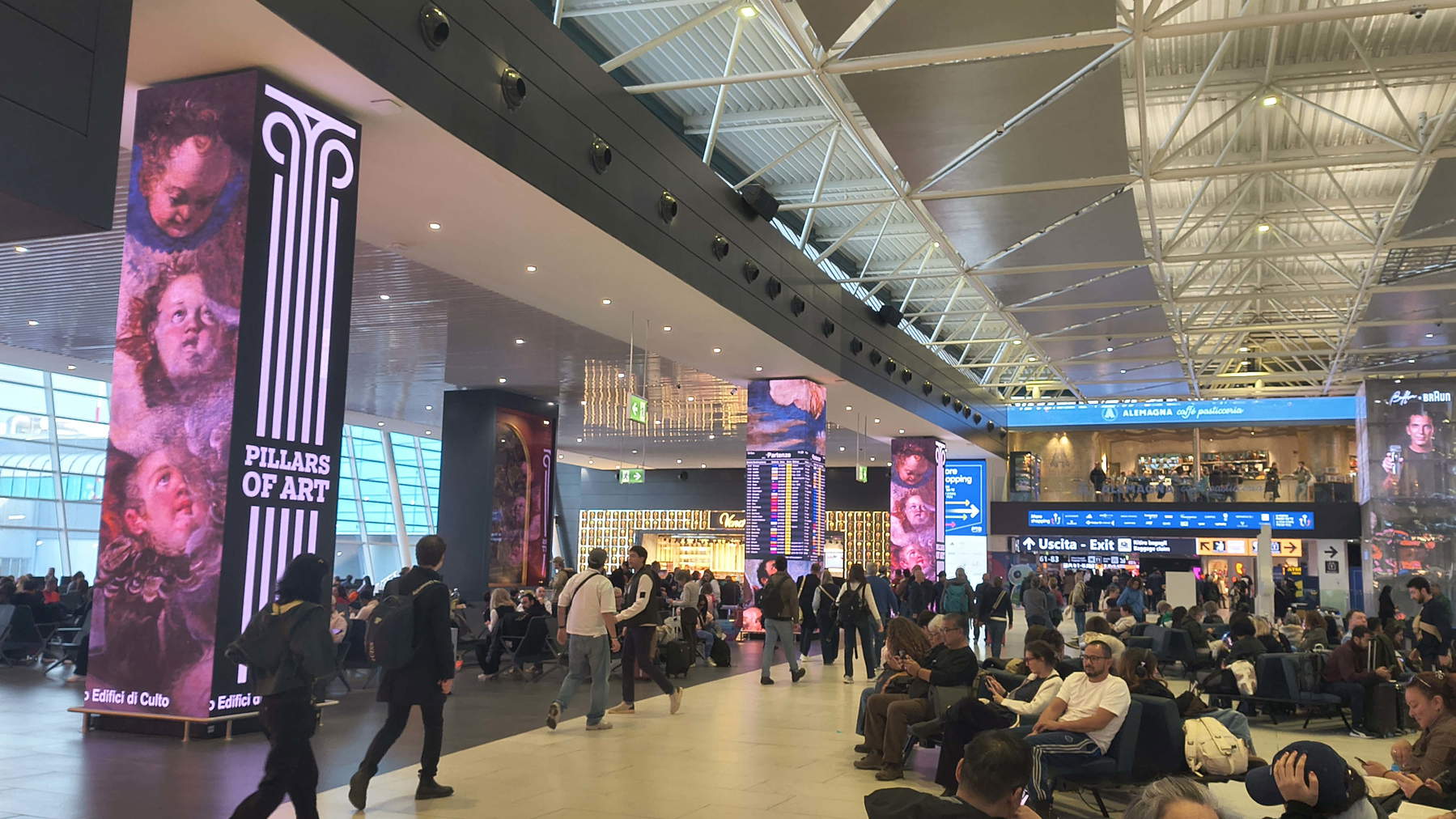
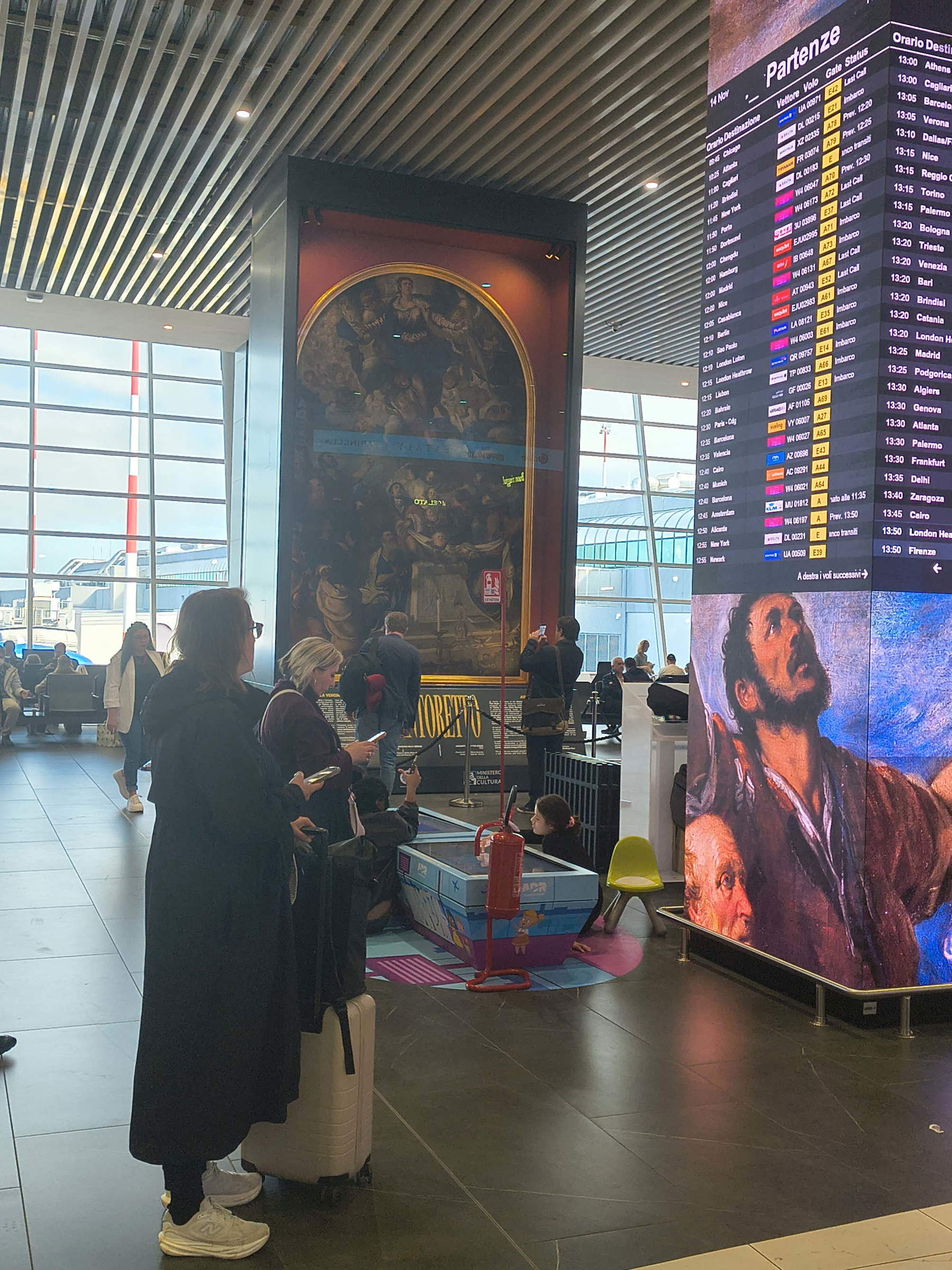
Given, therefore, that the criterion of “scientific validity” for a loan is evidently vague and open to various interpretations, let’s set aside the usual debates and simply consider a couple of practical aspects. First: I’m not a big fan of public transportation, and I don’t know how often officials from the Ministry of the Interior and the Ministry of Culture take a train or a plane, but I’m fairly certain that, for anyone, a train station or an airport is a place where one hopes to spend as little time as possible. Now, for some years now, a curious idea has taken hold: that train stations, airports, subways, and various other infrastructure facilities should take on the appearance of shopping malls, art galleries, and museums—based on the observation that a traveler is also a human being with money to spend and time to kill. Train stations, for example, no longer limit themselves to offering what they’ve always offered—which was more than enough—namely, food and reading material, a café, and a newsstand: at Roma Termini, for instance, I can now quite easily buy some shower gel or a scented candle, but I no longer know where to find a newspaper to grab on the fly before my train leaves.Tintoretto’s *Assumption* is therefore a sort of cultured equivalent of Nashi Argan—that is, a way to fill a lull when the traveler has grown tired of scrolling on their smartphone. At most, passengers waiting for a delayed flight have been given a point of contact to whom they can direct their complaints and pleas while waiting to board.

Second: the loanof Tintoretto’s *Assumption* is the result of an agreement that has been renewed for three years (first, Bernini’s *Salvator Mundi* was on display at the airport; then the stained-glass windows attributed to Giotto from the Museum of Santa Croce in Florence were displayed there, and now it’s the Jesuit altarpiece’s turn). The terms of the agreement are unknown, but even if the loans are not subject to a fee (though that would be surprising, since it is well known that the Fund for Places of Worship lends for a fee: authorization to move assets under the FEC’s jurisdiction is subject to regulations requiring a fee for loans, calculated using a logarithmic formula applied to the insurance value estimated by the Ministry of Culture, which provides for increases of one-third for each month beyond the first quarter) In any case, one must accept the idea that revenue from loan fees ( or rather, “Revenue from agreements for the tourist and cultural use of the FEC’s heritage,” as the budget line item is called) constitutes a not exactly negligible portion of the Fund’s final accounts. There is therefore no valid reason to believe that the Ministry of the Interior, with the necessary authorizations from the Ministry of Culture, will stop circulating the FEC’s assets; thus, I fear thatTintoretto’s *Assumption* will not be the last work to delight travelers awaiting boarding. One might ask why such a demanding work was chosen this year when it would have been possible, as was done last year, to instead bring out of a museum some piece that isn’t absolutely essential but has a high-profile name (and one might ask those involved to return to that approach: after all, there’s no reason to think that Tintoretto’s altarpiece is the final installment in the series). One might also ask those involved to make the terms of the agreement clearer instead of giving the impression that anyone going to Fiumicino to catch a flight can’t wait to stop and look at the Tintoretto, but we won’t go so far as to ask them to change the formalities. On the other hand, it must be said that the Ministry of the Interior did not hesitate to conceal the FEC’s strategy, especially considering that Undersecretary Wanda Ferro explicitly stated that the “intention” is to “take the works of art out of the sites for which they are intended through the FEC and make them accessible to more people.” The problem, therefore—even before we consider that there is an undersecretary who speaks of “moving out” or “where they are,” is the spread of a culture of excessive musealization—radical musealization, we might say—in which a work of art, even before being anything other than a work of art (a devotional object, a decoration, a piece of furniture, a relic for a community, a meaning that takes shape, an object that, in essence, has a life of its own), is a banner to be displayed under conditions similar to those found inside museums. Museums, however, are usually the final destination of a work of art—the place where they generally end up once they have finished doing what they were created to do. And if moving a work from a museum to an airport might be an attempt—however clumsy and equally questionable—to breathe new life into a painting, then moving an altarpiece that is still in its original location to an airport appears to be a forced and coercive change in its intended use, however temporary it may be (Tintoretto’s *Assumption* will remain at Fiumicino until summer, and until then, anyone visiting the Jesuit Church in Venice will have to settle for a poster). At best, it may be an openness to the unexpected, but I fear it is too sophisticated an idea when there is an undersecretary, to quote the press release, who justifies the loan with the opportunity to “allow thousands of travelers, both Italian and international, to admire one of the most beautiful works of the Italian sixteenth century.” The official rationale —namely, the “promotion of the immense artistic and cultural heritage of the FEC, which belongs to the entire national community”—then raises questions about how the public is viewed: enthusiasts should be told that they’re considered so lazy that the altarpieces have to be shoved right under your noses when you board a plane so you can get to know them. However, it is also true that we live in an age where adults consider even reading a newspaper article too much of a hassle (otherwise Instagram captions wouldn’t exist), so the Ministry of the Interior has simply adapted to the times.
Warning: the translation into English of the original Italian article was created using automatic tools. We undertake to review all articles, but we do not guarantee the total absence of inaccuracies in the translation due to the program. You can find the original by clicking on the ITA button. If you find any mistake,please contact us.