
The Boy Selling Fish at Dusk: A Masterpiece by Ceruti at the Pitti Palace
by Federico Giannini e Ilaria Baratta 1 September 2026
Destination: Toscana
Listed as an anonymous work for seventy years, the *Boy with a Basket of Fish and Spider Crabs*, housed in Florence at the Palazzo Pitti, was finally attributed to its artist in 1982, following a restoration that revealed it to be the work of Giacomo Ceruti, the painter of the poor who became a sort of chronicler of the common people.


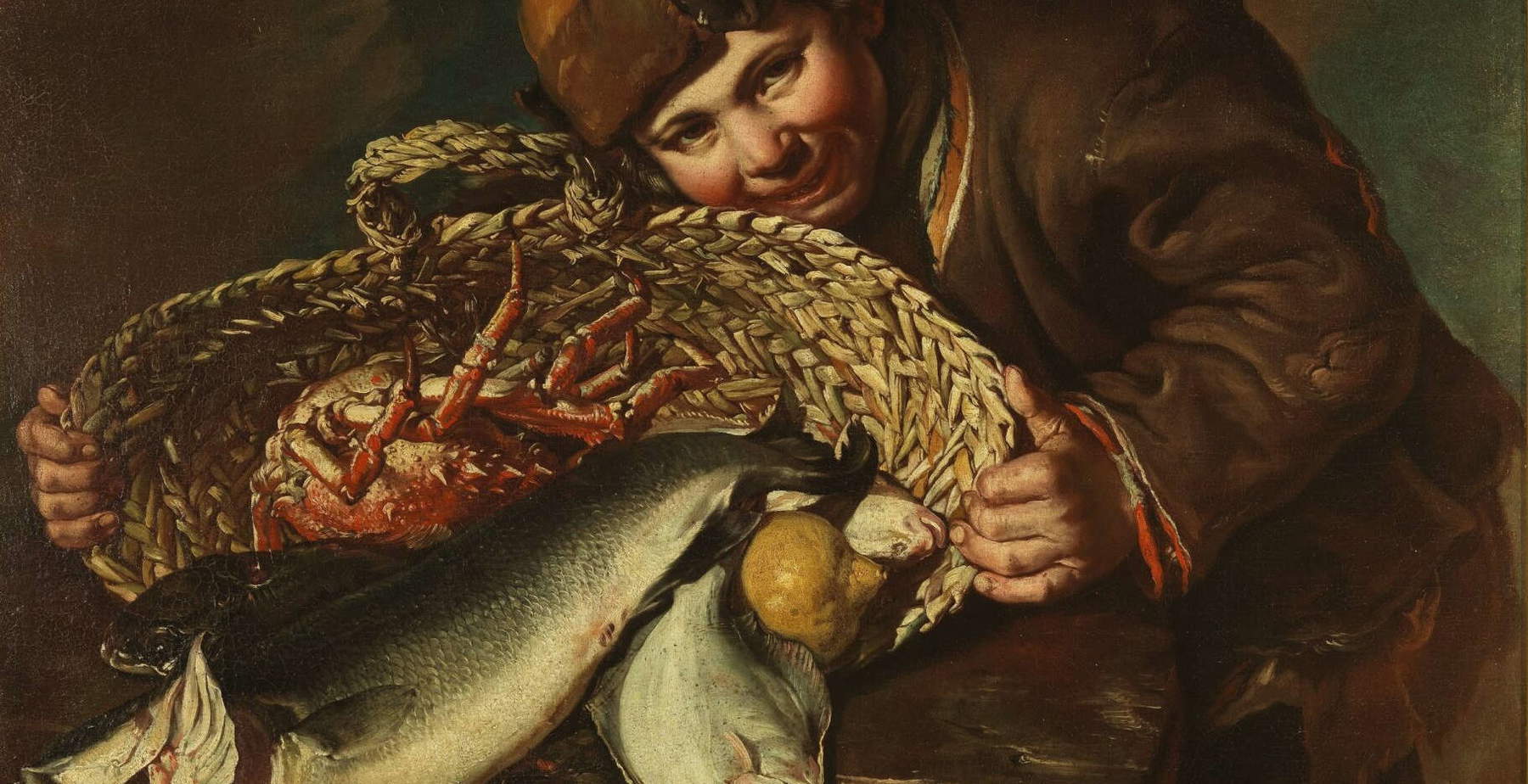
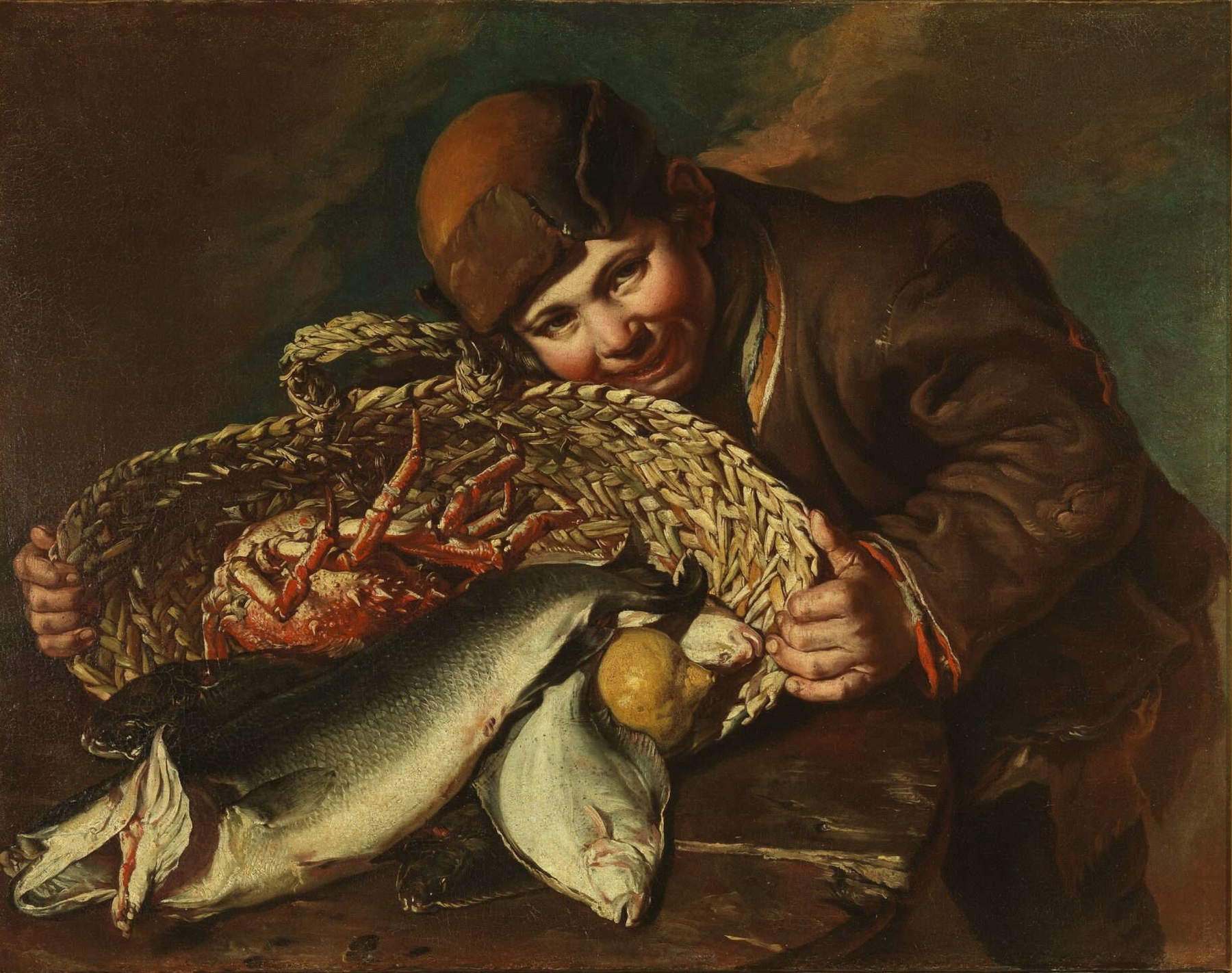
A sky shifting from pink to gray, the moment when the light of day gives way to twilight. In this twilight light, against a background devoid of architecture, we see a young boy smiling as he tips, with a sudden, decisive gesture, a woven basket onto a plain, worn wooden table. It is the simple, everyday scene of a fisherman’s apprentice who displays—almost proudly—the day’s catch, and to whom Giacomo Ceruti, in the fourth decade of the 18th century— —decided to bestow artistic dignity, as if it were the portrait of a nobleman: here, then, is his *Boy with a Basket of Fish and Spider Crabs*, a sort of manifesto of the mature phase of his career. Yet for most of the 20th century, no one could say who had painted it, and it’s only natural that this was the case: it was a painting commissioned for a private collector, the work of an artist and a genre that enjoyed their moment in the spotlight during those years; after that, the painters of everyday life were forgotten until their rediscovery in the mid-20th century.
The painting, now housed in the collections of the Palatine Gallery at Palazzo Pitti in Florence, first appeared in Florentine inventories in 1861, listed as coming from the royal collections of Parma: it had arrived in Tuscany as a gift from the House of Savoy, following the annexation of the Duchies of Parma to the Kingdom of Italy, but we do not know how it ended up in Emilia. Half a century later, in 1911, the work was once again listed among the palace’s art objects, but with a notation that revealed the obscurity into which it had fallen: anonymous artist. A painting of unquestionable quality, capable of standing up to comparison with the great masters of 18th-century genre painting, had remained nameless for decades, perhaps obscured by a surface altered by time and old overpaintings.
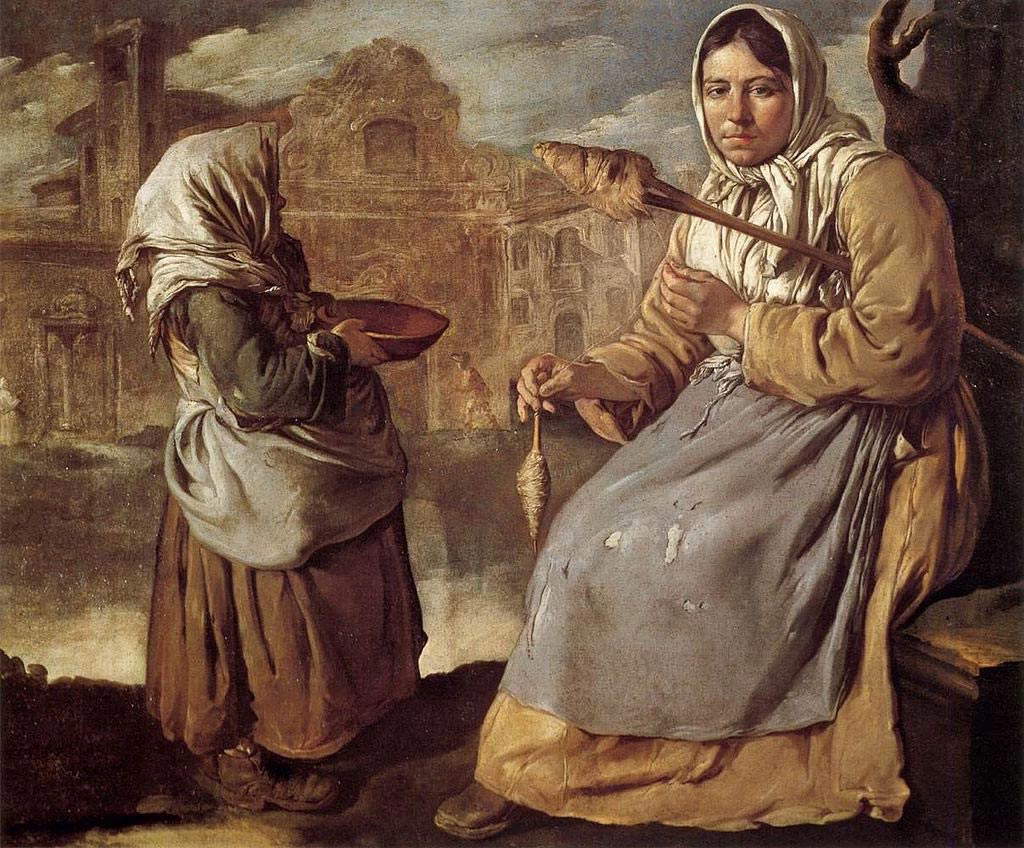
It was Marco Chiarini, an art historian and then director of the Palatine Gallery, who restored its identity; in the 1980s, he identified stylistic features in the painting attributable to Giacomo Ceruti, the Lombard painter who went down in history for his predilection, in his early years, for depicting working-class subjects and the marginalized. Confirmation came in 1982, when the work underwent restoration led by conservator Nannetta Del Vivo on behalf of the Florence Superintendency: the relining of the canvas, the cleaning of the surface, and the retouching of a few small areas of missing paint finally made it possible to clearly appreciate the work’s painterly quality and to attribute its authorship to Ceruti without reservation. Since then, the painting has become a permanent part of the artist’s catalog, cited in scholarly studies, including the volume dedicated to the painter published in 1987 on the occasion of a monographic exhibition, and has been displayed at exhibitions about him, including the major exhibition that the Santa Giulia Museum in Brescia dedicated to Ceruti in 2023—an exhibition in which *Boy with a Basket of Fish and Spider Crabs* featured as one of the cornerstones of Ceruti’s late painting period.
Anyone viewing the canvas today is confronted with an image constructed with few elements but great narrative effectiveness. The scene is almost entirely dominated by a boy with striking features, his face lit by a sincere smile, his head covered by a worn hat with upturned brims. He wears a heavy, leather-colored jacket—worn and frayed—a gray shirt, and dark pants, the typical attire of someone who works outdoors in the cold and has nothing to show for himself but the toil of his own hands. With an energetic gesture, the young man tips a large woven straw basket—the kind used by fishermen of the time to carry freshly caught fish—onto the table, displaying the fruits of his day’s labor with obvious satisfaction.
The composition of the pictorial space owes much of its impact to the treatment of light. A beam of light coming from the left floods the basket, caressing its woven texture and casting deep shadows inside it and on the surface below, creating an almost tactile effect that invites the eye to linger on the textural details even before focusing on the boy’s face: the light thus falls on the straw’s weave, on the spider crab’s legs, and on the fish’s scales. It is a compositional choice that reveals—as Claudia Musso wrote on the occasion of the 2023 exhibition in Brescia—how much Ceruti owed, at this stage of his career, to the great tradition of Northern still life, as filtered into Italy by figures such as Eberhard Keilhau, Monsù Bernardo, who was among the forerunners of modern realist painting, and—especially with regard to the composition’s framing—by Jacob van der Kerckhoven, a Flemish painter active in Italy under the name Giacomo da Castello, a reference that, according to Musso, was particularly significant for Ceruti during the years he spent in Venice. The boy’s large, strong hands—calloused from manual labor—and his posture, slightly bent toward the viewer as if offering his load, closely evoke the figures of the young porters, that is, the boys—often teenagers but sometimes little more than children—who roamed the markets carrying baskets of vegetables, fruit, cheese, and other goods, and whom Ceruti had made famous during his years in Brescia, when he portrayed with raw realism beggars, spinners, humble rural laborers, and, in general, all of humanity that, until the mid-17th century, had found no place in painting except in genre scenes imbued with allegorical meanings. Yet something in this painting has changed profoundly compared to those early works.
Experts do not entirely agree on the exact chronology of the work: the scholar Mina Gregori, basing her assessment on the painting’s collection provenance, has proposed dating it to the period Ceruti spent in Piacenza, between 1744 and 1745. However, upon closer analysis of the stylistic choices, this dating appears perhaps too late. The compositional framing of the still life in the foreground, slightly tilted toward the viewer, and the presence of elements such as the overturned basket, in fact find stronger parallels in two canvases that belonged to Marshal Schulenburg’s famous collection, dated between 1736 and 1738, which were also exhibited in Brescia in 2023. If this comparison is correct, the Florentine painting would have to be dated several years earlier than Gregori’s hypothesis, placing it precisely in the phase when Ceruti, having left Brescia, was engaging with the artistic circles of Venice and with a clientele quite different from that of Lombardy.
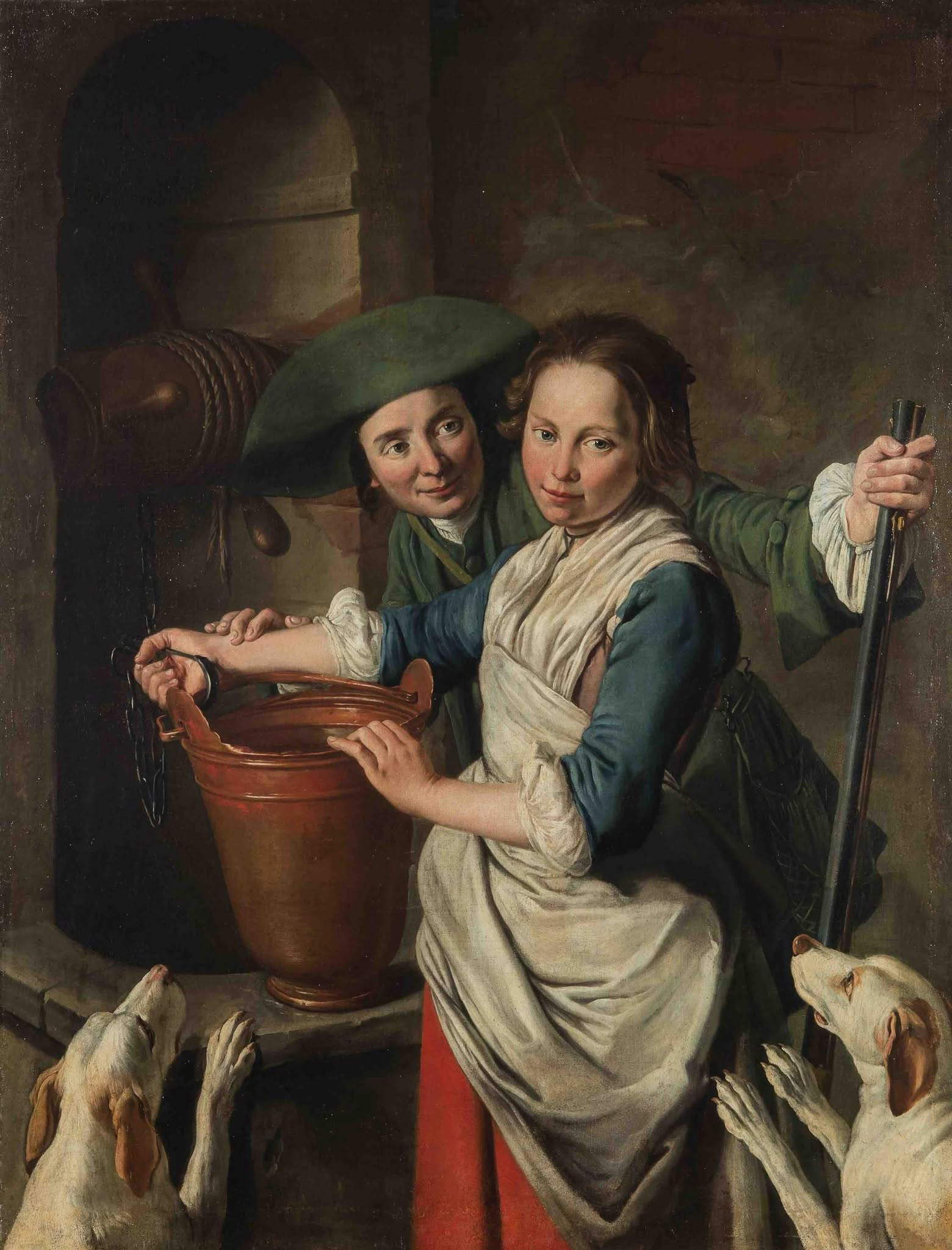
This is no minor detail, because it was precisely during those years that Ceruti’s painting underwent a radical transformation—one that can be clearly gauged by comparing the works from his Venetian period with the cycle of canvases once housed in the Busseti Palace in Tortona, created around the mid-18th century, following his stay in Veneto from 1736 to 1739. “It is enough,” wrote Francesco Frangi, “to observe the beautiful painting *The Encounter at the Well*, in which Ceruti depicts the insistent courtship of an attractive peasant girl by a young soldier, who looks at us with the hesitant expression of someone who does not seem displeased by such attentions. The result is a romantic, idyllic atmosphere that permeates the painting, rendered with the subtly ironic touches (the soldier’s slightly dazed expression) characteristic of certain 18th-century comedies. This is a far cry from the paintings of Padernello and their overtly pauperistic overtones: although she essentially belongs to the same world as her counterparts in the Brescia series—who spin wool or work at the bobbin lace frame in solitude—the peasant woman standing contentedly by the well no longer appears to us as a suffering creature in need of assistance.”
The comparison between the two phases of Ceres’s work is illuminating. In the Padernello cycle, the peasant woman intent on spinning wool or working at the bobbin lace frame appears as a suffering figure, marked by the toil of life, with clothes often in tatters, bearing witness to a state of real poverty.In *Encounter at the Well*, however, the same type of folk character is depicted in intact clothing, and the thoughts crossing her face no longer concern daily survival but rather the almost lighthearted dilemma of whether or not to yield to courtship. This shift in style also extends to technique: the muted, dusty color fields of his early years give way to a brighter, smoother application of paint, which in the rendering of the female complexion achieves an almost porcelain-like effect.
The Boy with a Basket of Fish and Spider Crabs from Palazzo Pitti therefore fits, according to the most up-to-date critical interpretations, into this turning point. “That boy’s trade,” Frangi observes, “is the same as that of the memorable, weary, and pensive paper-carriers conceived by the painter during his time in Brescia. His disposition, however, is quite different, as is that of almost all the characters Ceruti brought to life beginning in the 1940s. Among them, the figures of the outcasts, the beggars, and the outright paupers have completely disappeared from the scene—and this is the most striking aspect of the story. It is as if the streets of the world had suddenly been rid of those unsettling presences.” This is a sign of how, starting in the 1740s, the figures of the marginalized and beggars disappeared almost entirely from the artist’s work—not because the conditions of the poorest classes had improved in the meantime (which, historically, did not happen), but because the tastes of his patrons had changed. After 1730, fewer and fewer collectors wished to hang images of misery on the walls of their homes: Ceruti, traveling through the artistic centers of Padua, Venice, and Piacenza—where he resided from 1743 to 1746—and finally Milan, realized this and adapted his painterly style to a more worldly and elegant sensibility: this is one of the reasons that lead us to believe that Ceruti did not feel any form of empathy—as we would say today—toward his subjects. For Ceruti, a poor person was first and foremost an aesthetic object: interpretations of Ceruti as being, on the contrary, driven by intentions of social criticism seem unlikely.
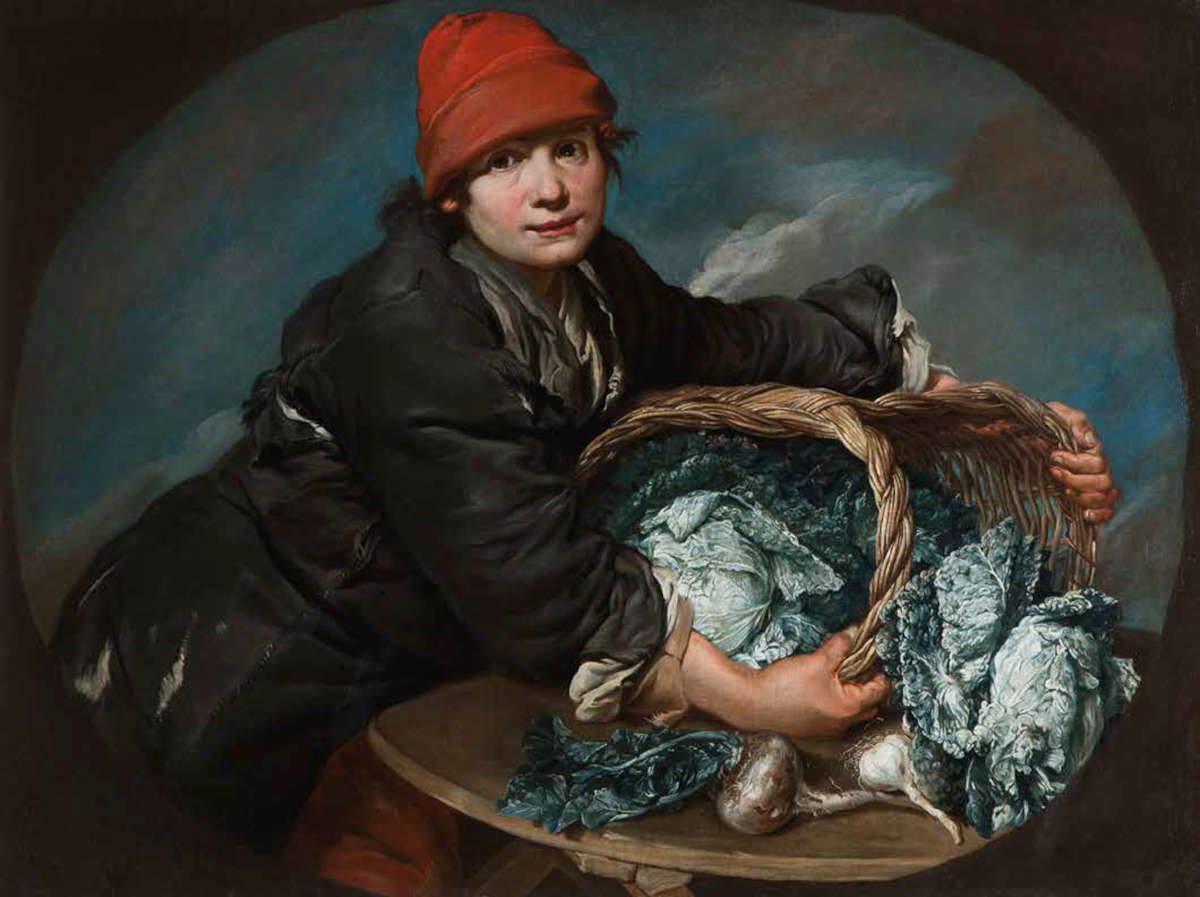
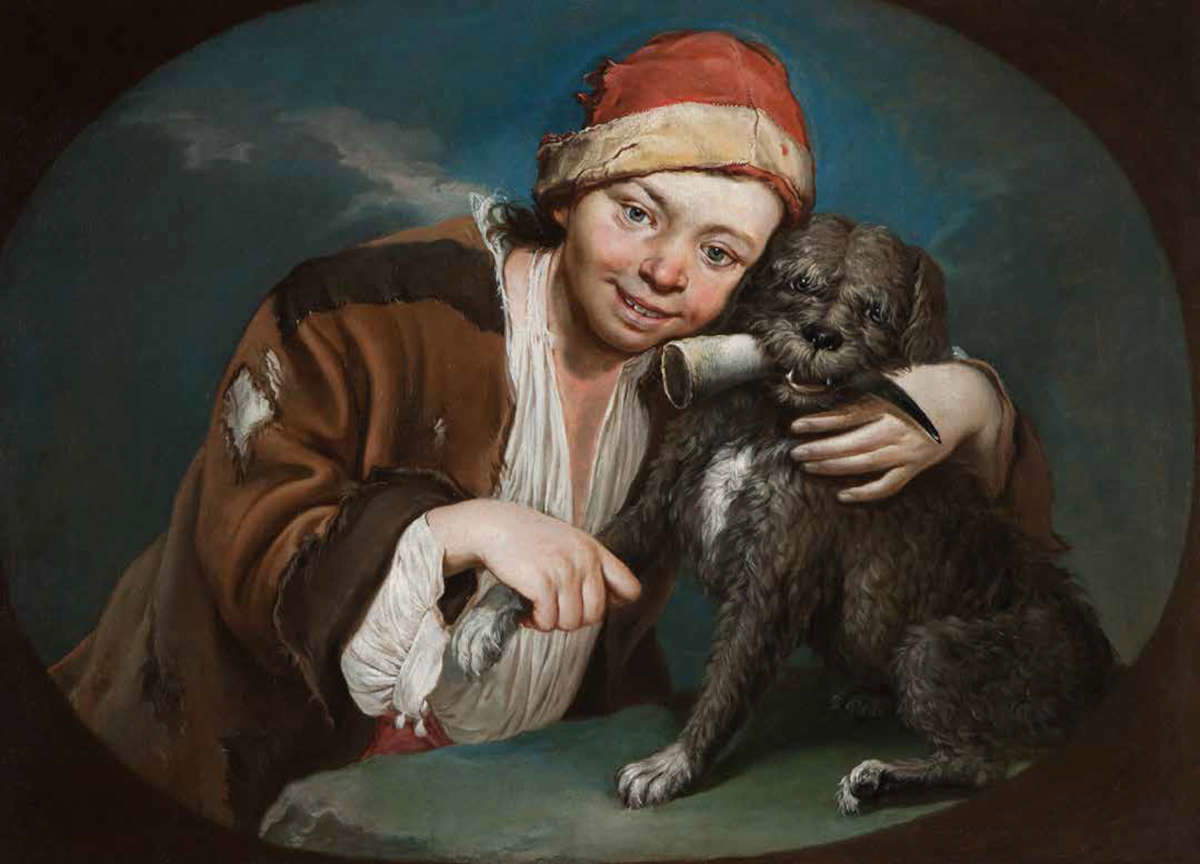
One final clue makes the story behind this painting even more intriguing: the position of the boy’s half-figure and that of the overturned basket reappear, almost identically, in another painting attributed to Ceruti, *Boy with a Basket of Vegetables*, now housed in Belfast as part of a pair of paintings intended to be displayed together. This compositional coincidence has led scholars to hypothesize that the Florentine work was also originally accompanied by a second canvas—now lost or not yet identified—with which it would have formed a pendant, in accordance with a widespread practice in 18th-century decorative painting, when genre scenes were often conceived and sold in pairs to adorn the homes of aristocratic and bourgeois families.
A small curatorial mystery therefore remains, adding to the now-resolved issue of attribution: from an anonymous work forgotten in nineteenth-century inventories to a precious testament to one of the most interesting phases of Giacomo Ceruti’s career, the period in which the Lombard painter, having moved away from the harsh themes of Brescian poverty, was able to reinvent his perspective on the working-class world with a new narrative grace, without losing that capacity for meticulous and empathetic observation that remains, even today, the most recognizable trait of his painting.
Today, many focus on the catch proudly displayed by the boy—a detail that evokes the world of work and small-scale food trade in the 18th century—though lately it has been reinterpreted in a… gastronomic sense, and even the Uffizi has enlisted a famous chef, Fabio Picchi, who devised a recipe using the ingredients the boy is dumping onto the table, evoking what we might call the “short supply chain” depicted in the painting: from catch to sale or delivery, likely destined for a home kitchen or a city market.
Food does not play a central role here, of course, serving merely as a pretext for a still life exercise, and thus serving more as a vehicle for demonstrating technical virtuosity (texture, light, material) than as a reference to actual dietary or culinary practices. This, however, has not prevented us from speculating on how that fish might have been prepared at the time. A fundamentally humble, simple cuisine: fish grilled and served with a little oil, or at most a bit of mayonnaise. Just as the boy in the painting probably ate it.