Food in Tuscan Last Suppers: Symbols and Customs from the Painted Table
by Noemi Capoccia 11 September 2026
Destination: Toscana
In 14th-century Tuscany, artists transformed the table of The Last Supper into a narrative space: bread, wine, fish, tableware, and unexpected foods are elements that reflect material culture, dietary practices, and the symbolic meanings of the Christian tradition.
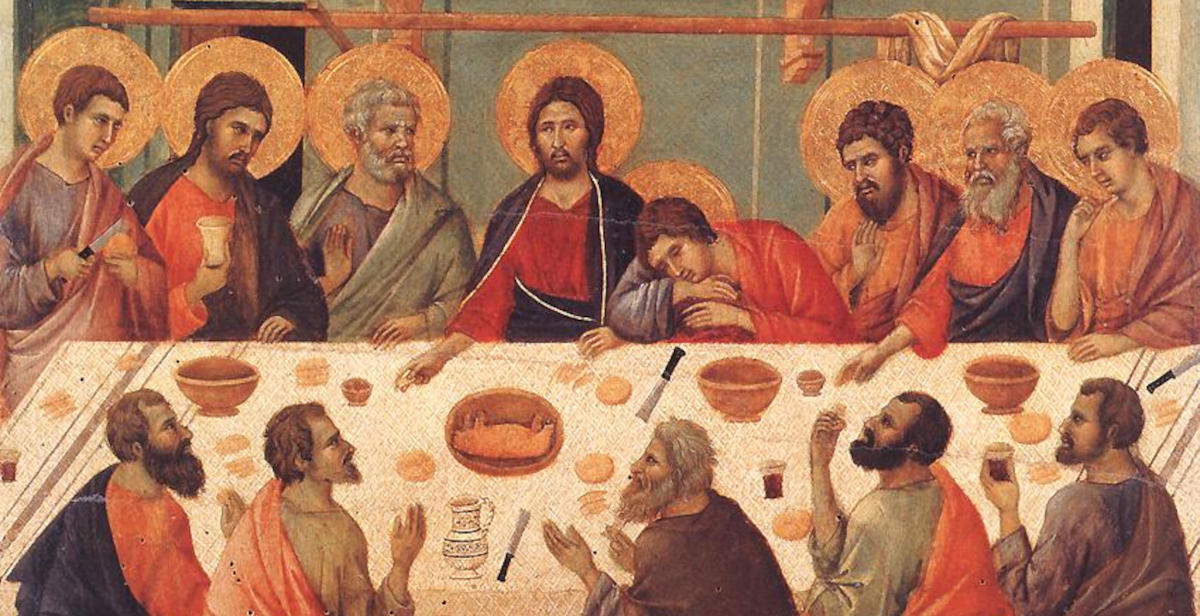
Anyone lookingat *The Last Supper* instinctively tends to focus on the central figures of the scene: Christ, the apostles, and the dramatic moment of the announcement of the betrayal. Yet, in the depictions created by14th-century (and Renaissance) Tuscan artists , even what appears on the table helps convey the meaning of the episode. Food, tableware, and utensils are elements that reflect the material culture of the era, the dietary customs of religious communities, and even the symbolic value attributed to food in the Christian tradition.
The Last Supper described in the Gospels corresponds to the meal that Jesus shared with the twelve apostles on the occasion of the Jewish Passover. According to tradition, the table should have included unleavened bread, roast lamb, bitter herbs (Exodus 12:1–8), wine, andcharoset—a mixture of dried fruit and spices that commemorated the slavery of the Jewish people in Egypt. In works of art, however, this set of dishes is not strictly adhered to. Painters often replace the foods prescribed by tradition with items from their own daily lives or introduce foods with specific allegorical significance. What does this mean? It means that the artistic process shapes the table into a reflection of the society in which they live.
The earliest Tuscan depictionsof The Last Supper already show how artists paid particular attention to the foods and objects arranged on the table. One example is preserved in the pulpit of the Cathedral of Santa Maria Assunta in Volterra, where, between the late 12th and early 13th centuries, the Tuscan sculptor Biduino, in collaboration with Bonamico’s workshop, created a stone sculpture cycle that included, in addition toThe Last Supper, The Sacrifice of Abraham, The Visitation,The Annunciation, and the column-bearing lions. In the relief depicting the banquet, located in the fourth intercolumniation between the central and left naves of the cathedral, the table is already marked by certain elements that would become recurring in subsequent iconography of the subject: loaves of bread, fish, and terracotta tableware help define the convivial setting and lend concreteness to the scene, combining its religious significance with an attention to the material culture of the time.

A few decades later, the theme underwent a new development in Siena. On the reverse side of the monumental *Maestà*, painted by Duccio di Buoninsegna (Siena, c. 1255 – 1318) between 1308 and 1311 for the high altar of the Duomo, one of the oldest depictionsof the Last Supper preserved in Tuscany appears. The work (a tempera panel on wood), now housed at the Museo dell’Opera Metropolitana in Siena, occupies the central part of the complex cycle dedicated to the stories of Christ painted on the reverse side of the panel that brought the Sienese master to prominence. While maintaining the restraint of the Byzantine tradition, Duccio already introduces elements that would profoundly influence later painting. The space gains a sense of depth for the first time thanks to the slant of the walls and ceiling beams, while the figures display a more intense narrative involvement than in previous works. But it is above all the panel itself that draws attention. Alongside the loaves of bread, small fish, glasses filled with wine, earthenware dishes, and knives, an unexpected element appears: a suckling pig.
The presence of the pig is surprising when compared to the Gospel account. In the Jewish religion, as in Islam, the animal was considered impure and its consumption was forbidden. The prescriptions contained in Leviticus (the third book of the Hebrew Bible) and Deuteronomy (the fifth book of the Hebrew Bible), as well as those found in the Quran, in fact prohibited its consumption.
“(…) the pig, because it has a split hoof and a cloven foot, but does not chew the cud; you shall regard it as unclean,” Leviticus 11.
“(...) and also the pig, which has a split hoof but does not chew the cud; you shall regard it as unclean. You shall not eat their meat, nor touch their carcasses,” Deuteronomy 14.
In Christianity, however, the consumption of pork was not prohibited, although it was restricted during penitential periods, such as Lent, Advent, the eves of major holidays, and Fridays, as a sign of moderation against the sin of gluttony. As noted earlier, Duccio’s choice demonstrates that medieval artists did not intend to faithfully recreate the Jewish Passover meal. They chose to reinterpret the episode and adapt it to the sensibilities and dietary customs of their own time.
Indeed, this iconographic freedom would also characterize subsequent depictions, particularly those of the Renaissance. The paintingsof the Last Supper, in fact, convey a theological reflection that uses food as a symbolic language. The foods and vessels convey a message intended for the religious who observed the images daily during their meals.
It was precisely within monasteries that the themeof the Last Supper took on an increasingly important role. With the spread of abbeys, convents, and monastic complexes, the refectory became one of the central spaces of religious life. Here, the meal was a communal act governed by a precise ritual. In many orders, the meal took place in silence, while a fellow monk read passages from the Bible or religious texts. Before entering the refectory, the monks would stop in the washroom, where they ritually washed their hands and prepared themselves spiritually for the meal. In this context, the pictorial decoration served a very specific purpose: to establish a connection between the nourishment of the body and that of the soul.

It is no coincidence that one of the most important artistic traditions dedicated to Last Supper depictions developed in Florence. Among the earliest interpretations of the subject by Taddeo Gaddi (Florence, c. 1300–1366) is*The Last Supper*, which was part of the ancient cabinet in the sacristy of Santa Croce and was painted around 1335–1340. The panel, now housed at the Accademia Gallery in Florence, was part of a complex originally consisting of twenty-eight panels painted in tempera on a gold ground, dedicated to the Stories of Christ and the Stories of St. Francis. Compared to the monumental decorations intended for refectories, the composition here remains simple and focuses attention on the central figures of the scene. Even the objects placed on the table are kept to a minimum: the table features only a knife and a terracotta plate—elements sufficient to evoke the convivial moment without resorting to a detailed depiction of the food. The simplicity of the composition reflects an early phase in the iconographyof the Last Supper, in which the religious significance of the episode takes precedence over the depiction of material culture.
A few years later, between 1345 and 1350, in the refectories of the city’s monasteries, images of the Crucifixion andthe Last Supper became an integral part of the architectural space and accompanied the monks daily during their meals. One of the best-known depictions from this period isthe *Tree of Life and Last Supper*, also created by Gaddi for the refectory of the Santa Croce convent in Florence, now preserved in the Cenacolo di Santa Croce in Florence. The imposing fresco, conceived as a large altarpiece that occupies the entire back wall of the room, features a complex iconographic program. The lower section depictsthe Last Supper, while the upper part is dominated by the great Tree of the Cross, flanked by scenes such as the Stigmata of St. Francis, St. Louis of Toulouse serving the poor, Jesus’ Supper at the Pharisee’s house, and the angel instructing a priest to bring food to St. Benedict in his hermitage, as well as numerous figures of saints, the Holy Spirit, and the Manfredi family coats of arms incorporated into the decorative frieze.
The decision to pairthe Last Supper with various scenes united by the theme of nourishment and charity reflects the refectory’s original function, where the friars ate their meals in silence, accompanying their time at the table with meditation. In the works of Taddeo Gaddi, as well as in that of Duccio di Buoninsegna, * *, elements of daily life appear, such as loaves of bread, wine, and earthenware tableware—details that help ground the scene in reality and foreshadow the focus on food and tableware that would fully develop in the great Last Supper paintings of the fifteenth century.
Interest in this Gospel episode is not limited to monumental painting. During the fourteenth century, the theme also found its way into illuminated manuscripts, as demonstrated by an illuminated “N” depictingthe Last Supper, attributed to the Tuscan school and now housed at the National Museum of San Matteo in Pisa, originating from the former convent of San Matteo in Soarta, Pisa. Executed on parchment, the miniature places the scene within the initial letter, enclosed in a geometric frame against a dark background and embellished with plant motifs that extend across the entire page. Around the set table, the apostles, gathered on the right-hand side, react with astonishment to Christ’s words announcing the imminent betrayal, while John, deeply distraught, collapses into the Master’s lap. In the background, walls and a tower appear, defining the architectural setting of the episode. Although the miniature’s small size does not allow for a detailed description of the food, the fundamental elements of Eucharistic iconography— bread and wine—are nonetheless recognizable on the table; these are consistently present in depictions ofthe Last Supper as a reference to the body and blood of Christ.

Alongside illuminated manuscripts, fresco painting also continued to explore the themeof the Last Supper within 14th-century Tuscan figurative art. An example attributableto the Giotto school is preserved in the Chapel of Santa Maria in Campo Arsiccio, in the municipality of Terranuova Braccioli (Arezzo), where the scene is depicted using the fresco technique. Here, too, the scene centers on the symbolic significance of the table, featuring the fundamental elements of the Eucharistic tradition: bread and wine. Added to these are various objects linked to the everyday aspect of the banquet, such as jugs, glasses, and ceramics, which help to make the depiction of the convivial moment more concrete and demonstrate the artists’ growing interest in rendering real-life objects.
The relationship between food and the depiction ofthe Last Supper underwent a further shift with the transition to the Renaissance, when the Gospel table also became a space for engagement with contemporary gastronomic culture. While in medieval and 14th-century works food was primarily a symbolic element linked to the Eucharistic meaning and the communal life of religious orders, in the 15th and early 16th centuries food became increasingly associated with a new focus on nature, pleasure, and the everyday life of humankind.
One of the most significant examples of this transformation isLeonardo da Vinci’s * **The Last Supper*, painted between 1495 and 1498 on the wall of the refectory of the Dominican convent of Santa Maria delle Grazie in Milan. The work, a monumental dry-paint mural, represents a turning point in the history of depictions of this subject. Leonardo created an image deeply rooted in the culture of his time, in which even the elements on the table take on a narrative role.
Among the foods depicted are dishes containing eels, a particularly interesting detail when compared with the dietary laws of Jewish tradition. According to the rules established by Mosaic law, in fact, only fish with fins and scales were considered edible: eels, lacking these characteristics, were therefore classified as forbidden foods.
“You may eat those that have fins and scales, whether in the seas or in the rivers. But of all the animals that move or live in the waters—in the seas and in the rivers—those that have neither fins nor scales, you shall regard as detestable,” Leviticus 11.
Their presence in Leonardo’s work demonstrates once again that artists did not necessarily seek a philological reconstruction of the Passover meal narrated in the Gospels. Instead, they reinterpreted the scene through the lens of their own era and knowledge.

Other details also show a departure from earlier depictions. In Leonardo’s painting, the numerous knives that characterized many medieval and Renaissance representations ofThe Last Supper are absent. These utensils, often pointed and prominently displayed, were used to cut food and bring morsels to the mouth, while table forks—already widespread in the Byzantine Empire—had long been viewed with suspicion by the Western Church, as they were considered instruments of diabolical perversion. Leonardo thus removes these objects from the scene and focuses attention on the psychological relationship between Christ and the apostles and on the emotional tension of the moment when the betrayal is revealed.
The presence of the eel also invites reflection on the significance attributed to the pleasure of the table in humanist culture. The rediscovery of classical texts in the fifteenth century had fostered a new appreciation of conviviality and the relationship between humanity and nature: even the enjoyment of food and the pursuit of culinary pleasure could be interpreted as manifestations of the richness of creation, provided they were maintained within a moral balance.
This sensibility also emerges in the literature of the time. The Sienese author Gentile Sermini, born toward the end of the 14th century, describes in great detail in Novella XXIX the preparation of an eel, also known as the “eel of San Vincenzo.” The account conveys the value attributed to cooking as a refined and complex art: the fish is cleaned, cut into portions, and threaded onto a skewer, interspersed with bay leaves, then seasoned with salt, vinegar, oil, pepper, spices, and cloves. After cooking, it is garnished with pomegranates, oranges, and other aromatic ingredients, transforming it into a dish fit for a refined table.
In any case, the culinary popularity of the eel had even more ancient roots. As early as the 4th century B.C., Archestrato of Gela—a Sicilian poet considered one of the first authors on gastronomy in Western culture—had paid homage to the fish in his work, describing it as “the only fish that is all flesh”. References to the eel thus span centuries of history, passing from ancient gastronomic literature to medieval and Renaissance tables.
A curious belief also developed around this animal, one that would go on to influence religious dietary practices as well. For a long time, it was believed that the eel lacked genital organs, a misconception dispelled only in 1912 thanks to the studies of the Danish biologist Johannes Schmidt, who clarified its reproductive cycle in his 1922 book *The Breeding Grounds ofthe Eel *. This supposed peculiarity, however, had allowed some Renaissance clergy to eat the fish even during Lent, as it was considered compatible with the dietary restrictions observed during penitential periods. Precisely for this reason, the eel came to take on an ambivalent significance: on the one hand, a symbol of gastronomic refinement; on the other, associated with moral criticism of gluttony and dietary excesses attributed to a segment of the clergy.
Observing the table thus reveals an often-overlooked aspect of the iconographyof the Last Supper. While the central figures and the theological significance of the episode remain unchanged, the foods change, as do the tableware, utensils, and gestures of conviviality. It is in these details that the gap between the Gospel narrative and its artistic representation becomes apparent: a gap that stems from the desire to make the sacred understandable to the people of one’s own time.