By Noemi Capoccia | 18/09/2026 13:42
With Christ at the center and the apostles arranged on either side—Judas recognizable among the diners—when viewing aLast Supper, the eye is drawn first and foremost to the scene and its figures. But in large, monumental Last Supper paintings, the painted wall cannot be separated from the space surrounding it. In fact, these murals were created for the refectories of monasteries, and it is precisely their location that determines, in part, their meaning. The frescoes that decorated the refectories of monasteries were not merely religious images to be contemplated: the painted table on the wall stood before the monks’ actual table; the meal depicted overlapped with the one consumed every day; and the Gospel scene thus became part of the community’s life. The story ofthe Last Supper entered the refectory and accompanied an ordinary moment—that of eating together.
In the Christian tradition, food naturally had a meaning that went beyond the need for nourishment: the communal meal was also a time for sharing and community life, while the bread and wine referred to the sacrament of the Eucharist. In monasteries, meals were governed by precise rules. What were they? Meals were eaten in silence, often while listening to the reading of religious texts, and certain rituals were observed before sitting down at the table. The refectory thus became a space where the material and spiritual dimensions ultimately overlapped.
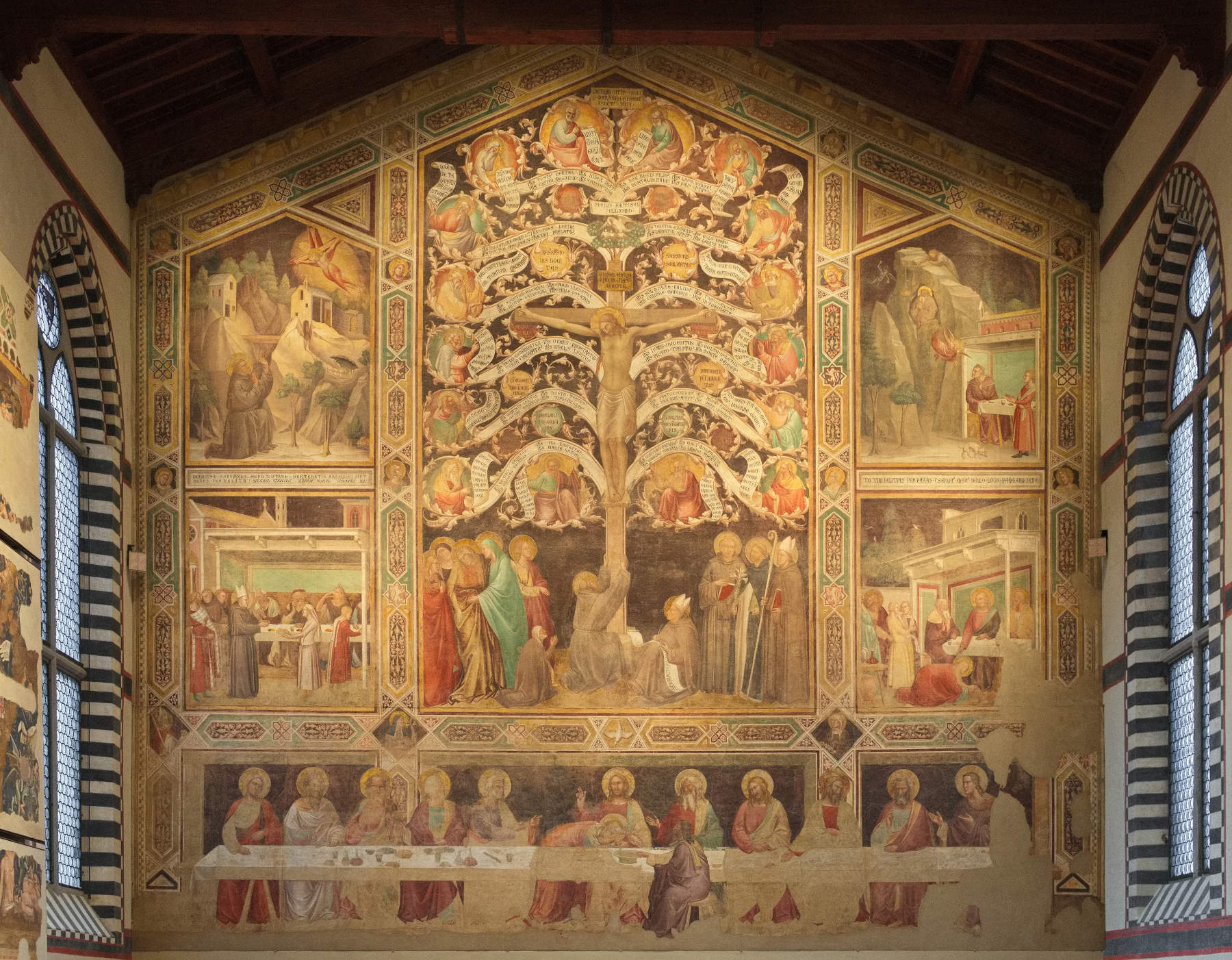
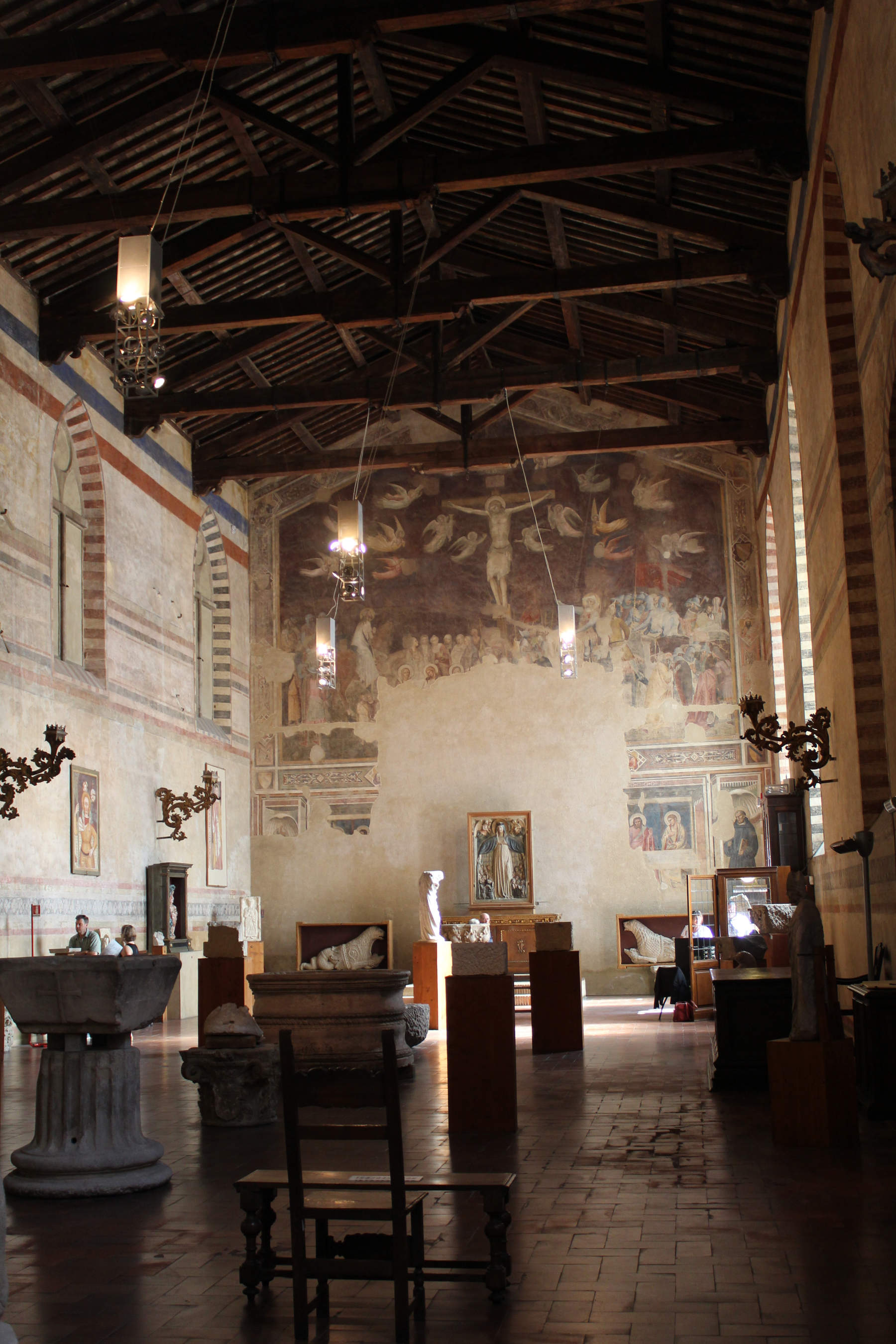
It was precisely in this context that, during the fourteenth century, the tradition of the “cenacoli” developed in Florence. The history of these grand depictionsof the Last Supper spans nearly two centuries and illustrates how, as painting evolved, so too did the relationship between the image, architecture, and the daily lives of the religious. Among the earliest examples are the refectories of Santa Croce and Santo Spirito, where Taddeo Gaddi (Florence, c. 1300–1366) and Andrea Orcagna ( Andrea di Cione d’Arcangelo; Florence, c. 1310–1388). The period in question is around 1350–1360, and in these cases, Gaddi’s and Orcagna’s LastSupper scenes do not yet occupy the absolute center of the composition. The main scene is the Crucifixion, while the Last Supper takes a secondary position. This approach reflects a conception still rooted in medieval tradition, in which the Last Supper is primarily linked to Christ’s sacrifice and his death on the cross.
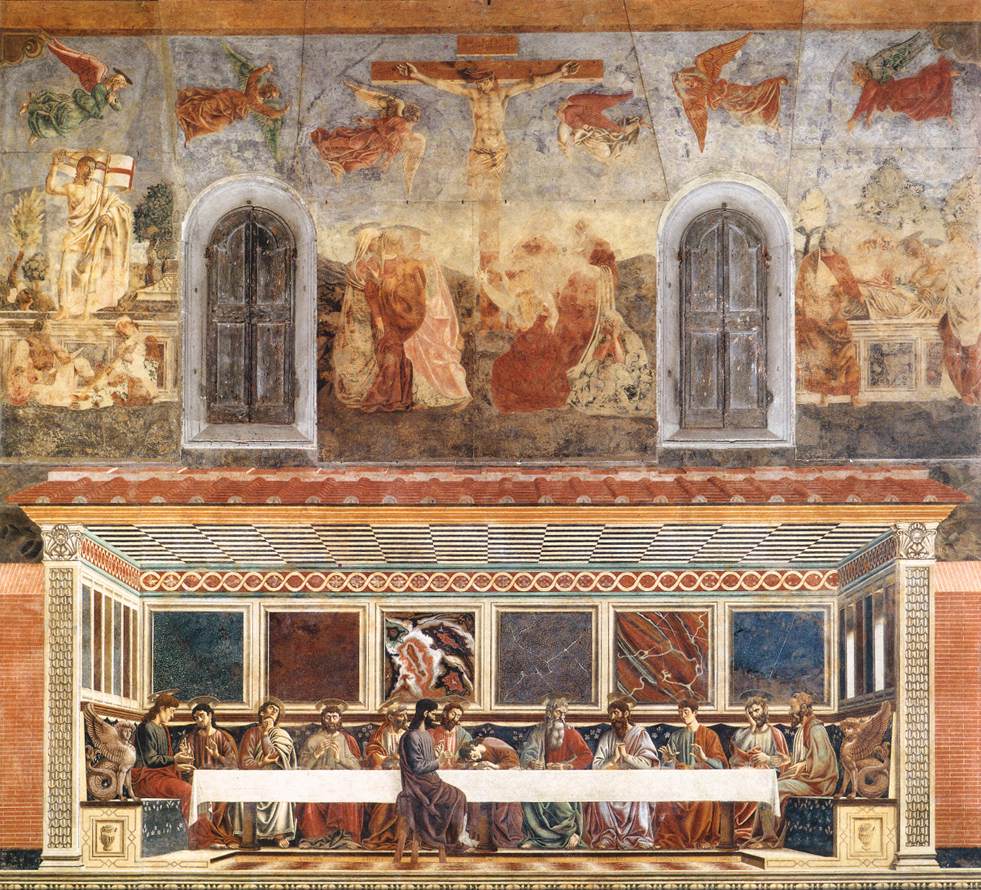
A significant change occurred in the 15th century with Andrea del Castagno ( Andrea di Bartolo; Castagno, 1421 – Florence, 1457). In the refectory of Sant’Apollonia, completed in 1447,The Last Supper occupies the main wall of the refectory. Above it are depicted the Crucifixion, the Resurrection, and the Entombment—scenes that establish a direct connection between the moment of the Supper, the sacrifice, and the promise of salvation. The space depicted by Andrea del Castagno is constructed using a rigorous perspective that seems to extend the actual space of the refectory, while the long table, the side walls, and the ceiling draw the eye toward the back of the room, and the apostles are arranged on either side of Christ. The scene is taken from the Gospel of John, at the moment when Jesus announces that one of those present will betray him.
But what makes this depiction so unique? Its relationship with the viewer standing before the fresco. The group consisting of Christ, Peter, John, and Judas is the focal point of the narrative tension, while the other apostles react with different gestures and postures. Christ maintains a central and composed position; John appears almost slumped over the table, while Peter leans toward the Master. Judas, on the other hand, sits on the opposite side of the table, separated from the other apostles. The composition as a whole creates a scene of great intensity, in which the geometry of the space and the arrangement of the figures help transform the refectory into a space that could almost be described as theatrical.
A few decades later, in the Last Supper paintings by Domenico Ghirlandaio (Domenico Bigordi; Florence, 1449–1494), the relationship between the painting and its setting became even closer. In addition to the Last Supper at the Badia di Passignano from 1476, the painter created two important Last Supper paintings in the early 1480s: one in the convent of Ognissanti (1480) and one in the convent of San Marco ( 1482). At San Marco, the painter created an architectural setting behind the apostles that opens onto the landscape. The painted ceiling seems to extend the actual ceiling of the refectory, and beyond the wall, trees, sky, and birds appear. At Ognissanti, the approach is similar, but the interaction among the figures is more dynamic: the apostles converse in pairs, turn toward one another, and react to Christ’s revelation. The arrangement of the diners also reflects the dining customs of the time. This technique helps lend credibility to the banquet. Table manners were, in fact, governed by precise rules of conduct, as also attested by the *De Quinquaginta Curialitatibus ad Mensam* by the poet Bonvesin da la Riva * * (Milan, c. 1240 – 1313–1315), a medieval text dedicated to good table manners.
Ghirlandaio’s Last Supper paintings also feature numerous symbolic elements. The vegetation in the background includes cypresses, palm trees, and citrus trees. In the Last Supper at San Marco, a peacock is also depicted, while in the Last Supper at Ognissanti, a dove is present. Even more explicit is the presence of the cat next to Judas in the Last Supper at San Marco, traditionally interpreted as a reference to evil. Judas is also the only apostle without a halo and wears a yellow robe. The attention to detail on the table extends to the fabrics and objects. In the Last Supper at Ognissanti, the tablecloth is decorated with griffin motifs, while in the one at San Marco it features elements related to architecture and birds.
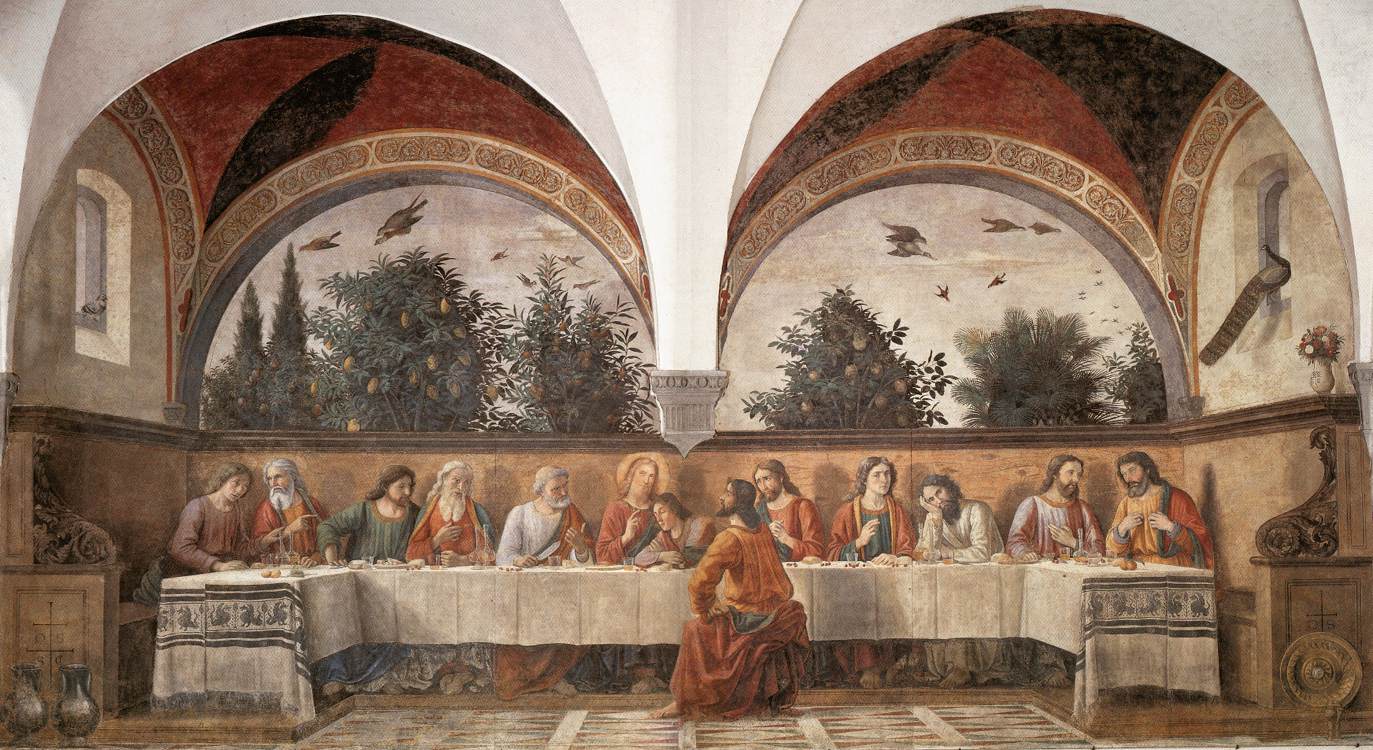
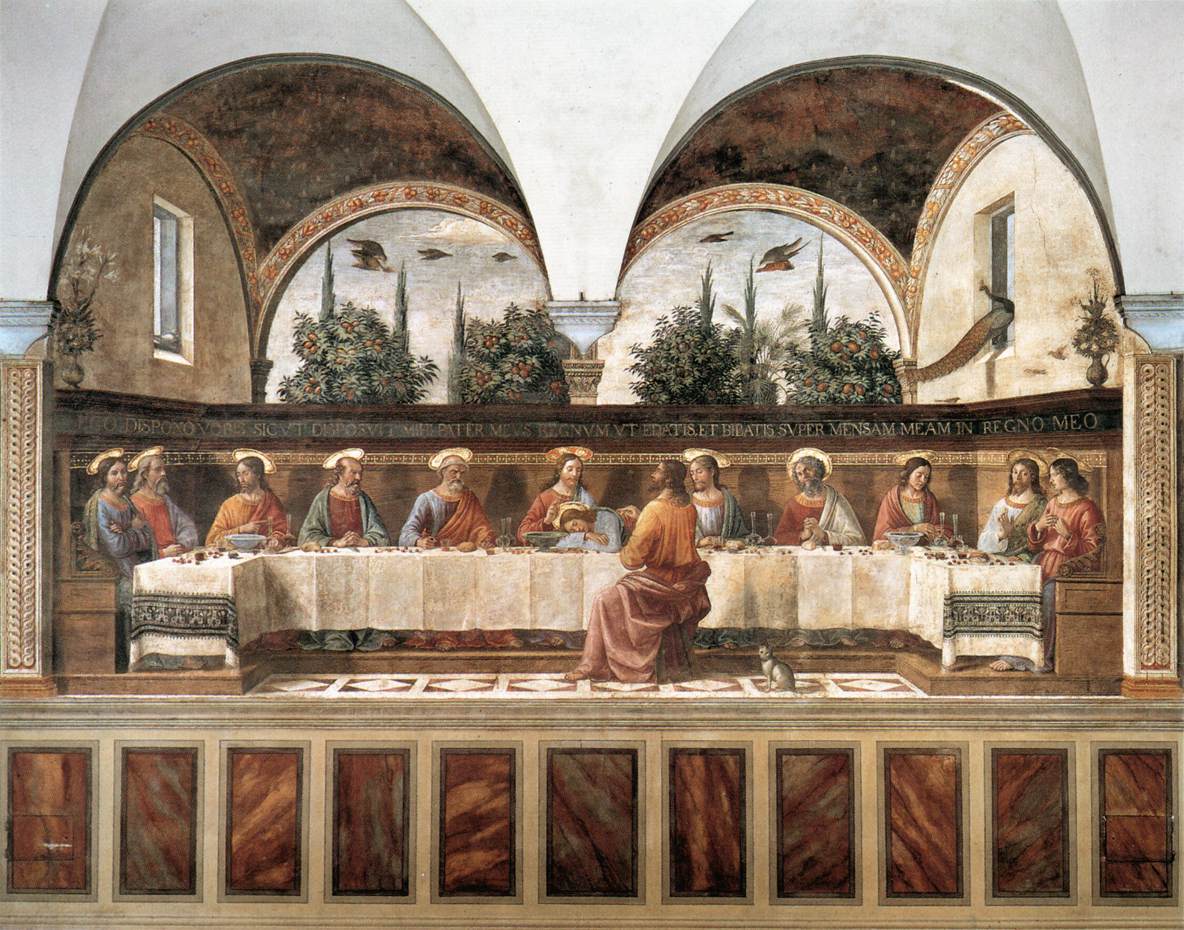
The food depicted also merits attention. Foods traditionally associated with Passover—such as matzo, lamb, bitter herbs, and charoset (a mixture of dried fruit and spices with symbolic significance, linked to the memory of the Jews’ slavery in Egypt)—are not depicted. Instead, items more closely tied to the culinary culture and collective imagination of the time appear. In the Last Supper at Ognissanti, citrus fruits and lettuce are depicted, while in the one at San Marco, for example, cherries are present. The presence of this red fruit on the table is, after all, not so unusual in religious art: cherries appear, with various symbolic meanings, in Federico Barocci’s 16th-century *Madonna of the Cherries*, in some works by Titian, and in Pietro di Nicola Baroni’s polyptych from around 1450, now in the National Gallery of Umbria. In the latter case, the figures are set against a gold background, and the cherries—which the Child holds in His hands—stand out as one of the elements most directly linked to the earthly world and the human experience. However, this is not a classic homage to nature. Those small fruits were an invitation to the faithful to engage in contemplation and reflection on the Passion of Christ. Red as blood, they evoked the sacrifice and the blood that would be shed on the cross. Even in Barocci’s *Madonna of the Cherries*, the fruit takes on a specific symbolic meaning. The cherry tree takes the place of the palm tree which, according to the account of Pseudo-Matthew, had offered shade and refreshment to the Virgin and the Child during their flight. Here, the cherries allude to the blood of Christ’s Passion, but also to the sweetness of Paradise.
Salt, bottles, and glasses containing wine and water also appear on the tables in the Last Supper scenes. These might seem like minor details, but it is precisely these elements that create a direct link between the meal depicted and the one consumed daily by the religious community. In the case of San Marco, this connection is significant: the refectory was in fact located near the convent’s guest quarters and was also used to welcome guests, including laypeople. The painting thus engaged with a space where the ritual of the table did not concern exclusively the religious community.
The transparency of the glasses and the precision with which the objects are depicted also demonstrate Ghirlandaio’s ability to create paintings attentive to the rendering of materials. Yet accuracy is never an end in itself; the objects on the table are part of the scene’s overall composition and its meaning. Meals in monasteries were, in fact, accompanied by a series of codified gestures: the monks entered the refectory in pairs, starting with the youngest, and before taking their seats, they bowed and made the sign of the cross before the sacred image. The fresco was therefore not something foreign to daily life: it was right before the diners’ eyes at the very moment the community gathered.
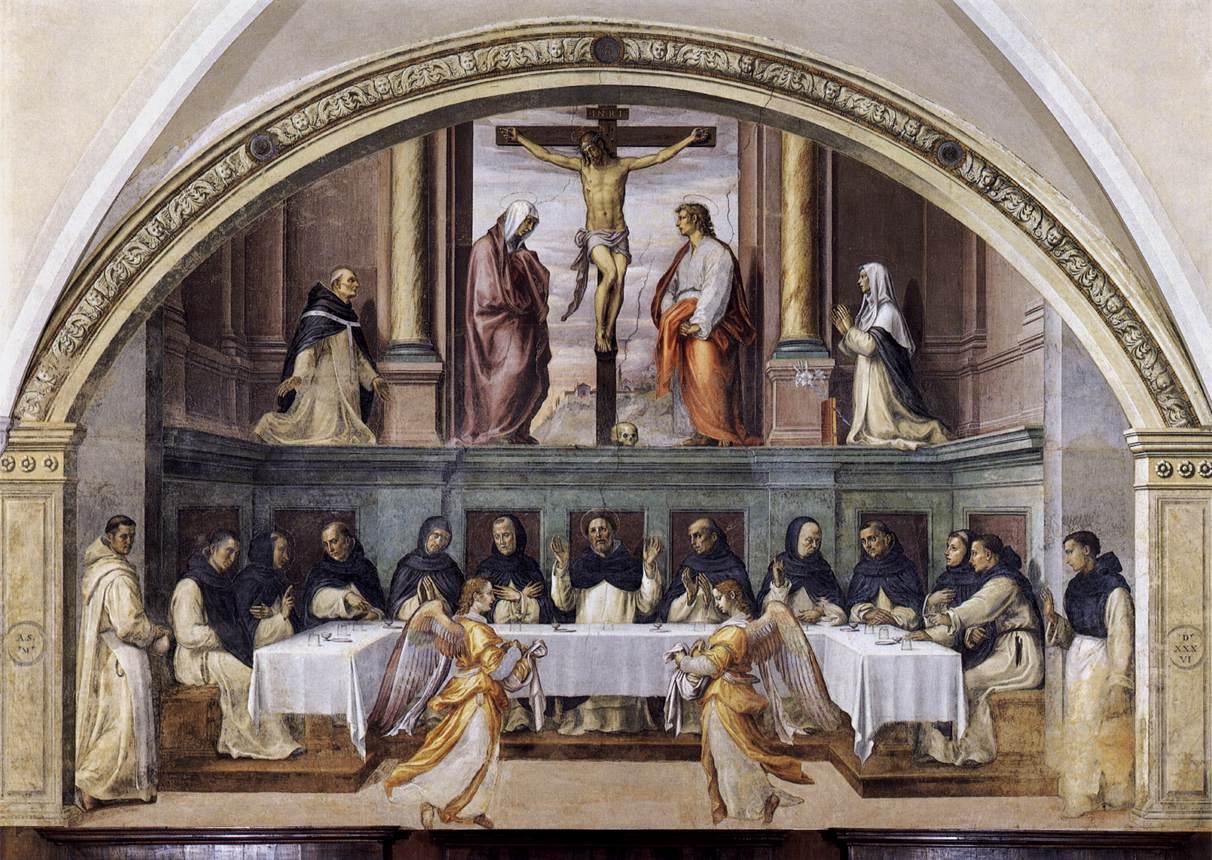
In the sixteenth century, this relationship changed once again in the refectory of San Marco. The increase in the number of novices made it necessary to expand the refectory, and a wall was demolished. With it, the large Crucifixion by Beato Angelico was also lost. In 1536, Giovanni Antonio Sogliani (Florence, 1492–1544) was commissioned to paint a new fresco: *The Miracle of the Dominicans Fed by Angels * or *The Crucifixion and the Miracle of the Bread of Saint Dominic*. Sogliani chose a composition different from the traditionalLast Supper. In place of Christ and the apostles, Saint Dominic appears surrounded by his friars. The scene refers to an episode from the saint’s life recounted by Jacopo da Varazze: after the friars had tried in vain to obtain food through alms, two strangers reportedly arrived at the convent bearing bread and wine. The upper part of the fresco depicts the Crucifixion, with the Virgin Mary and Saint John on either side of Christ and, below them, Saint Catherine of Siena and Saint Antoninus. In the lower section, however, several angels are bringing bread and wine to the friars. Here, too, the table plays an important role. The friars are seated before an empty table, while several overturned glasses allude to a rule of table manners: do not drink before eating.
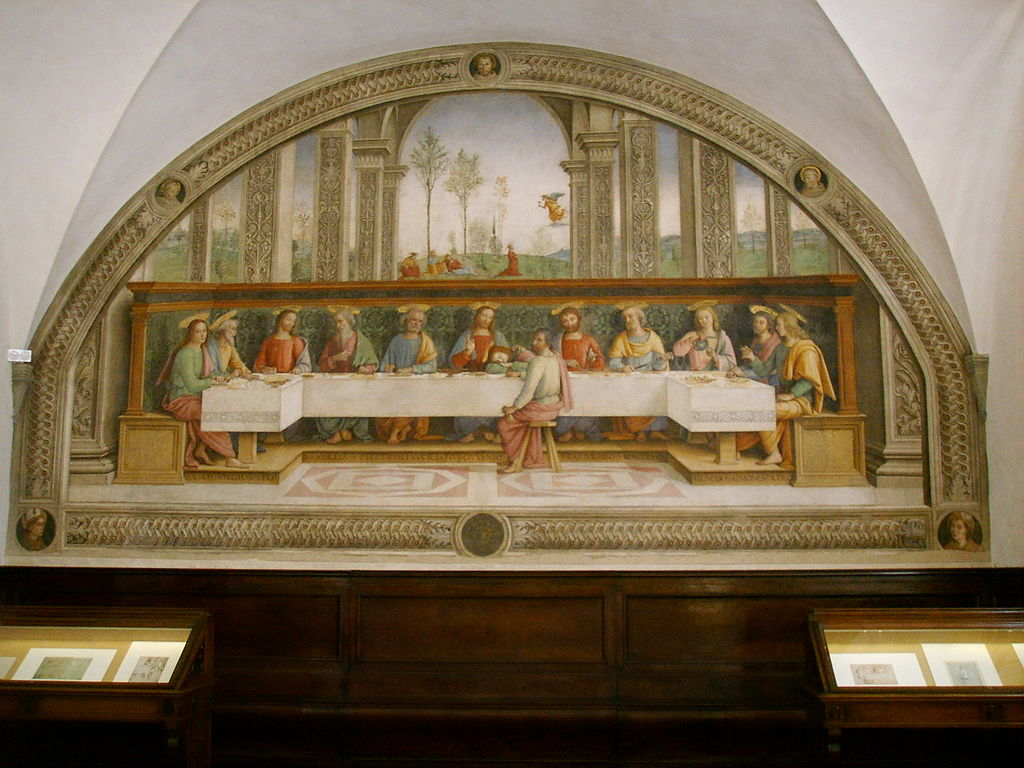
Another interpretation of the Florentine Last Supper appeared between 1493 and 1496 in the work of Pietro Perugino (Pietro Vannucci; Città della Pieve, c. 1450 – Fontignano, 1523) at the end of the fifteenth century (a further development of the Perugino tradition, moreover, can be found in the Last Supper of Candeli, a fresco attributed to Sogliani, dated to around 1510–1514 and preserved in the former monastery of Candeli in Florence), in the refectory of Fuligno, the former convent of the Franciscan Third Order sisters from Foligno, now known as Sant’Onofrio. Here, the setting appears more open and luminous. Behind the apostles stretches a vast landscape, while the figures are arranged more freely than in previous examples. In the background, a second Gospel scene is also depicted: Christ in the Garden of Gethsemane, while the apostles sleep. Further in the distance, an angel holding a chalice is visible. The Last Supper thus becomes a narrative that connects various episodes of the Passion.
In the early decades of the sixteenth century, the Florentine model of the Last Supper also engaged with the innovations introduced by Leonardo da Vinci (Vinci, 1452 – Amboise, 1519) in his *Last Supper* at the Convent of Santa Maria delle Grazie in Milan. The work was known even far beyond the Lombard city thanks to the circulation of copies and engravings, and it came to influence Florentine painting as well. Another interesting example is Franciabigio’s ( Francesco di Cristofano; Florence, 1484–1525), located inthe former monastery of San Giovanni della Calza. The fresco is mentioned by Giorgio Vasari and is considered the first—and virtually the only—Florentine Last Supper to directly incorporate Leonardo’s revolutionary composition. In reality, there is no documentation of Franciabigio’s travels to Milan: his connection to Leonardo must therefore be attributed to the circulation of imagesof *The Last Supper*, which allowed artists to become familiar with and study the work even without having seen it in person. The attribution of the fresco to Franciabigio is also supported by another detail: the artist’s monogram and the date 1514 appear on the leg of a stool.
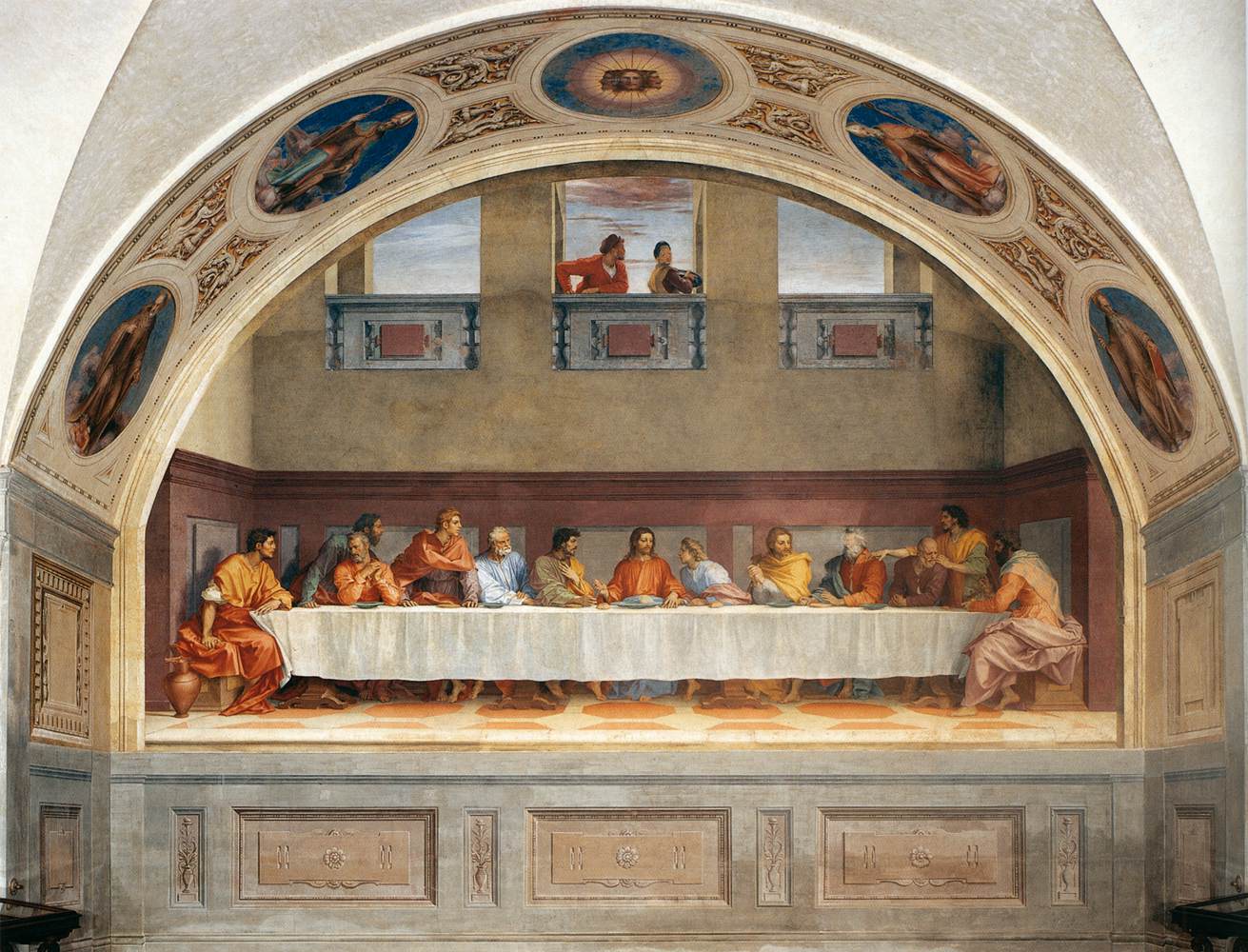
With Andrea del Sarto ( Florence, 1486–1530), in the San Salvi refectory, completed in 1526,*The Last Supper* takes on a different form. The entire dramatic tension of the scene remains concentrated within the painted refectory. There are no sacred episodes in the background, and the architecture becomes a fundamental part of the perspectival composition. Two figures looking out from a loggia witness the scene as spectators—an unusual presence, because it introduces into the painting someone who seems to be watching what is happening alongside those standing before the fresco. The distinction between the depicted space and real space thus becomes more difficult to perceive. Perspective and trompe-l’œil transform the painted refectory into a sort of extension of the real one; the figures seem to occupy a space in which the visitor, too, can feel involved, and the sacred scene thus engages directly with the viewer.
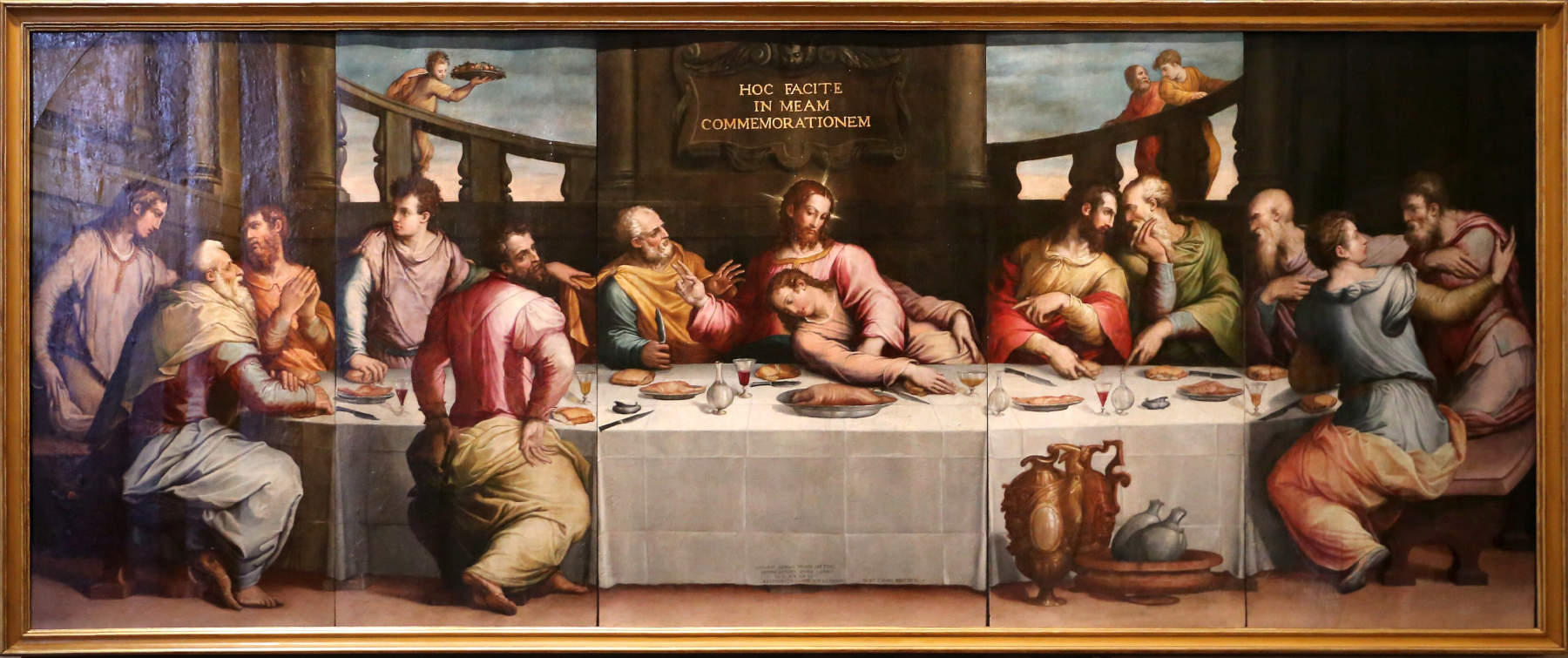
With Giorgio Vasari (Arezzo, 1511 – Florence, 1574), the history of Florentine monumentalLast Supper paintings reaches the mid-16th century and demonstrates how the traditionof the Last Supper intended for refectories continued even through a technique other than fresco. Between 1546 and 1547, Vasari created a monumental “Last Supper” in oil on panel, now housed in the Cenacolo di Santa Croce. The work was commissioned in 1546 with the agreement that it would be delivered within six months and was executed based on the drawing now housed at the Staatliche Graphische Sammlung in Munich. The panel was intended for the refectory of the Murate, the cloistered Benedictine convent on what is now Via Ghibellina, considered one of the most elite religious institutions in Florence at the time. In truth, sources seem to disagree regarding who commissioned the work. A noblewoman, Faustina Vitelli, may have contributed to the cost on the occasion of her entry into the convent, or Pope Paul III may have done so through Lelia Orsini Farnese, a nun connected to the pope’s family who is said to have acted as an intermediary with the abbess Gianna Bonsi. The role of Giovan Maria Benintendi, who oversaw the project, is, however, well documented.
The painting’s subsequent history is also linked to the transformations of Florentine religious buildings. With the suppression of religious orders decreed by the French government between 1808 and 1810, the Murate convent was closed, and its real estate and furnishings were confiscated by the state.The Last Supper was then moved from the San Marco complex and, in 1815, arrived at Santa Croce, where it was placed in the Castellani Chapel and remained for over fifty years. With Vasari, the tradition of Florentine Last Supper paintings continued to evolve in terms of techniques and compositional solutions, yet it maintained its relationship with the space for which these works had been conceived.
For nearly two centuries, therefore,*The Last Supper* found its way into refectories and engaged directly with the lives of the religious communities that inhabited them. It is precisely the overlap between the painted table and the real one that gives these spaces a special meaning, and this is perhaps why, in Florentine Last Supper paintings, food, tableware, the architecture, and the landscape are all part of the narrative and help establish a direct connection between the sacred image and the daily lives of those who sat before that wall every day. It is a tradition in which painting thus becomes an integral part of life in the refectory.