Botticelli's Pomegranate: A Fruit, the Blood of Christ, and the Unity of the Church
by Redazione 4 September 2026
Destination: Toscana
In Sandro Botticelli’s *Madonna of the Pomegranate*, the infant Jesus holds in his hands the fruit that Christian tradition has transformed into a symbol of the Passion, of fertility, and of the communion of the faithful—a symbol as ancient as the Mediterranean itself.

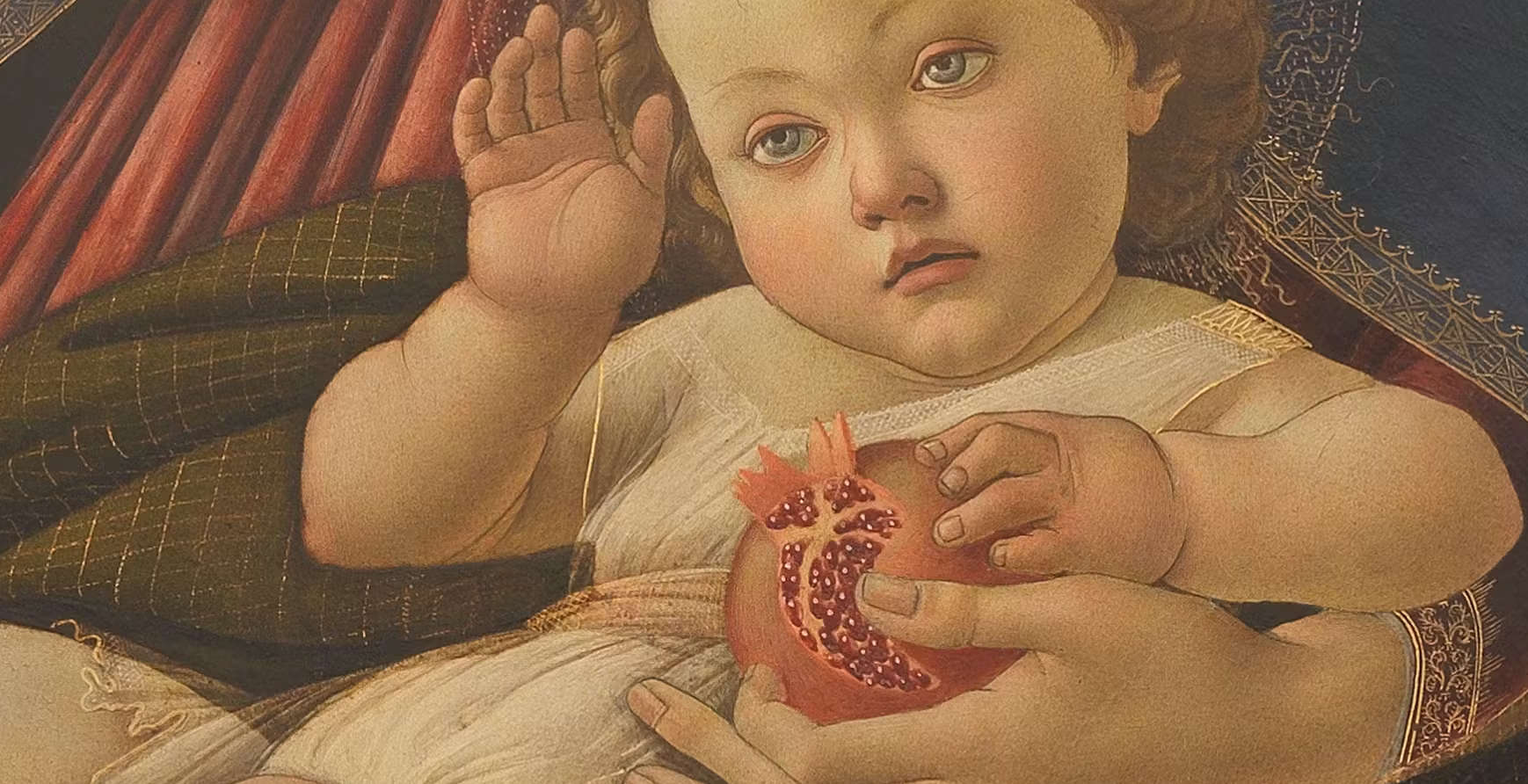
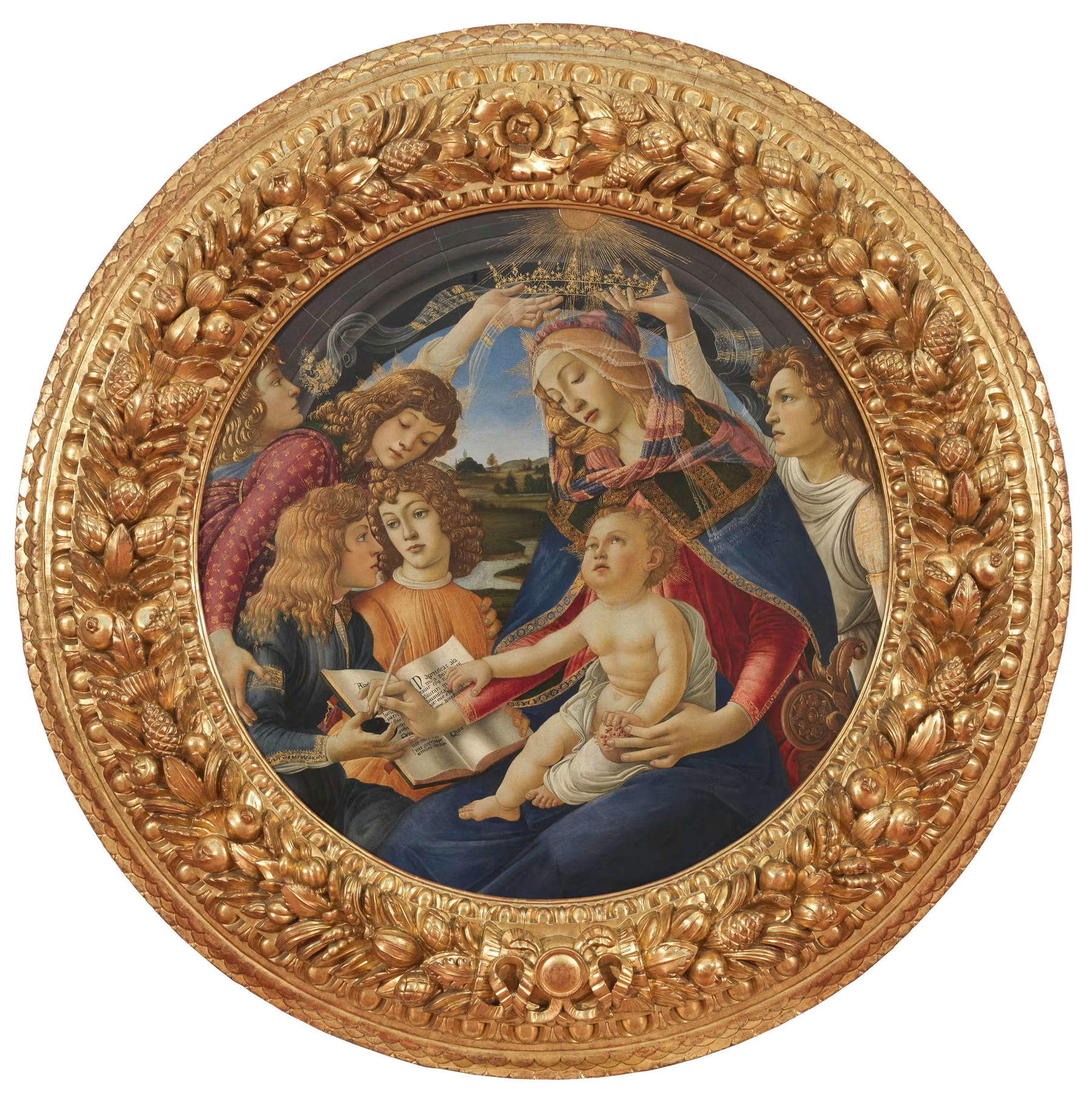
In the center of a roundel housed in the Uffizi Gallery, a mother offers her child a split pomegranate, its seeds a vivid red verging on purple. This is no ordinary gesture: in 15th-century Florentine religious painting, that fruit carries with it centuries of layered meanings, and Sandro Botticelli, around 1487, distilled them into an image that has continued to be interpreted, discussed, and reinterpreted for over five hundred years. The Madonna of the Pomegranate does not merely depict a scene of domestic tenderness: through precise botanical detail, it portrays the announcement of a destiny.
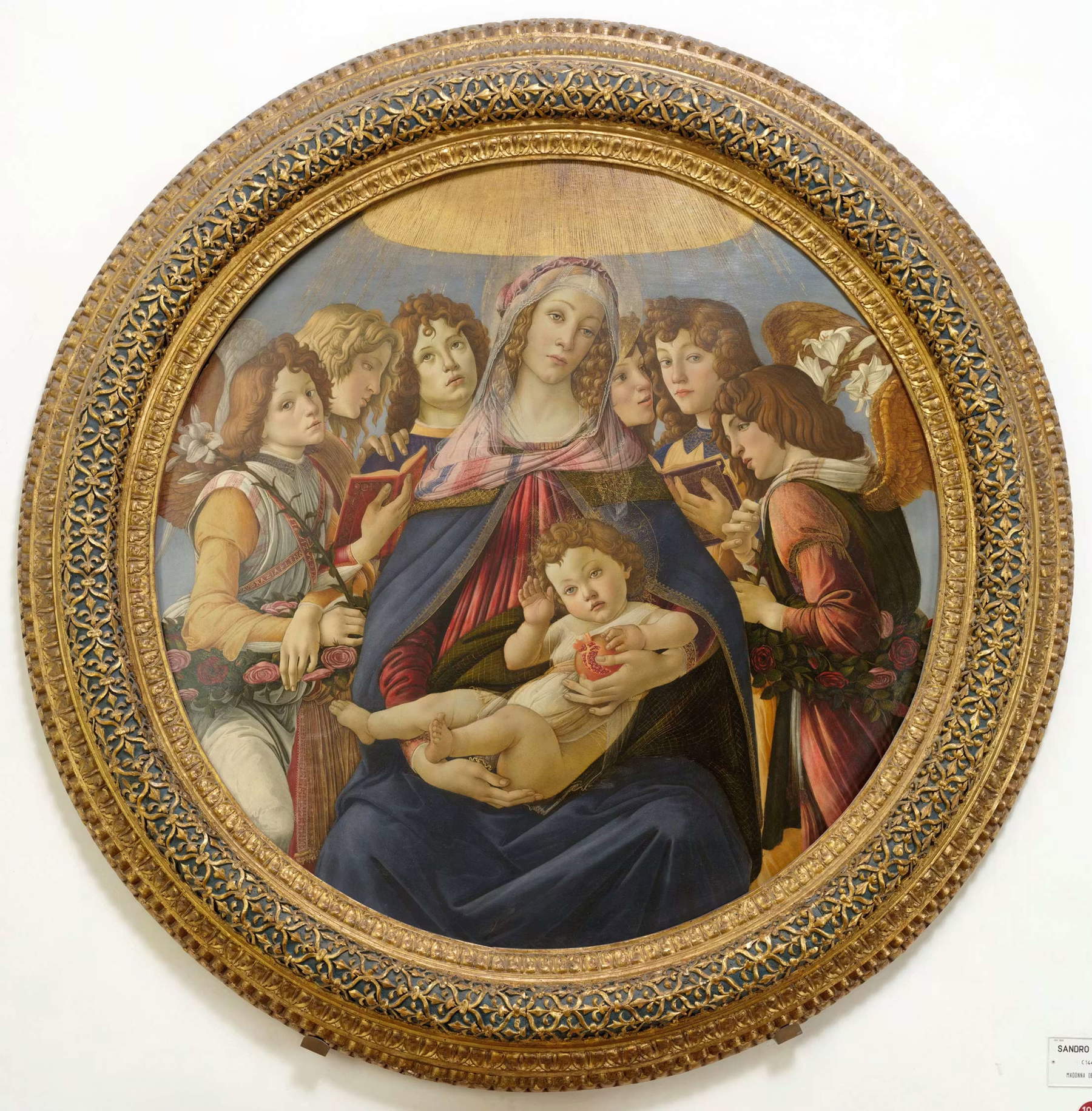
The painting is a tempera on panel measuring 143.5 centimeters in diameter, created during the artist’s prime. The Virgin is seated at the center of the composition, wrapped in a cobalt-blue mantle that expands around her to form an almost pyramidal shape, anchored at the bottom by the pose of the Child, lying horizontally, as if to serve as a counterpoint to his mother. Around her, six angels are arranged in a semicircle, in gestures that are symmetrical but not identical: two hold a garland of roses, others carry white lilies—a symbol of Marian virginity—while still others are absorbed in reading or exchanging whispered confidences. One of them looks out of the scene, toward the viewer: in the tradition of Renaissance painting, the figure who gazes back at the viewer in this way has the task of drawing the viewer’s attention to the center of the action. Embroidered on the stole of the angel on the left are the words of the angelic greeting, *Ave gratia plena*, an explicit reference to the Annunciation that broadens the meaning of the scene beyond the moment depicted.
It is within this solemn, almost architectural composition—despite the circular format typically reserved for domestic rather than ecclesiastical use—that the gesture of the pomegranate is inserted. The infant Jesus grasps it naturally, without hesitation, resting his hand on the fruit his mother offers him. The faces—that of the Virgin in particular—do not appear serene: a shadow of sadness permeates the composition, as if knowledge of her son’s destiny were already written in that gaze. This is a detail that scholars have noted on several occasions, drawing parallels between the oval shape of the Virgin’s face and other masterpieces from the same period—from the Madonna of the Book to numerous portraits—and linking the composition as a whole to another work now in the Uffizi, the *Madonna del Magnificat*, with which the *Madonna of the Pomegranate* is compared due to similarities in format, facial features, and figurative structure, as well as the presence of the pomegranate, which is also visible in the *Madonna del Magnificat*.
Sources do not fully agree on the exact date. There is, however, a reference—attributed to the art historian Gaetano Milanesi—to a payment made in 1487 for a tondo depicting the Virgin commissioned by the Florentine magistracy of the Massai di Camera, an administrative body of the Republic, intended to decorate the Audience Hall. It was Herbert P. Horne, in the early 20th century, who proposed identifying that document with the panel known today, based on a detail of the original frame: a band of gilded lilies on a blue background, which was said to allude to the political alliance between Florence and France. However, it has never been possible to locate the document cited by Milanesi, and this gap has left room for a debate that continues to this day. Some scholars have proposed dating the work as early as 1480; others have placed it after Botticelli’s return from Rome, around 1482; and still others have suggested a narrower range, 1480–1481. On one point, however, critics have never had any doubts: Botticelli’s authorship of the painting has never been questioned, regardless of the exact year of its creation.
Even the frame, exquisitely crafted by a Florentine woodcarving workshop, has an attributional history that remains unresolved: it has been attributed to both Giuliano da Maiano and Giuliano da Sangallo. The fact that it has survived to this day alongside the panel—without having been lost or replaced, as happens with the vast majority of ancient paintings—remains a rare occurrence, allowing us to view the work in a setting closest to what was originally intended. The panel’s provenance is better documented: in the 17th century, it entered the collection of Cardinal Leopoldo de’ Medici, one of the most important collectors of his time, before finally arriving at the Uffizi in 1780, where it remains today. There are also several workshop copies of the composition, a sign of the rapid fame the original achieved: one is in the State Museums in Berlin, another in the Aynard Collection in Lyon, and a third in London, in the Wernher Collection. It was precisely this latter version that, in 2019, underwent an attribution review by conservators at English Heritage, who—after removing a layer of yellowed varnish and conducting a series of radiographic and pigmentological analyses—recognized the work as a piece from Botticelli’s Florentine workshop, and not a late copy, as had been believed for over a century. The revision concerns the attribution to the workshop—not necessarily to the master’s own hand—but it nonetheless confirms how much the model created for the Uffizi was considered, even in its own time, a prototype to be replicated.
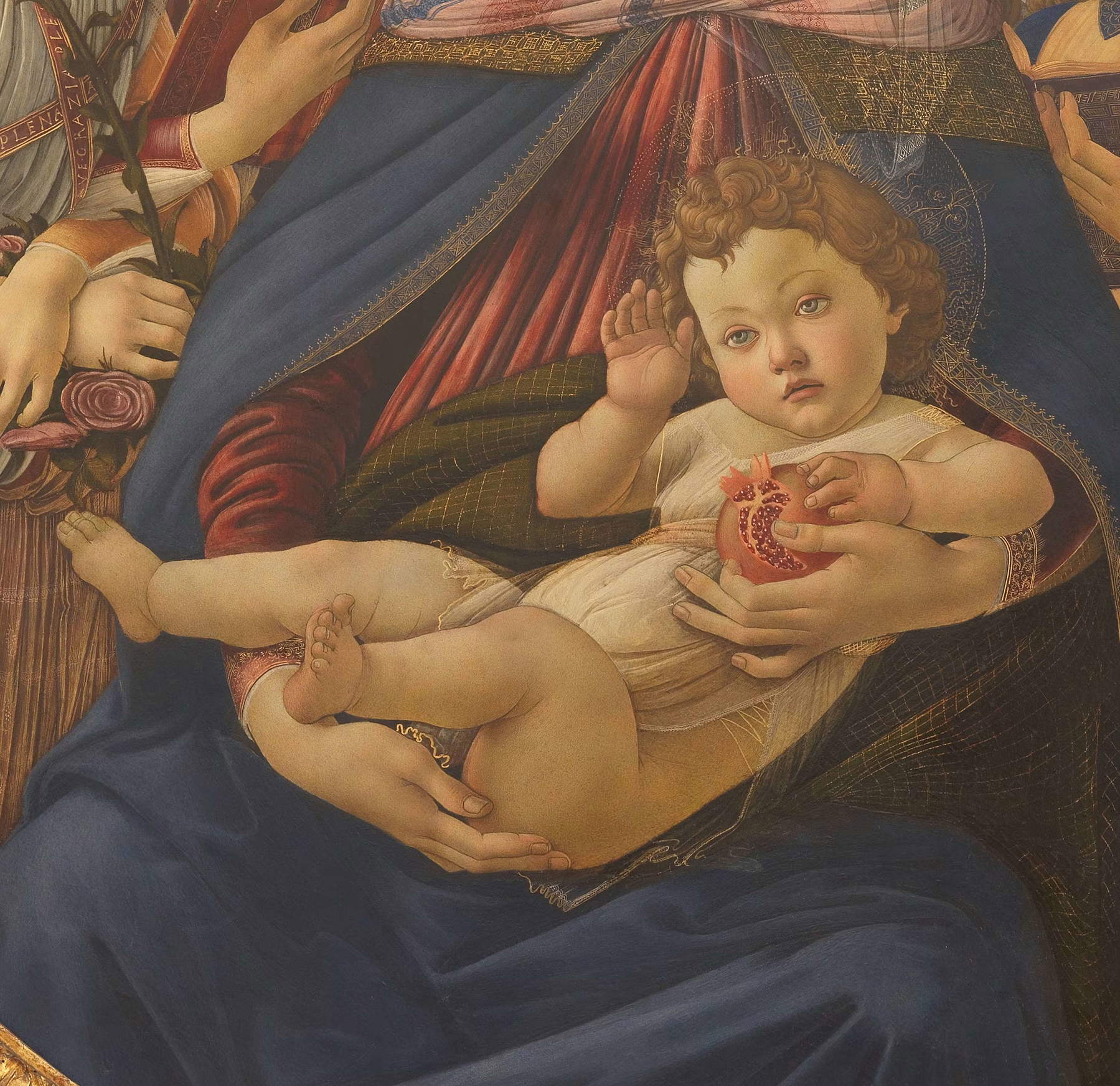
At the center of it all remains the fruit. The pomegranate is a thorny shrub that has been widespread in the Mediterranean region since antiquity; its name derives from the Latin *malum granatum*, meaning “apple with grains.” When you open the fruit—a fruit associated with autumn, the season of full ripeness—you find small, irregular niches, separated by thin, whitish membranes, filled with tiny seeds enveloped in translucent red pulp. It is precisely this structure—a single shell enclosing a multitude of seeds that are distinct yet united—that has made the pomegranate a symbol capable of transcending different cultures and religions without losing its significance. In Greek mythology, it was linked to the myth of Persephone, who was forced to return periodically to the underworld for having eaten a few seeds of the fruit offered by Hades, and was thus associated with the cycle of the seasons, death, and the return to life; it was also an attribute of Hera, goddess of marriage and fertility, and according to tradition, it was Aphrodite herself who gave it as a gift to the people of Cyprus.
This layer of pagan meanings—linked to fertility, royalty, and regeneration—did not disappear with the advent of Christianity but was partly absorbed and reoriented. In Christian iconography, the pomegranate becomes above all an image of the Passion: the tiny, numerous red seeds are interpreted as an allusion to the blood shed by Christ for the salvation of humanity. This association recurs consistently in sources dedicated to Botticelli’s painting and explains why it is the Child himself, in the Uffizi panel, who is holding the fruit: in the Renaissance iconographic tradition, when Jesus himself holds it in his hand, the gesture is interpreted as a conscious foreshadowing of his own sacrifice—almost an omen accepted from childhood onward. At the same time, the small crown above the fruit—a remnant of the flower’s calyx—has always suggested an association with royalty, reinforcing the interpretation of the pomegranate as a symbol of abundance and sovereignty, as well as suffering.
A second meaning concerns the very structure of the fruit, with its distinct seeds enclosed within a single husk: an image that Christian symbolism associates with the Church, a community of the faithful and diverse peoples held together by a single bond. This interpretation was already present in the allegorical treatises of the late 16th century:in Cesare Ripa’s*Iconologia*, a foundational text for the figurative culture of the modern era, the pomegranate appears as an attribute of the Academy, Concord, and Conversation, always signifying union, cohesion, and orderly exchange among distinct individuals.
Viewed from this perspective, the Madonna of the Pomegranate appears as a point of convergence rather than an isolated invention. Botticelli does not create a new symbol but draws upon a layered repertoire that has spanned the Mediterranean world for millennia before him: from Archaic-period votive statuettes depicting female deities holding the fruit, to Renaissance fountains and reliefs in which the pomegranate reappears as a decorative motif, and on to other Madonnas bearing the same attribute painted by Filippo Lippi, Beato Angelico, or Carlo Crivelli. What distinguishes the panel in the Uffizi is the degree to which this symbolic charge is composed: no rhetorical emphasis, no narrative excess, but a quiet gesture between mother and child, in which the awareness of the sacrifice to come is intuited only in the gaze, while the Child’s hand rests on the fruit with the naturalness of one who accepts—without yet fully understanding it—his own destiny.
The work’s popularity, moreover, has never waned. Even in the artist’s workshop, the model was deemed worthy of being replicated several times, a sign that Florentine patrons recognized its value both as a devotional image and as a figurative work; in the centuries that followed, the painting continued to attract the attention of art historians and conservators, as demonstrated by the story of the version preserved in England, which was returned to its proper critical context only after months of cleaning and analysis. This trajectory also subtly traces the history of art history: the attribution of an ancient work is rarely a fact established once and for all; more often than not, it remains the provisional result of an ongoing comparison between archival documents, stylistic analysis, and—in recent decades—increasingly sophisticated investigative technologies. This is another reason why the Uffizi panel, despite being the best-known and most thoroughly documented example, must be understood within a network of copies and variations that have accompanied its legacy since the 15th century.
Ultimately, the question remains as to why, among the many fruits available in the imagination of the time, the pomegranate in particular established itself as such a recurring attribute in Marian iconography. The most convincing answer points to the fruit’s very physical structure: few other natural elements allow one to visualize, in a single object, both the idea of multiplicity and that of unity, both the color of blood and the promise of renewed life. A fruit that opens to reveal its seeds is, in and of itself, an image of revelation: something that was hidden becomes visible, offered to the gaze of the observer. It is no surprise that painters, treatise writers, and theologians—each working with their own tools—have found in that very image common ground for expressing different yet converging ideas about the nature of sacrifice, faith, and the community of believers. Botticelli’s panel, with its unemphatic composure, remains perhaps the most balanced example of this long symbolic tradition as applied to Florentine religious painting of the late fifteenth century.