





While historiography on Caravaggio’s*Saint Francis* has struggled to find its bearings, it is in *The Arrest of Christ* that the house of cards of bureaucratic exegesis collapses spectacularly under the weight of geometry. Documents extracted from the Mattei archives confirm that the original *The Arrest of Christ* was purchased for 125 scudi in January 1603. A monumental payment, which included a sumptuous “black frame with gold arabesques.” Official historiography has claimed that the canvas now in Dublin, measuring just 133 by 169.5 centimeters, is simply that very work. To resolve the glaring discrepancy with the much larger dimensions recorded in the ancient inventories (approximately 144 by 218 centimeters), Francesca Cappelletti theorized in 1990 that the canvas had undergone a drastic, hypothetical trimming on all four sides. This spatial mutilation was deemed essential to reconcile the archival records with the Irish painting.
However, in 1994, just as the academic world had comfortably settled on that theory, Sergio Benedetti’s restoration tore away the veil. X-ray examination revealed an irrefutable fact: the Dublin canvas retains its original framing selvedges intact. The work has never been cut by even a single millimeter; it was created precisely with those compressed and tight dimensions. Moreover, the two-centimeter correction to an ear, the repositioning of a buckle on the soldier’s belt holding the sword, and other minor adjustments show no signs of structural rethinking. Whereas the Ruffo di Calabria version showed two arms raised upward in the X-ray: behind Caravaggio’s figure was another soldier, and the painter himself painted his self-portrait atop another figure (the lamp held by Caravaggio had been painted larger, and the flame does not spill over from the lamp held by Caravaggio himself, whereas in the Dublin version, the candle’s flame spills dangerously from the lamp below Caravaggio’s hand).
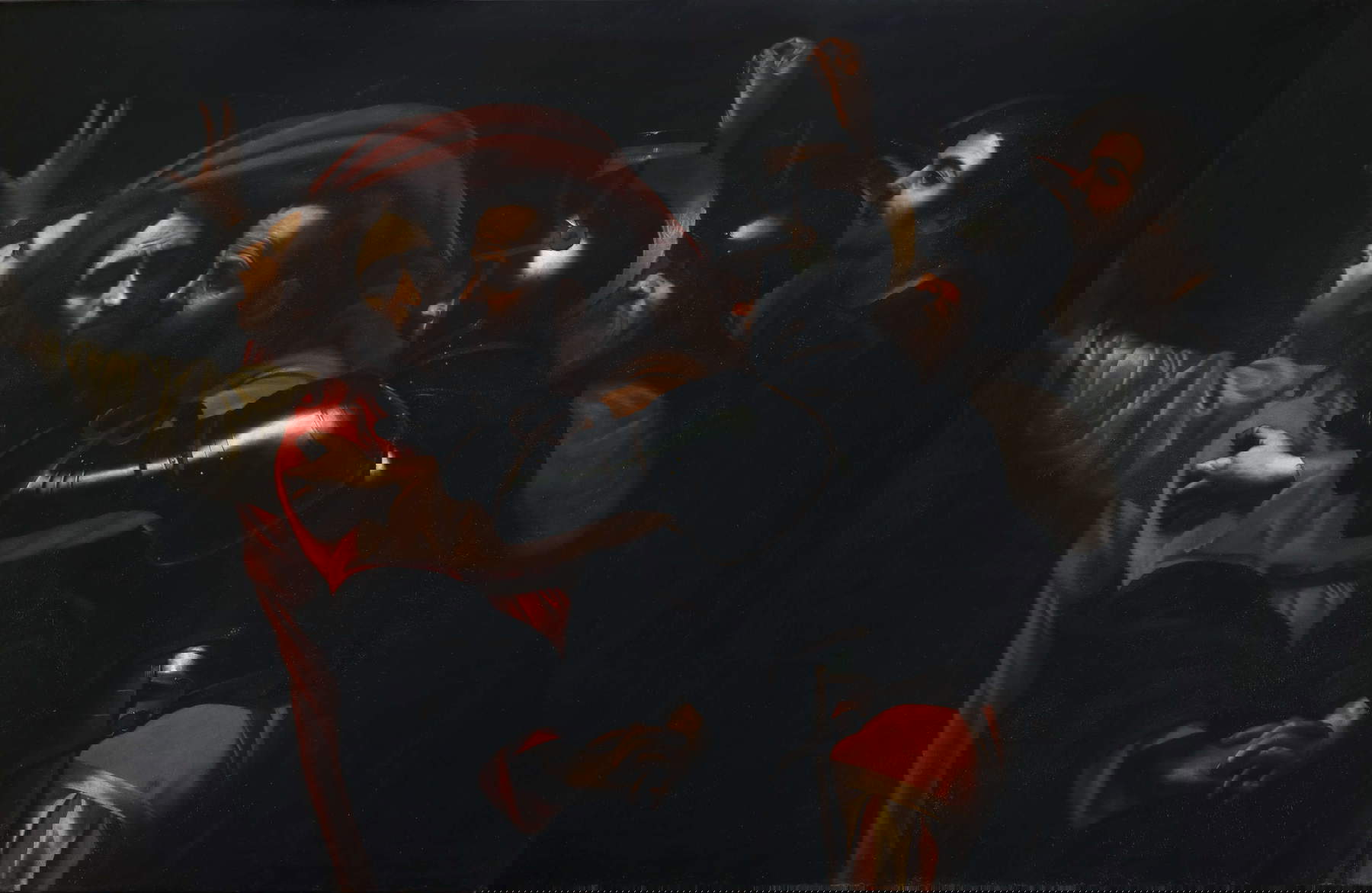
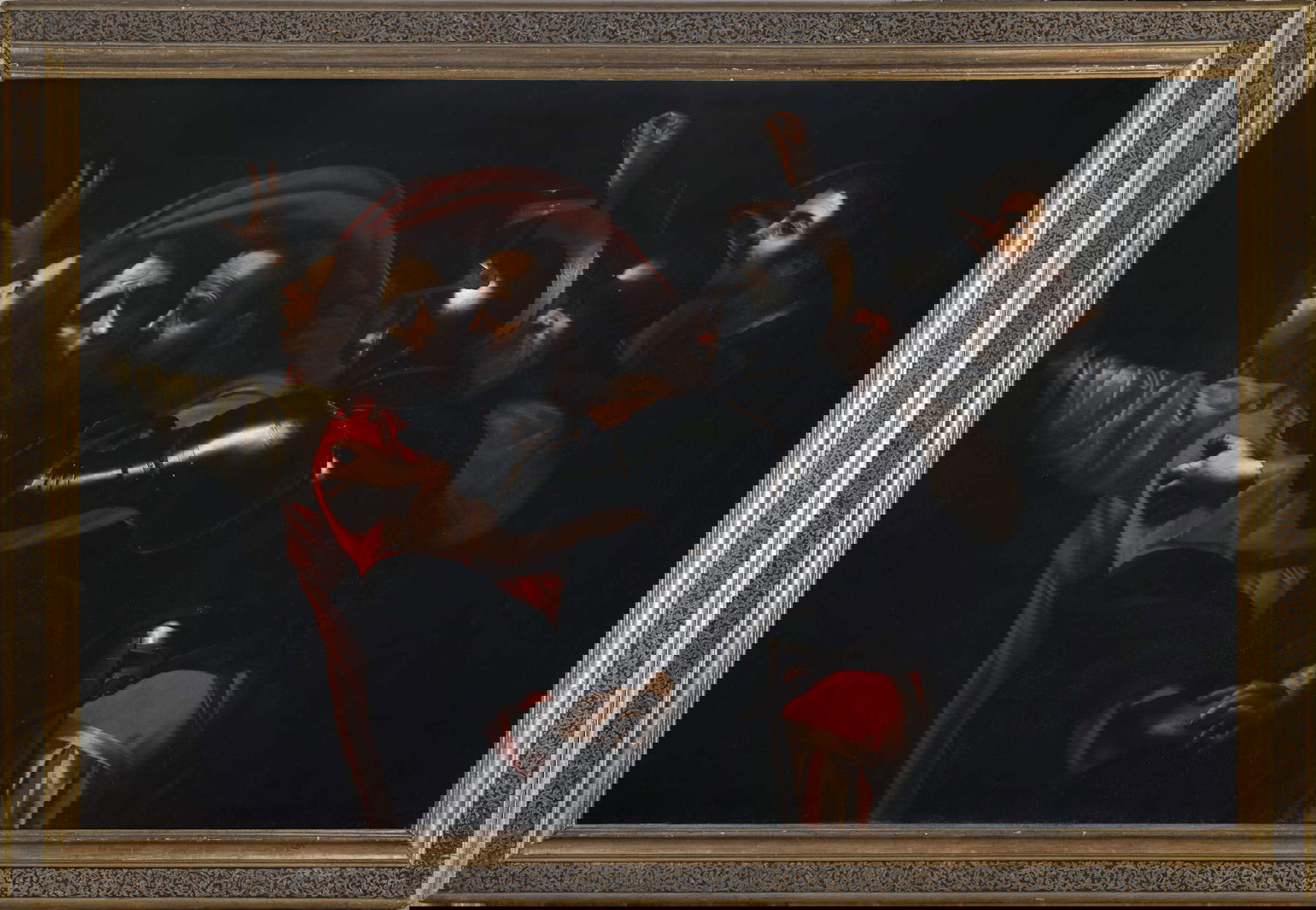
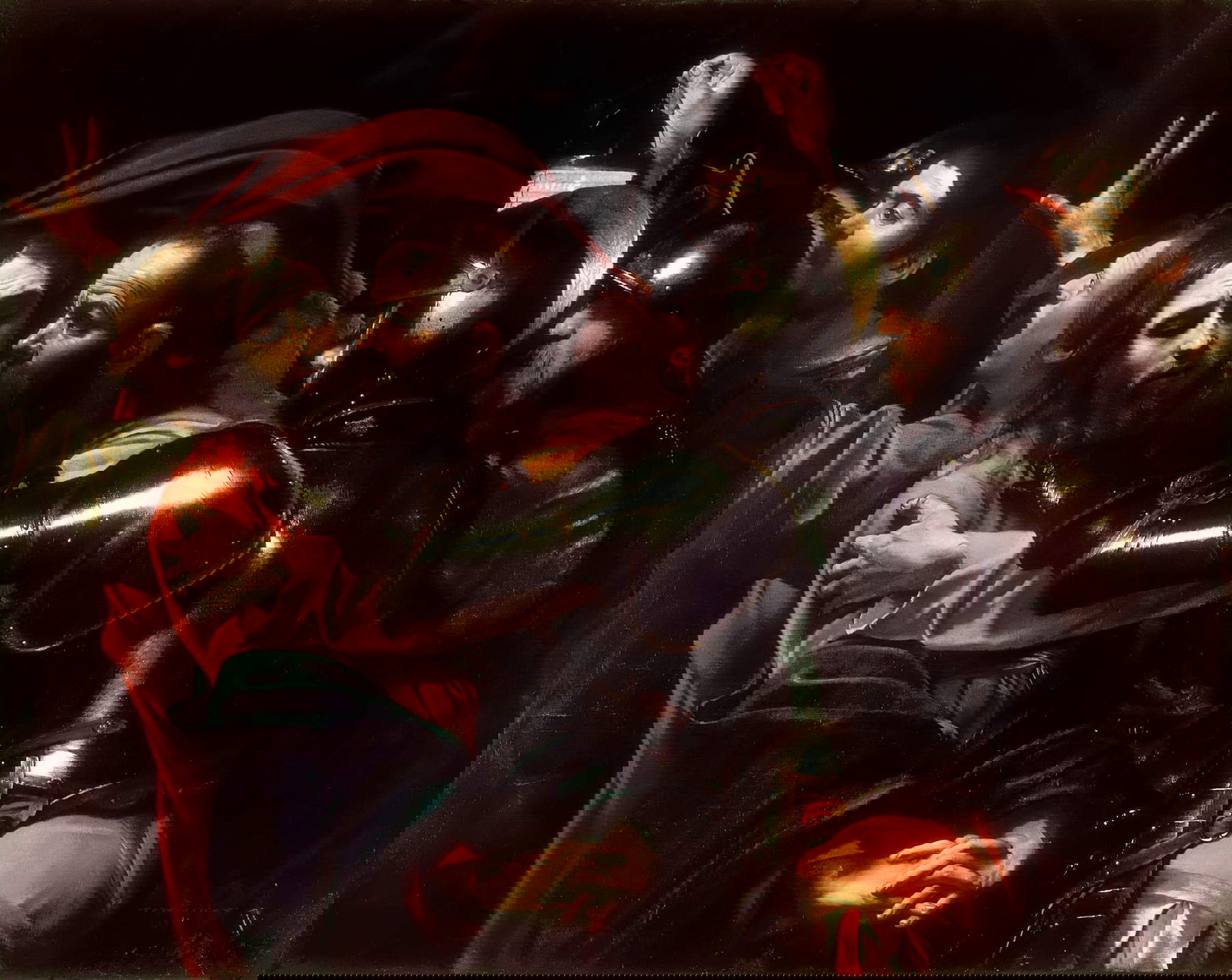
How, then, can we solve this mystery? In 1625, Asdrubale Mattei commissioned Giovanni Serodine to paintThe Meeting of Saints Peter and Paul on the Way to Martyrdom specifically as a spatial pendant to The Arrest of Christ. Serodine’s masterpiece, which has survived intact, measures 144 by 220 centimeters. The law of Baroque symmetry allows for no exceptions: Caravaggio’s original must have possessed the same monumental stature to fit within the black frame with gold arabesques recorded in Giovan Battista’s inventory of 1616. The historical truth lies hidden in the intricacies of the inheritance divisions of 1624–1626, when Alessandro Mattei transferred the assets to his uncle Asdrubale: amid that whirlwind of guardianships and exchanges aimed at rescuing the royal treasures from the clutches of the tax authorities, Paolo Mattei received, in an initial donation in 1623 from his cousin Giovan Battista Mattei, “Caravaggio’s The Arrest of Christ, with its black frame embellished with gold arabesques.” For Asdrubale, owning it had been a source of distress since 1604, when, for political reasons, Asdrubale himself had to part with Caravaggio’s *Saint Sebastian*, mentioned in his 1604 inventory, as Francesca Cappelletti herself argues in her introductory article in *Caravaggio and the Mattei Collection* by Sergio Benedetti (Electa, 1995): probably in agreement with his son Paolo, Asdrubale exchanged the original Caravaggio before 1626—the year in which the executorship was officially concluded—obtaining in exchange another version of the “The Arrest of Christ by Caravaggio with its gilded frame,” measuring 133 by 169.5 centimeters, which was hung as a doorpiece in the bedroom of Abbot Paolo Mattei’s apartment overlooking Via dei Catinari. In 1624, upon Giovan Battista’s death, Paolo Mattei was assigned the smaller version (the Dublin version), fitted with a new gilded frame, leaving the “Caravaggio’s Arrest of Christ with its black frame decorated with gold arabesques,” in its original setting, as a painting above the door in the ground-floor hall, where it formed a pair with Antiveduto Gramatica’s “Dispute Among the Doctors with its black frame adorned with gold arabesques.”
In the 1802 inventory, Paolo Mattei’s painting was listed as “The Seizure of Our Lord, with its gilded frame by Gherardo delle Notti”: it is the same version that, in the same year, was sold to Lord Nisbet under the convenient attribution of “Gherardo delle Notti” (Gerrit van Honthorst) for 80 scudi. The 1802 inventories revealed that an authentic Caravaggio was valued at 500 scudi, as demonstrated by the appraisal of *Saint Francis*: It is clear, at this point, that the downgrading of the canvas—which eventually ended up in Dublin—to a work by Honthorst was due to the fact that they were aware that that specific canvas was not the monumental original bound by the entail. The true original, measuring 144 by 218 centimeters, remained protected and anonymous, destined for Asdrubale along with the Antiveduto Grammatica. The two paintings are mentioned in the 1613 inventory, as Francesca Cappelletti notes, and in Asdrubale’s inventory, compiled by another hand, a series of paintings is listed, including “The Dispute of the Doctors with its black frame adorned with gold arabesques” and “The Arrest of Our Lord with its black frame decorated with gold arabesques” (both anonymous): some of them come from Giovan Battista Mattei’s inventory following his death in 1624 (the two paintings were mentioned in Giovan Battista Mattei’s inventories of 1616 and 1624, with black frames adorned with gold arabesques, like those by Caravaggio and Antiveduto Gramatica). In 1625, Asdrubale Mattei commissioned, as a pendant to the “The Arrest of Christ with its black frame with gold arabesques by Caravaggio” measuring 144 by 218 centimeters, “The Meeting of Peter and Paul on Their Way to Martyrdom,” measuring 144 by 220 centimeters, in Serodine for 23 scudi. The painting passed to the Colonna family of Stigliano, and in 1676 it was appraised by Luca Giordano at 400 scudi. In 1770, it passed to Anna Ruffo of Calabria, and upon her death in 1830, the canvas was inherited by a descendant of a branch of the Ruffo family, from whom it eventually passed, in 2003, to its current owner, as a copy of the Dublin version measuring 133 by 169.5 centimeters.
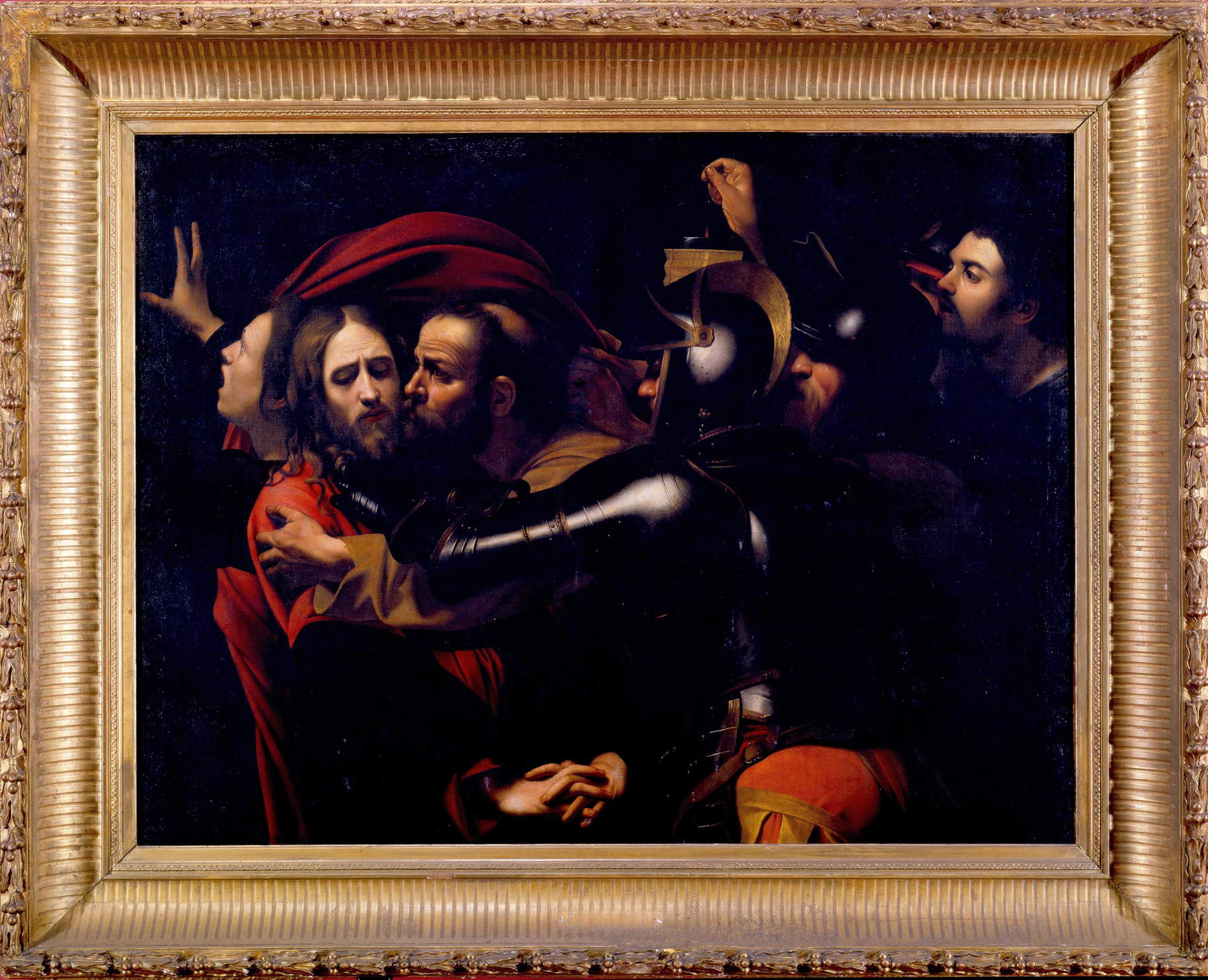
In the book *Il Trattenimento dei Virtuosi* (Argos, 2005), which mentions the paintings in Palazzo Mattei di Giove, Sergio Benedetti, on page 162, in the entryfor *The Embrace of Peter and Paul on Their Way to Martyrdom*, notes that, in his 1950 article, Longhi had already hypothesized—based on the identical dimensions and stylistic similarities—a close connection between the canvas and its pendant, a connection later confirmed by the Mattei documents. Reading Longhi’s detailed analysis of the Serodine painting from 1950, one implicitly concludes that the version of Caravaggio’s *The Arrest of Christ* published by Sergio Benedetti himself—given its dimensions of 133 by 169.5 centimeters— did not form a pendant with Serodine’s canvas, which measures 144 by 220 centimeters; and it is for this reason that Francesca Cappelletti, in her 1990 article, argued that the Dublin *Arrest of Christ* had been cropped both on the sides and in height. Sergio Benedetti, in *Il Trattenimento dei Virtuosi*, on pp. 124–125, confirms that the *Seizure of Christ* in Dublin still retains its original selvedges (and thus has never undergone any reduction or alteration in proportions), arguing that the confusing entries in the 18th-century Mattei inventories—referring to a *Presa di Cristo* “reframed with its gilded frame” by Gherardo delle Notti—were either transcription errors or alluded to a “promoted” copy listed in the Mattei inventories.
In 1623, Giovan Battista Mattei had donated to his cousin, Paolo Mattei, son of Asdrubale, the “Arrest of Christ with its black frame decorated with gold arabesques.” In 1624, Paolo Mattei received, as a new gift, the “Capture of Christ with its gilded frame by Caravaggio”: the canvas remained in Paolo Mattei’s apartment until 1802, when it was purchased by Lord Hamilton Nisbet. Sergio Benedetti, after reviewing the inventories uncovered by Laura Testa and Francesca Cappelletti, consulted the two scholars, and the Dublin painting was identified as the original Caravaggio work painted for Ciriaco Mattei, mentioned in the payment record with its “painted” frame for 125 scudi, thereby relegating the forgotten *Capture of Christ*—with its black frame and gold arabesques—from the Sannini collection to the status of a copy. Longhi had exhibited this work in the 1951 Milan exhibition as a copy of an original yet to be identified (Longhi was unaware of the Mattei inventories at the time).
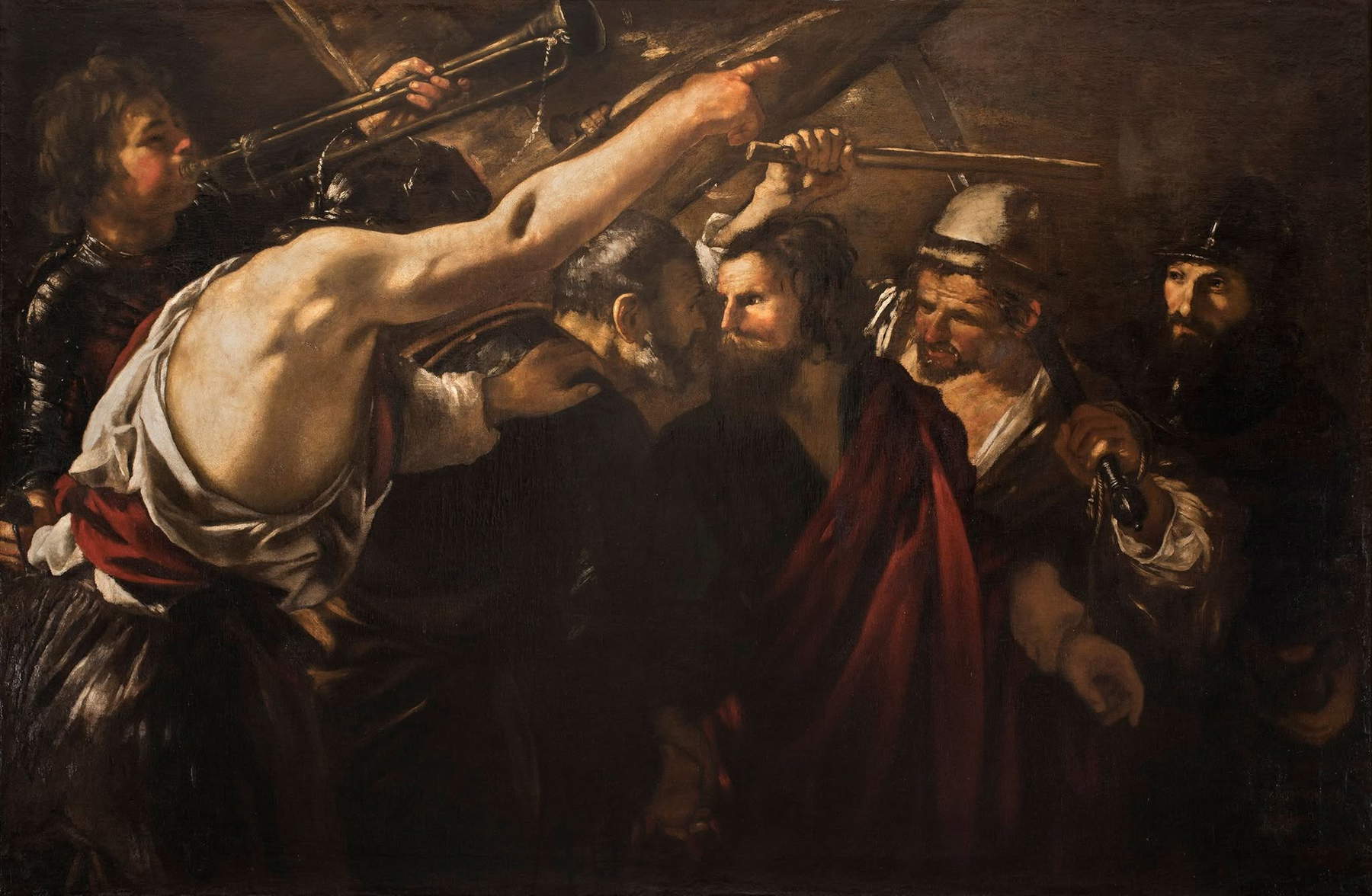
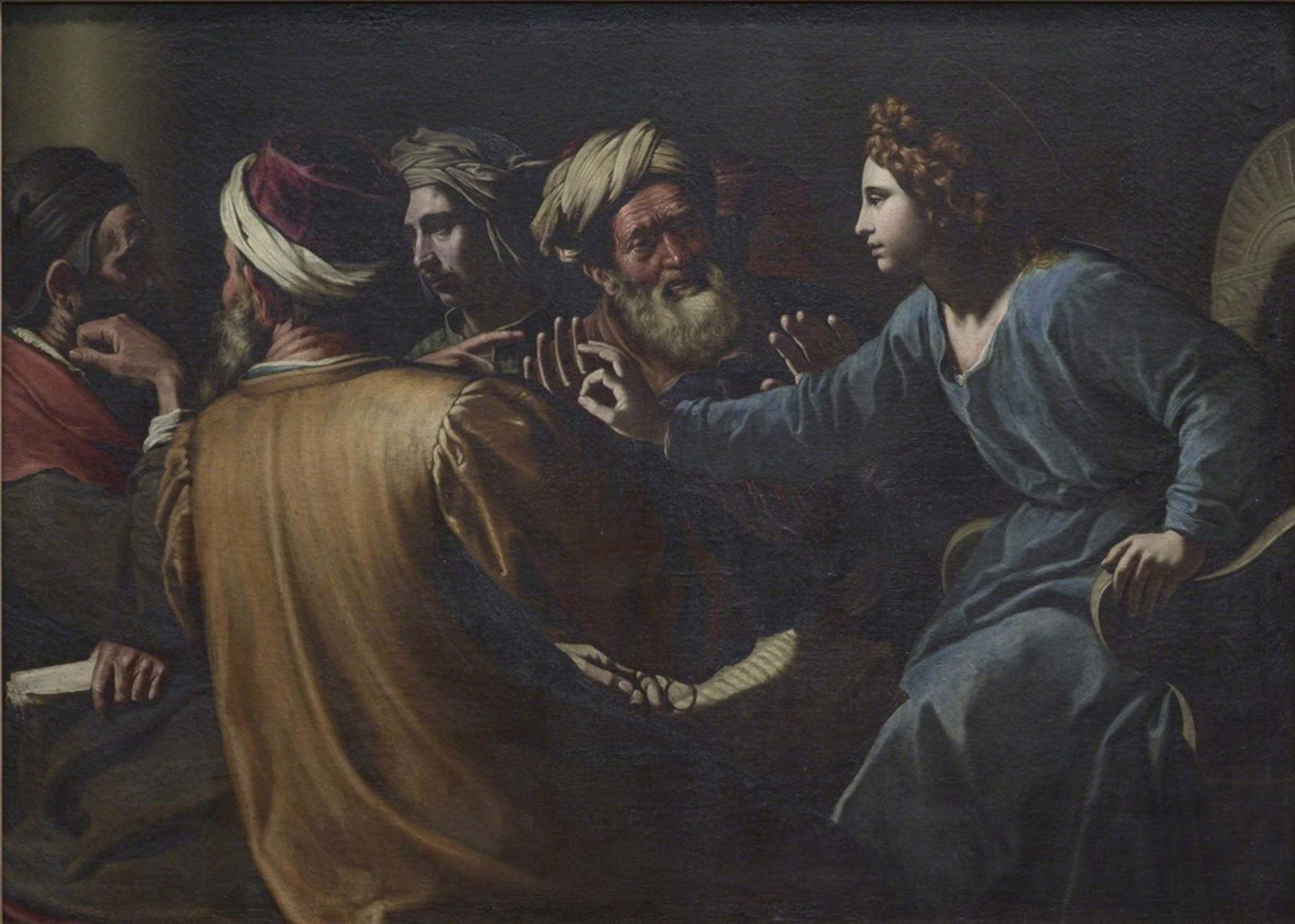
There is no doubt that the Sannini copy is the only one to provide us with a complete account of the composition of the original, which we must therefore assume was cropped quite early on (perhaps to make it more conform to standard gallery formats) and that, in this reduced state, it then served as the basis for all other copies traced to date. Longhi subsequently rejected the Odessa version—though he considered it of high quality—due to its smaller dimensions compared to the Sannini version: the Sannini version is more expansive and perfectly conforms to Bellori’s description, with John fleeing with his arms outstretched, whereas in the Odessa version one of his arms was cut in half, the scene appeared compressed, and, moreover, its dimensions are similar to those of the Dublin version (133.5 by 171.5 centimeters). Scholars such as Denis Mahon, Mina Gregori, Claudio Strinati, Anna Coliva, Francesco Petrucci, Clovis Whitfield, Pierluigi Carofano, Emilio Negro, Nicola Spinosa, Fabio Scaletti, Sergio Rossi, Maurizio Marini, Herwarth Röttgen, Vincenzo Pacelli, Sergio Guarino, Carmelo Occhipinti, Michele Frazzi, Marco Baldassarri, Caterina Napoleone, and numerous internationally renowned antiquarians such as Ferdinando Peretti, Gilberto Algranti, Fabio Megna, Alberto Di Castro, Fabrizio Apolloni, and the conservators Carla Mariani and Silvia Cerio (and I’m sure I’ve forgotten a few scholars, for which I apologize).
The rediscovery of these inventories, therefore, must not become a pretext for lazy bureaucratic filing, but must remain a stimulus for an investigation that marries the document with conservation analysis, the ink with the very fiber of the canvas. Only in this way can connoisseurship reclaim its leading role, freeing Caravaggio from the confines of partial hypotheses to restore him to the dramatic truth of his subject matter and his history.


The author of this article: Mario Bigetti
Mario Bigetti è un antiquario romano. Già proprietario della galleria Laurina Arte, ha scoperto numerosi dipinti, soprattutto del Sei e del Settecento romano, specializzazione della sua attività. Nella sua collezione possiede il San Francesco in meditazione e la Presa di Cristo, entrambi attribuiti a Caravaggio da una parte della critica più autorevole.Warning: the translation into English of the original Italian article was created using automatic tools. We undertake to review all articles, but we do not guarantee the total absence of inaccuracies in the translation due to the program. You can find the original by clicking on the ITA button. If you find any mistake,please contact us.





















 IT
IT FR
FR DE
DE ES
ES CN
CN


