




by Redazione 17/10/2026



Categories: Works and artists / Disclaimer
In the Codex Atlanticus, Leonardo drew two machines for roasting meat, one of which uses hot air from the chimney to automatically regulate its rotation speed. This ingenious design may also shed light on how the artist sought commissions in Milan.


“This is the true way to cook roasts.” Leonardo da Vinci (Vinci, 1452 – Amboise, 1519) is not the sort of man to make such a categorical statement in a treatise on natural philosophy or a fortification design: in fact, he wrote it next to a drawing of a rotisserie, on folio 21r of the Codex Atlanticus, preserved at the Biblioteca Ambrosiana in Milan, and there is no reason to believe he was joking. The fact that a man who elsewhere designs war machines and studies the flight of birds would pause to explain how to properly rotate a piece of meat over a fire continues to amuse scholars, as Carlo Vecce himself admitted— one of the leading experts on Leonardo da Vinci, who, in a 2013 entry on the folio, spoke of a technological precision that “almost makes one smile” when we consider that it is applied to such an everyday aspect of life.


The full sentence reads: “This is the true way to cook roasts, for depending on whether the fire is moderate or strong, the roast turns slowly or quickly.” At its core lies an idea that at first glance seems obvious (but is actually quite ingenious): the rotisserie should not always turn at the same speed; it must turn according to the heat of the fire. Translated into more contemporary Italian, Leonardo means that if the flame is strong, the roast turns quickly, and if it is low, it turns slowly—something anyone who has ever cooked a steak in their life knows perfectly well. The point, however, is that in Leonardo’s invention, this mechanism is supposed to operate automatically. In other words, the cook does not need to intervene to turn the meat according to the intensity of the fire, because the machine adjusts itself.


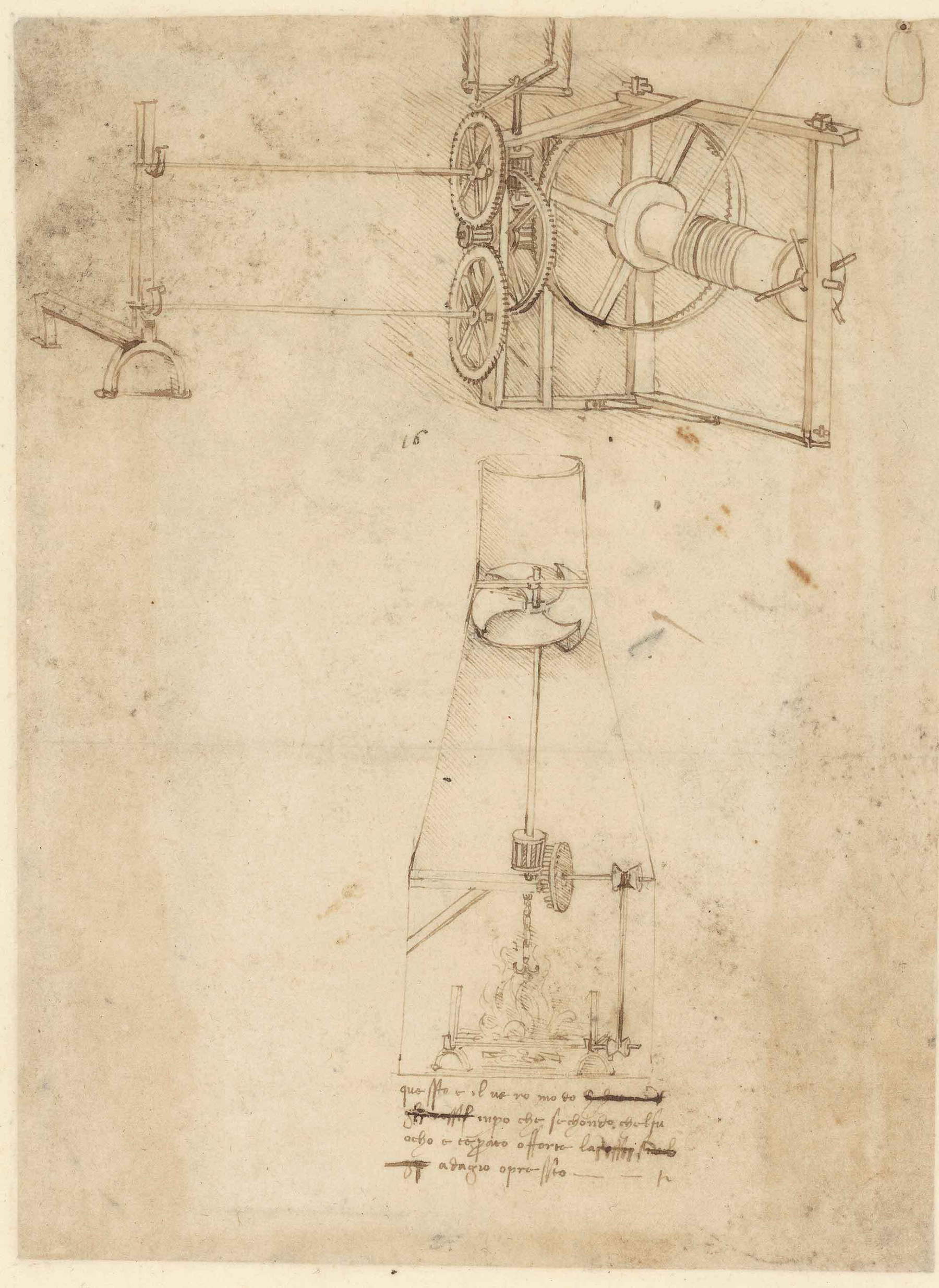
The sheet measures 255 by 191 millimeters and is drawn in pen and ink. It contains two rotisseries, and the two drawings illustrate two different principles. The upper drawing shows a rotisserie driven by a counterweight: the weight descends, pulls a rope, and turns an axle, according to a mechanism that, as scholar Matthew Landrus has observed, is the same as the one appearing on folio 24r of the Codex Atlanticus. However, a falling weight alone would accelerate; for this reason, its speed is slowed by a spool fitted with feathers, which, through air resistance, prevents the machine from spinning too fast and instead keeps it moving at the right speed to cook the roast. In 1978, Carlo Pedretti described the same device as a clockwork mechanism with a falling weight regulated by a flywheel. Landrus adds a detail: the top diagram shows a single rotation speed for two horizontal spits and for a vertical device with four spits, which are also vertical. Thus, a single machine can cook multiple roasts.


The lower drawing is the one from which the phrase originates, which Leonardo jots down beneath his machine. Here there is no weight: the roast is turned by the hot air produced by the fire itself, which rises up the chimney. Augusto Marinoni, in his 1975 description, explains that the airflow is concentrated by the narrowing of the chimney, and that the rotation speed is automatically regulated by the intensity of the flame. According to Landrus’s interpretation, there is a fan inside the chimney—a propeller driven by the rising hot air—and this fan rotates the hooks and the horizontal spit. The higher the flame, the more hot air rises and the faster the fan spins; with a low flame, less air rises and everything turns slowly. The spit, therefore, moves on its own by harnessing the energy produced by the heat of the flame. All the cook had to do was light the fire and, if necessary, check that everything was going smoothly during cooking.
The advantage Landrus identifies is very practical: the meat should not suffer from being overcooked. There is no adjustment mechanism to calibrate and no brake to adjust, because the very same heat source that cooks the roast is also what moves it. In that sentence by Leonardo, “the true method” is not the boast of an amateur cook, but the synthesis of a technical argument. The same oven with an automatic rotisserie appears in another codex, the one preserved at the National Central Library of Florence: the idea, therefore, is not confined to the page and is not an isolated whim. The invention did not remain on paper either: several recent exhibitions on Leonardo’s machines have recreated his rotisserie.
There is another curious detail, unusual for Leonardo da Vinci, that has little to do with mechanics and much to do with the man himself: Leonardo is famous for his mirror writing—that is, writing that proceeds from right to left—which has forced generations of readers to flip his manuscripts so that the text would be legible. Here, however, that is not the case; the phrase is written in the conventional direction, just as anyone would write it. Vecce refers to it as “autograph but right-handed” writing—that is, written in the normal direction. The descriptions on these—which Landrus considers to be the artist and scientist’s oldest mechanical drawings —were written in the easily legible direction, from left to right, rather than from right to left as in most of his drawings. This is no minor detail, because writing that can be read without a mirror is writing intended for a reader. Landrus puts forward a hypothesis: the sheet may have been originally conceived as a presentation drawing. In support of this, he also cites the crossed-out text beneath the lower rotisserie, which shows that Leonardo was working to simplify and clarify the description. The thought does not flow spontaneously: it is corrected, refined, and prepared for someone.
It is here that the page ceases to be a curiosity about Renaissance cuisine and becomes a document of a job search: according to Landrus, these drawings are part of what appears to have been a portfolio—or a treatise—on automata, a work that he hypothesizes would have also included the machine for cutting files depicted on folio 24 recto of the Codex Atlanticus. All were designed around 1480. They are “useful drawings,” writes the scholar, which showcase the skills of an engineer and master painter seeking commissions in Milan. The picture Landrus paints is quite precise: according to the historian Benedetto Dei (Florence, 1418–1492), Leonardo da Vinci accompanied a group of Florentine merchants to Milan on June 15, 1480, and there is evidence that in that year, and later in 1482, Leonardo was seeking work in the Lombard city as a painter, sculptor, and engineer. By April 1483, he had secured the important commission for the Virgin of the Rocks and had moved permanently to Milan to carry it out, together with Ambrogio and Evangelista de Predis. One contextual detail helps explain why an engineer would need to demonstrate his skills on paper. The Sforza family, who ruled Milan at the time, traditionally preferred to award engineering contracts for specialized tasks based on the professionals available on the market, rather than hiring permanent teams paid by the ducal court: consequently, anyone wishing to work for them had to demonstrate that they could do something specific. Leonardo, writes Landrus, offered his inventive approaches to mechanical technology—accompanied by illustrations—to prove his skills as an engineer.
In this context, a rotisserie would not be a minor object but would function as a sort of calling card: it demonstrates that the creator knows how to make a weight, a rope, an axle, and a current of air work together. And he demonstrates this with an application that anyone, in any stately home or kitchen, would have been able to understand.
The traditional dating places it around 1480: Carlo Pedretti wrote in 1978 that the style and handwriting suggest a later date, confirmed by the sketch on folio 94 verso of the Codex Atlanticus. Landrus accepts this same timeframe. Vecce, on the other hand, leaves the door open. The folio is “usually dated to 1480,” he writes, but perhaps the date could be pushed forward to the Milanese period, given the remarkable quality of the drawings with hatched shading. This is a purely stylistic argument: looking at the hand, Vecce sees a draftsman more mature than one might expect for 1480. What appears to be a difference of just a few years, however, changes the narrative. If the sheet dates from 1480, we are witnessing the early steps of an engineer trying to make a name for himself. If it is later—and from Milan—the sheet is no longer a candidate’s portfolio but the work of a man who has already found his path. The sources do not resolve the issue.
It would be easy to interpret the sheet as proof of Leonardo’s unique ingenuity, but Pedretti warns that it is not that simple: devices of this type, he notes, were common in Leonardo’s time and already appear in earlier manuscripts. The mechanical rotisserie, in and of itself, is not a Leonardo invention, but what sets it apart from other inventions—and makes this sheet more than just a reference page—is the idea of making the speed dependent on the fire itself, so that the machine regulates itself without human intervention. The success of these solutions, moreover, did not end in the fifteenth century. Landrus notes that both mechanisms on the sheet—or similar versions by other engineers—influenced the Italian engineer Vittorio Zonca (1568–1603), whose work was published posthumously in 1607.
Finally, there is one tangible fact that anyone looking at the sheet cannot fail to notice: it is incomplete. The original dimensions, writes Marinoni, were reduced by cutting away part of the upper drawing. The fold visible below the middle of the sheet shows that the lower part was cut away to a greater extent. In short, the “girarrosti” we see are what remains of a larger composition. The sources obviously do not tell us who cut them or when; we can only note that part of what Leonardo drew is no longer there. The other physical characteristics are those that scholars use to contextualize a sheet. Marinoni notes columns spaced 35 millimeters apart and a watermark—the “shears”—measuring 80 millimeters, located in the center of the sheet but slightly shifted to the left. This is the kind of information that means little to the general reader but allows specialists to date the paper and compare it with others.
In his entry, Vecce links this sheet to a Leonardo different from the one associated with major construction projects: the Leonardo who, he writes, deals with aspects of daily life with “extraordinary dedication,” and whom we will later encounter in his fables—featuring fire, the fireplace, and other domestic elements—or in other playful ideas. As an example, Vecce cites the beginning of the Trivulziano Codex, on folio 1 verso, where Leonardo jots down a curious anti-Petrarchan triplet: “If Petrarch loved the laurel so much, / it was because it goes well with sausage and thrush. / I cannot make a treasure out of them.” For Petrarch, the “lauro” is Laura’s laurel; for Leonardo, it is also a culinary ingredient, excellent for seasoning sausage and thrush, very common specialties during the Renaissance. The sources offer no further commentary, nor is any needed: the juxtaposition alone suffices to show how, within the same mind, the rigor of the engineer coexists with a taste for wit that finds its inspiration in the kitchen.
Taken as a whole, folio 21 recto reveals at least three distinct aspects. The first is technical: two distinct methods for rotating a roast—one using a counterweight with an air brake, the other driven by the hot air from the fireplace, which regulates itself. The second is biographical: a Florentine painter who, in 1480, moved to Milan in search of patrons, and who knew that for an engineer, demonstration is worth more than a promise. Or perhaps, even if he had already been “hired” by the Milanese court, he never stopped inventing. The third is philological, and lies in the questions that remain open: the dating, the purpose of the sheet, and the cut that mutilated it.
Then there is one more thing the sheet reveals, and it is the simplest. Whoever wrote “the true method” had in mind what happens in a kitchen—a cook who must tend the fire, a roast that risks burning. A self-regulating rotisserie isn’t the most spectacular machine of its time, but it’s one where the whole idea lies in the relationship between cause and effect: more heat, more air, more speed.
Warning: the translation into English of the original Italian article was created using automatic tools. We undertake to review all articles, but we do not guarantee the total absence of inaccuracies in the translation due to the program. You can find the original by clicking on the ITA button. If you find any mistake,please contact us.