





A Madonna of Humility of great interest—and previously unseen—is the one painted by Zanino di Pietro, which the Giorgio Baratti antique gallery is presenting at the 34th edition of the Florence International Antiques Biennale ( the asking price is 190,000 euros). One arm is folded beneath her head, cradling a deep sleep—almost unnatural for an infant—while the Child’s body lies stretched out across the Virgin’s legs, wrapped in a transparent veil traversed by sudden flashes of light. At a first, distracted glance, it might seem merely yet another variation of the Madonna of Humility, with the Virgin seated on the ground in a flower-filled meadow, following a figurative convention much cherished in Venetian and Marche painting of the early fifteenth century. Yet, hidden within that subdued demeanor and the precise posture of the infant Jesus lies a theological allusion of extraordinary depth, which draws directly on Byzantine artistic models to foreshadow, in the sleep of infancy, the dramatic mystery of the Death and the Deposition from the Cross.
The panel, a tempera painting measuring 71.5 by 53 centimeters that has reemerged from a private collection where it had been kept for at least two generations, is attributable to Zanino di Pietro, an artist of French origin (his name was likely Jean Charlier, and he was also known as “Giovanni di Francia”), who is documented in Bologna and Venice from 1389 and died before 1448. Art historian Angelo Tartuferi identified the painting and definitively attributed it to the master’s hand, recognizing the work as “an interesting addition to Zanino di Pietro’s catalog,” which is set to be featured shortly in a dedicated scholarly publication.
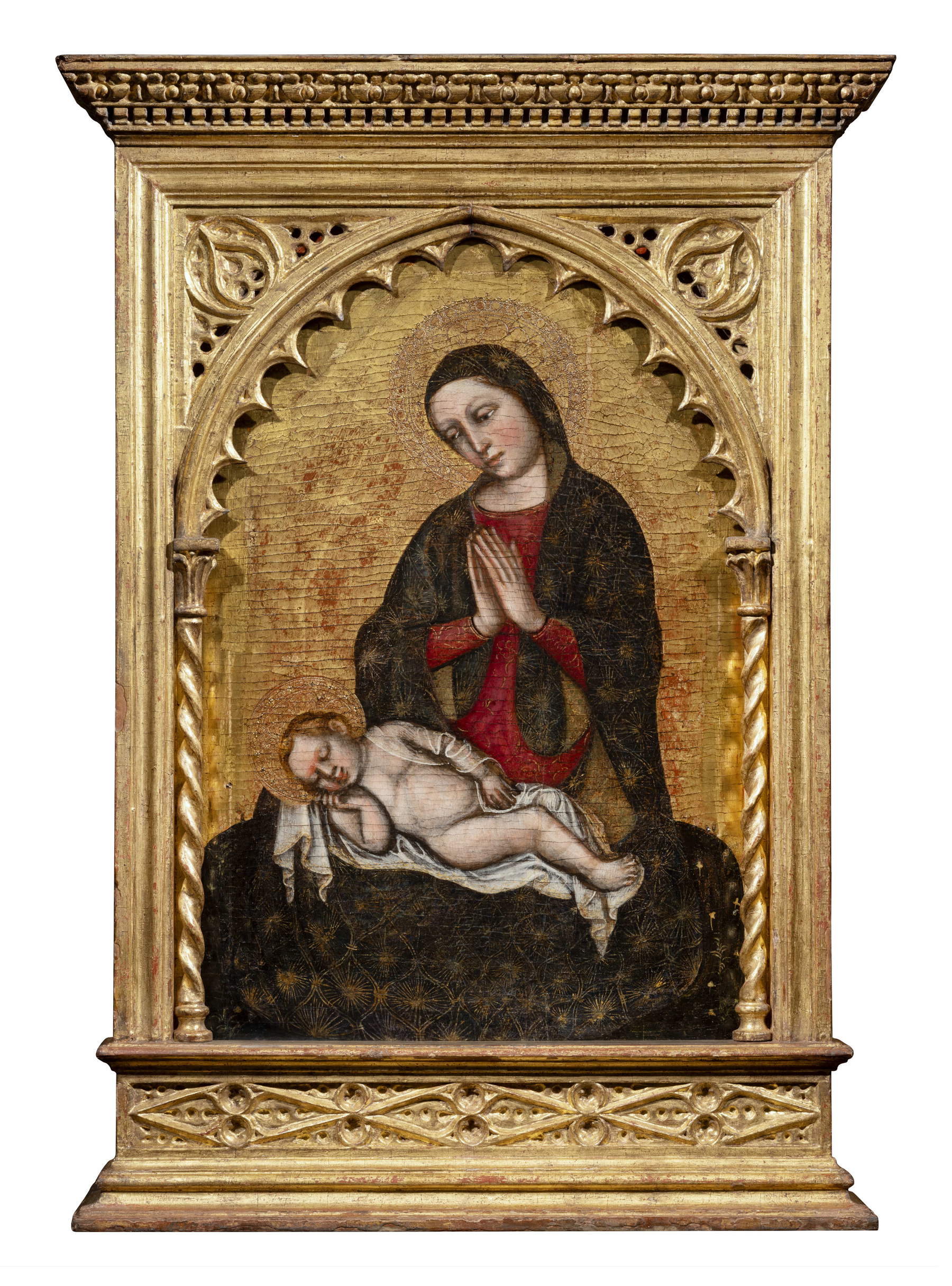
The significance of this discovery lies not only in its impeccable craftsmanship and good state of preservation, but also—and above all—in its refined and unusual iconographic choice: the Child’s gesture—with his arm bent to support his head as he rests on his right side—is in fact the unmistakable hallmark of the Christus Anapeson: this is a figurative motif that originated in the first half of the 14th century in Asia Minor and spread rapidly throughout the Balkans and along the Adriatic coast; it was conceived to depict the Son of God asleep—or sometimes with his eyes open— alluding to the divine vigilance that persists even in the sleep of death.
The presence of this complex Byzantine symbolism in a work intended for private devotion should come as no surprise when considered in light of Zanino di Pietro’s personality. The painter was no stranger to adopting iconographic solutions that were unusual or avant-garde for the Adriatic art scene. This is demonstrated, among other things, by the famous *Imago pietatis* brought to light by Mauro Minardi, in which the artist introduced a full-length depiction of the dead Christ flanked by the grieving Mary and John the Evangelist, effectively inaugurating a new figurative canon for Venetian painting of the time.
Stylistically and chronologically, according to Tartuferi, the painting dates to a crucial moment in Zanino di Pietro’s artistic evolution: the mid-1380s, during his early period. The artistic career of this transalpine master, who likely trained in Venice and was active in Bologna between 1389 and May 1406 before returning permanently to the lagoon city, has been reconstructed in recent years by Valentina Baradel through a monographic study that precisely outlined the continuous shifts in his artistic style. Zanino began with a solid, “neo-Giottesque” style—to which the rediscovered panel indeed belongs—and then gradually adopted the elegance of the late Venetian Gothic style disseminated by the workshops of Nicolò di Pietro and Jacobello del Fiore, until he reached a natural decline in quality during his late maturity. In the past, this complex alternation of phases and the close association with the lesser-known Master of Roncaiette had generated considerable critical uncertainty, leading to the splitting of the painter’s figure into his alter ego, Giovanni di Francia, until Serena Padovani undertook the fundamental work of reconstructing his artistic profile.
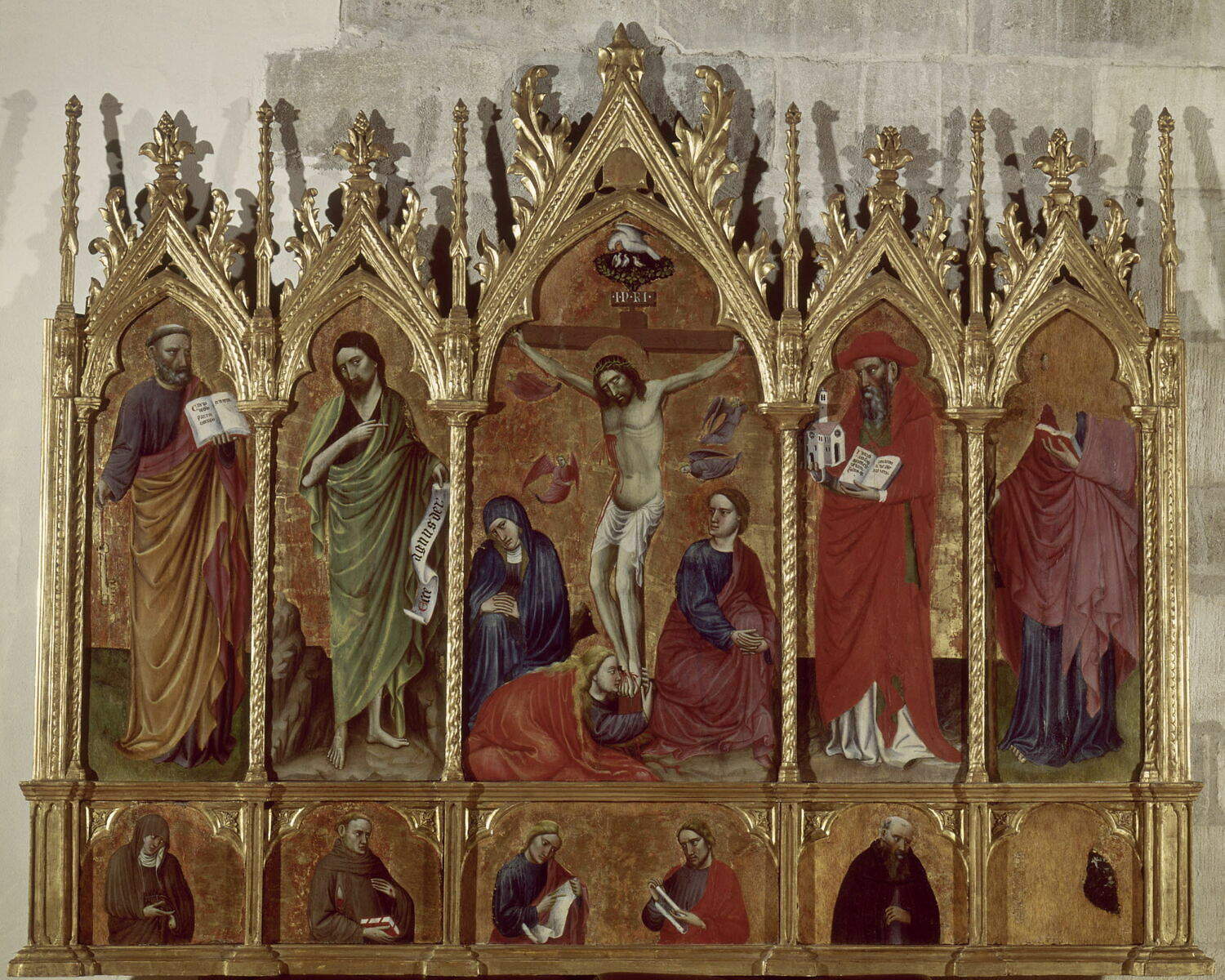
In this Madonna of Humility, which has reemerged from a private collection, Zanino’s authorship appears, however, according to Tartuferi, to be beyond any doubt, supported by a dense network of compelling morphological and pictorial parallels with other cornerstones of his early oeuvre. The primary point of comparison is the polyptych housed at the Musée du Petit Palais in Avignon (originally from the historic Campana Collection and long on deposit at the Museum of Dijon), depicting the Crucifixion at the center and Saints Peter, John the Baptist, Jerome, and James the Greater on either side. From this work, the new Madonna inherits a marked tendency to define bodily volumes with clarity, pursuing what Tartuferi identifies as the intent to offer a “highly plausible rendering, in naturalistic terms, of the roundness of the faces and the body.”
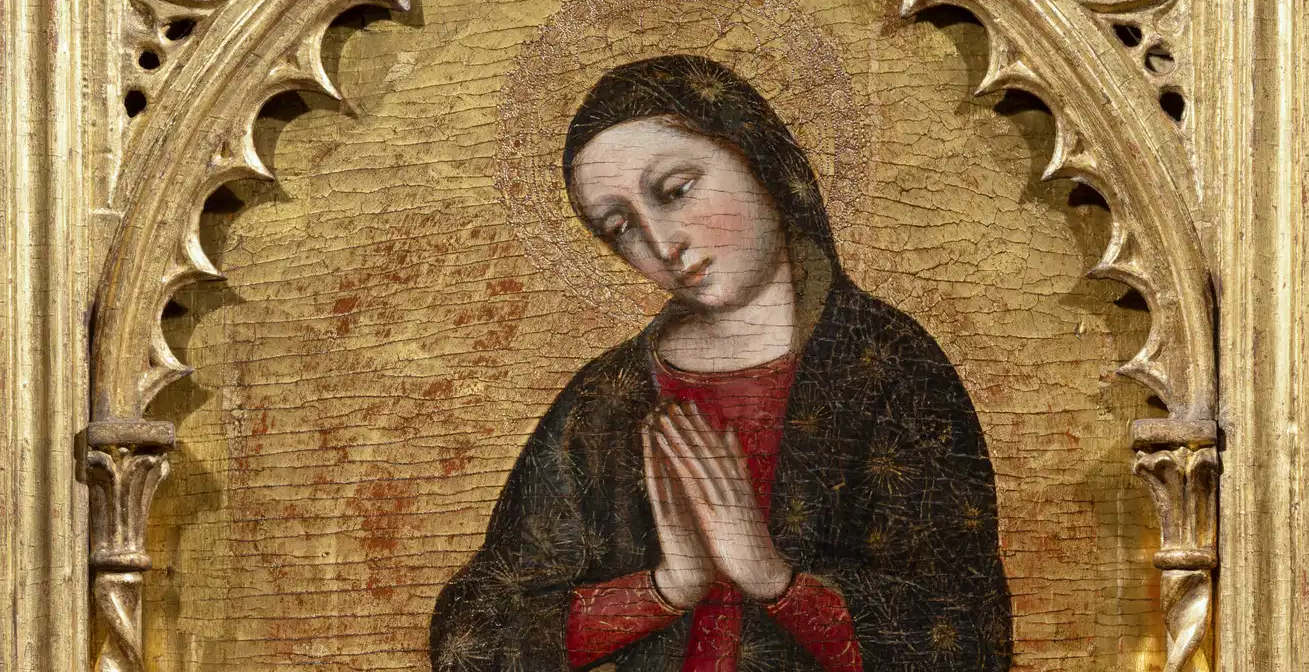
An even more striking similarity emerges with a second painting, the *Madonna degli Alberetti*, from the Bianchi Bonomi Collection in Milan. The affinity between the two panels goes beyond mere cultural analogy to a precise morphological correspondence: this can be observed, for example, in the shape of the Virgin’s face and, above all, in the rendering of the hands. The fingers are tapered and close together in a distinctive configuration that Tartuferi effectively describes as the “near-identical features of the face and hands, with fingers that are very tapered and close together, as if to form a sort of elongated spoon.”
The punched decoration of the halos further confirms the work’s dating to the first decade of the fifteenth century. The design engraved in the gold of the Virgin’s nimbus is, in fact, virtually identical to that found in the Madonna of Humility at the Tornabuoni Arte gallery in Florence, a work datable to shortly before or immediately after the panel presented at the BIAF by Giorgio Baratti. Within this network of comparisons, the rediscovered painting thus occupies a position midway between the Avignon polyptych and the Bianchi Bonomi Madonna, confirming, according to the scholar, a date of around 1405.
Having resurfaced from the anonymity of private collections with no prior documentation other than family memories spanning the last two generations, the Madonna of Humility is now presented to the public, scholars, art enthusiasts, and potential buyers in decidedly good overall condition. The painting underwent a thorough restoration, carried out by Sandra Pucci for the painted surface and by Roberto Buda for the examination and consolidation of the wooden support. The restoration, carried out according to strictly conservative criteria and involving minimal additions, focused on visually minimizing the abrasions that had become visible on the Virgin’s dark cloak and its folds. This cleaning and restoration have restored the full legibility of extraordinarily well-preserved details: the delicate skin tones of the Madonna and Child, the luster of the gilded background, and the refined craftsmanship of the two halos stand out. The halos, despite having been created using a single stamp, exhibit a dynamic, rich, and varied decorative pattern.
The restoration of this Madonna of Humility thus proves to be a valuable piece in understanding the stature of a master capable of synthesizing the sculptural rigor from beyond the Alps with the Byzantine influences of the Adriatic and the florid lyricism of the late Venetian Gothic. An independent and autonomous artistic personality who, as Tartuferi concludes, reaffirms the “significant role played by the transalpine painter in the diverse Venetian artistic landscape at the dawn of the new century.”
 |
| A "Madonna of Humility" by Zanino di Pietro Resurfaces: Giorgio Baratti Exhibits It at the BIAF |

Warning: the translation into English of the original Italian article was created using automatic tools. We undertake to review all articles, but we do not guarantee the total absence of inaccuracies in the translation due to the program. You can find the original by clicking on the ITA button. If you find any mistake,please contact us.




























 IT
IT FR
FR DE
DE ES
ES CN
CN


