



by
Noemi Capoccia  @noe_capo
24/11/2026



Categories: Ancient art / Disclaimer
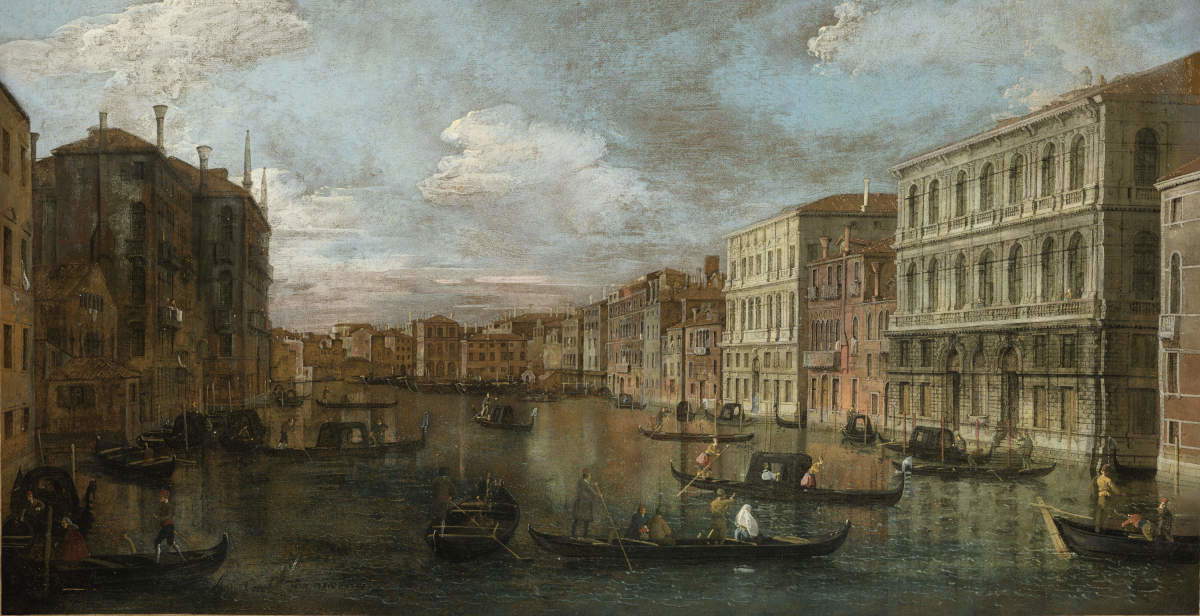
Signed and dated 1744, Canaletto’s painting depicts the Grand Canal as seen from Palazzo Pesaro toward the Fondaco dei Tedeschi. Rediscovered after a long period of obscurity, it was restored and studied before becoming part of the Palazzo Maffei collection in Verona.


An autograph painting by Giacomo Antonio Canal, known as Canaletto (Venice, 1697–1768), has been added to the collection of Palazzo Maffei in Verona. It is a view of the Grand Canal, signed and dated 1744, which has only recently resurfaced and has undergone restoration and new historical-artistic research. The work, titled *The Grand Canal Looking Southeast, from Palazzo Pesaro to the Fondaco dei Tedeschi*, is a new addition to the Venetian painter’s catalog and serves as an important testament to a crucial phase of his career.


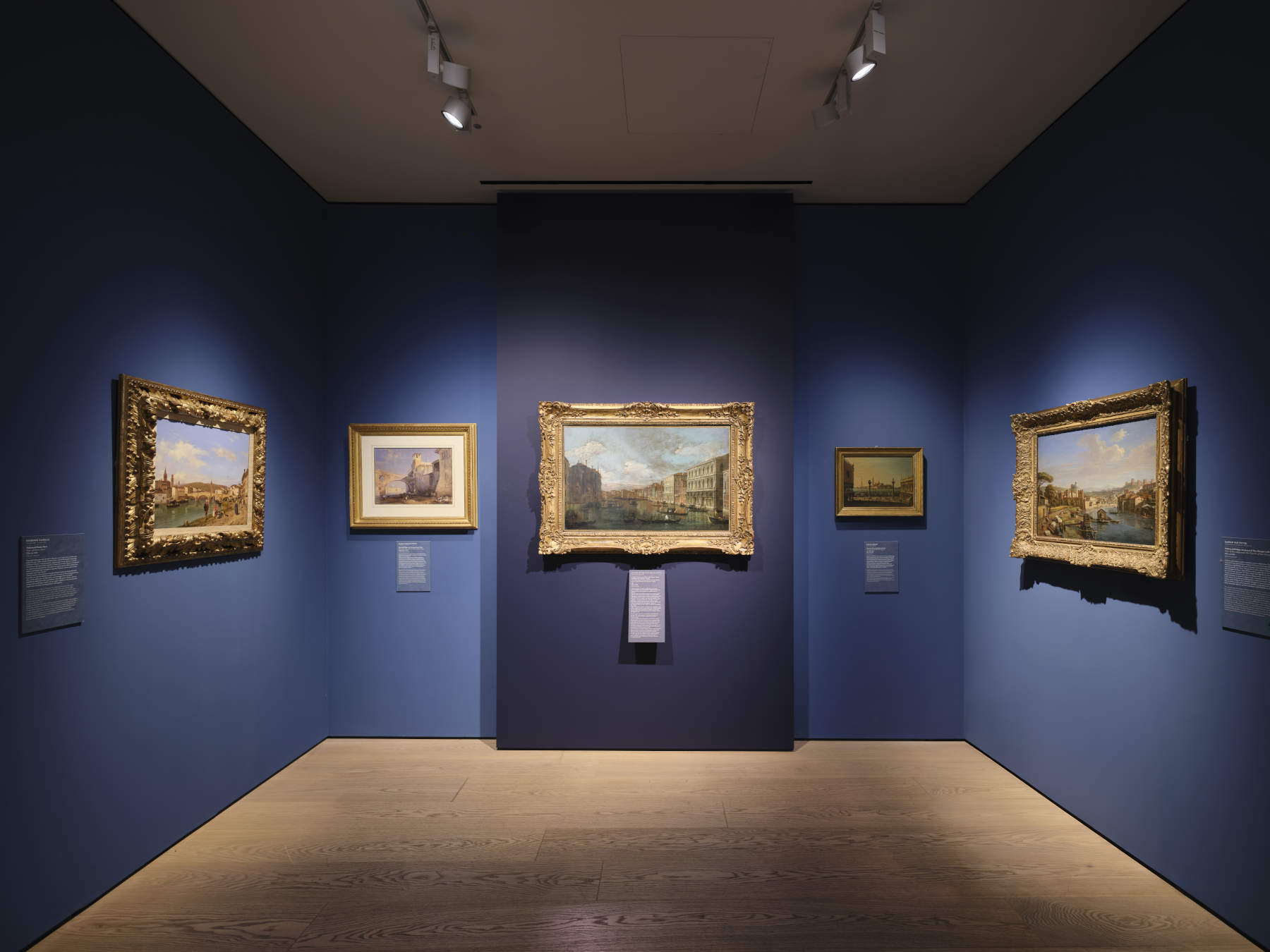
The painting’s inclusion in the Verona museum’s collection was made possible thanks to the interest of collector Luigi Carlon. Its arrival is also of particular significance for the public heritage of the Veneto region: there are, in fact, fewer than ten confirmed works by Canaletto accessible to the public in the region. The painting had been mentioned in 1975 by the Galleria Sacerdoti in Milan in the advertising pages of the magazine *Arte Veneta*, but it remained largely unknown until its recent reappearance.
Infrared and ultraviolet reflectography, the restoration carried out by Carlotta Beccaria, and the studies by Anna Bożena Kowalczyk—one of the leading experts on the artist—all contributed to confirming the painting’s authenticity. The analyses also provided deeper insight into the composition’s documentary value and its place in the painter’s creative trajectory.




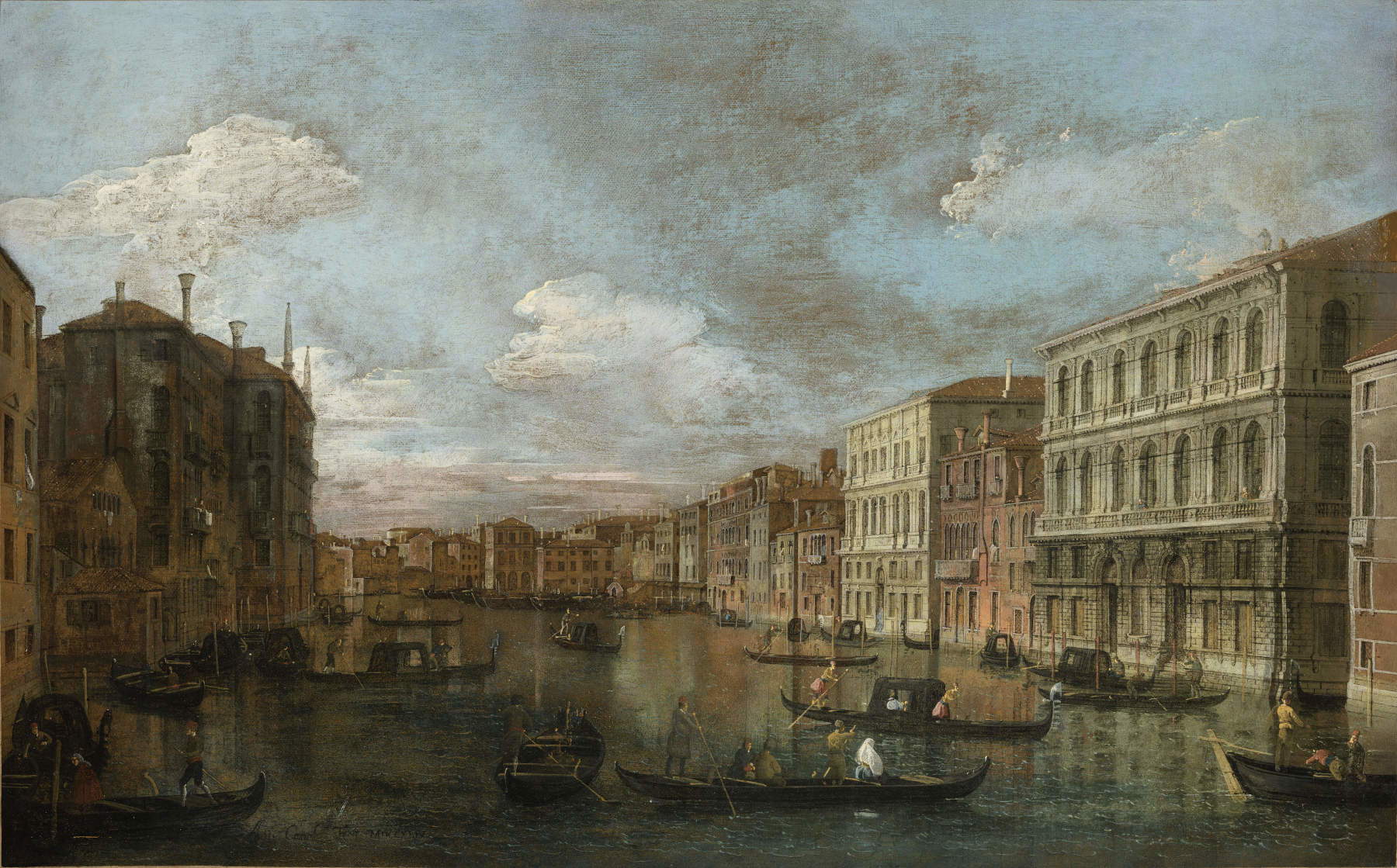
The view depicts the Grand Canal as seen from the center of the waterway, with Palazzo Pesaro in the background and the gaze directed toward Rialto and the Fondaco dei Tedeschi, whose corner with the turret is visible in the distance. In the foreground, Ca’ Pesaro is part of a composition that also includes Ca’ Corner della Regina, bathed in sunlight and separated from the Palazzi Correggio and Donà. On the opposite bank, in the shade, a small palace with a gabled roof appears, identifiable as the buildings later known as Contarini Pisani and Baldù. Further in the distance are Palazzo Fontana, adorned with obelisks; Palazzo Civran; the Fabbriche Nuove di Rialto; and a portion of the Pescheria. The sky is streaked with long, thin clouds, accompanied by soft white cumulus clouds in the upper part of the canvas. On the water, boats and figures are rendered with quick, fluid brushstrokes, while the light lends the scene a rosy hue, characteristic of Canaletto’s mature work.
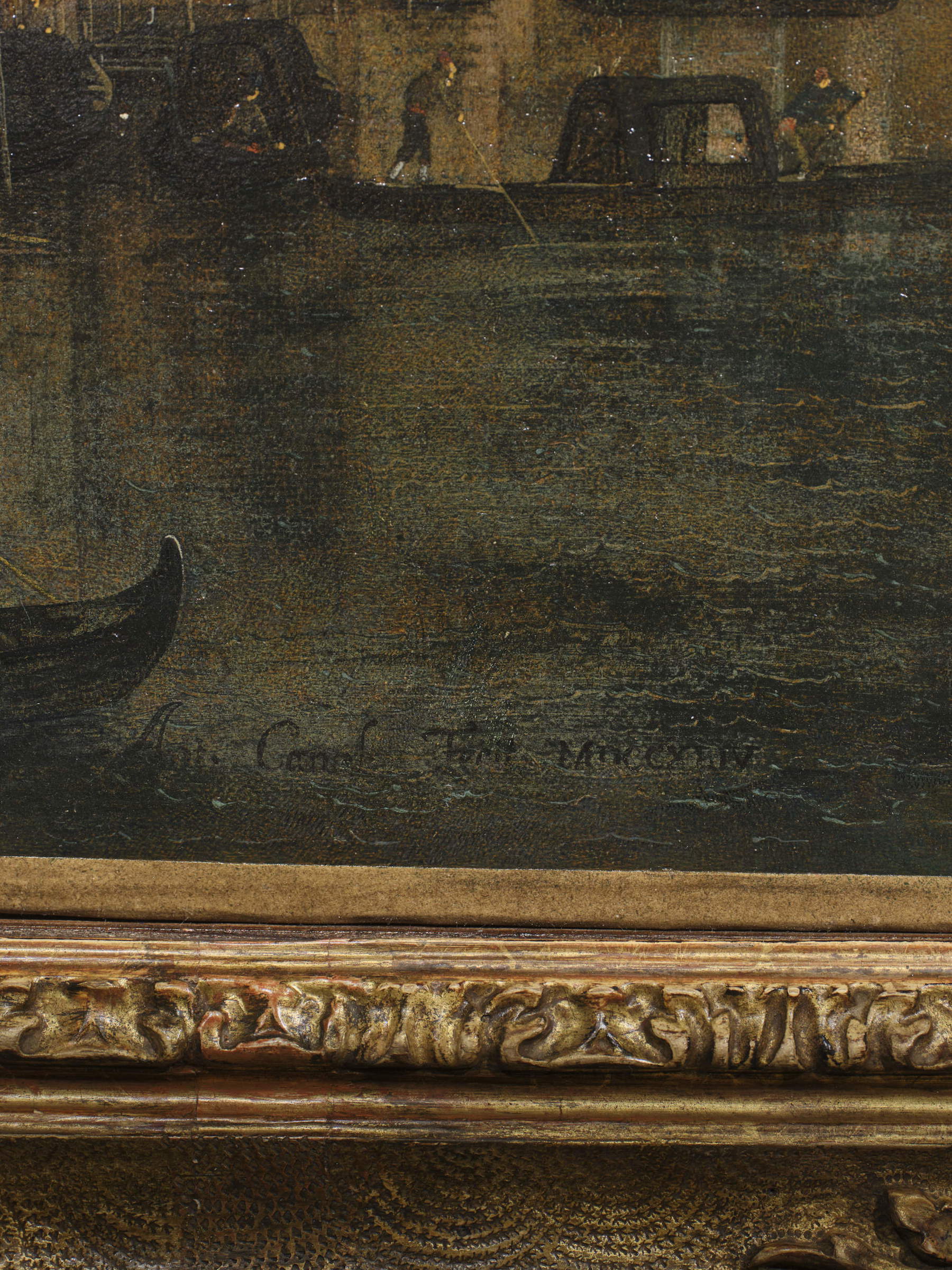
A particularly significant element is the signature in the lower left corner, accompanied by the date: Ant. Canal Fecit MDCCXLIV. This is one of the very few paintings signed by the artist. This decision may also have been linked to the need to distinguish his own work from that of his nephew and pupil Bernardo Bellotto (1722–1780), who as early as 1743 and 1744 was already capable of producing high-quality cityscapes, imitating his master’s style and technique. Canaletto, who was usually reluctant to sign his canvases, may therefore have begun doing so during those very years to make the authenticity of his works more readily recognizable.
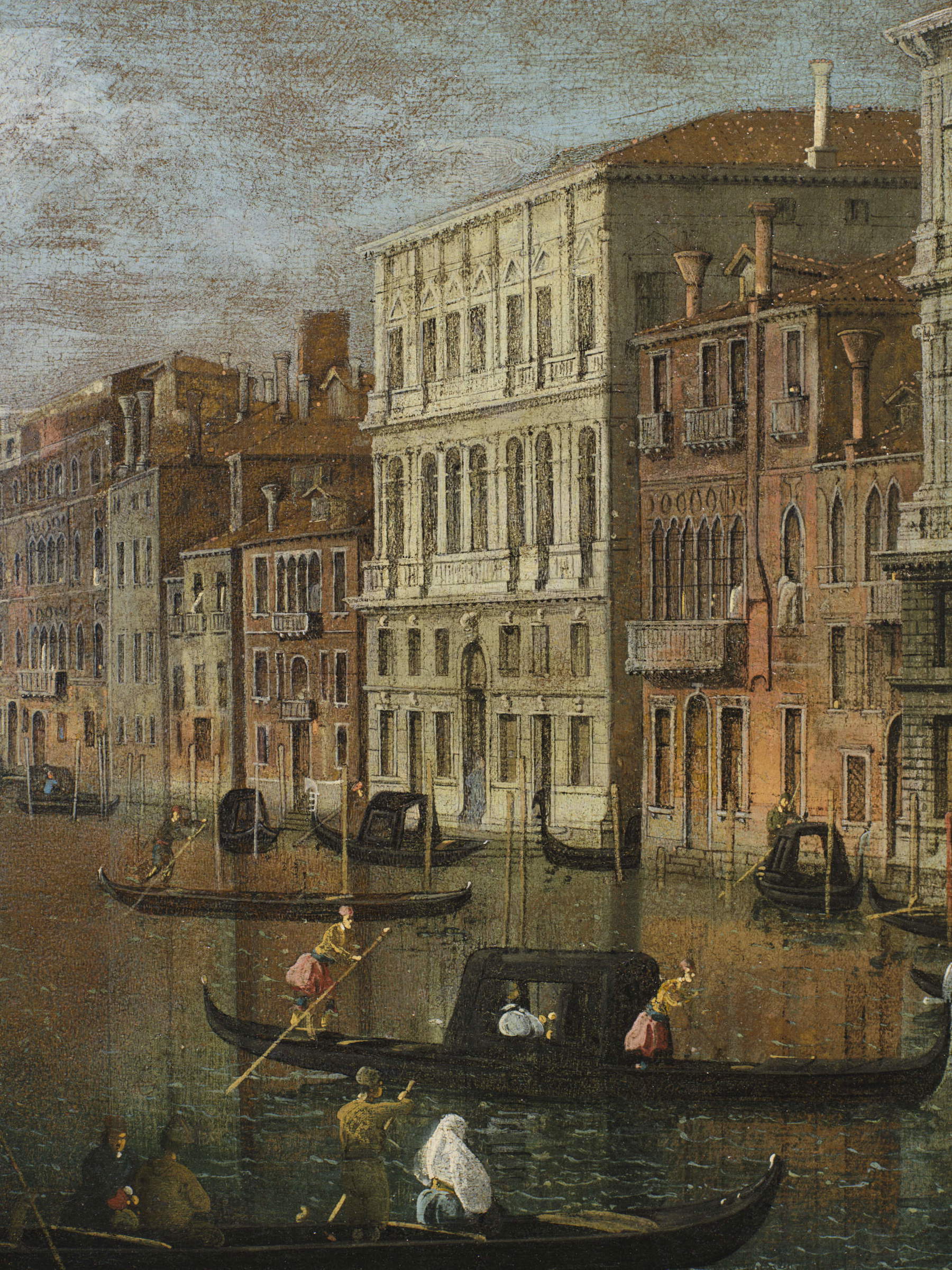
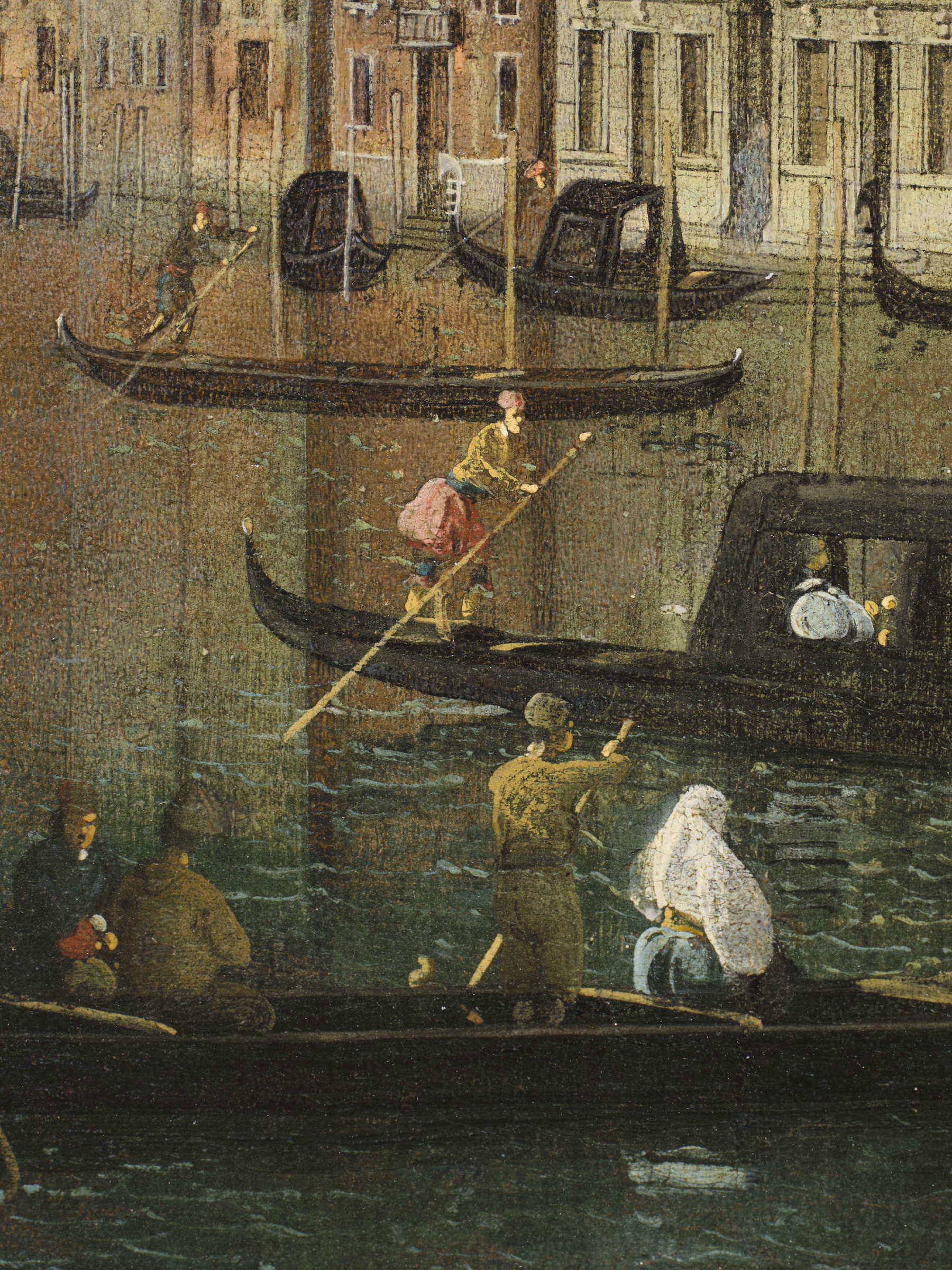
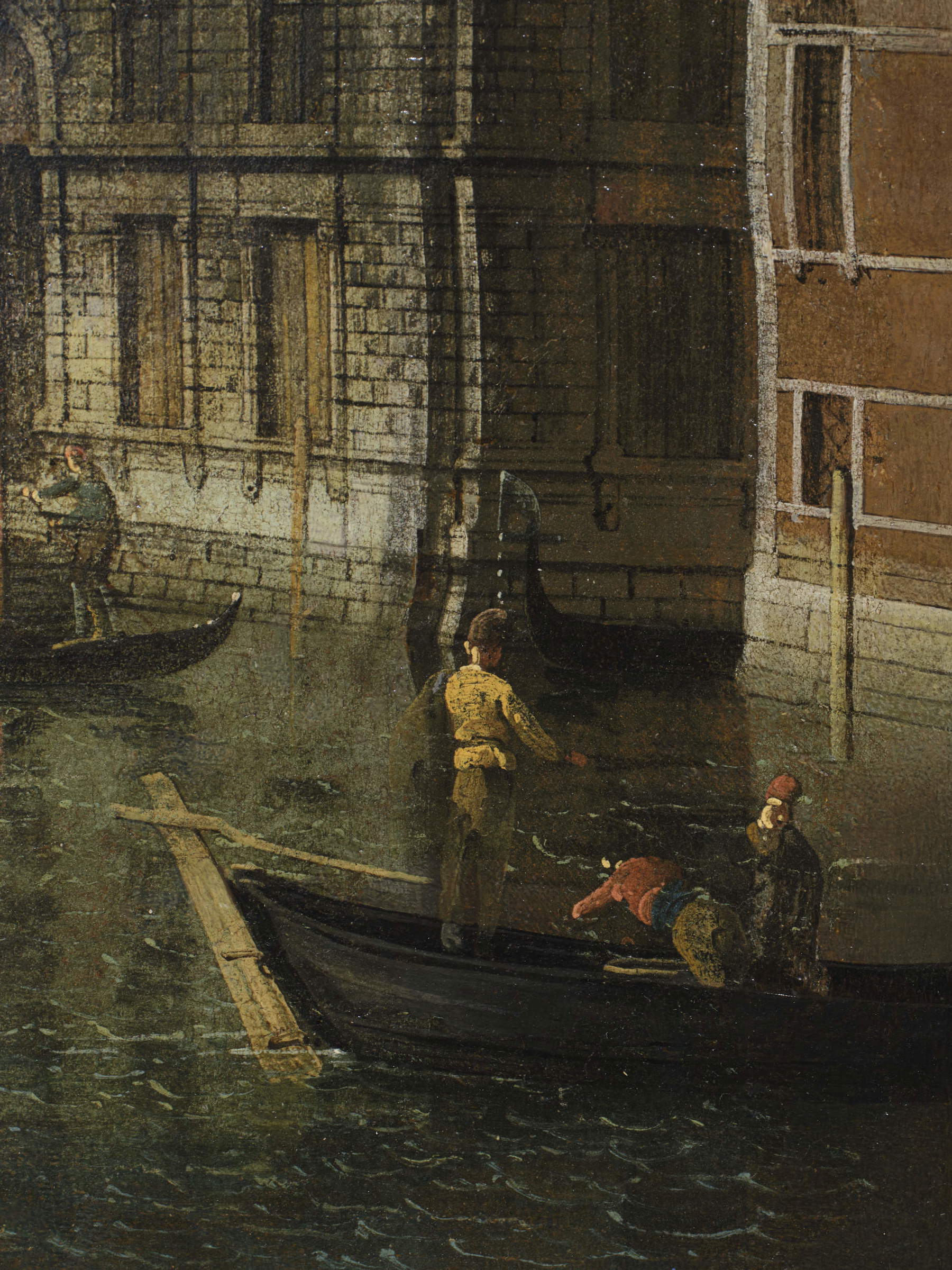
The date of 1744 places the painting at a time when the landscape painter had reached full artistic maturity, shortly before his departure for London in 1746. During this phase, Canaletto’s painting was distinguished by its attention to detail, the pursuit of more complex perspectives, and a distinctive quality of light. A decisive role in the artist’s career was played by the merchant and patron Joseph Smith, who was appointed British Consul in Venice in 1744. As early as the 1730s, Smith had been promoting the painter’s cityscapes among English nobles undertaking the Grand Tour, becoming one of the main intermediaries for his work.
To fulfill his numerous commissions, Canaletto used a camera obscura to create sketches of Venetian buildings, vistas, and events, which he could later rework and combine into new compositions. Among the materials used are those preserved in the so-called Cagnola Album, now housed at the Gallerie dell’Accademia in Venice. It is precisely from these sketches that an earlier version of the view of the Grand Canal—dated around 1734 and preserved in the collection of the Dukes of Bedford at Woburn Abbey—also derives. The canvas at Palazzo Maffei incorporates some elements of that composition but features numerous modifications. As Bożena Anna Kowalczyk notes, Canaletto reused some sheets from the album, adding architectural details absent from the Woburn Abbey version.
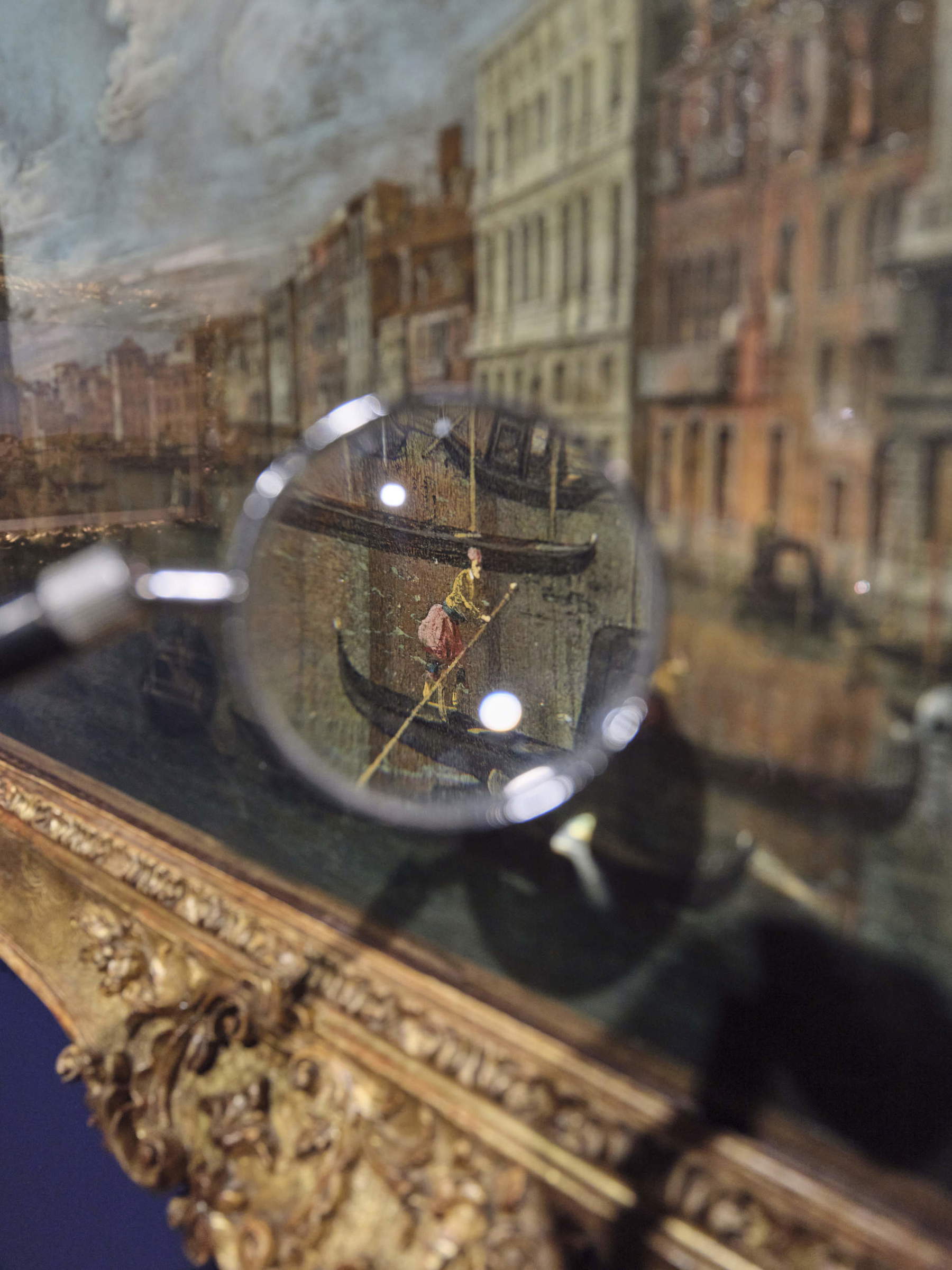
“He adds,” writes Anna Bożena Kowalczyk, “a portion of sheet 71v featuring the small building with the gabled roof, and conducts a new site visit to include the palace on the corner—both of which are absent from the Bedford canvas. For this new composition, he chooses a higher vantage point and completely changes the boats and figures, as well as the movement of the clouds. The row of buildings on the right bank, fanning out in the Bedford painting,…is now presented in a sharper perspective, characteristic of Canaletto since the late 1630s.”
The restoration helped restore clarity to the painted surface, which showed signs of an earlier transfer of paint from one canvas to another. The restoration involved removing the varnish and overpainting that had accumulated over time, allowing the original colors—which turned out to be lighter and more intense—to be revealed. During the restoration, technical details attributable to Canaletto’s painting practices were also identified, including the use of a varied color ground.
The view thus documents a period of experimentation in the Venetian painter’s oeuvre, as he was engaged in those years in the pursuit of bolder, more dramatic perspectives and a more vibrant luminosity. With its acquisition by Palazzo Maffei, the painting returns to the Veneto region and is made accessible to the public, entering into dialogue with the other cityscapes and landscapes in the collection, including Gaspar Van Wittel’s View of Verona on the Adige River near the Church of San Giorgio in Braida (1705).
 |
| A previously unseen Canaletto resurfaces after nearly three centuries: the painting joins the collection at Palazzo Maffei |
Warning: the translation into English of the original Italian article was created using automatic tools. We undertake to review all articles, but we do not guarantee the total absence of inaccuracies in the translation due to the program. You can find the original by clicking on the ITA button. If you find any mistake,please contact us.