





Annibale Carracci’s *River Landscape with Boatmen* (Bologna, 1560–1609), perhaps the work that generated the most buzz during the 34th edition of the Florence International Antiques Biennale, which runs through October 4 at Palazzo Corsini, has been sold. The canvas, a 66-by-86-centimeter oil painting dating from the late 1580s, presented at the exhibition by the Rimini-based gallery Alice Fine Art, had received the Painting Prize—awarded each year to the best painting at the event— and has now also been sold, as confirmed by the gallery, which, for reasons of confidentiality, declined to disclose either the buyer’s identity or the transaction price.
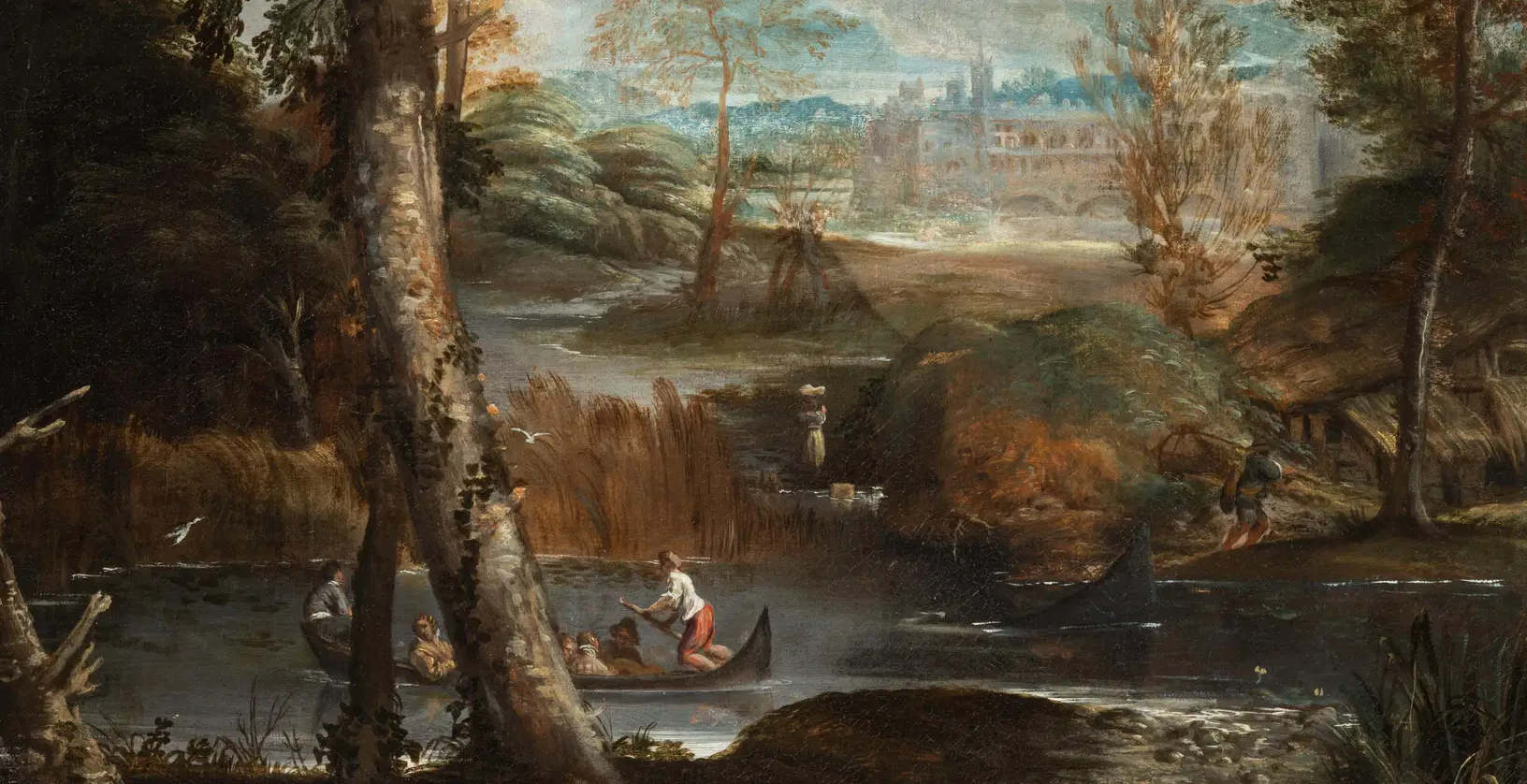
The painting depicts a waterway crossed by a small boat, set amid dense vegetation consisting of trees and reeds. The human figures in the scene play a secondary role to nature, to the point that they seem almost absorbed by their surroundings. It is precisely this relationship between man and landscape that makes the painting particularly significant in Annibale Carracci’s artistic development: here, nature is not merely a backdrop for the unfolding of a story, but acquires an autonomous presence and becomes the true subject of the depiction.
The canvas belongs to an important phase in the Bolognese painter’s artistic development, when the landscape began to be conceived no longer merely as an accessory to the composition, but as a genre with its own autonomy: Carracci constructs the scene through rapid, fluid brushwork, in which light and shadow alternate among the vegetation and across the various planes of the view, and the diffused light helps unify the space and create a soft atmosphere, while the brushwork keeps the landscape in a state of movement and vitality. It can be said that this is one of Carracci’s earliest paintings—if not the very first—in which nature no longer serves as a backdrop to an episode of another genre—whether evangelical, biblical, or mythological—but becomes an autonomous subject.
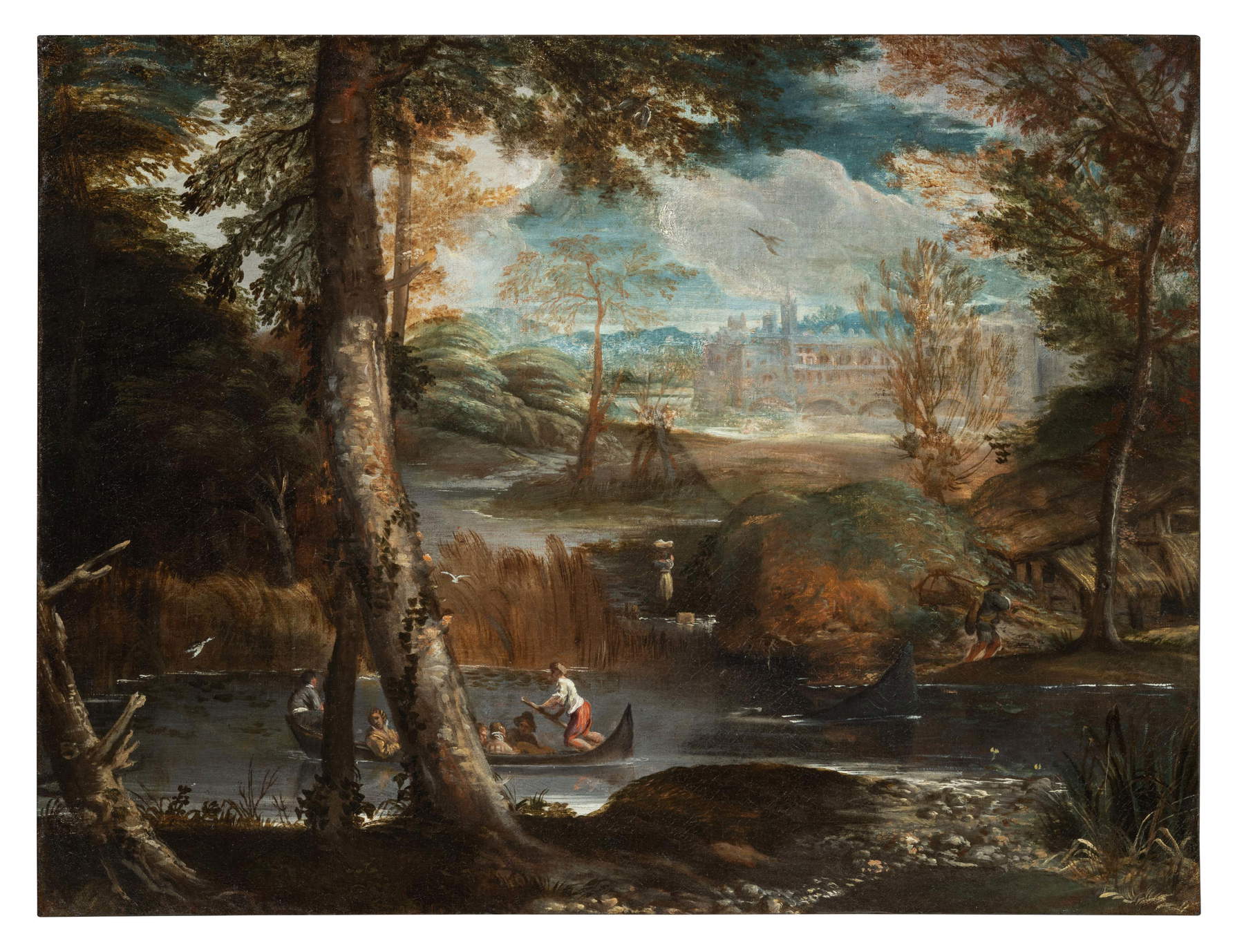
What makes the painting even more interesting is its history in the art world and among art historians. The work was initially in the Platky Collection in Leipzig, before passing to the collection of Fritz Haussmann in Berlin. It was Hermann Voss who first attributed it to Annibale Carracci in 1919; the scholar revisited the work in 1931, when the painting was still in the Haussmann collection. The painting was subsequently sold—presumably by Haussmann himself—to a Swiss collector, whose heirs have preserved it to the present day. Although it had previously been known only through a photograph, the work has maintained a presence over time in the critical literature following Voss’s publications, and its reappearance at the BIAF thus allows us to once again directly observe a painting that belongs to a particularly important phase of Annibale’s experimentation with the theme of nature.
Landscape is, in fact, one of the areas in which the Bolognese painter developed an artistic exploration destined to have lasting consequences. In *River Landscape with Boatmen*, the natural elements are not subordinate to the presence of the figures: trees, water, reeds, and light determine the composition of the image and establish its rhythm. The boat crossing the river appears almost as a minor element within a much vaster space, while the viewer’s gaze is guided through the vegetation toward successive planes, progressively immersed in light.
Venetian painting is one of the influences evident in the canvas. Annibale had the opportunity to experience it firsthand during a trip he took with his brother Agostino in late 1587, an experience that contributed to his understanding of the Venetian tradition. The painting particularly highlights an interest in the effects of light and in the ability of color to create atmosphere. The reference to Titian is most evident in the soft, enveloping tones and in the exploration of light. But in Carracci’s landscape, the Venetian influence is reworked in a different direction. The solemnity and scenographic composition of the great Venetian landscape tradition are replaced by a view characterized by greater naturalness. Nature does not simply appear organized as a monumental composition; rather, it seems observed in its concreteness, through a style of painting capable of conveying its atmosphere. This is also why the painting holds a significant place in the development of Annibale Carracci’s landscape art; he experimented with various genres during the transition from the sixteenth to the seventeenth century, developing a visual language destined to exert a strong influence on the painting of subsequent generations. In landscape painting, one of the most innovative directions of his artistic exploration lies precisely in the recognition of nature as an autonomous subject.
In *River Landscape with Boatmen*, this shift is particularly evident, and the result is a view in which the observer can lose themselves among the various planes of nature, following the course of the water and the succession of trees and reeds. The canvas on display in Florence thus belongs to a phase in which Carracci is helping to transform the very way landscape is understood in Italian painting: its significance lies not only in the quality of the view or the collecting history associated with it, but also in the historical-artistic moment to which it belongs—namely, the period in which nature began to emancipate itself from the subordinate role it had played in much of the preceding tradition. Evidently, whoever purchased the painting took these aspects fully into account and succeeded in acquiring not only a testament to the birth of the 17th-century landscape, but a concrete work in which a boat, some boatmen, the water, trees, and reeds are enough to create a scene in which nature, rather than man, occupies the center of the viewer’s attention.
 |
| Annibale Carracci’s landscape, which caused quite a stir, was sold at the BIAF |

Warning: the translation into English of the original Italian article was created using automatic tools. We undertake to review all articles, but we do not guarantee the total absence of inaccuracies in the translation due to the program. You can find the original by clicking on the ITA button. If you find any mistake,please contact us.

























 IT
IT FR
FR DE
DE ES
ES CN
CN


