




by Redazione 13/10/2026



Categories: Ancient art / Disclaimer
In Brescia, the Tassara Foundation acquired *The Good Samaritan*, a masterpiece by Romanino, and loaned it to the Pinacoteca di Brescia. The painting depicts a Gospel parable rarely seen in Renaissance art and conceals unusual details, perhaps linked to its mysterious patron.


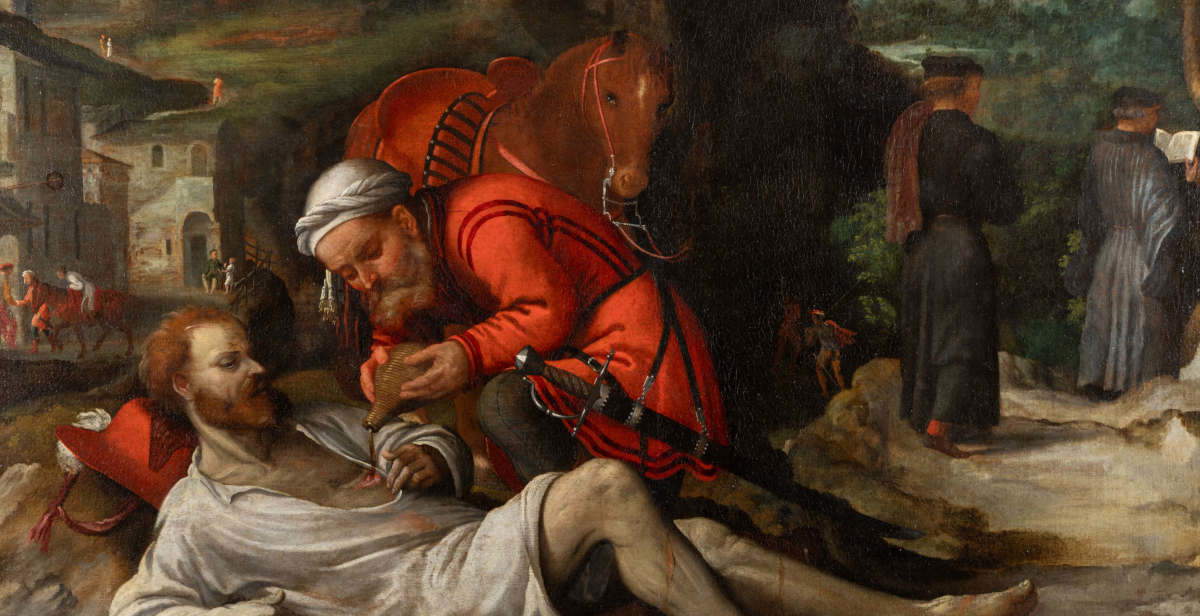
An important addition to the Tosio Martinengo Art Gallery in Brescia: a painting depicting the Good Samaritan by Girolamo Romanino has been loaned to the Brescia Museums Foundation by the Tassara Foundation. The scene depicts one of the most famous parables from the Gospel of Luke, but does so with a richness of detail and narrative elements that is far from typical in Italian Renaissance painting. In Romanino’s painting, a wounded man lies on the ground, nearly lifeless. A traveler bends over him and tends to a wound in his side, while in the background, several armed men walk away after robbing him. A little further on, two monks continue on their way without stopping. The work, an oil on canvas measuring 155 by 120 centimeters, painted around 1540, enriches Room VII of the Pinacoteca, dedicated to private devotion. Its addition represents more than just an expansion of the collections: the painting introduces a subject previously absent from the museum and allows for a deeper understanding of Romanino, one of the leading figures in Brescian painting of the early 16th century, highlighting his penchant for concrete storytelling, attentive to gestures and everyday reality.


The Gospel parable tells of a man attacked by robbers on the road from Jerusalem to Jericho. A priest and a Levite see him but pass him by. Instead, a Samaritan—a member of a people viewed with suspicion by the Jews of the time—comes to his aid: he bandages his wounds, takes him to an inn, and pays for his care. When asked who acted as a neighbor toward the wounded man, Jesus responds by overturning every formal hierarchy: what matters is not the religious role of the one who encounters the person in need, but the compassion that drives him to help. In the history of Italian art, this story has enjoyed relatively limited popularity. Romanino approaches it with an unusual narrative breadth, depicting on the canvas not only the central episode but also—unusually—the circumstances leading up to it and the consequences of the rescue. The viewer can thus follow the entire story through a sequence of scenes unfolding within the landscape, almost as if the painted surface were a narrative divided into several moments.


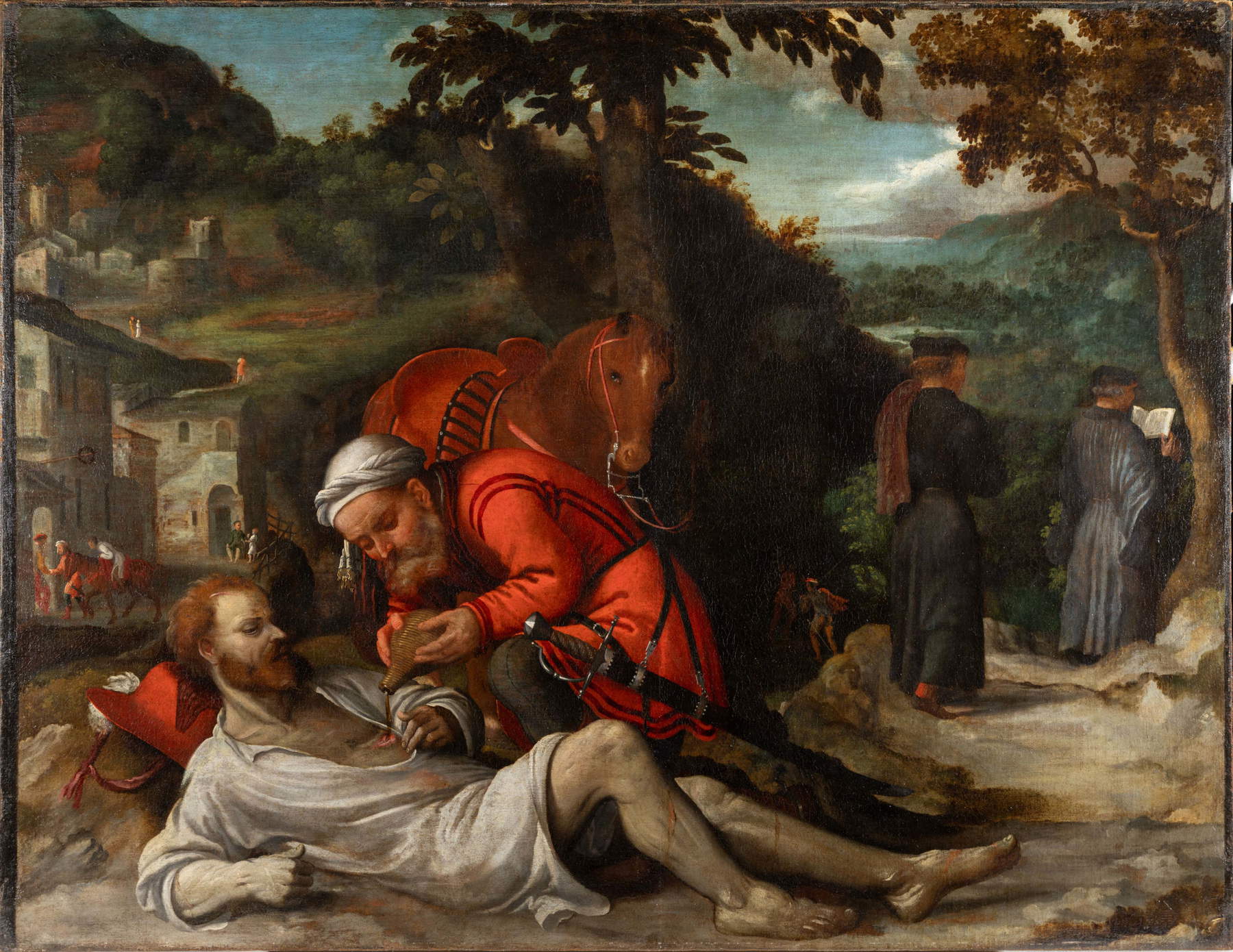
In the center, the Samaritan bends over the wounded man and pours a liquid—likely oil or wine, as in the Gospel account—from a flask onto one of his wounds. The body of the man being helped has a grayish complexion, which underscores his dire condition, while the rescuer’s gesture is careful and measured. The wound in his side may allude to the one inflicted on Christ during the crucifixion, introducing a possible symbolic interpretation into the depiction of an act of charity. Behind the two men stands a horse—an animal with an imposing presence—which turns its gaze toward the viewer. A large, dark tree trunk occupies the center of the composition and visually separates the various scenes; this element, too, could take on a Christological meaning, as it evokes the wood of the cross. These are possible interpretations that demonstrate how rich the scene’s composition is in allusions and how it extends beyond a simple illustration of the biblical narrative.


Romanino arranges the other moments of the parable on either side of the main group. On the right, in a landscape that fades into the distance amid the outlines of buildings and bluish mists, the fleeing attackers can be glimpsed. Their figures, armed and agitated, seem to belong more to the military reality of the sixteenth century than to an indistinct biblical past. A little further on, the priest and the Levite appear, dressed in black, continuing on their way without offering aid to the man on the ground. Their demeanor is almost haughty, in contrast to the Samaritan’s active compassion. The painter, therefore, does not merely distinguish the characters through their actions: he characterizes them with clothing, postures, and details that make the moral interpretation of the story more immediate. The choice to set the story in a landscape reminiscent of the Lombard Pre-Alps also helps to bring the Gospel episode closer to the sensibilities of the artist’s contemporary audience.
On the left side of the canvas, meanwhile, the concluding part of the story unfolds. The wounded man is carried on horseback to an inn, where the Samaritan pays the innkeeper to care for him. The rustic houses, built of stone and brick, are depicted with care, as are the roof and the building’s sign. These details evoke a familiar setting in the eyes of an early 16th-century observer. The narrative seems to extend even beyond what is recounted in the Gospel. In the distance, an old man is seen sitting in front of a house and a child in a white robe—a presence whose meaning cannot be determined with certainty. It could be an episode added to ideally complete the story, as if the tale of charity were being passed on to a new witness. Further in the background, however, a traveler carrying a small bundle is heading toward a city, where other figures appear to be waiting for him. This scene, too, could allude to the conclusion of the rescued man’s journey, now that he has recovered.
One of the most intriguing aspects of the painting, however, concerns the identity of the Good Samaritan himself. His face is rendered in an almost portrait-like manner, while his bright red robe and turban clearly distinguish him from the other figures. At his side he carries a sword with a curved blade, the shape of which has been likened to a dussack, a weapon common in Central Europe: this is another unusual element that could provide a clue as to the possible identity of the patron. The origin of the work is, in fact, unknown. The format, not intended for a monumental altarpiece, suggests a private setting or one associated with a confraternity, and the choice to depict the parable of the Good Samaritan in particular may have been connected to an act of charity—perhaps a bequest to a charitable institution. From this perspective, the central figure might bear a resemblance to the person who commissioned the painting, eager to identify with the act of aid and its moral significance. The hypothesis remains open: the sword, in particular, could indicate a figure of foreign origin, perhaps a soldier from Central Europe who had settled in Brescia. In this case, the Good Samaritan from the Gospel story—a figure outside the injured man’s religious group—might have become an image through which to represent a personal condition and affirm the social value of one’s generosity. A striking red hat with a white feather, placed beneath the injured man’s head, has also been considered a significant detail, although it is difficult to attribute a precise meaning to it.
What makes the story even more interesting is a print created in 1543 by Georg Pencz, a German painter and engraver trained in the circle of Albrecht Dürer. The engraving follows a composition very similar to Romanino’s, but modifies certain elements: the Good Samaritan appears less distinctively rendered, the sword loses some of its distinctiveness, and the horse is scaled down and moved behind the tree trunk. Above all, the priest and the Levite take on a less prominent role, while the episodes added by Romanino on the left side are omitted. These differences have fueled debate about the relationship between the two works. According to one interpretation, the painting may be derived from the engraving; another hypothesis, supported by art historian Carlo Bertelli and scholar David Landau, suggests instead that it is possible Pencz was familiar with the painting and created a version more faithful to the Gospel account, toning down its more anomalous and potentially controversial aspects. If this were the case, Romanino’s painting would have been in public circulation as early as the sixteenth century, making it accessible to a foreign artist traveling through Italy.
The matter has not been definitively resolved. A further point of comparison is a painting dated 1537 and housed at the Rijksmuseum in Amsterdam, attributed to the so-called Master of the Good Samaritan. The canvas features a similar composition and could represent a precedent for both Romanino and Pencz’s print. This comparison, too, invites us to consider the Brescian painting within a network of images and models circulating in sixteenth-century Europe.
The documentary history of the work is equally fragmentary: the first known record dates back to Giovanni Battista Carboni, who saw it in the collection of the Maffei family of Brescia before 1760; the collection subsequently passed to the Fenaroli counts through a marriage, and the painting may have remained in that family until the late nineteenth century. After further changes of ownership, it was purchased in 1925 by the art historian Pietro Toesca and published that same year by Nicodemi, who indicated that it was located in Florence. Through Toesca’s daughter, Ilaria, the painting passed to her heirs, until it was acquired by the Tassara Foundation.
The scholarly literature has unanimously attributed the work to Romanino, and it was displayed in exhibitions dedicated to the painter in Brescia in 1965 and in Trento in 2006. The most widely accepted date is around 1540, although Alessandro Nova, in his 1994 monograph, proposed dating it closer to 1544, based on a different interpretation of its relationship to Pencz’s engraving. A restoration carried out in 2018 also made it possible to lighten the amber patina of the old varnish, revealing a more vibrant and clear color palette. The canvas consists of two panels joined by a central vertical seam and retains traces of a previous lining on the reverse.
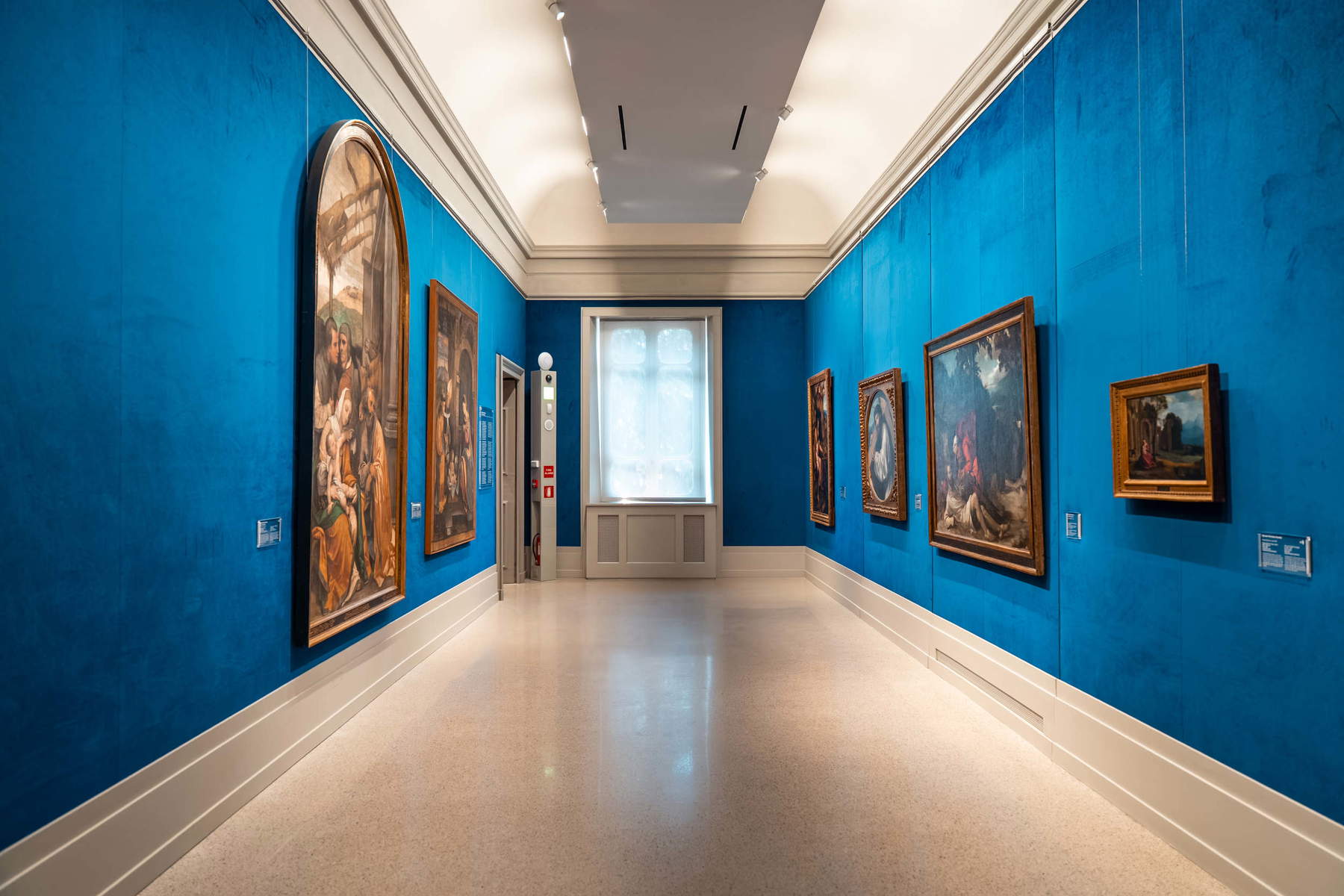
Its arrival at the Pinacoteca Tosio Martinengo now allows the painting to be viewed within the context of early 16th-century Brescian painting. Room VII brings together works by Romanino, Moretto, and Savoldo, alongside works by Callisto Piazza and Giovanni Cariani. These are small- and medium-sized paintings, commissioned for chapels, oratories, confraternities, and private residences, in which the depiction of the sacred is accompanied by a particular focus on the everyday aspects of reality (naturalism, the exploration of color, and the emotional closeness to the figures were intended to draw the viewer into the religious narrative, making its meaning more immediately accessible).
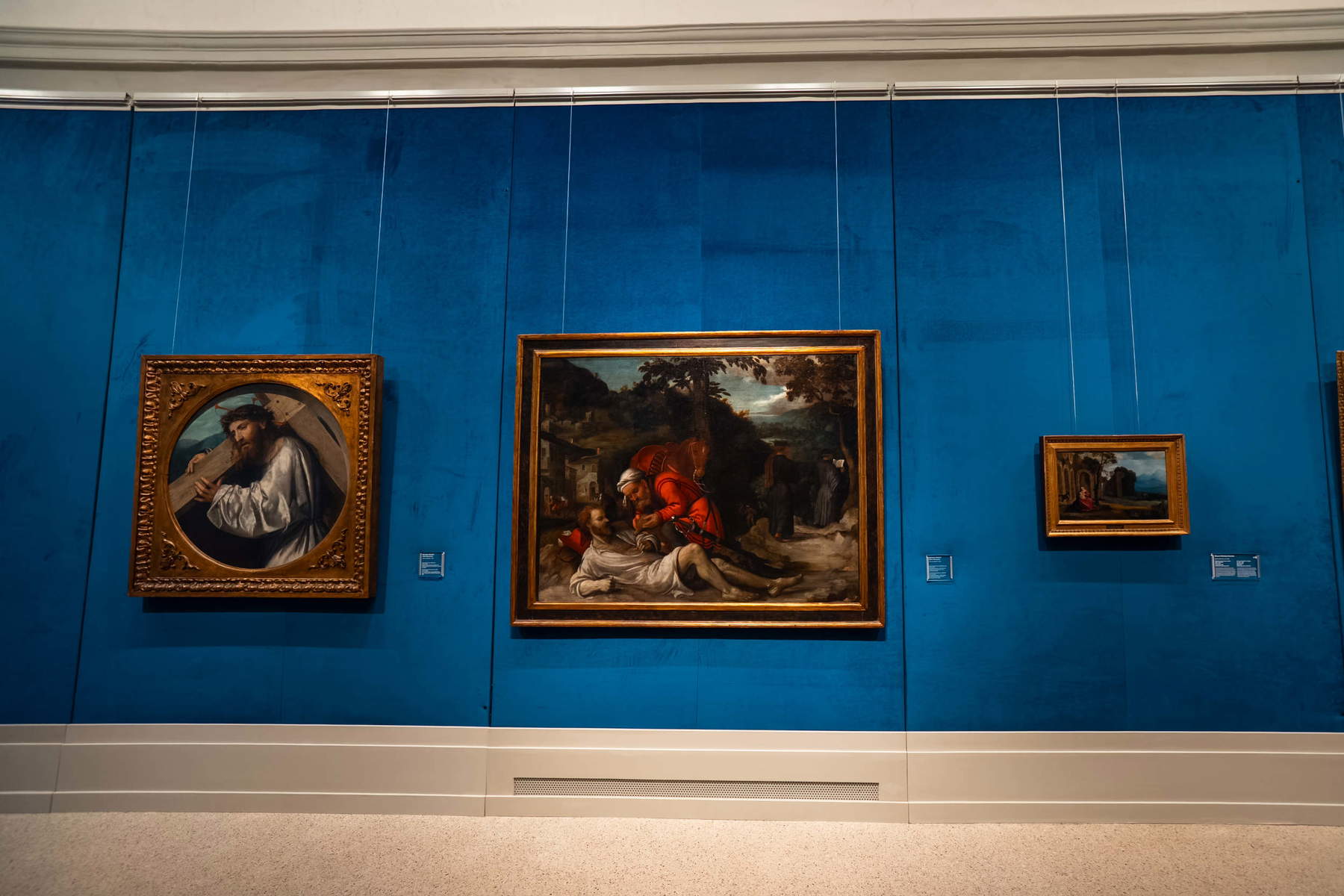
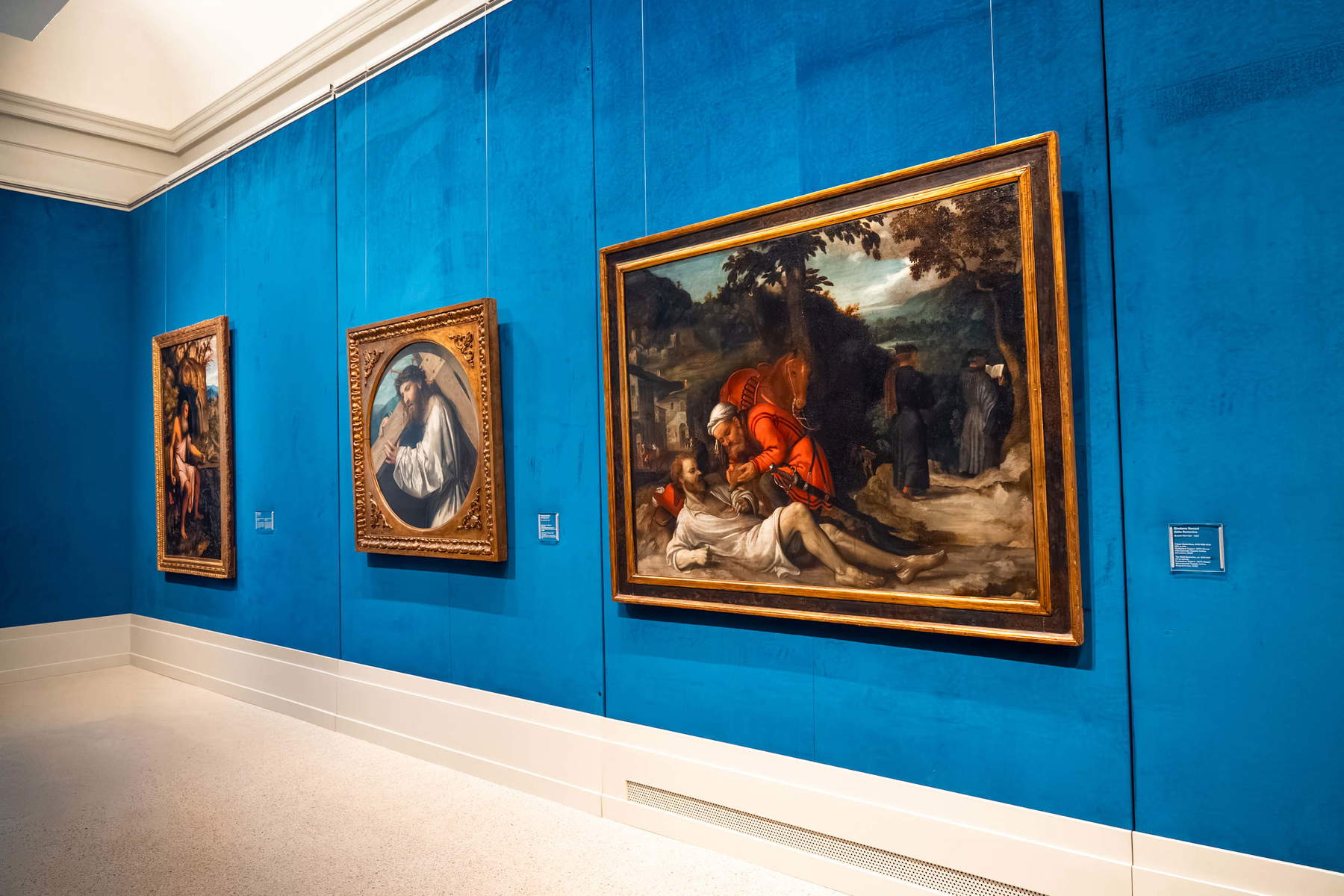
In this setting, *The Good Samaritan* enters into dialogue with two other works by Romanino already on display: *Saint Jerome * and *Christ Carrying the Cross*. This comparison allows for a deeper exploration of the variety of his painterly exploration and the anti-classical character of a visual language that prioritizes expressive intensity and narrative concreteness. The painting also stands alongside Cariani’s*Christ’s Encounter with Veronica*, in which Venetian tradition intertwines with the Lombard attention to natural details and with influences of Northern origin. The addition of the new painting has also led to some changes in the gallery’s layout, which have redefined the visual relationships between the works.
Finally, the theme of charity—central to the parable—echoes the social reality of sixteenth-century Brescia, where hospitals, orphanages, pious institutions, and confraternities dedicated to assisting the sick and the destitute were widespread. One of these institutions may well have been the canvas’s original destination, although no documents currently exist that would allow us to identify it. The painting thus also serves as an indirect yet significant testament to the role that solidarity played in city life.
The acquisition by the Tassara Foundation and the loan to the Brescia Museums Foundation now bring *The Good Samaritan* back into the public sphere and make available to the city a work that for centuries remained in private collections. This new addition is part of a process of expansion at the Pinacoteca, which, since 2019, has led to the arrival of twenty-seven new works through acquisitions and loans. Now Romanino’s painting adds a new chapter to this story: a rare work, rich in questions, that combines artistic exploration with the memory of charity and the shared creation of cultural heritage.
Statements
“The arrival of Romanino’s *The Good Samaritan* at the Tosio Martinengo Art Gallery,” says Brescia Mayor Laura Castelletti, “is the result of an initiative of great cultural and civic value, demonstrating how the development of public heritage can continue to grow thanks to collaboration among institutions, foundations, and members of the community. This work significantly enriches the city’s collections, filling an important gap in the narrative of Brescia’s Renaissance and offering citizens and visitors a new and extraordinary perspective on Romanino’s painting. Special thanks go to the Tassara Foundation for the generosity with which it chose to acquire the painting and make it available for public enjoyment. This gesture confirms that, where there is a will, culture can serve as the ideal arena for expressing responsibility toward the community and future generations. Starting today, Brescia has yet another treasure to showcase and preserve, and I am certain that Fondazione Brescia Musei will do so to the best of its ability.”
“The significance of this acquisition for the Fondazione Brescia Musei lies in the manner in which the painting is now becoming part of the Tosio Martinengo Art Gallery’s collection,” adds Francesca Bazoli, president of the Fondazione Brescia Musei. “The Good Samaritan does not, in fact, belong to a private individual who, having owned it for generations within their family, chose to donate it to the museum: it was acquired by the Tassara Foundation with the explicit purpose of making it available to the city and thus contributing to the enrichment of the civic collection. This is a concrete example of how public heritage can continue to grow through collaboration between institutions and members of the community—a community that has clearly recognized the role of the Fondazione Brescia Musei as an infrastructure at the city’s disposal for generating social and cultural impact.”
“The collaboration between the Tassara Foundation,” says its president, Flavio Pasotti, “and the Brescia Museums Foundation is not a one-off event but began with the first exhibition in Brescia co-produced for the ‘Bergamo-Brescia Capitals of Culture’ initiative and has continued in recent years, becoming an important part of the city’s cultural fabric. The Tassara Foundation’s partnership with MITA is not an isolated event but rather a dialogue with institutions, associations, and foundations as a means of mutual growth. The acquisition of *The Good Samaritan*, which will be on display starting today at the Tosio Martinengo Art Gallery, complements that of Romanino’s tapestry on cardboard, which was displayed on loan from a private collection at the Renaissance exhibition and acquired by the Tassara Foundation in the same spirit of returning the city’s historical and artistic heritage to it.”
“The arrival of Romanino’s new masterpiece, loaned by the Tassara Foundation to the Tosio Martinengo Art Gallery,” says Stefano Karadjov, director of the Brescia Museums Foundation, “takes on exceptional significance in light of the upcoming opening of the major exhibition dedicated to the Bicentennial of Brescia’s Civic Museums : ‘Treasures. The Great Story of Brescia’s Museums. 1826–2026, which, starting November 4 at the Santa Giulia Museum, will tell the story of the civic collections by highlighting the contributions of citizens, collectors, organizations, and institutions in building a participatory museum narrative that reflects the entire community. “The acquisition of this painting offers a highly relevant example of this very dynamic: the promotion of cultural heritage as the result of a shared process, in which a commitment to the city’s culture can translate into a concrete decision to acquire a work and make it available to the public.”
 |
| Brescia: A masterpiece by Romanino on loan to the Tosio Martinengo Art Gallery |
Warning: the translation into English of the original Italian article was created using automatic tools. We undertake to review all articles, but we do not guarantee the total absence of inaccuracies in the translation due to the program. You can find the original by clicking on the ITA button. If you find any mistake,please contact us.