





In February 1798, while French troops were occupying Rome, proclaiming the Roman Republic, and arresting Pope Pius VI, the Jacobin authorities summoned Antonio Canova ( Possagno, 1757 – Venice, 1822) to appear before the Section of the Arts of Design at the National Institute. The Venetian sculptor was asked to take a formal oath containing the prescribed formula: “I swear hatred for sovereigns… ”. Canova, a mild-mannered man far removed from fanaticism and deeply connected to papal circles and the international aristocracy that frequented the capital, did not lose his composure: he simply stood up and replied in his native language with a few words destined to become famous: “I hate no one.”
For the artist, who had experienced the entry of the revolutionary armies into Italy as a traumatic event and who, in 1797, had watched helplessly as his Republic of Venice dramatically fell, the pressure from the new regime marked a turning point. Although at first the French generals had vied with one another to honor and “flatter” him, the demand for that oath and the shock of the collapse of the political and social order in which he had lived drove him to flee. In May 1798, he therefore left Rome and took refuge in the tranquility of his hometown, Possagno, remaining there until November 1799. During this self-imposed exile in Treviso, Canova decided to suspend his sculptural work almost entirely to devote himself to an exceptional and introspective period of painting. It was precisely during this period— which began as a personal response to the dramatic events of history—that the painting depicting the Penitent Magdalene came into being ; the Carlo Orsi Gallery has brought this work to the 2026 edition of the International Antiques Biennale in Florence, with an asking price of 350,000 euros.
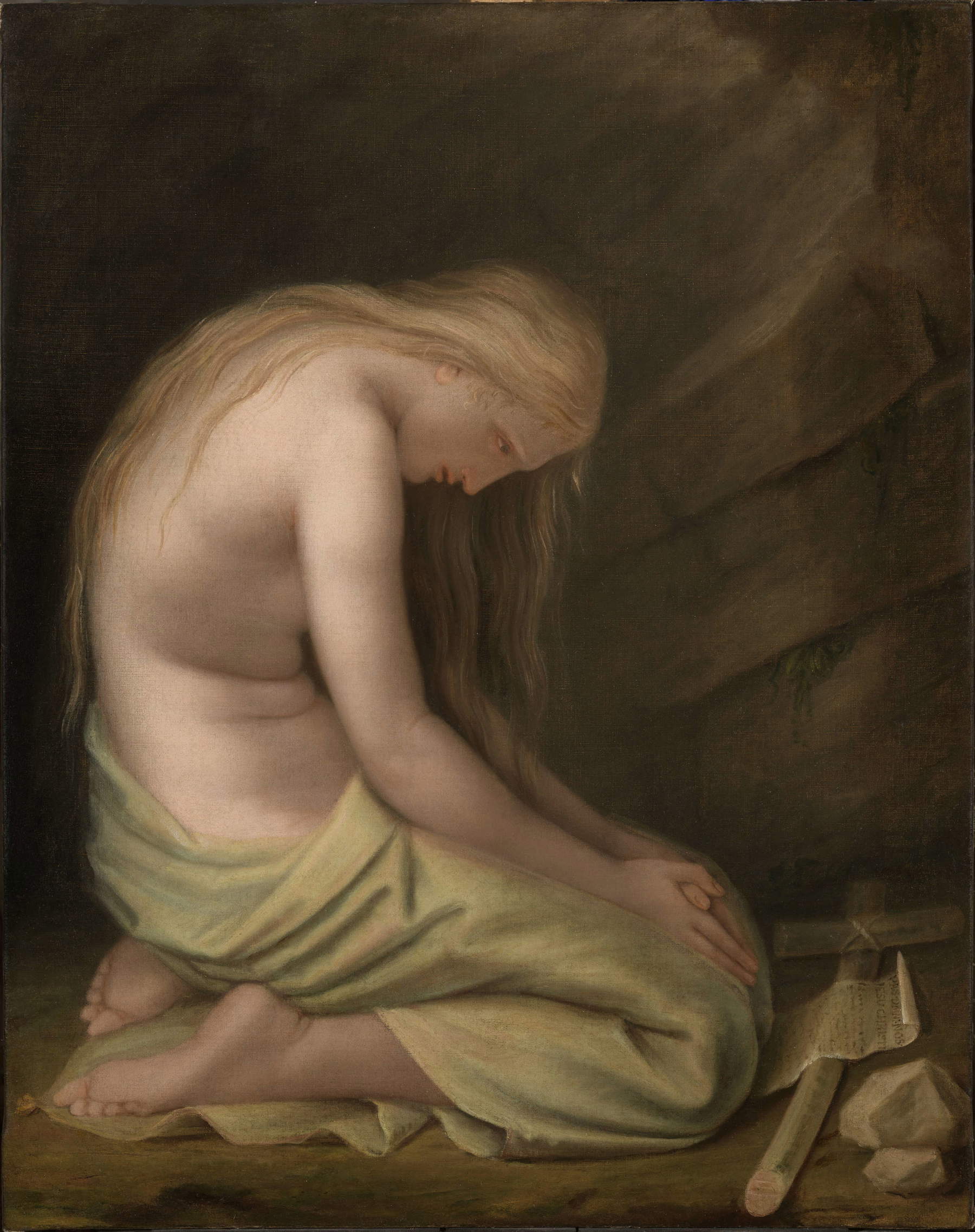
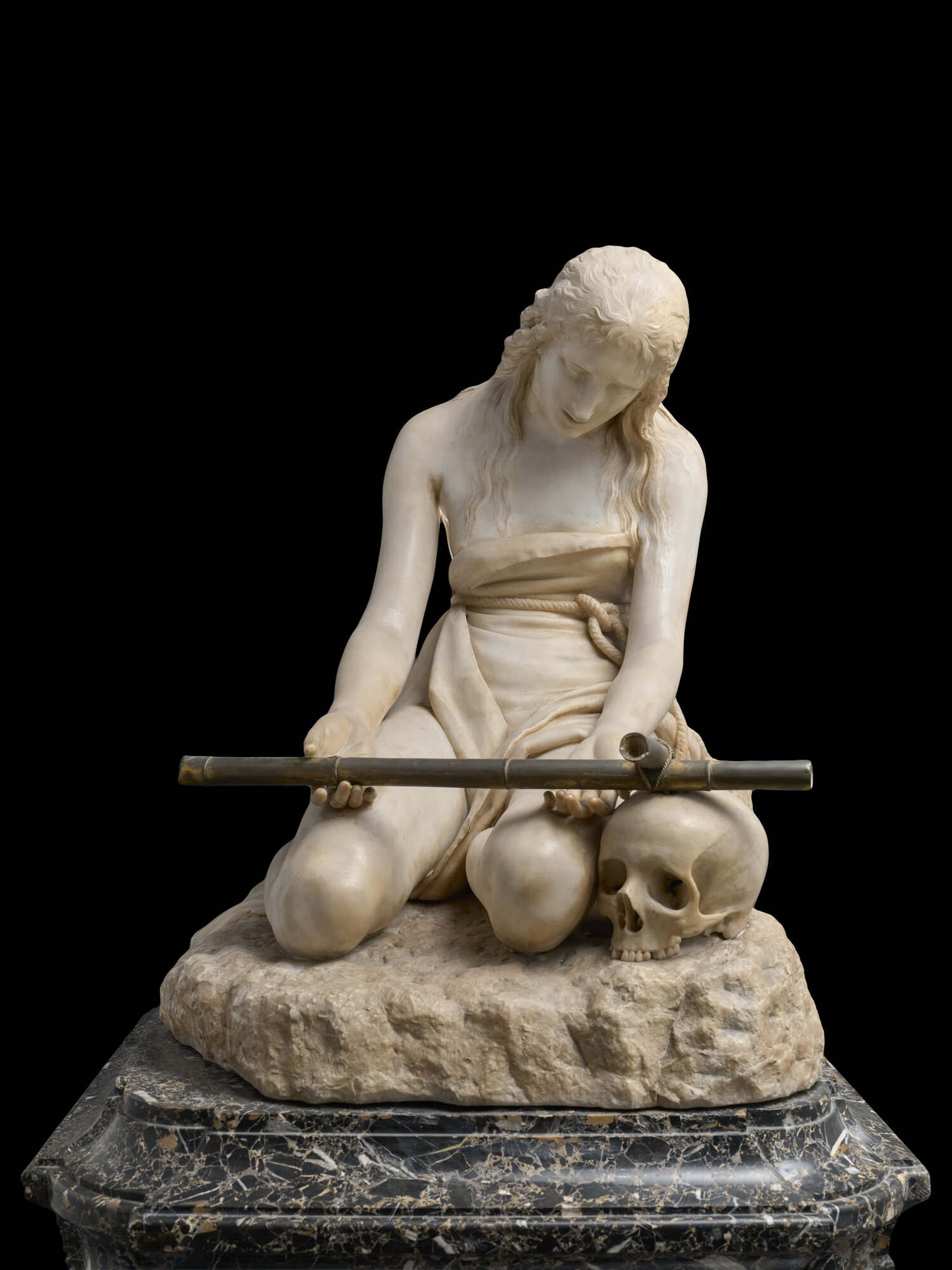
The work—a recently rediscovered oil on canvas measuring 105 by 81 centimeters, studied by Professor Fernando Mazzocca and restored at Carlotta Beccaria’s Milan studio—represents a discovery of primary importance for the very limited catalog of Canova’s paintings. But its rediscovery is particularly fascinating because it pieces together a human story of friendship, loyalty, and the restoration of honor that arose, in turn, from the turmoil of the Napoleonic Wars. In Possagno, in fact, Canova was reunited with Count Tiberio Roberti of Bassano: years earlier, the nobleman had commissioned him to create the first marble version of the Penitent Magdalene, the one now housed in Genoa at Palazzo Tursi. Roberti’s fate, however, had been shaped by those very same wartime events: in the fall of 1796, Napoleon had established his headquarters right in the Roberti family’s residence in Bassano, plunging the family into severe financial hardship and forcing the count to abandon the purchase of the now-completed marble sculpture. Canova, pressed by the French General Jean-François Julliot and yielding to his flattery, eventually sold the statue to him. Through this transaction, the marble masterpiece would later find its way into the famous collection of Count Giovanni Battista Sommariva. Sommariva would turn it into an icon of the era’s art collecting, going so far as to exhibit it in Paris at the 1808 Salon within an almost theatrical and mysterious setting: a cabinet lined with dark silk and embellished with a large mirror.
Aware of the distress caused to his friend and the financial sacrifice the count had been forced to make, Canova wished to offer Roberti moral compensation: during his stay in Possagno between 1798 and 1799, he therefore painted the Penitent Magdalene in oil with his own hand and gave it to him as a gift, compensating him for having been forced to forgo the marble version. The genesis of the painting thus lies at the perfect intersection of two destinies upended by the French invasion: that of the sculptor who fled Rome and that of the patron from Bassano who had fallen from grace.
As reconstructed in the recent biography by Francesco Leone (Antonio Canova: Life and Work, 2022), painting represented for the artist a wholly private and secondary pursuit compared to the monumental sculpture that brought him international fame. Although he had painted self-portraits in his youth and had learned the technique in Rome in the studio of Pompeo Batoni (a master for whom he harbored genuine devotion, even as he good-naturedly poked fun at his bigotry in his *Travel Notebooks*), Canova considered his paintings a private pursuit. He categorically refused to sell them, even in the face of enormous financial offers, preferring to keep them or give them to a small circle of close friends, such as Ambassador Girolamo Zulian or Prince Abbondio Rezzonico.
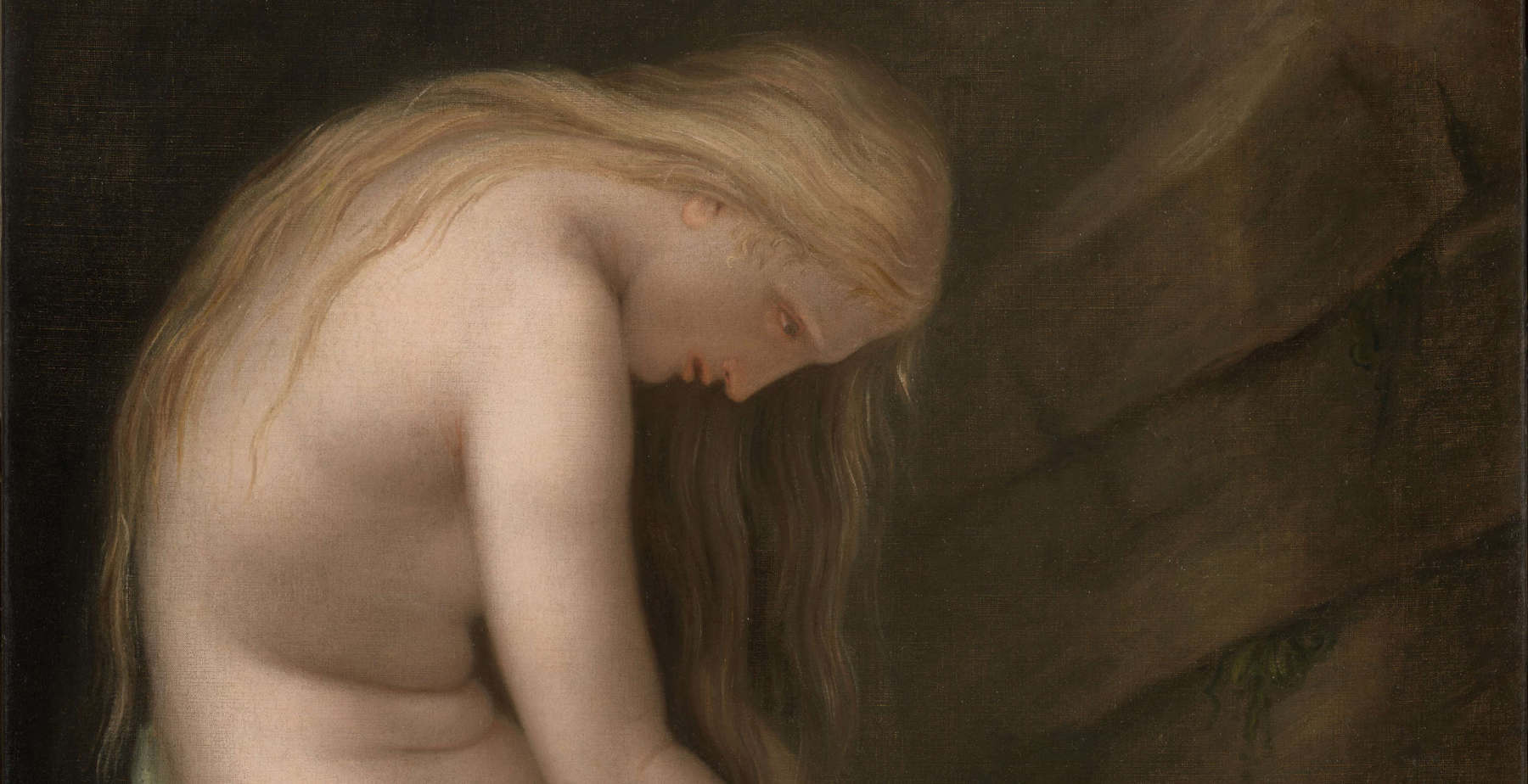
Furthermore, the sculptor typically used painting as a preliminary experimental ground before tackling marble—a process clearly illustrated by the numerous Venuses in the style of Titian and Giorgione executed in Possagno to refine the pose of the famous Paolina Borghese as the Victorious Venus. In the case of the Penitent Magdalene for Tiberio Roberti, however, the process was diametrically opposite: it was not a preparatory painting sketch, but rather, as Mazzocca explains, “a very faithful painterly transcription of the profile of the famous sculpture.” A comparison between the Sommariva statue now in Genoa and the rediscovered canvas reveals a surprising fidelity in the profile and composition: “The pose is slightly different,” explains Mazzocca, “but it retains the motifs of the kneeling figure with her head bowed. The arms are also posed differently, as are the hands, but the feet are practically identical.” It is, therefore, a process that begins with the sculpture and leads to the painting, contrary to Canova’s usual practice. Overlaid on this sculptural rendering is also the memory of Canova’s important journey through Northern Europe between 1798 and 1799, when he visited the art collections in Vienna, Munich, Potsdam, and Dresden. “In Dresden,” Mazzocca recalls, “he was particularly struck by the works of Correggio, and the paintings from these years reveal a clear homage to the Emilian master’s ideal of grace.”
What makes the history of this painting even more solid and fascinating is the rigorous sequence of documentary evidence that has tracked its journey from the very beginning. The first record dates back to an archival note from 1799 signed by Francesco Zardi, known as “Fantolin.” Zardi was the brother of Angela Zardi, Canova’s mother, who, after being widowed, remarried almost immediately, leaving her son in the care of his paternal grandfather, Pasino. In the document, the uncle “Fantolin” noted that he had paid for “two soasi” (that is, two frames) made of “nogara” wood—walnut—intended for his nephew’s painting. The rediscovered canvas is still perfectly preserved in its original walnut frame from 1799.
Subsequently, the work is mentioned inthe “Draft Biography” of 1805–1806 and referenced in 1823 in Giuseppe Falier’s “Memoirs ,” in which he confirmed that “the Magdalene is preserved in Bassano, at the home of Count Roberti,” and added that the sculptor had never parted with any other paintings “despite being repeatedly urged by generous offers,” praising the canvases from Possagno as capable of rivaling the masterpieces of Titian and Paolo Veronese. Also mentioned in Missirini’s 1824 monograph, the painting appeared in Giuseppe Pavanello’s 1976 catalog raisonné under the designation D32 and was classified as missing. For decades, in fact, scholars had been able to glimpse its forms only through a copy painted by Luigia Giuli (an amateur painter and housekeeper at Canova’s home in Rome; the copy is now housed at the Accademia di San Luca in Rome) and through a beautiful burin engraving by Antonio Zecchin based on a drawing by Carlo Panoli.
The recovery of the original painting restores its complex emotional and aesthetic power. For Canova, the theme of Mary Magdalene was a true field of exploration, suspended between the sacred and profane sensuality. A subject explored in many variations: from the first Sommariva statue to the second marble replica created in 1809 for Viceroy Eugène de Beauharnais for the Villa Reale in Milan (now at the Hermitage in St. Petersburg), to the distinct and dramatic interpretation of the Reclining Mary Magdalene, sculpted for British Prime Minister Lord Liverpool, which was also believed to be lost and was only recently rediscovered in a private collection.
The painting, presented for the first time in 2022 as part of the exhibition *Canova and Painting. The Penitent Magdalene, a Rediscovered Painting at the Antonio Canova Gypsotheca Museum in Possagno, curated by Mario Mascotto and Vittorio Sgarbi with contributions from Fernando Mazzocca and in collaboration with the Carlo Orsi Gallery in Milan—which brought the work to the BIAF this year— allows us to rediscover an unusual side of Canova—namely, an artist who, at the darkest moment of his political and personal journey, found in painting the intimate language through which to transform the wounds of war and his debt to a friend into a gesture of extraordinary poetry.
 |
| Canova and the Rediscovered Magdalene: The Work the Sculptor Created to Right a Wrong |

Warning: the translation into English of the original Italian article was created using automatic tools. We undertake to review all articles, but we do not guarantee the total absence of inaccuracies in the translation due to the program. You can find the original by clicking on the ITA button. If you find any mistake,please contact us.























 IT
IT FR
FR DE
DE ES
ES CN
CN


