





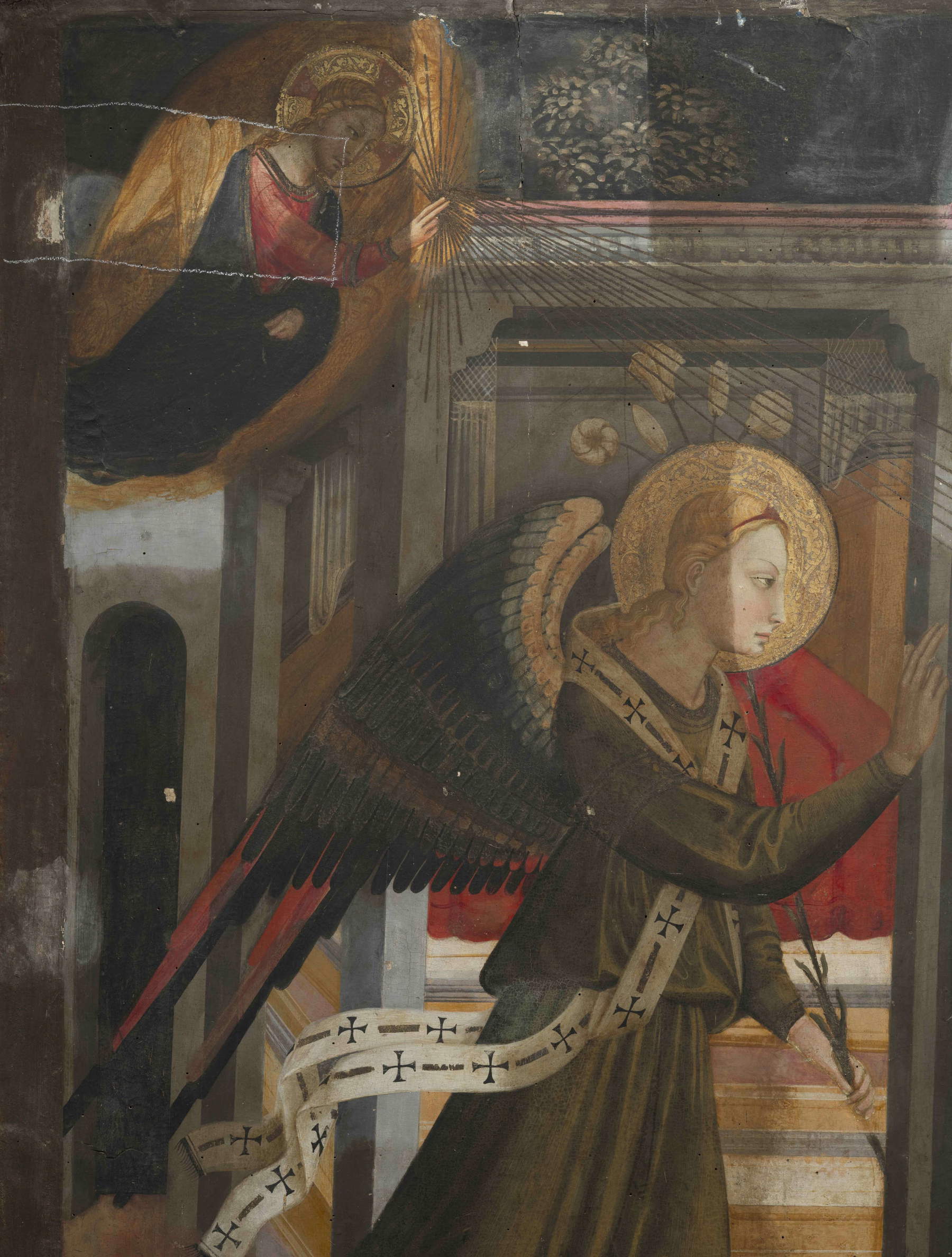
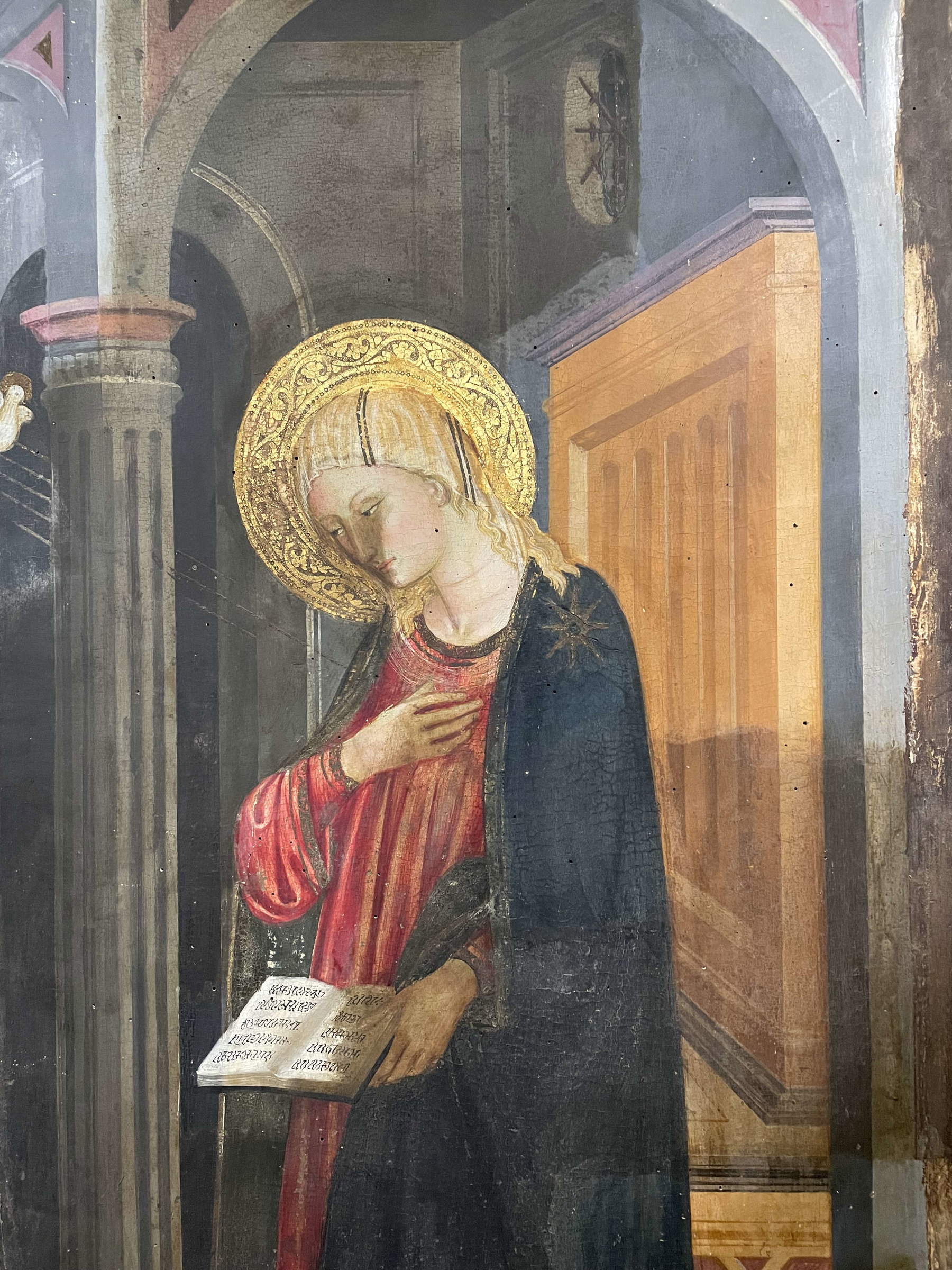
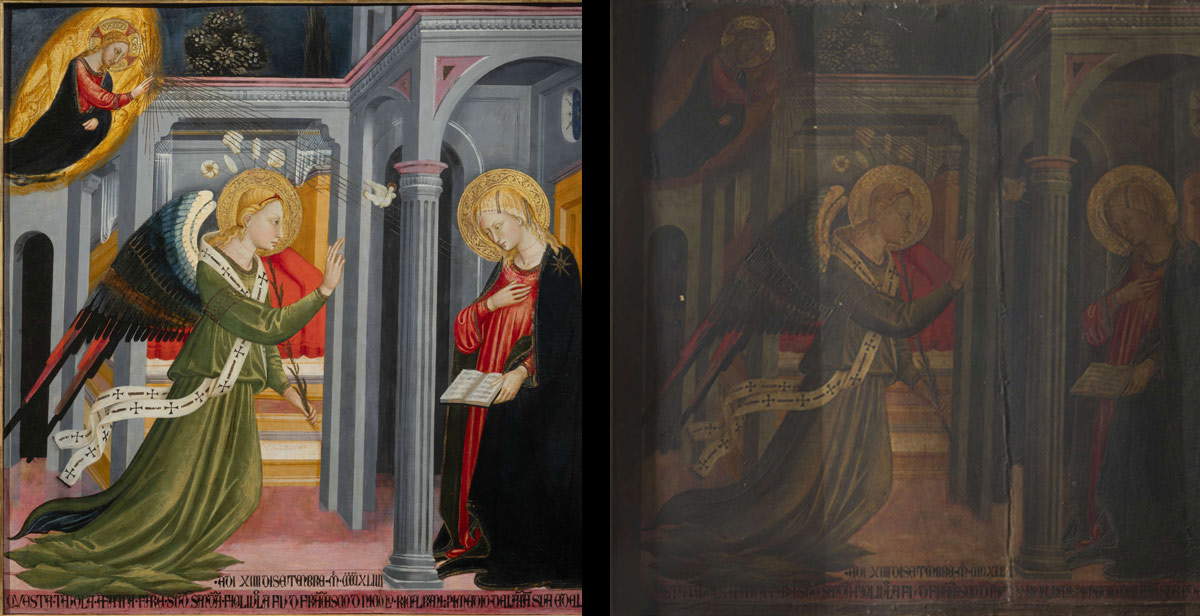
To understand just how much a painting can change after restoration, one need only look atthe *Annunciation* by Neri di Bicci (Florence, 1418/1420–1492) in the Church of Sant’Agata in Florence. Beneath a thick layer of grime, yellowed varnish, and old overpainting, the scene had lost some of its clarity. Now, following the restoration supported by Friends of Florence, the light gray of the architectural stonework, the dark foliage of the trees in the background, the pastel tones of the Madonna’s and the angel’s skin, and above all the luminosity of the halo accompanying the appearance of God the Father are once again clearly visible. The restoration of the painted surface was carried out by Muriel Vervat , while Roberto Buda’s firm, Relart, handled the work on the wooden support, and Ottaviano Caruso conducted the diagnostic examinations.
The panel, dated 1444, is one of the works that document Neri di Bicci’s early period , when the painter was still closely associated with his father’s workshop, that of Bicci di Lorenzo (Florence, 1373–1452), and to a late-Gothic figurative style that, in mid-15th-century Florence, was gradually giving way to the new artistic explorations of the early Renaissance. Attributed to Neri di Bicci by art historian Matteo Marangoni in 1915,the Annunciation alsopreserves a clear record of its origin: an inscription at the bottom notes that it was commissioned by Sister Sandra di Francesco di Niccolò Riccialbani as a votive offering for herself and her mother.
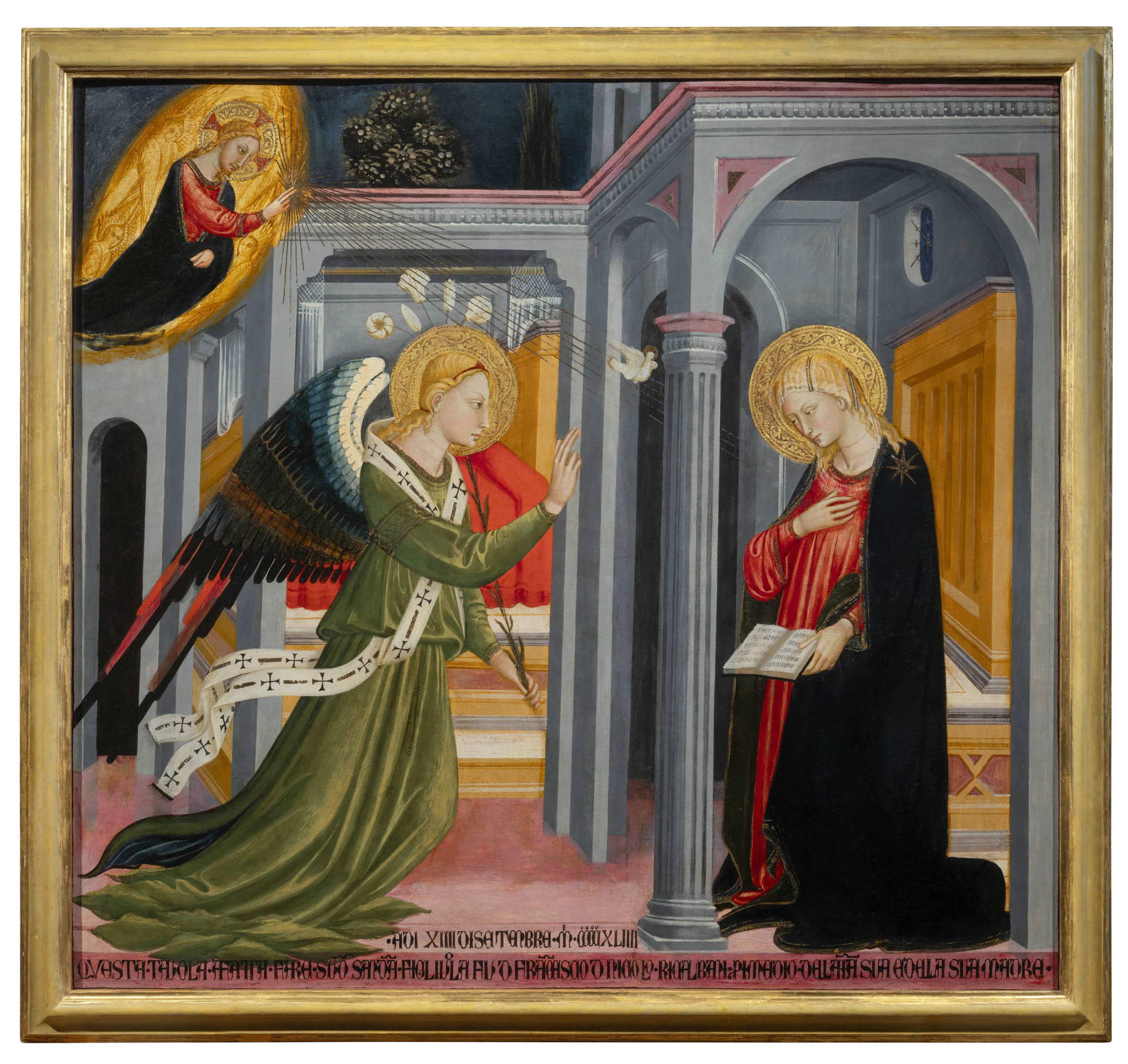
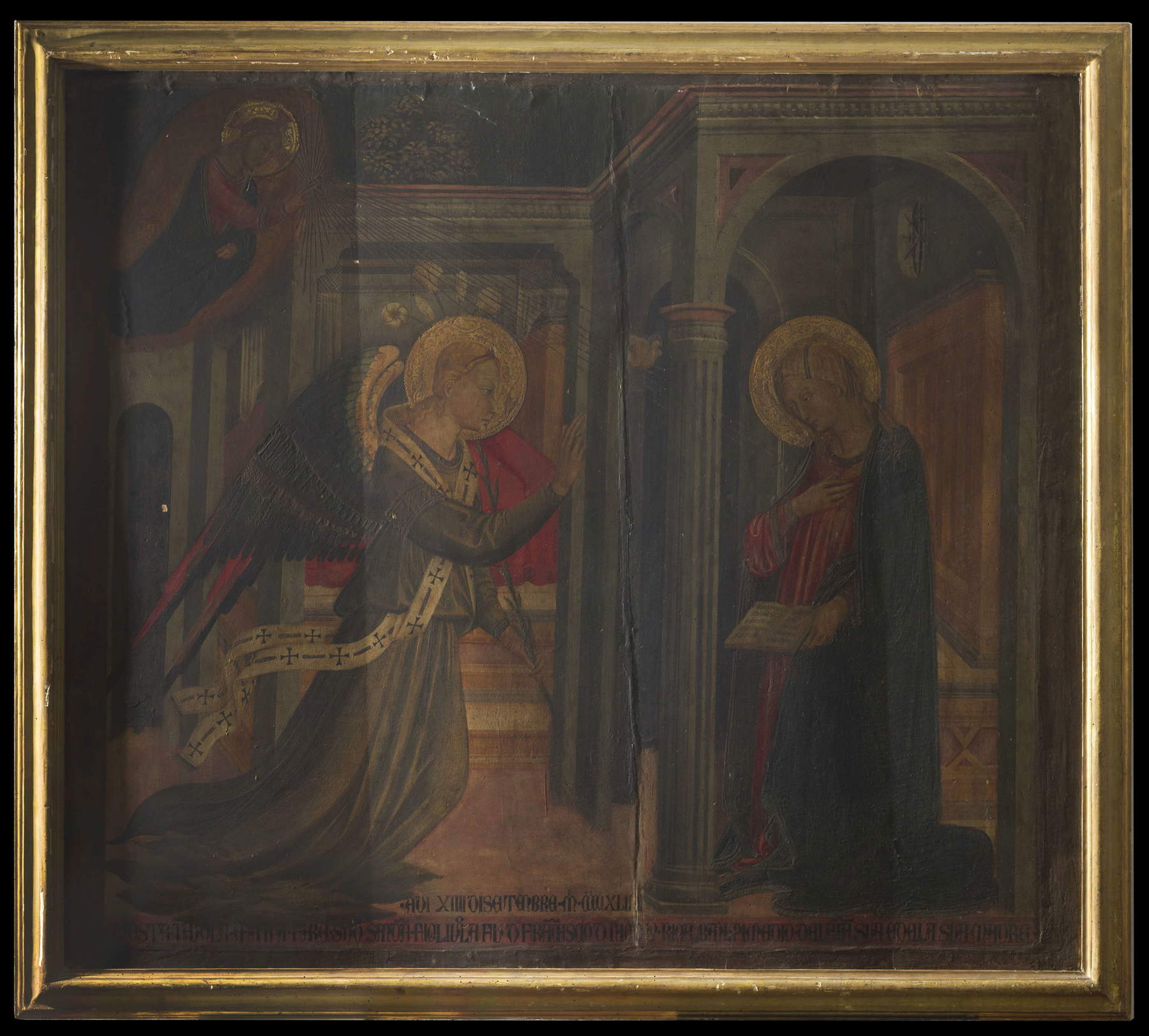
It is therefore an ex-voto, a painting created for personal devotion, but also a testament to the system of artistic production in 15th-century Florence that was centered around the great workshops. Its very early date, the simplification of the composition, and the artistic language still tied to late-Gothic stylistic elements have led scholars to attribute the panel to the workshop of Bicci di Lorenzo. The most plausible hypothesis is that the commission was entrusted to Bicci himself—who may have conceived the composition—and that the work was then executed by the young Neri, who was then among the collaborators in his father’s workshop. Neri’s hand is particularly recognizable in the facial features of the figures. The result is a painting that today—freed, following restoration, from the alterations accumulated over time—allows us to better appreciate the characteristics of this phase of the artist’s career. This is not yet the style of the mature Neri di Bicci—who was destined to take over his father’s workshop a few years later—but rather that of a young painter working within a visual language inherited from tradition and standing on the threshold of a period of profound change. The sceneof the Annunciation, in fact, draws on a model that was particularly popular in Florence at the time: that of the so-called “Florentine Annunciation,” the 14th-century fresco located on the counter-façade of the Santissima Annunziata sanctuary and considered miraculous by popular devotion. The success of this model is also documented by other works: the resemblance is particularly striking when compared tothe Annunciation in the Florentine church of Sant’Angelo a Legnaia, dated 1440, and to the one painted for the church of the Madonna della Salute in Borgo a Buggiano in 1442. The popularity of these compositions demonstrates how models originating in the urban context could also be adopted outside of Florence, in the countryside.
The Annunciation of Sant’Agata exhibits certain characteristics that reveal its still-unrefined stage of development: for example, some inconsistencies in the architectural layout and a still-naive rendering of the anatomical volumes beneath the drapery. Yet it is precisely these aspects that help situate the painting at a specific point in Neri di Bicci’s artistic development, while the narrative language of the panel retains a freshness consistent with the nature of the work and its votive origin.
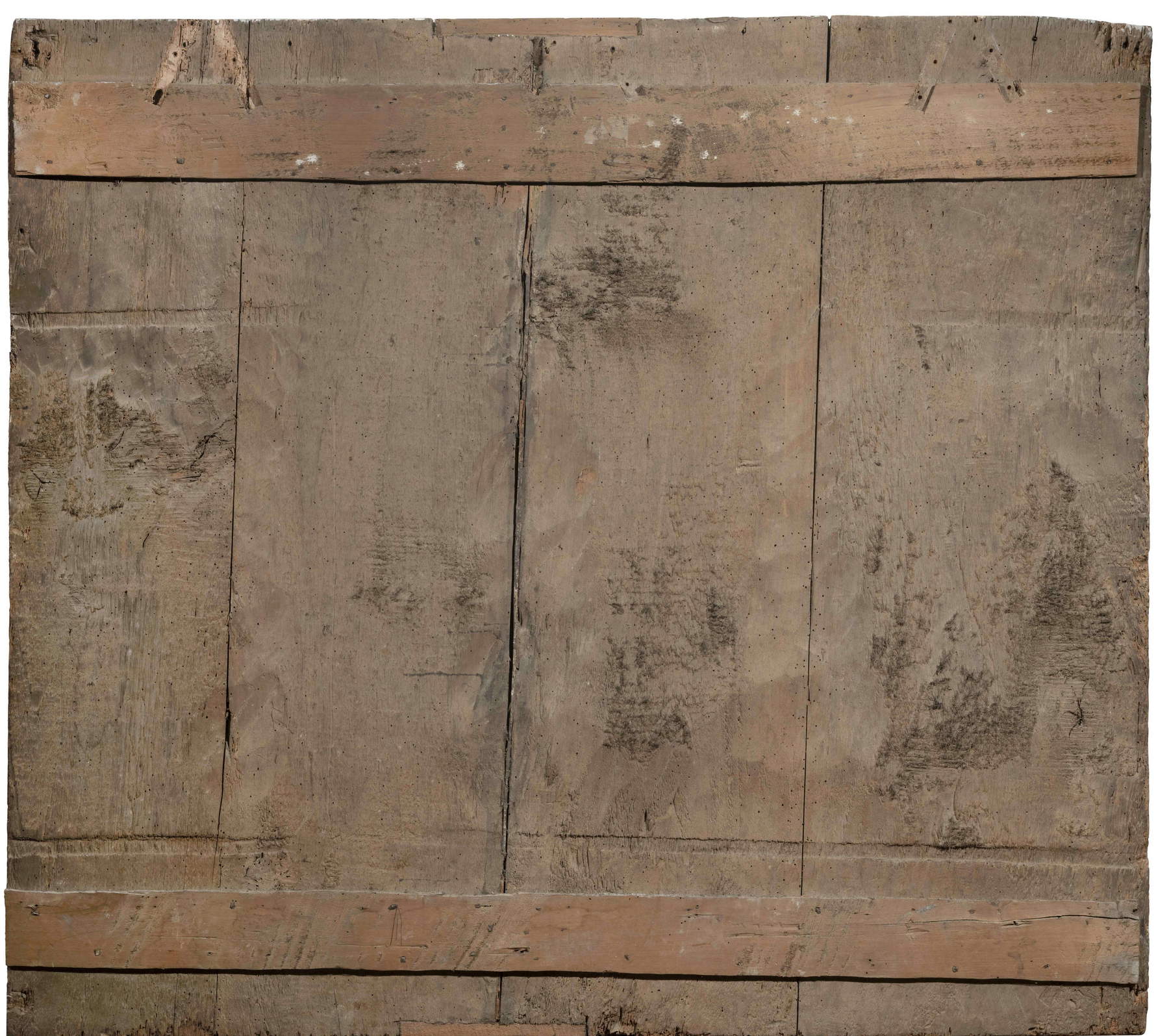
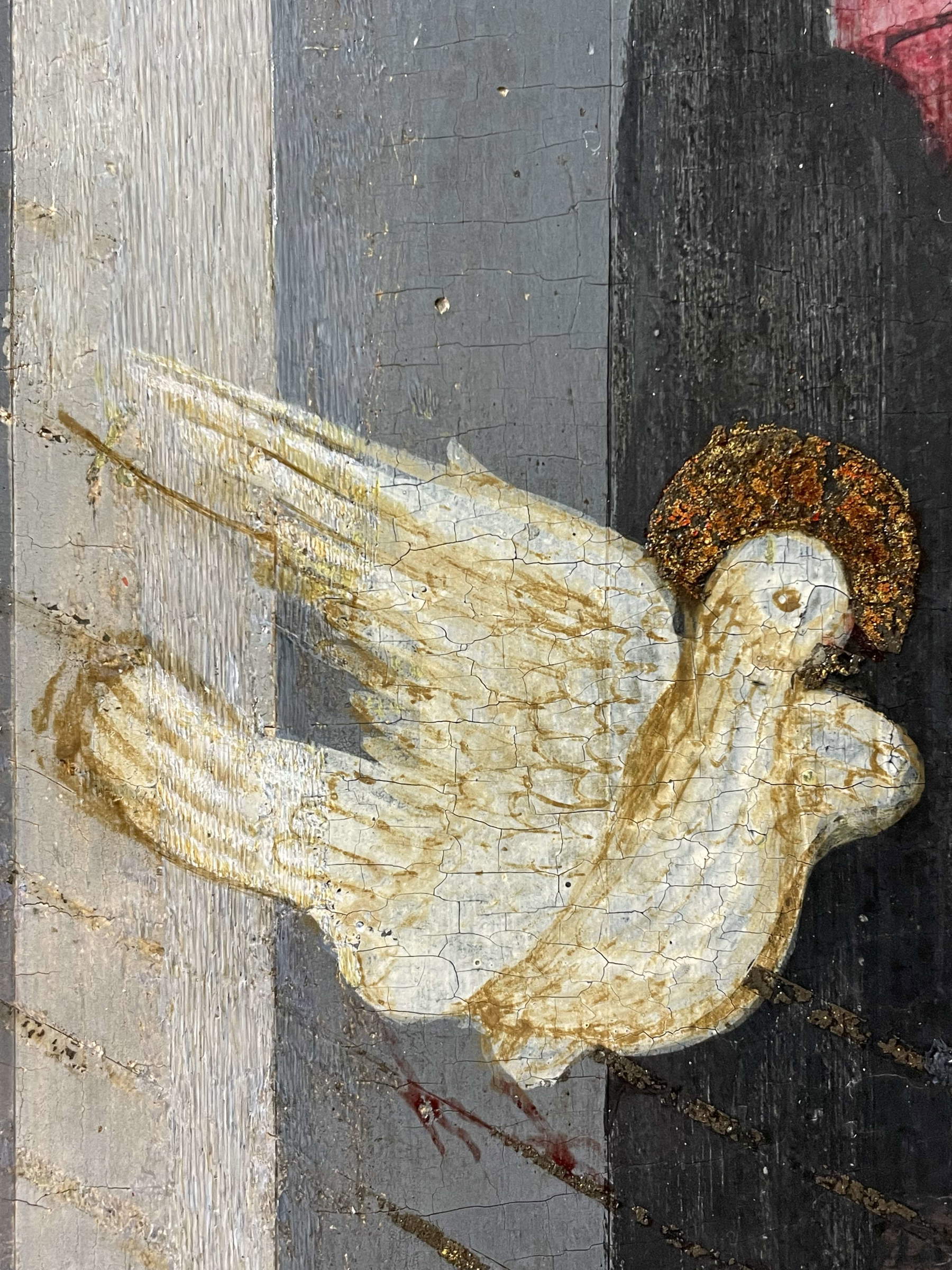
The restoration project began with a problematic state of preservation. This situation, moreover, fifty years after the description contained in the entry of the 1976 General Catalog of Cultural Heritage, still presented similar problems. At that time, the panel was described as having “dirty paint, craquelure, a deep vertical crack, and flaking paint.” Those same issues were also found during the recent restoration: the painted surface had accumulated a thick layer of environmental grime, yellowed varnish, and repainting over the original areas of color loss. The damage also affected the edges of the panel. Along both vertical sides, over a width of about ten centimeters, there were two strips of dark brown paint, applied roughly to cover the raw wood of the support. Muriel Vervat’s technical report notes that a gilded, shaped perimeter molding was likely originally intended, similar to the one found on another Annunciation by Neri di Bicci in the Church of Santa Trinita and akin to that on the panel of Saint Agatha.
Before any work was carried out on the surface, the overall condition of the work was documented. The diagnostic investigations conducted by Ottaviano Caruso included ultraviolet fluorescence photography, which was useful for assessing and documenting alterations in the varnish and previous retouching, as well as an infrared reflectography examination, conducted at various exposure levels and aimed primarily at visualizing the underlying preparatory drawing.
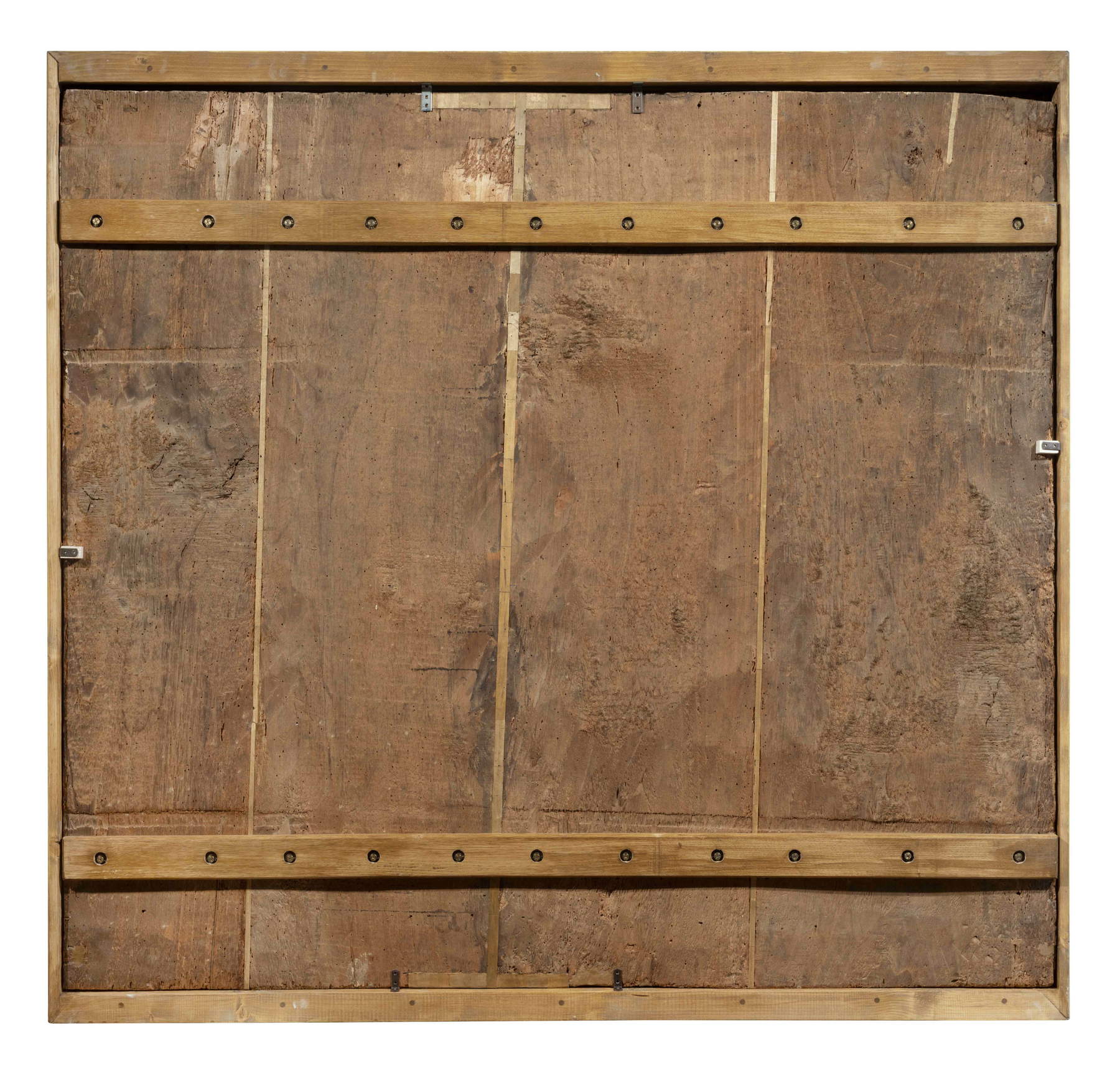
The support also required treatment, which, as mentioned earlier, was carried out by Roberto Buda’s firm, Relart. The panel consists of four poplar wood planks joined vertically and originally held together by two nailed crossbars. These crossbars were one of the elements compromising the panel’s preservation and have been replaced. The vertical cracks in the panel were also repaired, and the wood underwent treatment to combat an active infestation of wood-boring insects. As for the painting itself, Muriel Vervat worked on the surface to restore the scene’s legibility.
And the most immediately noticeable result concerns the color palette: the restoration has, in fact, made it possible to once again distinguish the color of the architectural stone—a light gray that contrasts with the dark mass of trees in the background. The pastel tones of the skin tones of the Madonna and the angel have also become visible again, while the removal of surface alterations has restored luminosity to the halo signifying the presence of God the Father.
The restoration of the colors, however, is not the only outcome of the intervention: the ability to better interpret the painted surface now allows for a clearer observation of a panel that marks a significant transition in 15th-century Florentine painting. Neri di Bicci was trained in the workshop of his father, Bicci di Lorenzo—a large-scale production facility organized along quasi-entrepreneurial lines and capable of meeting a very high demand for sacred images. The commission for *Saint Agatha* also fits into this context; it may have been conceived by Bicci and entrusted to his son for execution. The date of 1444 makes the panel particularly interesting for tracing this transition: just past the midpoint of the 1440s, about three years after the completion ofthe Annunciation of Saint Agatha, Neri di Bicci would have taken over the management of his father’s workshop, and Bicci di Lorenzo would have died in 1452. The work in the church of Sant’Agata thus dates from a period prior to the son’s emergence as an independent artist, when his painting still retained a strong connection to the late Gothic tradition in which he had been trained.
It was also a time when Florence was undergoing a decisive transformation of its figurative language. The new trends of the early Renaissance were represented, in particular, by the works of Filippo Lippi, Domenico Veneziano, and Beato Angelico, which enjoyed widespread success in the city in the mid-fifteenth century. The Annunciation of Saint Agatha thus bears witness to a transitional phase: on the one hand, the persistence of late Gothic models and stylistic elements; on the other, the dawn of a new era destined to profoundly transform Florentine painting.
The restoration was supported by donors William and Jeanne Bice and was carried out in collaboration with the Parish of San Charbel, the Superintendence of Archaeology, Fine Arts, and Landscape for the Metropolitan City of Florence, and the Province of Prato. The completion of the restoration was presented on September 21, 2026, in the Church of Sant’Agata, located at Via San Gallo 108, in the presence of the pastor of San Charbel, Father Dani Kamal; the president of Friends of Florence, Simonetta Brandolini d’Adda; ABAP official Silvia Benassai; and Muriel Vervat.
Speaking on behalf of Friends of Florence, Simonetta Brandolini d’Adda stated that the restoration now allows the community to “once again appreciate the colors and details of the Annunciation following a restoration that has made the work accessible once more to the faithful and visitors. “I would like to thank the parish, the Superintendency, and everyone who contributed to this project, especially restorer Muriel Vervat for her work and donors William and Jeanne Bice.”
Father Dani Kamal also emphasized the significance of returning the work to the church and the community, expressing his gratitude to the president of Friends of Florence, the donors, the Superintendency, the restorer, and all those who collaborated on the project. In his words, the restoration allows the panel to regain “the dignity and clarity that time had partly obscured.” The parish priest’s hope is that the work will continue to serve, for the community and for those who contemplate it, as a meeting point between the beauty of art and the religious dimension for which it was intended.
The Annunciation is thus once again legible in its pictorial details and material structure. But the restoration also allows us to take a closer look at an early phase in Neri di Bicci’s career: a panel painted while the artist was working in his father’s workshop, based on an established devotional model and still deeply rooted in the late-Gothic tradition. The restored surface, with its contrasts between the light-colored stone, the dark trees, the delicate flesh tones, and the luminous halo, now conveys with greater clarity precisely that transitional phase in which the artistic language of 15th-century Florence was changing.
 |
| How a Painting Changes After Restoration: Here Are the Colors of Neri di Bicci’s “Annunciation” |

Warning: the translation into English of the original Italian article was created using automatic tools. We undertake to review all articles, but we do not guarantee the total absence of inaccuracies in the translation due to the program. You can find the original by clicking on the ITA button. If you find any mistake,please contact us.





























 IT
IT FR
FR DE
DE ES
ES CN
CN


