



by Redazione 08/11/2026


Categories: Ancient art / Disclaimer
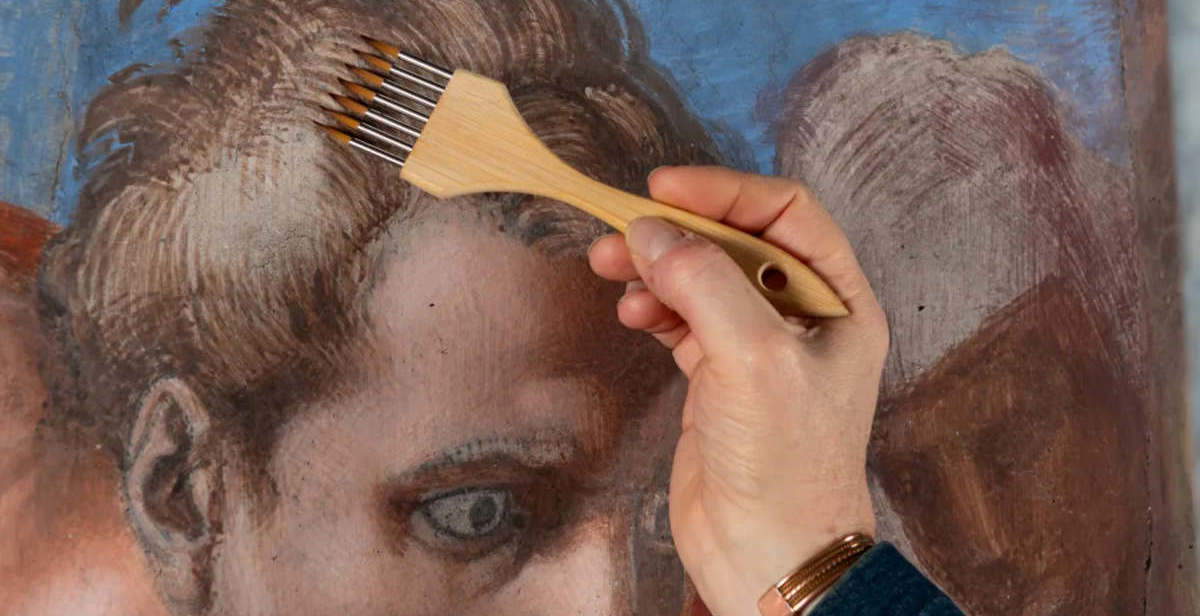
While cleaning *The Last Judgment*, restorers at the Vatican Museums discovered that Michelangelo used multi-tipped brushes—likely made by himself—to achieve the same effect on the plaster as the fluting on marble. The work also revealed a hidden self-portrait.

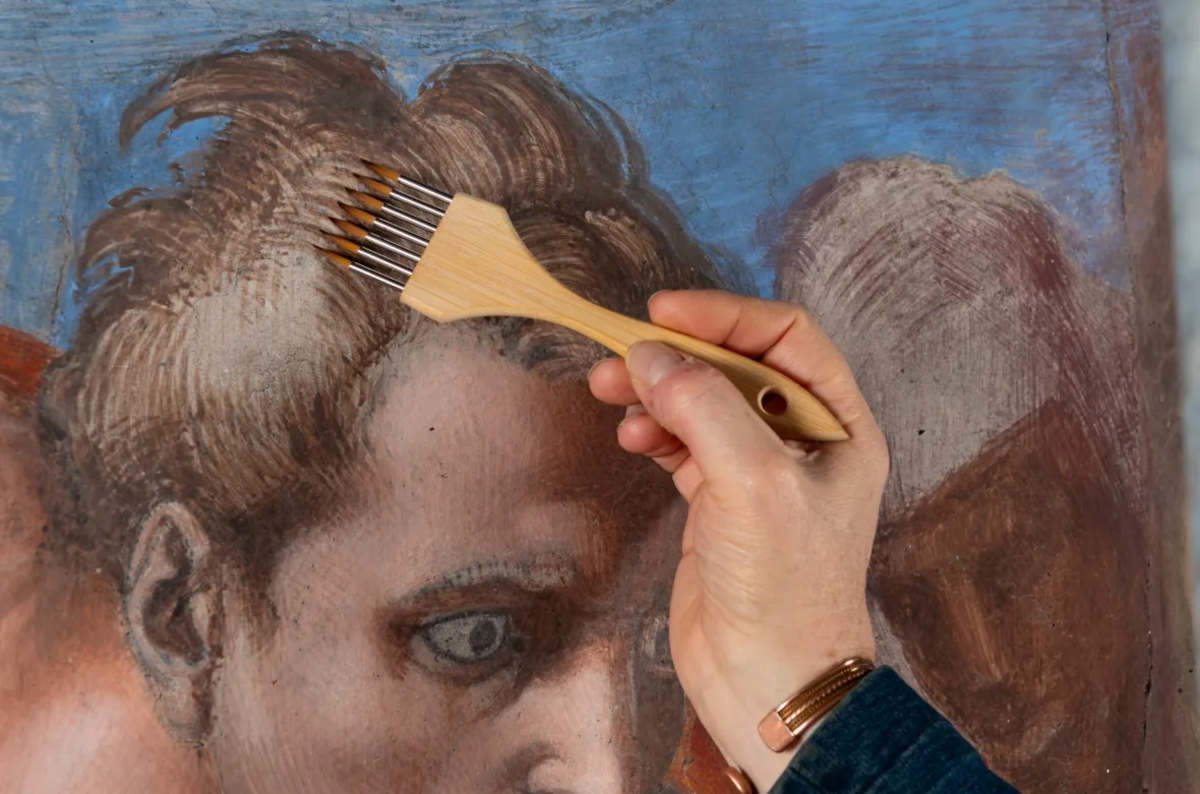
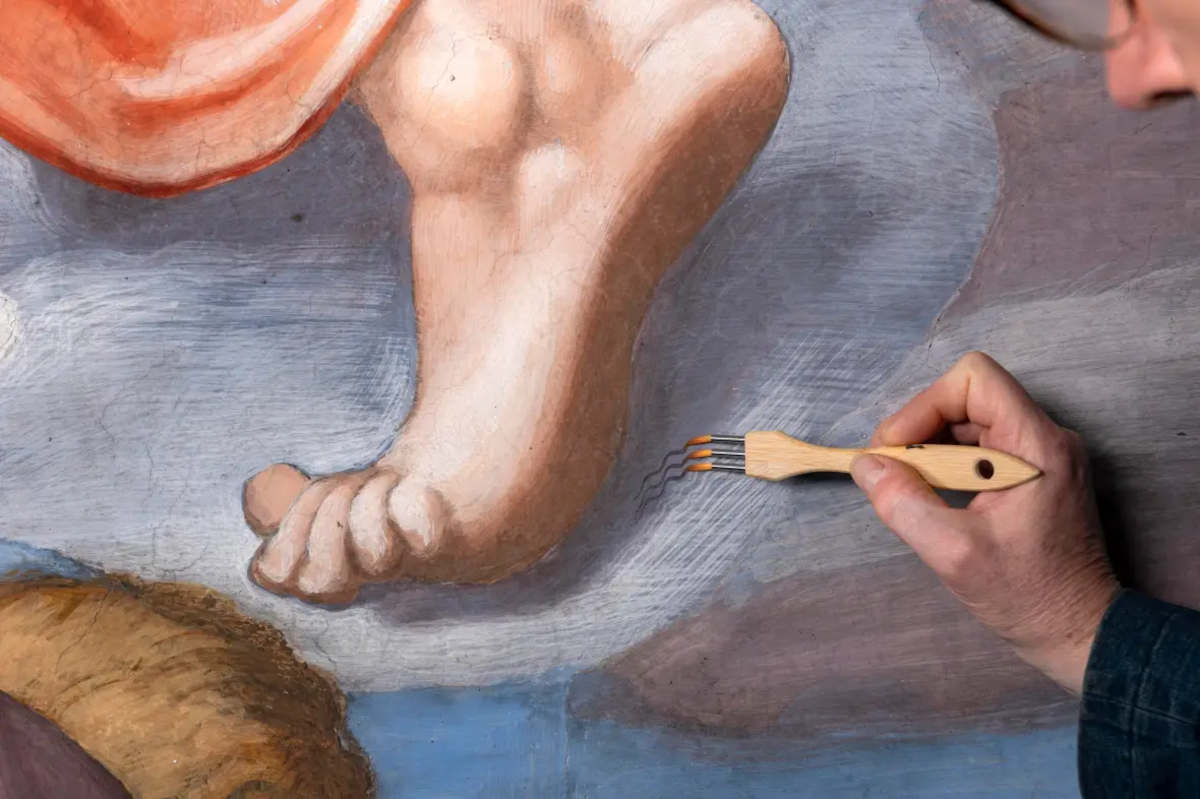
One detail didn’t add up: Paolo Violini, director of the Vatican Museums’ Painting Restoration Laboratory, was standing on the scaffolding set up in front of the altar wall of the Sistine Chapel, just a few centimeters from *The Last Judgment*. As the cleaning process brought the original colors to light, he noticed a brushstroke that deviated slightly from its path. Next to it were other parallel brushstrokes, and they all had exactly the same undulation. At first, he had noticed that Michelangelo painted with parallel strokes to achieve the cross-hatching effect characteristic of the frescoes; he then realized that many of these parallel strokes shared the same undulation, which led him to conclude that Michelangelo used special multi-headed brushes—that is, brushes designed so that each head had, in turn, a small brush at its tip—allowing multiple parallel lines to be drawn with a single stroke.


After all, a hand drawing a line never repeats the same tremor across ten different marks on its own. If all the strokes move together, it means they were made at the same time, with a single tool. This observation led to one of the most interesting discoveries made about The Last Judgment in recent years: to paint the fresco, which features more than three hundred figures—some ascending to heaven and others plunging into hell— Michelangelo systematically used multi-tipped brushes, similar to a comb, which he most likely made himself.


Ten Brushes in One
According to Violini, the tools came in various types: analysis of the frescoes in the Sistine Chapel revealed traces of a three-headed brush, as well as others up to 15 centimeters wide, which could, in fact, combine as many as ten small brushes. The restorer is convinced that the artist made them himself.


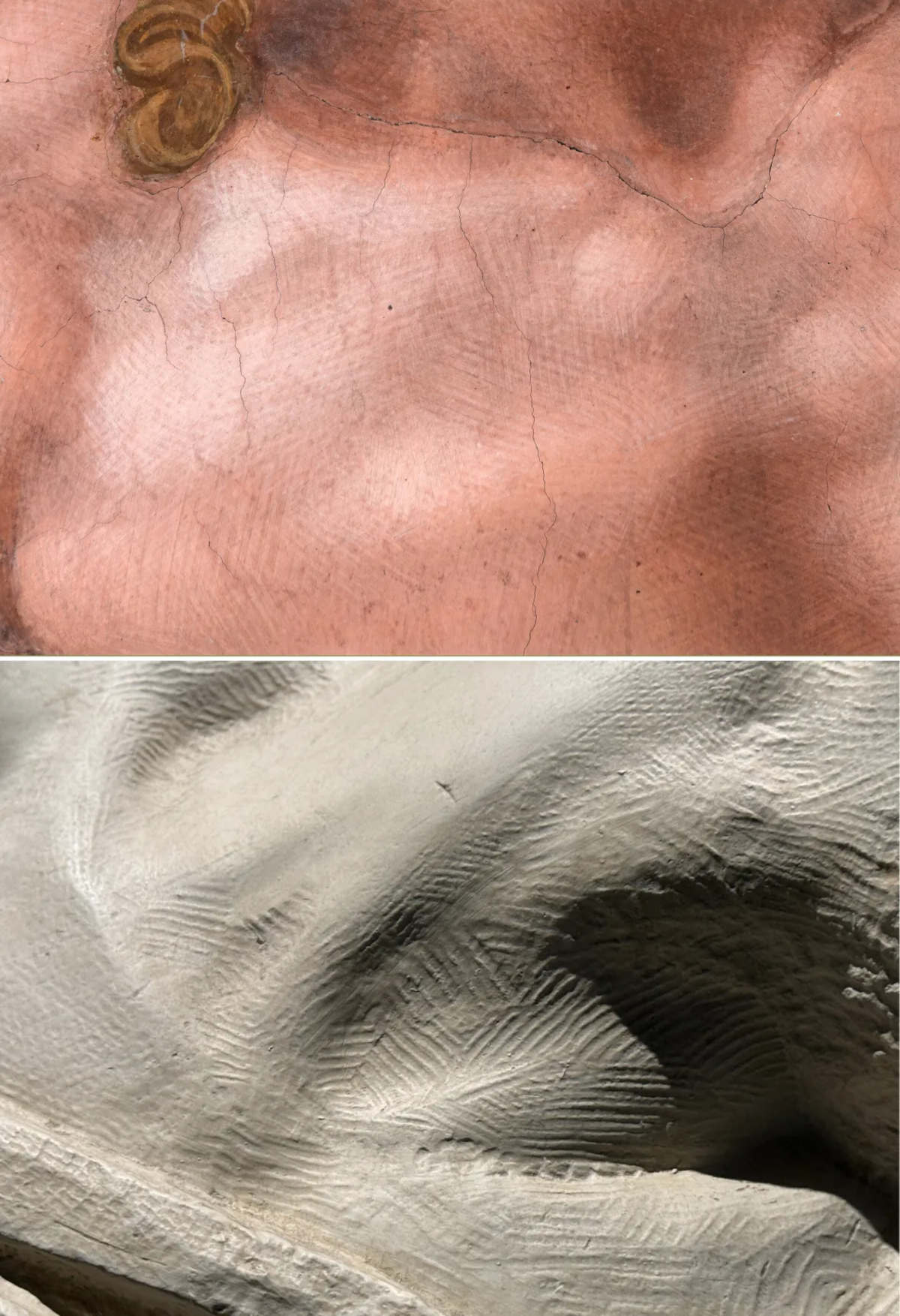
According to Violini, there are several reasons for this choice: these brushes were used to paint more quickly, of course, but also to achieve that cross-hatching effect that the artist obtained with a multi-pointed chisel when sculpting—an effect necessary to create more dynamic sculptures capable of reflecting light in different ways to make it shimmer. Specifically, the tool in question is the “gradina,” the serrated chisel that sculptors use to work marble and which leaves a series of parallel grooves on the surface. Michelangelo had transferred this effect onto the plaster. By crossing series of parallel strokes in different directions, he created a texture on the wall similar to that of carved stone. A comparison between the details of the fresco and a plaster cast of the Bandini Pietà, Michelangelo’s sculpture, highlights the similarity between the two hatching techniques: with his brushes, Michelangelo sought to achieve in painting the same results he had attained in sculpture.
This also gave rise to an important difference compared to other painters. Usually, brushstrokes follow anatomical forms and trace the curve of a muscle or the volume of a shoulder. Michelangelo, on the other hand, crossed the strokes, constantly changing their direction, so that the light would shimmer on the bodies. The same tool allowed him to apply broad swaths of color more quickly. When used on the hair of the figures surrounding Christ, the multi-tipped brush produced parallel strokes in a single gesture and created a wavy effect.
A White Veil Over the Fresco
A rare opportunity made it possible to see all of this. Between February and March 2026, The Last Judgment underwent extraordinary maintenance work (here is our tour of the scaffolding). The Sistine Chapel was closed, and seven levels of scaffolding were erected in front of the altar wall. The work, entrusted to the Vatican Museums’ Restoration Laboratory, was intended to clean the fresco of the deposits that had accumulated over the approximately thirty years since the last restoration, which took place in the 1990s. Ultimately, it also provided a better understanding of the techniques used in its creation and revealed some hidden details.
The main problem was a uniform white film of calcium lactate, a salt that had formed on the fresco as a result of perspiration from the millions of visitors to the chapel. To remove it, thirty restorers worked in two shifts for thirty days, applying special compresses to the painting. The Last Judgment has thus regained its characteristic clarity and vivid colors.
The restoration project and its results are documented in the book *Michelangelo 2026*. The Extraordinary Conservation of The Last Judgment, edited by Barbara Jatta and Fabrizio Biferali and published by Edizioni Musei Vaticani. The book also includes a contribution by Fabio Morresi of the Scientific Research Office and explains in detail the conservation issues that emerged following the restoration in the 1990s.
The Face Hidden in Death’s Robe
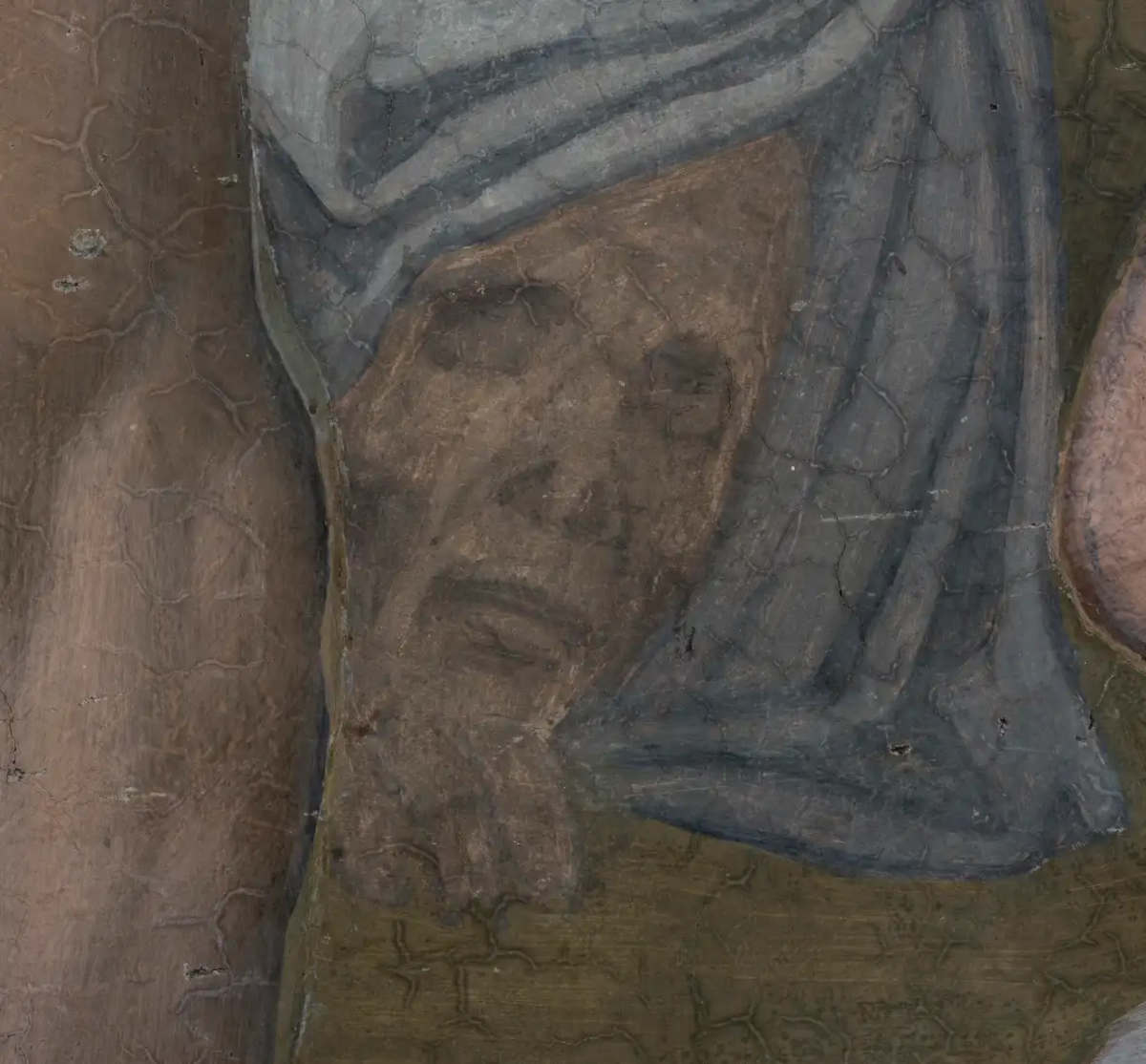
The work on the scaffolding also made it possible to see up close a detail that was already known but had been difficult to make out until now. In the lower register of the fresco, on the left side, Michelangelo painted the resurrection of the bodies: the dead emerge from the earth before ascending to paradise or plunging into hell. There is an allegory of death, and among the folds of her robe appears a gaunt face gazing at the viewer. According to Biferali, curator of the 15th- and 16th-Century Art Department of the Vatican Museums, this is a hidden self-portrait of the artist. The face is, in fact, very similar to Michelangelo’s features.
The face on the cloth worn by Death had already been noticed, but the cleaning process made it visible for the first time, Biferali explained to The Times of London. The scholar links the self-portrait to a specific episode in the creation of the Last Judgment: “It is the final section of the Last Judgment completed by Michelangelo in 1541, after he had begun it in 1536, and while he was painting it, he fell from the scaffolding. Fortunately, he was only a few meters above the ground, but he still broke his leg and had to stop working for a few months.”
Once he had recovered, Michelangelo reportedly decided to leave a memento of that accident. “I believe he then painted his own face among the dead who are rising again because he felt reborn after the accident, and also because he felt reborn upon reaching the end of five years of work,” explains Biferali. The scholar describes the self-portrait as the “silent yet eloquent” mark of an artist who felt reborn after the torment of the work.
It is not the only self-portrait in The Last Judgment. In the fresco, Michelangelo also depicted Saint Bartholomew, the martyr who was flayed alive, holding his own skin in his hands, and on that skin appears a face very similar to that of the artist. Both there and in the guise of Death, the self-portrait is linked to the theme of the body’s decay. “Michelangelo,” concludes Biferali, “was obsessed with death and rebirth.”
 |
| Michelangelo painted with a multi-bristled brush shaped like a comb: the discovery in the Sistine Chapel |
Warning: the translation into English of the original Italian article was created using automatic tools. We undertake to review all articles, but we do not guarantee the total absence of inaccuracies in the translation due to the program. You can find the original by clicking on the ITA button. If you find any mistake,please contact us.