



by Redazione 18/11/2026


Categories: Ancient art / Disclaimer
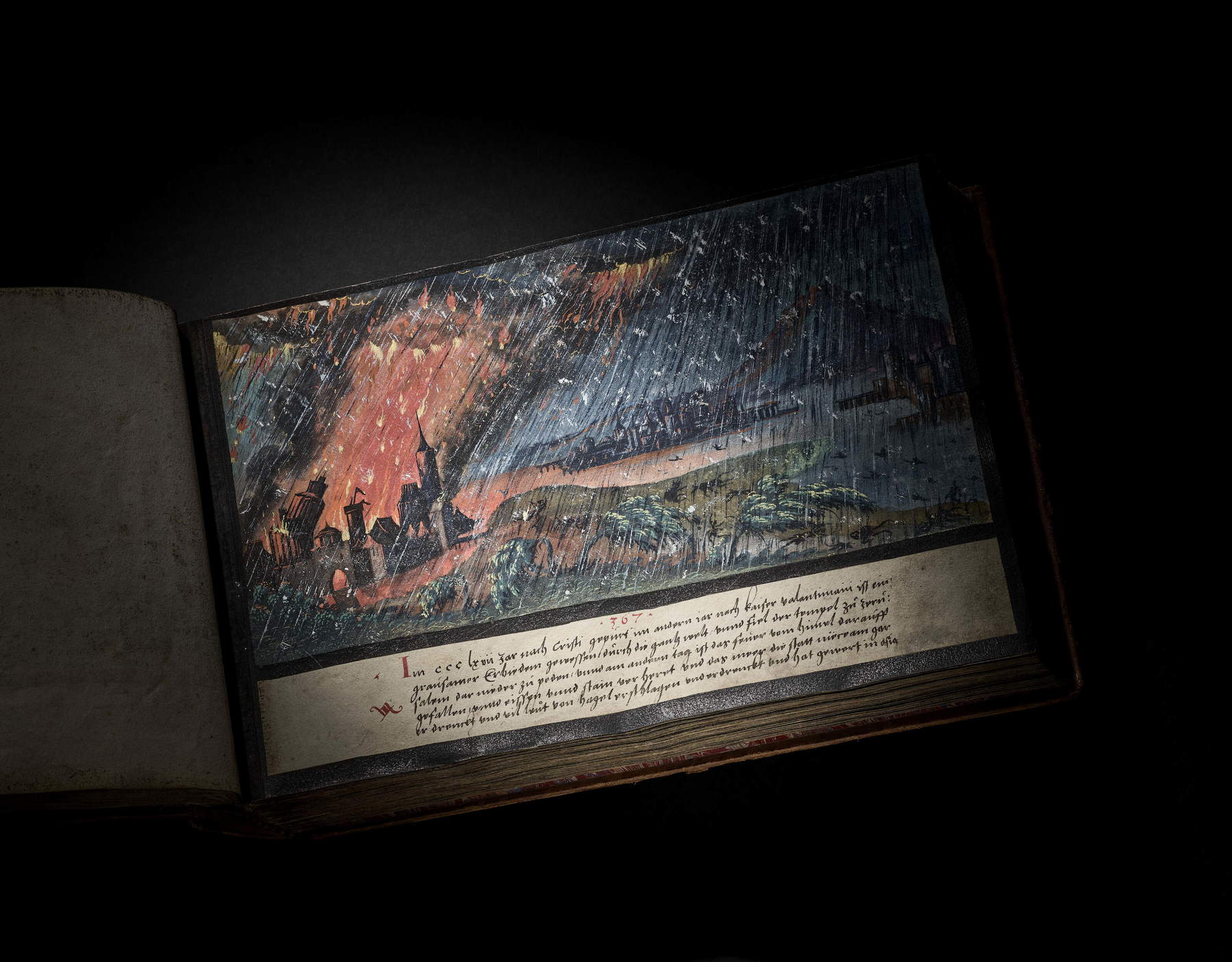
Rains of fire and blood, monsters from the sea, cities destroyed by volcanoes: The Book of Miracles, an illuminated manuscript created in Augsburg, Germany, around the mid-16th century, compiled illustrations of end-of-the-world visions and actual catastrophes. It will go up for auction at Christie’s on December 10, with an estimate of between 700,000 and 1 million pounds.


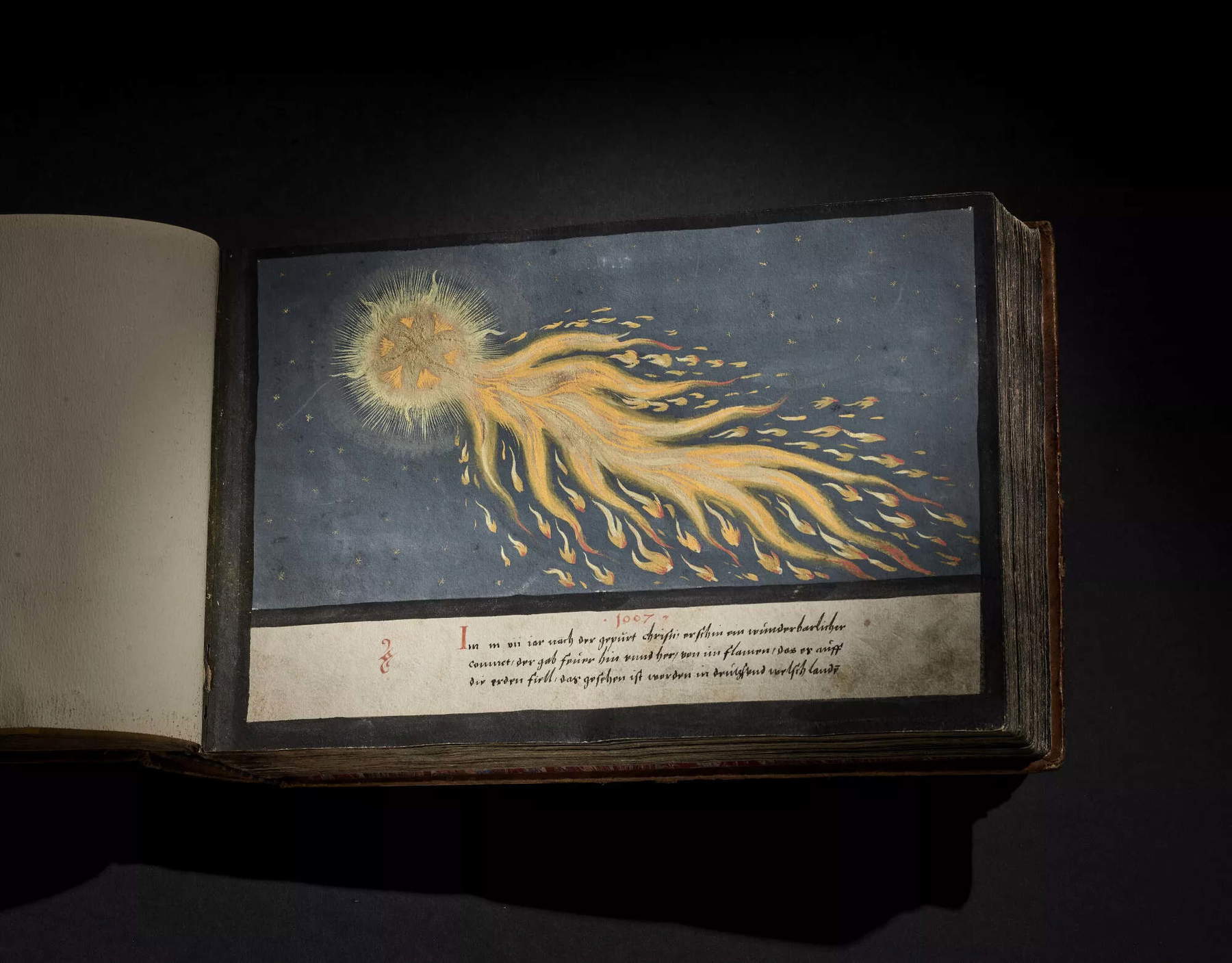
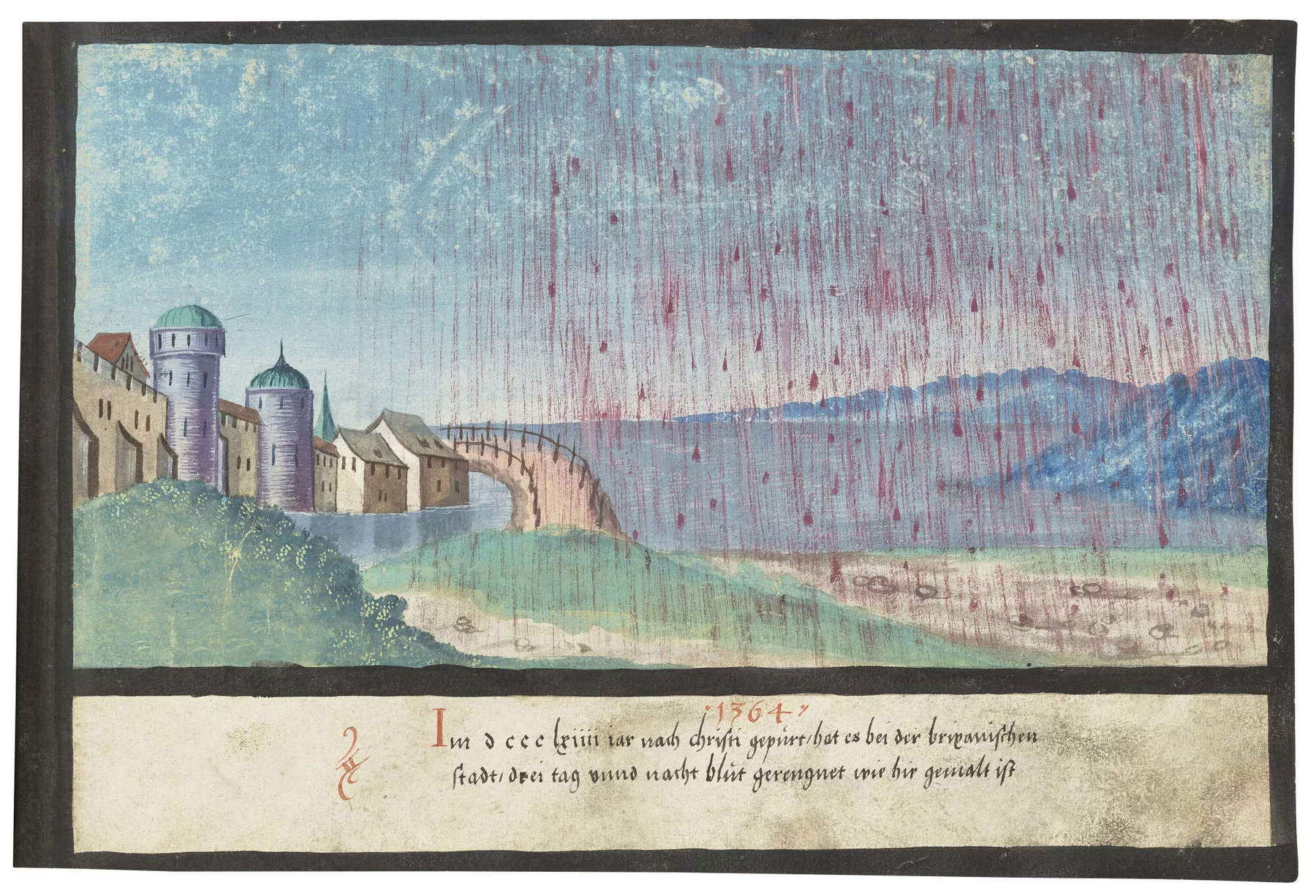
In 1541, something happened in the sky over Augsburg, Germany, and someone thought it was worth painting. Eleven years later, in 1552, a hailstorm struck Dordrecht, in the Netherlands, and that, too, ended up on an illuminated page. The two images are part of a much longer sequence, one in which recent news events appear alongside multiplying suns, blood-red moons, fiery comets, swarms of locusts, volcanic eruptions, dragons, and monstrous births. They are all miniatures from the Book of Miracles, also known as the Augsburger Wunderzeichenbuch, literally “the Book of Wondrous Signs of Augsburg.” It is an illuminated manuscript, created in Augsburg around 1552, in which the history of humanity is told through its signs and wonders. The codex contains 167 miniatures, and Christie’s describes it as one of the most remarkable pictorial chronicles of the 16th century to have survived to the present day. On December 10, 2026, it will be the highlight of the Valuable Books & Manuscripts auction in London, as part of Classic Week. The estimate ranges from 700,000 to 1,000,000 pounds (approximately 838,000 – 1.2 million euros).

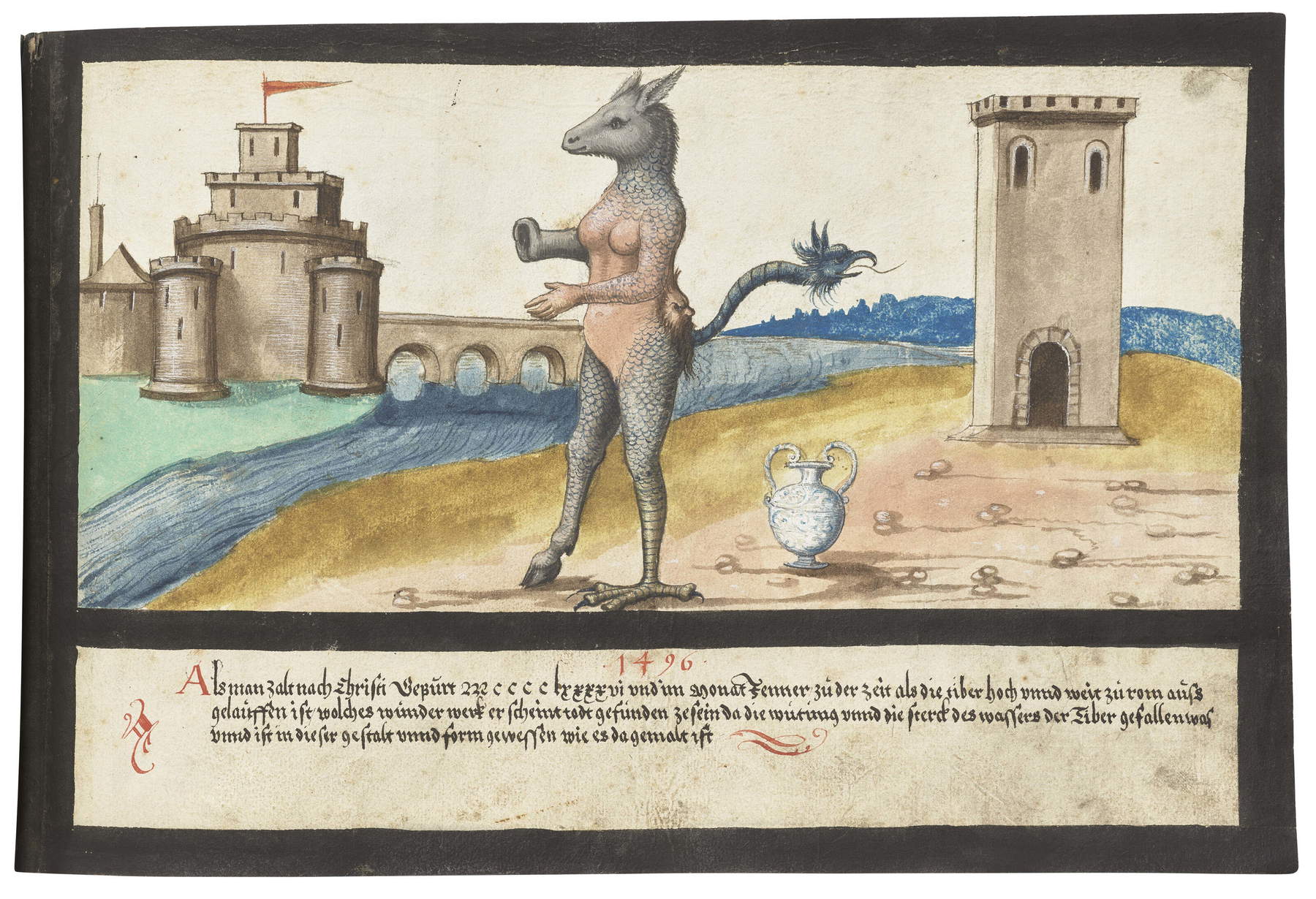
The volume should be read as a history of the world rather than merely as a catalog of curiosities. The narrative proceeds in chronological order: it opens with the Creation, moves through biblical episodes, traverses ancient and medieval history, reaches the contemporary events of the artist who painted it, and concludes with the end of the world—the Apocalypse. The central section is the most surprising, as it records specific events with dates and locations. A comet and an earthquake in 1300—the year, as the caption notes, when Pope Boniface VIII established the first Jubilee. A solar eclipse in 1009, with the moon “as red as blood” and a burning torch falling from the sky, followed by deaths and famines in Germany and Italy. A monstrous creature found dead on the banks of the Tiber after the flood of January 1496. A swarm of locusts carried to Poland in 1527 by a wind from Turkey, with insects “gray and gold in color, just as depicted here.” The most recent event is the hailstorm that struck the Dutch city of Dordrecht in 1552 (folio 171). That date marks the point after which the manuscript was completed. The book places particular emphasis on these visions of the end of the world, on these apocalyptic devastations, with disturbing images: blood falling from the sky, rains of fire, cities devastated by volcanic eruptions, monsters emerging from the sea. The thread that ties this narrative together is a specific idea: extraordinary natural phenomena, according to the mindset of the time, were not mere accidents, but signs that held meaning for people and demanded interpretation. In the pages of the manuscript, the flood, the earthquake, and the storm hold the same status as the comet or the battle fought in the heavens: they are all messages to be deciphered. And it is precisely the inclusion of recent events, documented with dates and locations, that makes the book interesting even today.


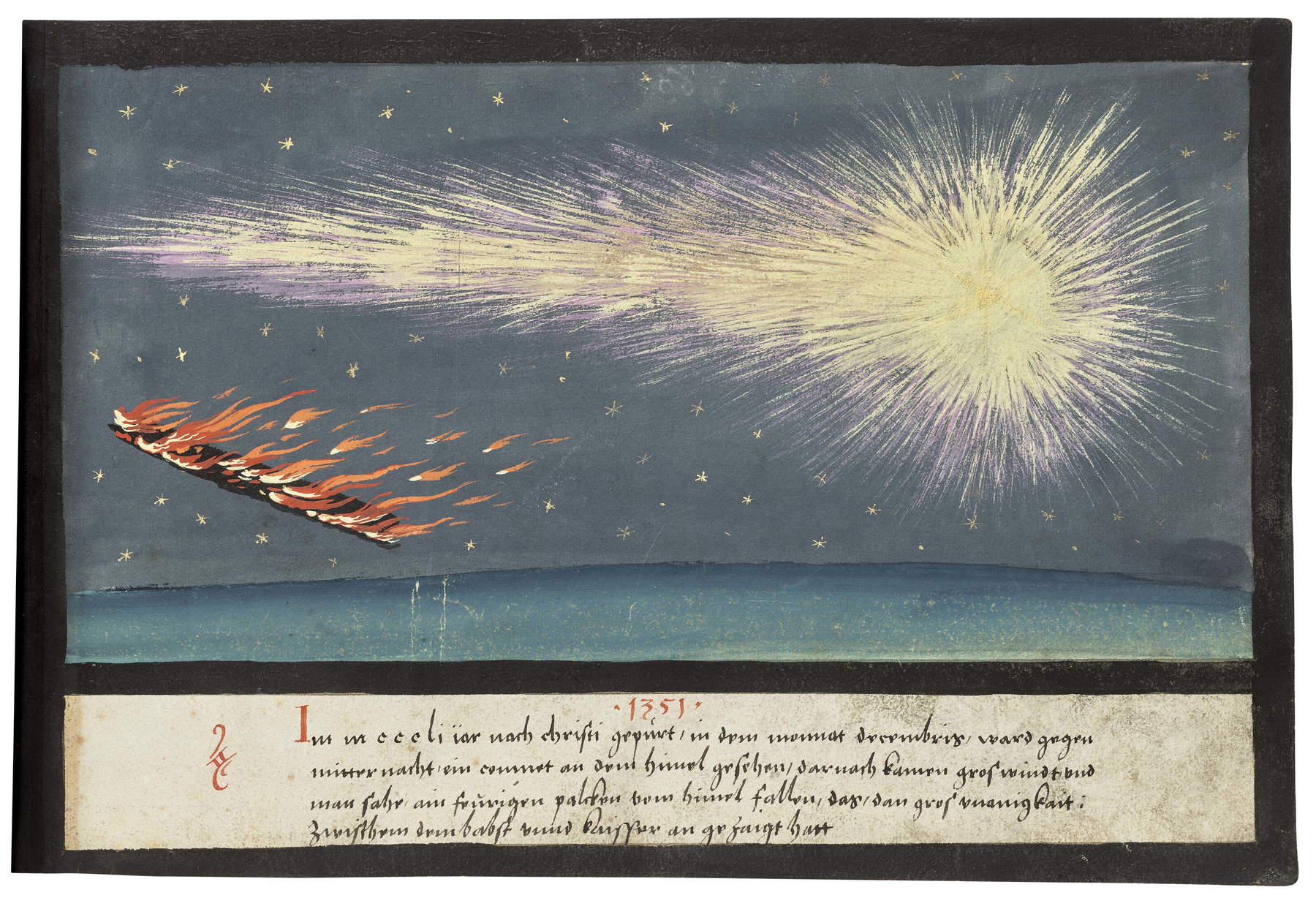
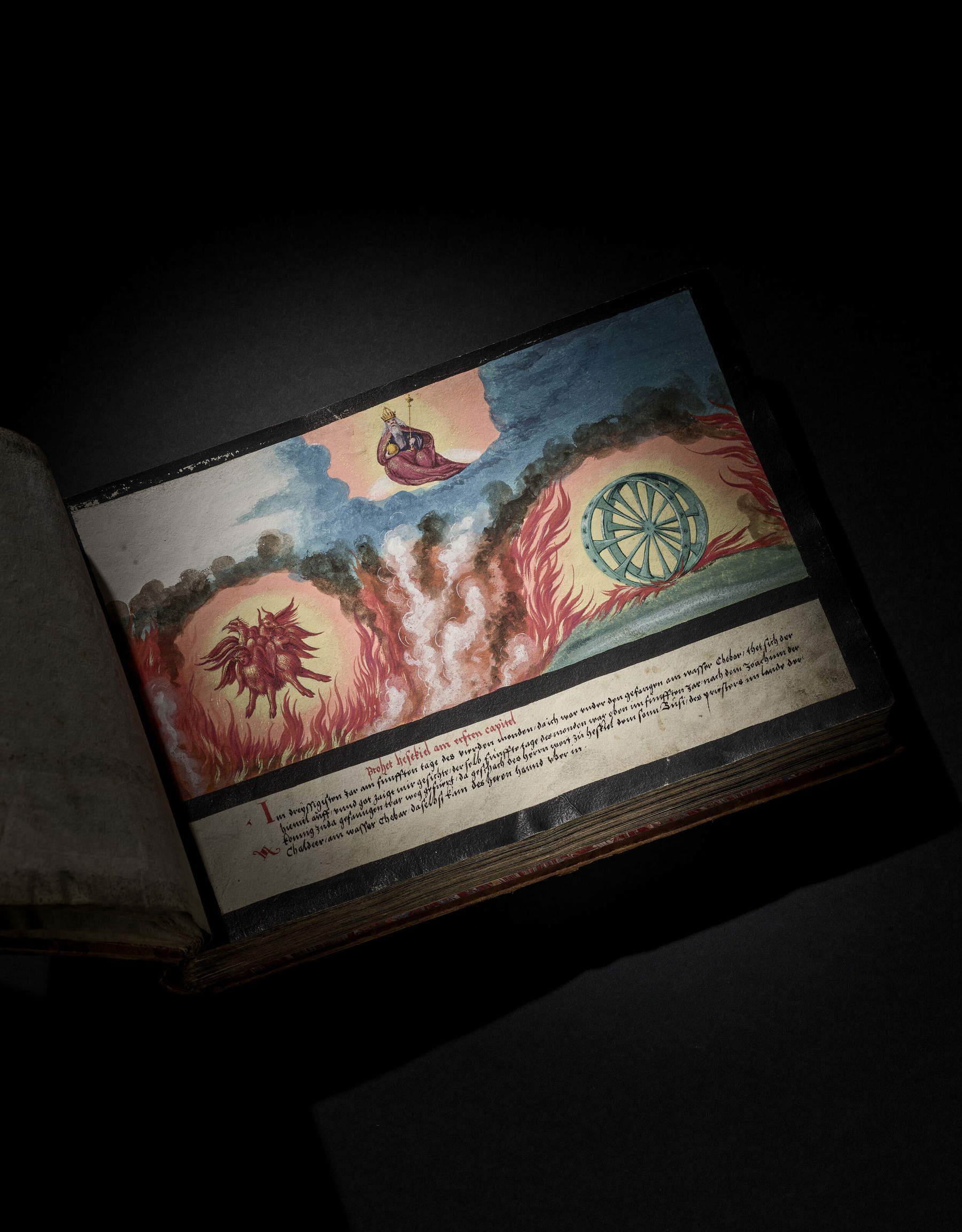
The celestial phenomenon of 1541 and the hailstorm in Dordrecht in 1552 do not come from the Bible or ancient chronicles: they are events that occurred close in time to the author, perhaps still fresh in the memory of those who leafed through the volume. Alongside apocalyptic visions, therefore, the manuscript preserves traces of real events, recorded and transformed into images. Eugenio Donadoni, an international specialist in medieval and Renaissance manuscripts at Christie’s in London, has emphasized this dual nature: “What makes the manuscript particularly compelling is the way it straddles the line between observation and belief: these images document real events and natural phenomena, while at the same time revealing how people in the 16th century sought to understand what they were seeing and what these extraordinary events might signify.”

The connection to Augsburg is evident from several clues. Some captions explicitly refer to events that took place “here in Augsburg,” and the paper on which the miniatures are painted bears watermarks associated with the city in the 16th century. The attribution also points there: the manuscript is attributed to Hans Burgkmair the Younger and Heinrich Vogtherr the Younger, along with their respective workshops. It is therefore not the work of a single artist, but a collaborative effort in which multiple artists and collaborators contributed to the creation of the cycle of images. None of the miniatures are signed, but the manuscript offers a rare clue: leaf 117 depicts two deformed calves, one with two heads—stillborn on January 14, 1529, in Langweid, near Augsburg—and another found in 1532 near Donauwörth. The caption contains a first-person confession by the painter, who recounts having purchased the animal’s hide for half a florin from a parchment maker. The painter signs his name as Hans Burgkmair, and according to Christie’s, this is Hans Burgkmair the Younger, who, upon his father’s death, inherited the workshop of Hans Burgkmair the Elder, a renowned painter and engraver from Augsburg. Burgkmair the Younger is best known for the tournament books he produced in the mid-16th century. The first, now in the Staatliche Graphische Sammlung in Munich, was commissioned by Duke William IV of Bavaria and created in collaboration with his father. Another is in the Bayerische Staatsbibliothek, while a third, signed and datable to around 1553, is preserved in the Hofbibliothek in Sigmaringen. It was precisely the Sigmaringen manuscript that made it possible to confirm his involvement in the Book of Miracles. Art historian Till-Holger Borchert recognized in it the same mastery of gouache and subtle use of gold and silver, both in the tournaments and in the highlights of the comets in the Augsburg manuscript.
Heinrich Vogtherr worked alongside Burgkmair. According to Borchert and scholar Giulia Bartram, the most likely collaborator is Heinrich Vogtherr the Younger, an established artist in Augsburg who had inherited a thriving workshop from his father, along with his repertoire of models, and who also worked for the Habsburg court, designing coins, banners, and coats of arms. One of his drawings from 1542 depicting the battle between the Amalekites and the Israelites, signed “HVE,” features figures similar to the knight on folio 126 and a similar use of white highlights in the clouds. The book also features motifs by his father, Heinrich Vogtherr the Elder.
The artists of Augsburg did not start from scratch. The iconography of the Book of Miracles draws on the works of some of the leading figures of the German Renaissance: Hans Holbein the Younger, Hans Sebald Beham, and Albrecht Dürer. The manuscript can therefore also be read as a gathering point, where diverse figurative models are reworked and adapted into a unified narrative about the history of the world and its omens. It is not surprising that Dürer appears among the visual sources, given the apocalyptic theme that concludes the volume. Images of wonders and the last days circulated widely in German visual culture of the time, and this manuscript is a particularly rich example of this trend. The main source for the chronicle of wonders was a collection of loose sheets, usually illustrated with a single black-and-white woodcut, which were widely circulated in the German-speaking world at the time. Scholar Jonathan Bastable considers it plausible that the patron provided the artists with a collection of sheets accumulated over the years, and their task would have been to transform those monochrome prints into vivid, colorful images, turning the book into a collector’s item and , in turn, a marvel. The patron remains unknown, although such a sumptuous and elaborate production must certainly point to a wealthy patron. The fact remains thatthe *Augsburger Wunderzeichenbuch* is the product of a growing fascination with omens, cosmological events, and prodigious natural phenomena—a fascination rooted in what scholar Jennifer Spinks has termed a “culture of wonders”: which began under Emperor Maximilian I, continued through the Lutheran Reformation, and intensified in the mid-sixteenth century amid peasant revolts, fears of invasion, the Schmalkaldic War, apocalyptic expectations, and the effects of the Little Ice Age, which brought storms, droughts, and crop failures. Even Hartmann Schedel’s *Nuremberg Chronicle*, printed in 1493, depicted comets, blood rains, and monstrous births: about thirty of the wonders from the manuscript also appear there. In the 1550s, printed *Wunderzeichenbücher* —true compendia of wonders—began to appear, such as those by Jakob Rueff, Job Fincel, and Conrad Lycosthenes.
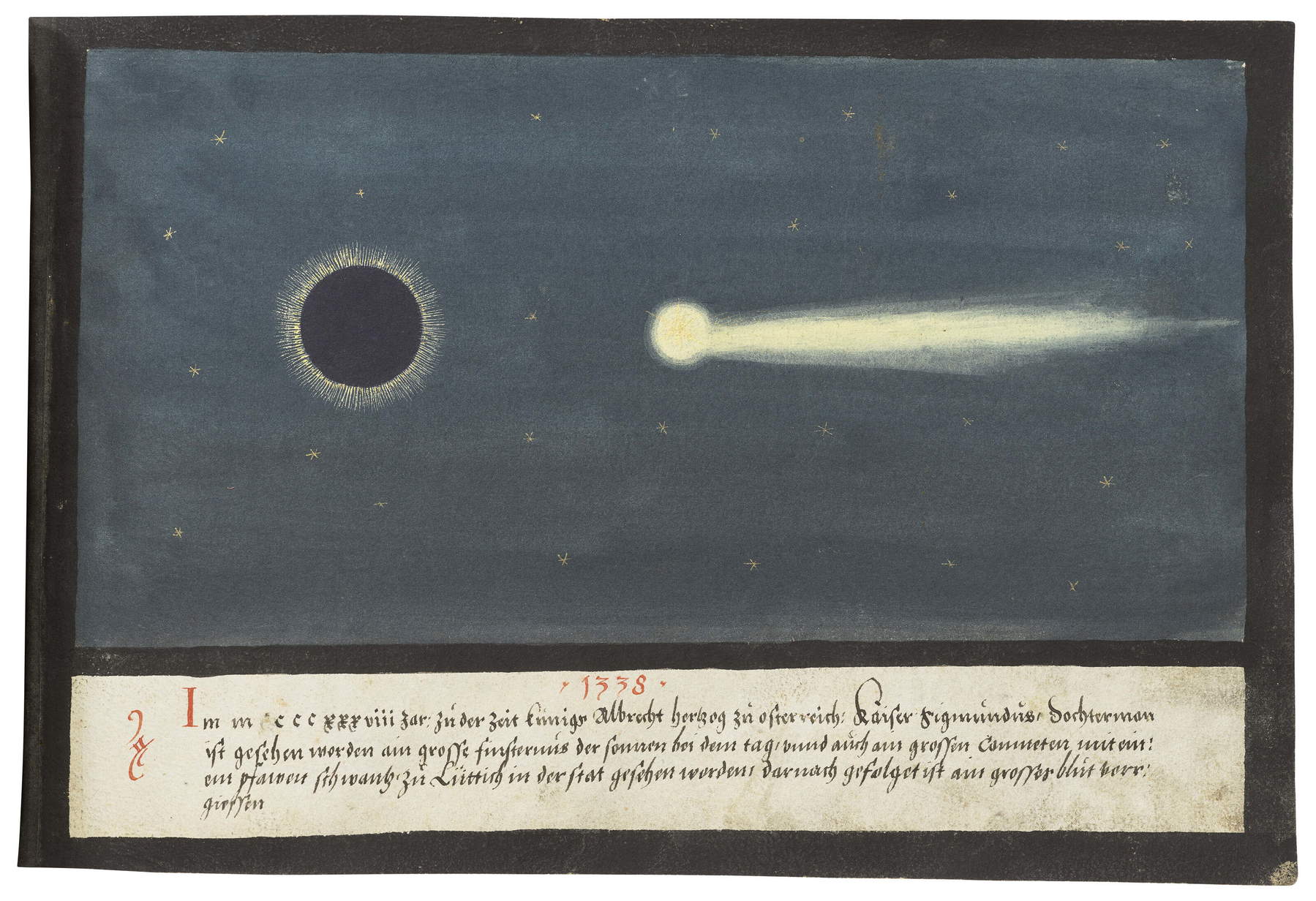
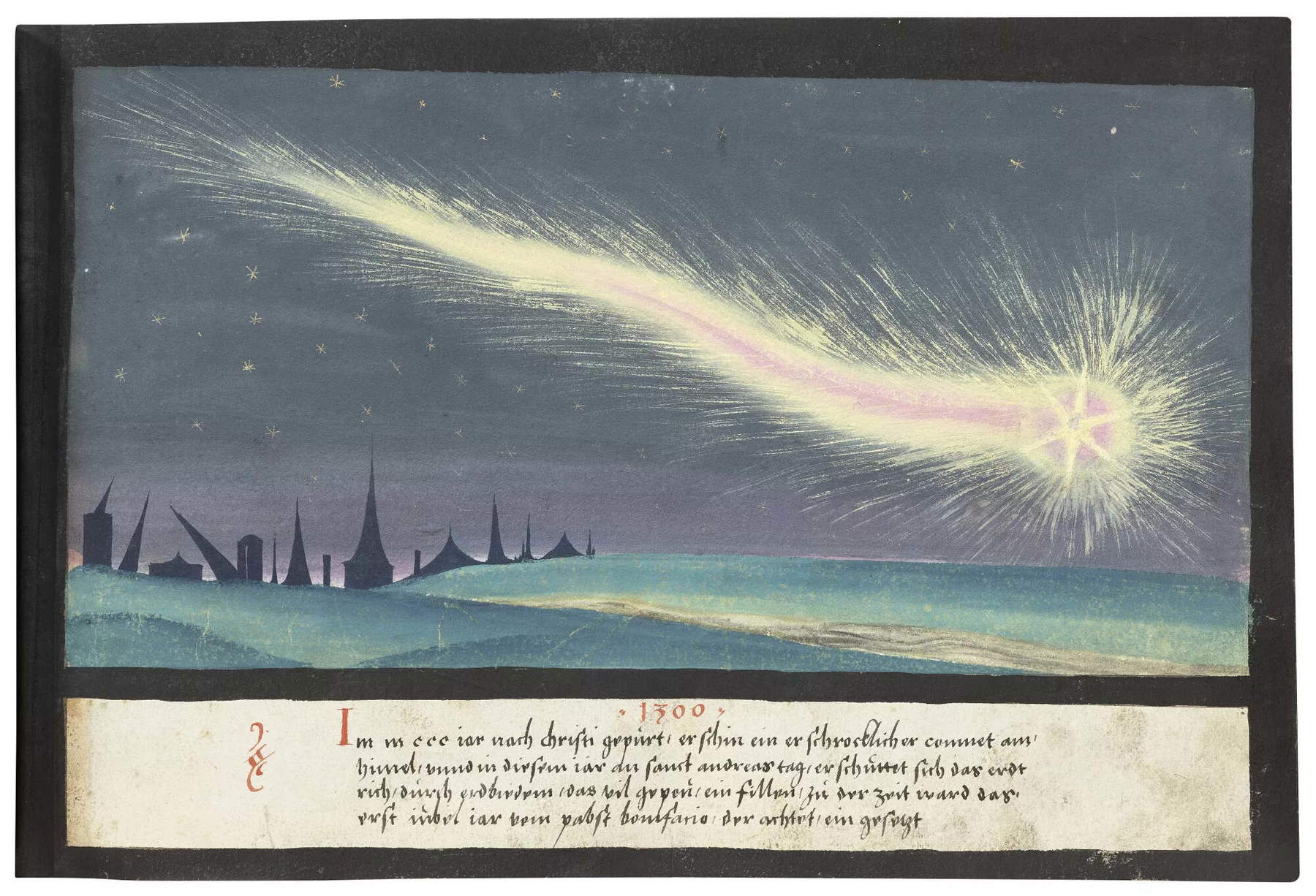
The most striking pages are those dedicated to the sky: comets appear on no fewer than 26 pages, and according to Borchert, this is perhaps the most extensive ancient collection of comet images that has survived to the present day. Each is depicted differently: Bastable describes one as a celestial spark scattering white embers across a starry sky, another as striped and orange like a tiger’s coat, and a third with a ghostly arm wielding a sword upon which three stars are aligned. The most beautiful, according to Bastable, is a luminous yellow streak against a blue and purplish sky, which appeared in 1506 over an unnamed city before “turning its tail toward Spain.”
Then there are the parhelia, multiple suns produced by the refraction of light in the atmosphere. The series of phenomena observed above Vienna (folios 102–107) is derived from a leaflet by Pamphilius Gengebach from 1520. Borchert considers this perhaps the most important artistic achievement of the manuscript, due to its atmospheric treatment of color: auroras and solar halos against a deep nocturnal blue, or yellow and golden reflections in the clouds at dawn. Other images record what was seen in Augsburg. On May 16, 1528, between 11:00 a.m. and noon, “this figure was sighted in the sky, near the sun, in Augsburg” and remained visible for an hour and a half or more. In 1541, on folio 139, the caption notes that “here in Augsburg” three suns arranged in a triangle were seen, surrounded by a rainbow. It is precisely these details, together with the watermarks on the paper (one of which corresponds to a type used in Augsburg in 1552), that allow us to locate the manuscript.
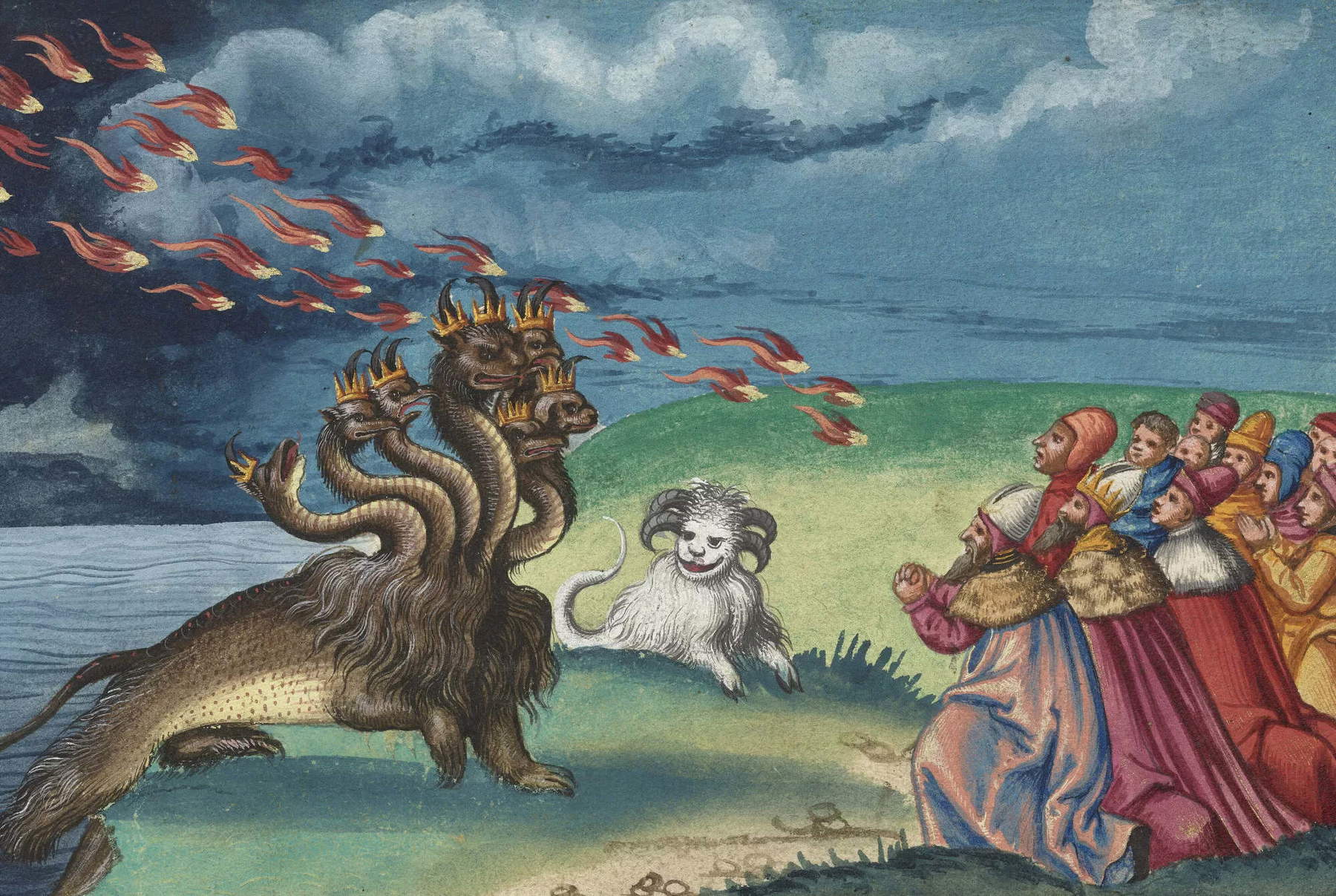
There are several interesting episodes. Five suns with smiling faces spin like a carousel above the rooftops of Leipzig. Above Worms, in November 1540, a moon and marvelous stars appear; above the Sernf Valley, in 1547, battles rage among the clouds. Ten pages are devoted to blood rain, a rare phenomenon in which sand and mineral dust color the rain red. Among these is the blood snow that fell in Styria in 1226 and 1229.
Catastrophes are also depicted: the eruption of Vesuvius, earthquakes in Italy and Spain, and floods in Germany and the Netherlands, with shattered towers, collapsing buildings, and figures hurled into the air or swept away by the waters. In 1530, the flood in Vlissingen forced the inhabitants to take refuge in trees, where, according to the caption, they starved to death before the waters receded. The painter depicts them as pale, human-shaped leaves, clinging to branches or scattered on the ground.
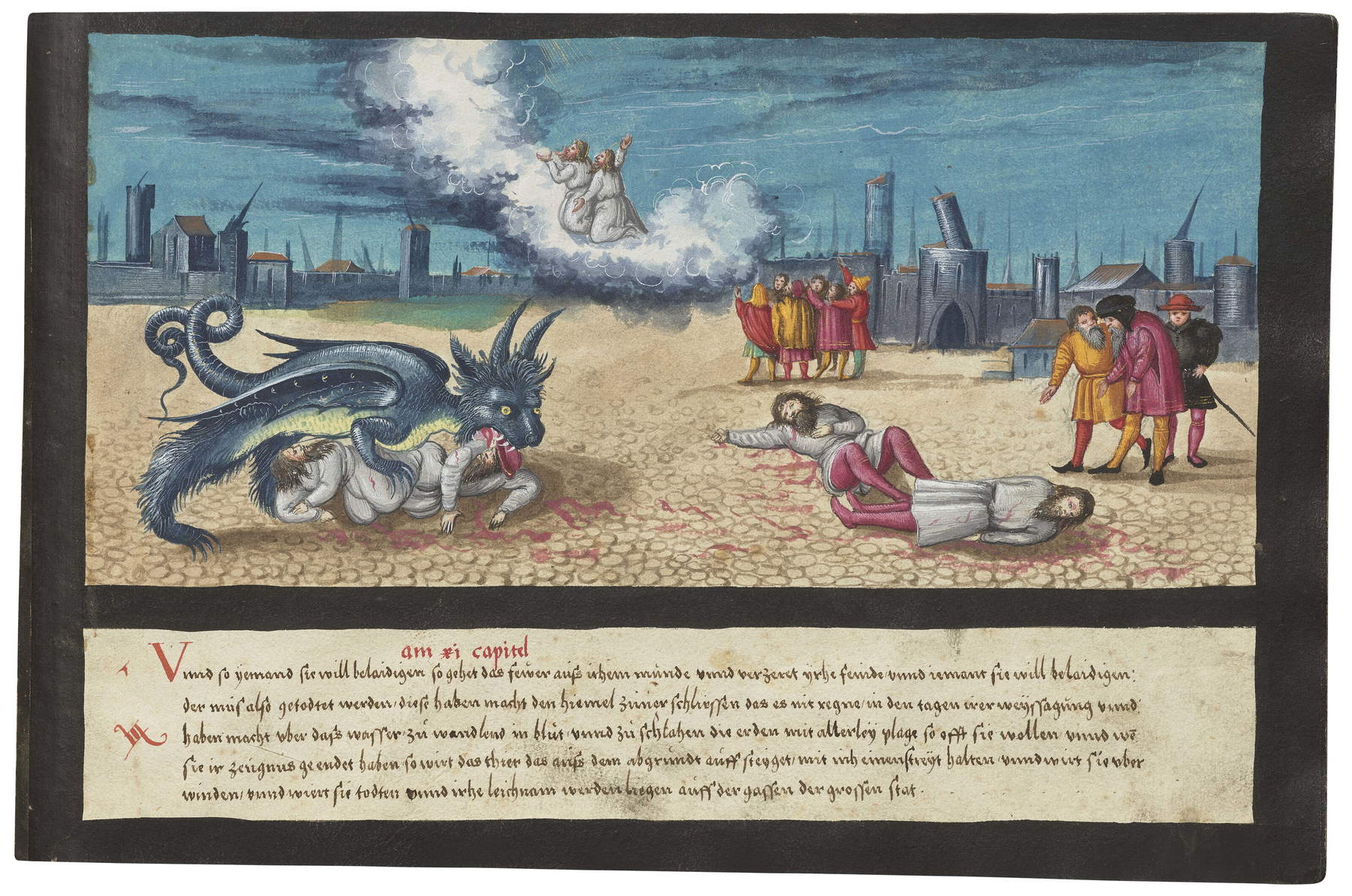
In the gallery of monstrous births, a comparison with the sources reveals an interesting detail. The Landser sow on sheet 88 is derived from an engraving by Dürer from around 1496. The monster of the Tiber on sheet 90 is based on a print by the engraver Wenzel von Olmütz and on Lucas Cranach’s “Papal Donkey” by Lucas Cranach, published in 1523 in a pamphlet by Luther and Melanchthon that interpreted every part of the creature’s body as an attack on the papacy. In the Book of Miracles, that interpretation disappears. The flag bearing the papal keys is no longer visible on Castel Sant’Angelo, and the caption simply states that the creature was found dead after the river flooded. Bastable notes that the book lacks the calls for repentance typical of leaflets and that the patron seems more interested in meteorological causes than in omens. At times, the painter hints at a natural explanation, as in the gigantic gray knight seen in the sky in 1533, painted with the ethereal texture of a cloud. “The Book of Miracles is an extraordinary window into the Renaissance imagination,” Donadoni added. “Its 167 miniatures capture a world fascinated by signs, wonders, and inexplicable phenomena, bringing together comets, eclipses, floods, monstrous births, and visions of the Apocalypse.”
The manuscript’s recent history also has a touch of the romantic. It belonged to a private Bavarian collection, and bookseller and auctioneer Hugo Ruef described it as having come from the library of a small Baroque castle in southern Germany. On July 3, 2008, it was auctioned by the Hugo Ruef auction house in Munich as lot 393, along with 56 other lots from the same castle, including furniture, rugs, and tankards. In 2010, it was purchased by James Faber of London and later entered the collection of Mickey Cartin. “Mickey Cartin, the current owner, is an eclectic collector whose interests span various categories,” explains Donadoni. “He is perhaps best known for his extensive collection of contemporary art—for example, the fabulous works by Josef Albers, Giorgio de Chirico, and Roman Opałka in his collection—so it’s easy to see how he was drawn to the paintings in this book.”
Before the auction, the manuscript will be on public display. The Book of Miracles will be exhibited in London from December 4 to 10, 2026, and then, as mentioned, it will go under the hammer on December 10 at Christie’s Valuable Books & Manuscripts sale during Classic Week.
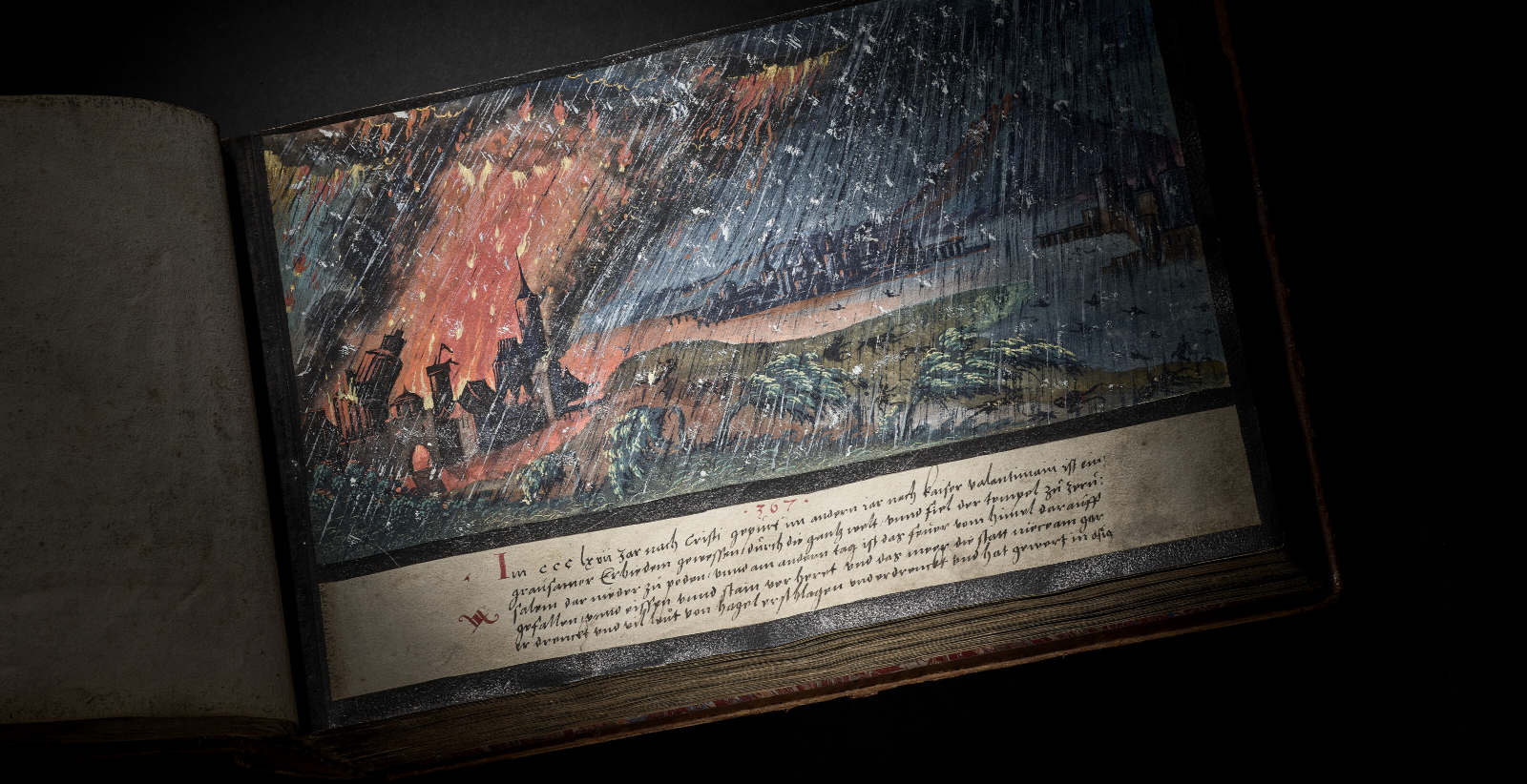 |
| This 16th-century manuscript described the end of the world. It is now up for auction. |
Warning: the translation into English of the original Italian article was created using automatic tools. We undertake to review all articles, but we do not guarantee the total absence of inaccuracies in the translation due to the program. You can find the original by clicking on the ITA button. If you find any mistake,please contact us.