





The archaeological site on Via delle Botteghe Oscure in Rome has reopened to visitors following a complex restoration project involving one of ancient Rome’s most important monumental complexes: the site preserves the monumental remains of a Roman temple. Sponsored by the Capitoline Superintendence for Cultural Heritage and carried out as part of the PNRR Caput Mundi program, the project’s primary objective was to protect and enhance the archaeological structures.
The work involved the consolidation and restoration of the archaeological materials, particularly the surviving peperino columns, which showed clear signs of deterioration due to the passage of time and weathering. At the same time, a new security system and a modern artistic lighting system were installed, designed to highlight the complex even in the evening hours. Thanks to the work carried out, the structures have been made safe and more easily accessible to the public, allowing for a more immediate appreciation of the monument’s original grandeur.
The history of the site’s discovery dates back to 1938, when significant archaeological finds came to light during expansion work on Via delle Botteghe Oscure. The discovery led to the suspension of the construction projects planned for the area and made it possible to preserve a precious fragment of ancient Rome. Even today, the complex stands as a significant testament to the transformations that have shaped the Campus Martius over the centuries.
The remains visible today belong to a vast monumental complex that included a temple surrounded by a four-sided portico. The sacred building, constructed during the Republican era and subsequently restored after the fire that devastated Rome in 80 A.D. during the reign of Domitian, was characterized by monumental architecture featuring peperino columns covered in stucco and Corinthian capitals. Beneath the building at Via Celsa 3–5, portions of the eastern and southern walls of the temple’s cella, dating to the Flavian period, have been preserved. Of particular interest is a section of the large plinth intended for cult statues, still visible leaning against one of the preserved walls. These elements allow archaeologists to partially reconstruct the building’s internal layout, which must have featured two rows of columns arranged a short distance from the side walls. Further clues are provided by a fragment of the Forma Urbis, the large marble map of Severan-era Rome now on display at the Celio Archaeological Park, which features an incomplete inscription that scholars generally reconstruct as MINI[CIA]—an element that has fueled debate over the identification of the complex.
The attribution of the temple remains, in fact, one of the most debated issues in the topography of ancient Rome. According to one of the most widely accepted interpretations, the remains may belong to the Temple of the Nymphs, located within the Porticus Minucia Frumentaria, a structure used during the Imperial period for the free distribution of grain to the Roman population. Historical sources, however, mention the existence of two Porticus Minucia. The older one, known as the Porticus Minucia Vetus and built by Marcus Minucius Rufus, likely served a ceremonial function and may have been connected to the Temple of the Lares Permarini, generally identified with the so-called Temple D in the sacred area of Largo Argentina.
The reopening of the area therefore represents not only the restoration of an important archaeological site but also a new opportunity to deepen our understanding of one of the most complex and fascinating aspects of ancient Rome.
“Thanks to the Caput Mundi program and resources from the PNRR, we are restoring a site of great historical value to the city, adding another piece to the puzzle of promoting Rome’s archaeological heritage. This is a concrete commitment to making our history increasingly accessible and enjoyable for citizens and visitors alike,” stated Rome’s mayor, Roberto Gualtieri. “I would like to thank,” he added, “the Capitoline Superintendence for Cultural Heritage, the archaeologists, the conservators, and all the professionals who contributed to the restoration of this important site.”
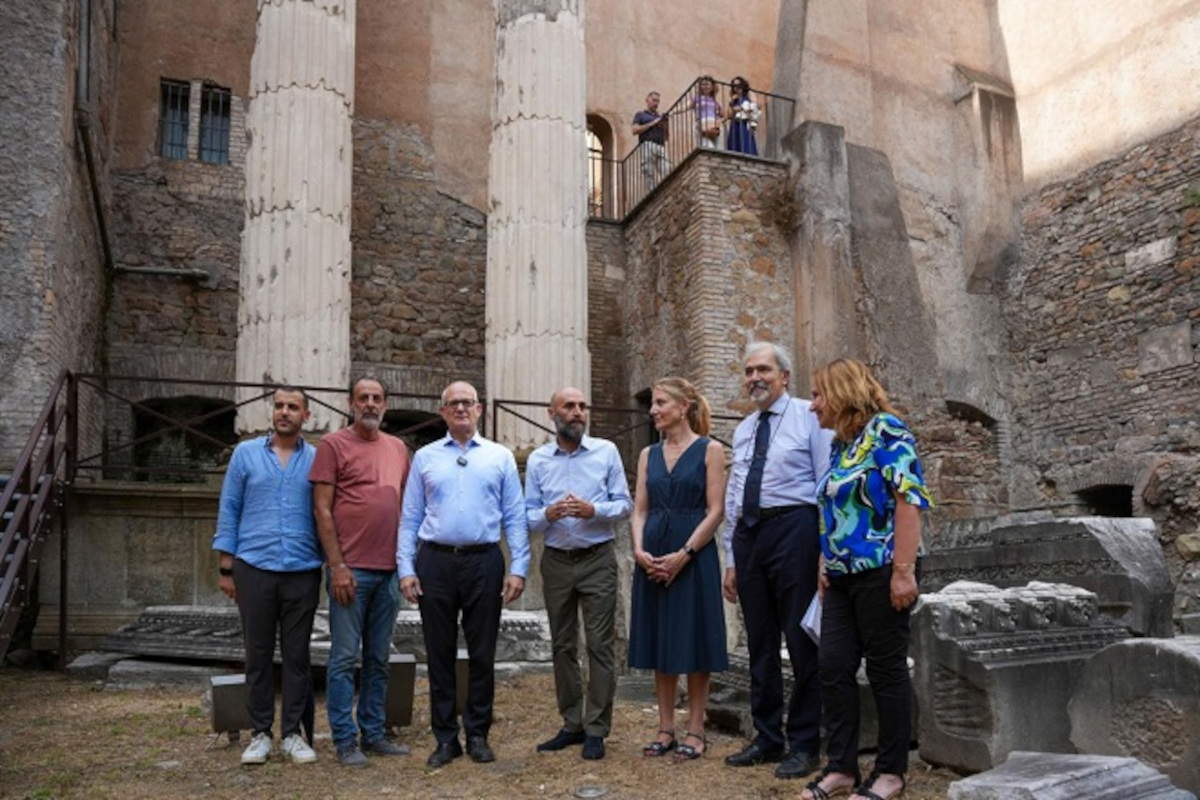 |
| Rome: The archaeological site on Via delle Botteghe Oscure reopens. It contains the remains of a Roman temple. |

Warning: the translation into English of the original Italian article was created using automatic tools. We undertake to review all articles, but we do not guarantee the total absence of inaccuracies in the translation due to the program. You can find the original by clicking on the ITA button. If you find any mistake,please contact us.

























 IT
IT FR
FR DE
DE ES
ES CN
CN


